As LegalShield's senior vice president of consumer analytics, I spend a lot of time digging into the unique data we have on the legal and financial stressors facing everyday Americans. Our data comes directly from over 35 million requests from consumers seeking legal help since 2002 on issues spanning personal finances, foreclosures, bankruptcies and more.This election cycle, we're taking a close look at how consumer stress levels vary geographically between red, blue and purple battleground states. What we've found so far is quite fascinating—there appears to be a widening gap between consumer stress in battleground states versus the national average. And historically, this divergence has signaled which party will win the White House.
The numbers don't lie
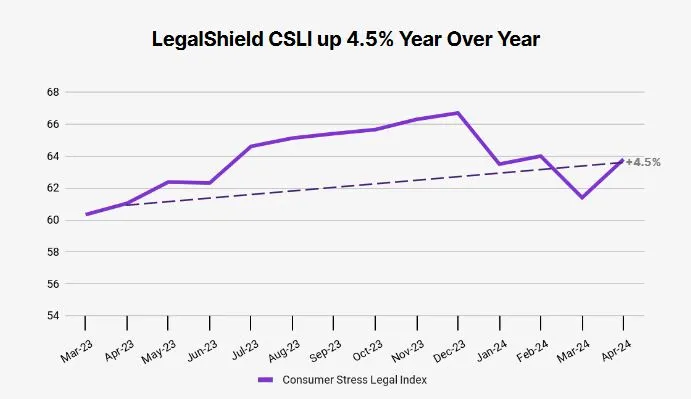
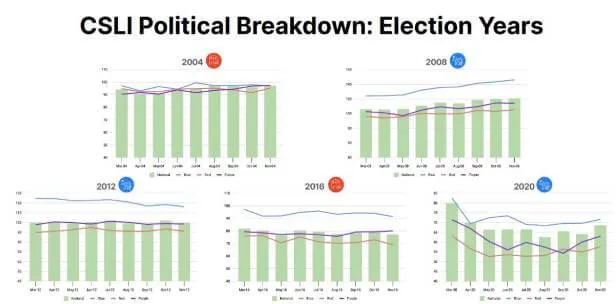
In April, our Consumer Stress Legal Index (CSLI) rose 2.4 points nationally to 63.8. This benchmark index has been a reliable leading indicator of the widely followed Consumer Confidence Index, with an inverse correlation of -0.85. As consumer legal stress rises, confidence tends to drop around 2-3 months later.Sure enough, April's Consumer Confidence reading fell 7.7 points to 97.0 after our CSLI ticked up. The drivers were higher inflation persisting at 3.4% annually despite the Fed's aggressive interest rate hikes, a mixed jobs report, and consumer finance issues on the rise.But the real story is in the battleground states data. In April, the margin between lower consumer stress in swing states and the higher national index more than doubled to 3.1 points. Swing state stress rose just slightly to 60.7, while the national index jumped to 63.8.This widening gap is important because our data over the past 20 years shows a clear pattern—when battleground states have exhibited lower relative stress levels, a Democrat was elected president in 2008, 2012 and 2020. Conversely, when swing states had higher stress than the nation, a Republican won in 2004 and 2016.
Bankruptcy filings a bellwether
Breaking it down further, all three subindices that make up the CSLI—Consumer Finance, Bankruptcy and Foreclosure—moved higher in April after declining in March.The Bankruptcy Index jumped to 31.1, up 35% year-over-year. This is significant because LegalShield's Bankruptcy data has historically led actual bankruptcy filings by two quarters with a 0.98 correlation. After a sharp drop during the pandemic relief fundings, consumer bankruptcies appear to be creeping back towards pre-pandemic levels.The volume of billing disputes LegalShield is seeing is another red flag on the consumer finance front. April calls about billing issues were the second highest ever recorded after the March 2021 peak.While foreclosure stress did rise 2.2 points, that index remains 4% lower than last year and below the two-year average. So, housing issues are not the current driving factor behind rising consumer angst.
My projection: Advantage incumbent?
As a data analyst, I need to caveat that it's still very early in the election cycle and consumer sentiment can certainly shift in the months ahead. Economic conditions, inflation, jobs numbers and interest rates will all play a role.However, if the current trend of lower relative stress in battleground states versus the nation persists, history suggests that could favor the incumbent party retaining control of the White House.Of course, this is just one economic data point. But it's a very telling one from the trenches of consumer financial and legal affairs. The diverging gap warrants close watching through early November. Here’s where you can read the latest report, April’s Consumer Stress Legal Index.
Obtén las respuestas que necesitas, cuando las necesitas
¿Necesitas un poder notarial pero te preocupa el costo? Es natural preocuparse por pagar servicios legales, pero es importante no quedarse atrapado/a en dólares y centavos. Después de todo, no le puedes poner precio a la tranquilidad, y eso es exactamente lo que ofrece un poder notarial.
En Estados Unidos, un divorcio sin oposición generalmente cuesta al menos $1,500, mientras que un divorcio con oposición puede empezar en $5,000 y superar los $20,000 en casos complejos. El costo total depende de los honorarios de abogados, los costos judiciales y el nivel de conflicto entre los cónyuges.
A veces la gente tiene reacciones emocionales fuertes a la palabra "prenupcial" porque sienten que su pareja no confía en ellos. Pero un contrato prenupcial trata de establecer confianza y justicia. Puede ser una forma prudente y cariñosa de comenzar un matrimonio. Un contrato prenupcial es una manera en que dos personas resuelven cómo manejarán el dinero y los bienes antes de decir "acepto".
La mayoría de nosotros sabemos que deberíamos tener un testamento. Simplemente seguimos encontrando razones para posponerlo. Si eso te suena familiar, no estás solo/a. Sigue leyendo para aprender qué puedes hacer al respecto.
Planificar el futuro de tu familia toma tiempo y reflexión. Una herramienta que puede ayudar es el fideicomiso familiar: un arreglo legal que te permite decidir cómo se administra y se comparte tu propiedad con las personas que te importan.
Decidir tramitar el divorcio ya es bastante difícil sin tener que preguntarte si estás llenando el formulario correcto. Cada estado maneja el proceso de manera un poco distinta, y es normal sentir dudas acerca de dónde empezar. Reunimos información sobre lo que puede suceder durante el trámite, incluyendo perspectivas de una abogada de verdad, para darte más claridad en este camino.
Prepararse para un divorcio implica reunir documentos financieros y personales, hacer un presupuesto de tus gastos mensuales, asegurar tus cuentas digitales e inventariar tus bienes. También es importante decidir qué tipo de divorcio se adapta a tu situación y consultar con un abogado antes de presentar la petición para proteger tus derechos.
Saber qué tipo de abogado necesitas depende del asunto legal que enfrentas: derecho de familia para divorcio o custodia, planificación patrimonial para testamentos, derecho laboral para conflictos en el trabajo, derecho tributario para impuestos, entre otras áreas. Consultar con un abogado de práctica general o una firma proveedora de LegalShield te puede ayudar a identificar la especialidad correcta.
•
13 min de lectura
*See your plan contract for details. Additional fees, limitations, and waiting periods may apply.