
What Is a Registered Agent for an LLC & How Can They Help Small Businesses?


Get the legal advice you need without the hourly legal fees
Editor's note: This post was originally published March 16, 2022, and has been updated for accuracy, comprehensiveness, and freshness on February 27, 2026.
When you start an LLC, you’ll find many references to registered agents, and you’ll be required to provide information about your registered agent. So, what is a registered agent for an LLC?
Every state requires that limited liability companies have registered agents. The agent is the official point of contact between the business and the state. They're also the contact person for any legal action involving the LLC. Let’s explore how they are instrumental in forming your business.
Table of contents:
- What is a registered agent for an LLC?
- Is a registered agent required?
- How to become a registered agent for an LLC: 4 legal requirements
- How to find a registered agent
- How much does it cost to hire a registered agent?
- Set your business up for success with LegalShield
- Frequently asked questions
What is a registered agent for an LLC?
The registered agent for an LLC acts as a go-between for the state and the LLC, giving both sides a single place to go for handling administrative, legislative, and regulatory requirements.
If the government needs to communicate with your business or your business is involved in a legal action, the registered agent is the person to contact. In some states, the registered agent is called the resident agent, statutory agent, or registered office.
What does a registered agent do?
An LLC’s registered agent is the designated point of contact for when the state or the court wants to communicate with a corporation or LLC.
The agent communicates with the authorities on behalf of the business and ensures that important information reaches the necessary parties. They also help fulfill legal obligations between the state and the business entity and ensure you’re following regulatory requirements.
The responsibilities of a registered agent include:
- Receiving government correspondence, such as tax notices and compliance information
- Receiving legal documents, such as subpoenas, court papers, or documents related to a lawsuit
- Recording and forwarding communications to the correct contact person within the business
- Managing important government and legal deadlines and filings
Is a registered agent required?
In a word, yes. When you start small business registration and form an LLC, the law in all 50 states requires that you have a registered agent. You must name the agent in your LLC documentation when you file to obtain a Certificate/Articles of Organization.
Without a registered agent, the state has no way to give notice to your corporation or LLC. After all, there is no such thing as a corporation that can walk down the street; it is a legal entity, but it needs some person to act as the intermediary (or representative). And the registered agent is even more important if you incorporate in a different state from where you actually do business.
The registered agent is there so that the state can communicate with the business entity — sending any paperwork, declarations from the state, annual reports, and tax forms. The agent acts as a go-between for the state and the LLC, giving both sides a single place to go for handling administrative, legislative, and regulatory requirements.
The registered agent is also the point of contact for legal actions, such as a lawsuit or other service of process.
The legal risks of not having a registered agent
Not having a registered agent could cause an LLC to lose its legal status and face other penalties. Failing to have an agent could also cause you to miss vital communications about taxes, compliance, and legal actions.
Without a registered agent for your LLC, you could face issues involving:
- Fines and penalties: Not naming a registered agent could result in fines between $50 and $500. Some states have monthly penalties that add up the longer you are without an agent. This is money that you could be spending on growing your business.
- Non-compliance: If you didn’t name a registered agent, you're likely not in compliance with state laws and don’t have the benefits afforded to an LLC. And without an agent handling communications, your LLC could miss out on important compliance information in the future. This could lead to further problems, including lawsuits and business shutdowns.
- Missing documentation: Without a registered agent, you could miss important documents. For example, you could get shut down for not paying taxes that you didn’t even know you owed.
- Limited ability to defend interests: If someone sues your company, the court will contact the registered agent. If you don’t have one, you could lose your lawsuit in a default judgment without ever knowing you needed to mount a defense.
- Loss of good standing: Your business could lose its “good standing” with the state without a named agent. You may have to pay reinstatement costs before you can go back to operating.

How to become a registered agent for an LLC: 4 legal requirements
Becoming a registered agent isn’t difficult, but agents must meet several requirements. Registered agents must:
- Have a physical address. Registered agents must have a physical address in the same state as the LLC. P.O. boxes do not count because they don’t prove a physical presence.
- Hold regular business hours. The agent must have regular business hours (Monday through Friday from 9 a.m. to 5 p.m. local time).
- Be a resident of the business’s registered state. If the agent is a person, the agent must be a resident of the same state as the business.
- Conduct business legally. If the agent is a business, the agent must have the legal right to do business in the state where the LLC is located.
Can you be your own registered agent for an LLC?
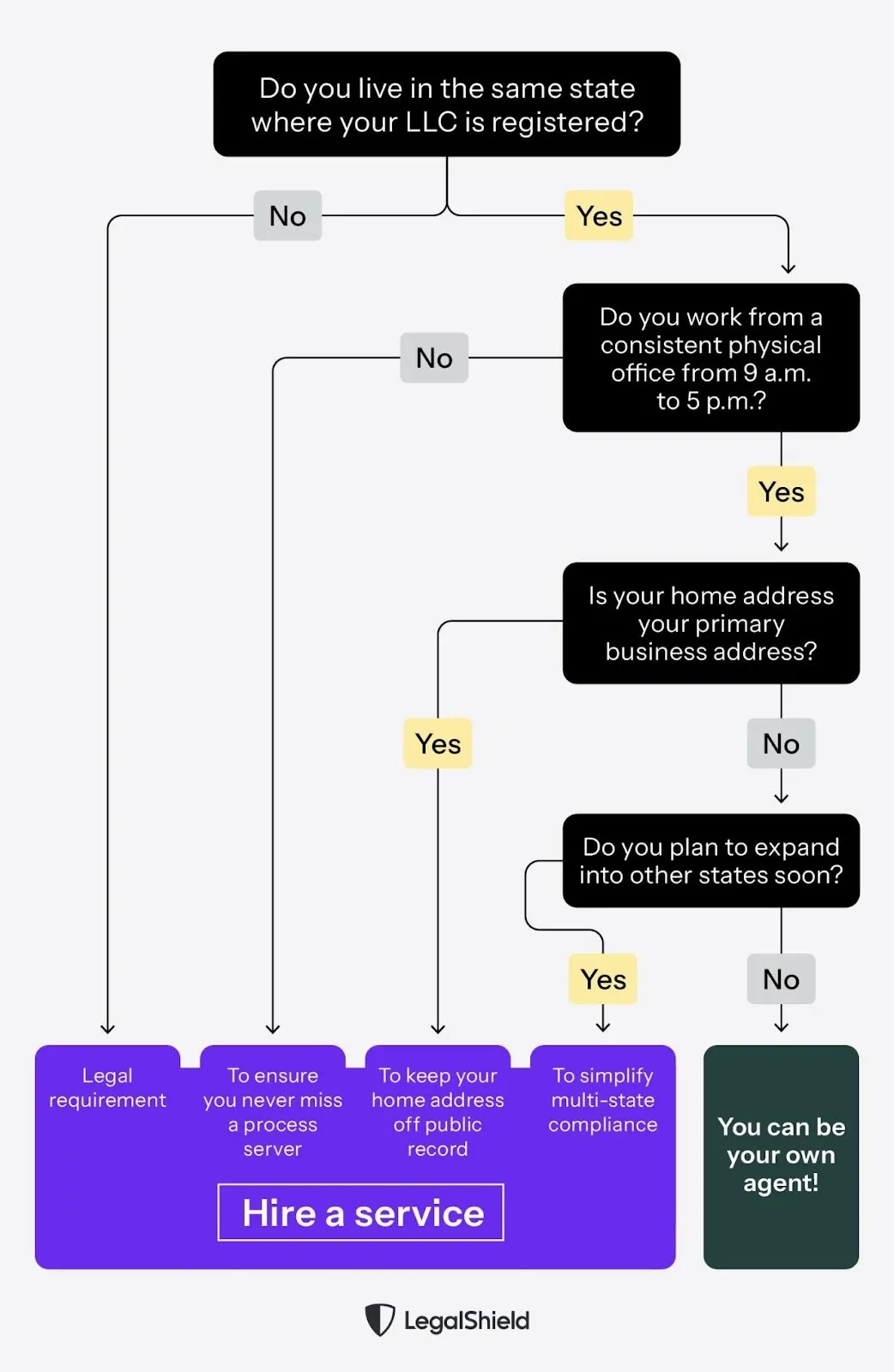
As a business owner, you can be your own registered agent — that is, if you have the time. Naming yourself as the registered agent can save you money, but it’s not the best solution for every business.
Owning an LLC is a lot of work, and acting as your own agent adds another layer of responsibility and complexity. You may feel particularly stressed by the task if you live in another state, travel frequently, or have another job.
Considerations for becoming your own agent include:
- The ability to maintain regular office hours in the same state as the LLC
- The ability to devote enough time to the task
- Privacy concerns that could come from listing your home or business address as the registered agent in public documents
Being your own agent may be a more doable option for small or single-member LLCs. Larger LLCs, LLCs with multiple members, and LLCs with operations in more than one state may benefit from using a service.
How to find a registered agent
The most elementary requirement for a registered agent in almost any state is that they must be a resident of the state, with a physical address (not a P.O. box). The registered agent can even be another business entity in some cases, but that entity must itself have authorization to do business in the state.
Many businesses choose a corporate officer or director to be the registered agent. Lawyers and CPAs also frequently serve as registered agents. There are even some states where the registered agent can be the business entity itself, so check for the specific legal requirements for creating a business in each state. Many states require the registered agent to consent to serving as your registered agent, which may include filing additional paperwork when setting up your business entity.
Many businesses opt to designate a third party as a registered agent, which has many advantages. Naming a law firm or other third party can offer you the following benefits:
- Privacy: Public records will list the third-party agent’s address — not your address or the address of your company. Additionally, if your LLC is ever sued, legal papers will be served at the third party’s office.
- Assured legal compliance: Having a designated third party to handle tax notices, receipt of legal documents, and other compliance issues ensures things do not fall through the cracks. This can help you avoid fines and penalties.
- Availability: Hiring a third party ensures there’s someone to respond to communications if someone contacts your company. It also ensures someone is there when you need to reach your agent. Not all third-party agents respond to communications on your behalf, so be sure to understand the scope of registered agent services.
- Flexibility: The third party’s address doesn’t change if your business moves. Therefore, you can relocate without having to file for and pay for expensive address changes with the state.
- Reductions to your workload: Letting someone else handle governmental and legal communications and paperwork reduces your workload and saves you time. You can pour that energy into your company instead of into “red tape.”
- Easy expansion: When you work with a third party with offices in multiple states, it makes it easier for your business to expand into those states as well.
How much does it cost to hire a registered agent?
Hiring a registered agent for your LLC could cost anywhere from several hundred to several thousand dollars a year. There are several factors that can influence this cost, including the type of third-party agent you select, the size of your business, and the amount of official communication the agent needs to handle.
You could hire an individual professional agent. You could also hire a registered agent service. Many LLCs choose to work with a lawyer or law firm, giving you the added benefit of having an agent who can offer legal advice when needed.
But the cost of working with a third-party may be well worth it when you consider the time it can save you and the protections it can offer against fines, penalties, and non-compliance.
Set your business up for success with LegalShield
Finding a registered agent for an LLC is likely one of the many questions you have when incorporating a business. LegalShield can connect you with an attorney to help you with your LLC and business questions.
LegalShield gives you access to experienced lawyers at prices you can actually afford. A provider attorney may consult with you on forming an LLC, applying for business licenses, and provide you with everyday support. Contact us today and discover "A Smarter Way to Handle Life’s Legal Moments".
Frequently asked questions
Find answers to commonly asked questions about registered agents for LLCs below.
Can I change my registered agent?
Yes, you can change your registered agent at any time. Simply file a form with your state’s Secretary of State’s office. There’s usually a minimal fee.
How is a registered agent appointed?
You appoint a registered agent by naming them on your business formation documents. You can appoint a new agent by filing a Change of Agent or Statement of Change form with the Secretary of State. The registered agent you select should consent to serving as your agent, and such consent may have to be filed with your formation documents.
Get the Answers You Need, When You Need Them
Content Specialist at LegalShield, creating educational resources about legal and consumer protection topics. She focuses on making complex legal and financial concepts accessible to readers and has contributed to various educational articles on consumer rights and protections.