
LegalShield Foreclosure Index Hits Six-Year High as Expired FHA Relief Comes Due
LegalShield's Consumer Stress Legal Index (CSLI) is built on roughly 150,000 consumer calls for legal help each month — a measure of what Americans are actually doing, not what they tell a survey
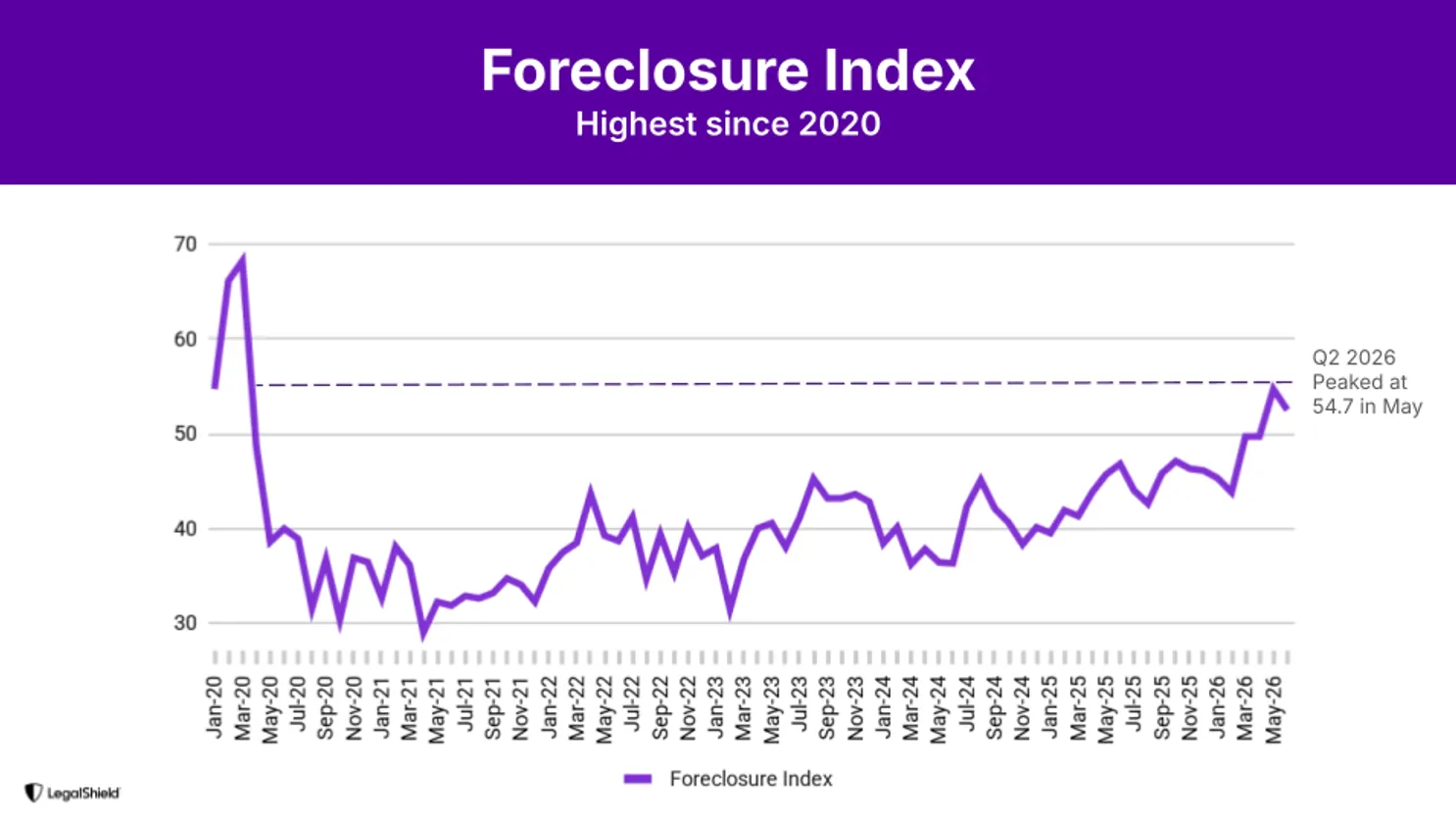
- Foreclosure Index up 12.2% YoY, its highest level since March 2020 — a reading that has historically preceded actual filings by one to two quarters
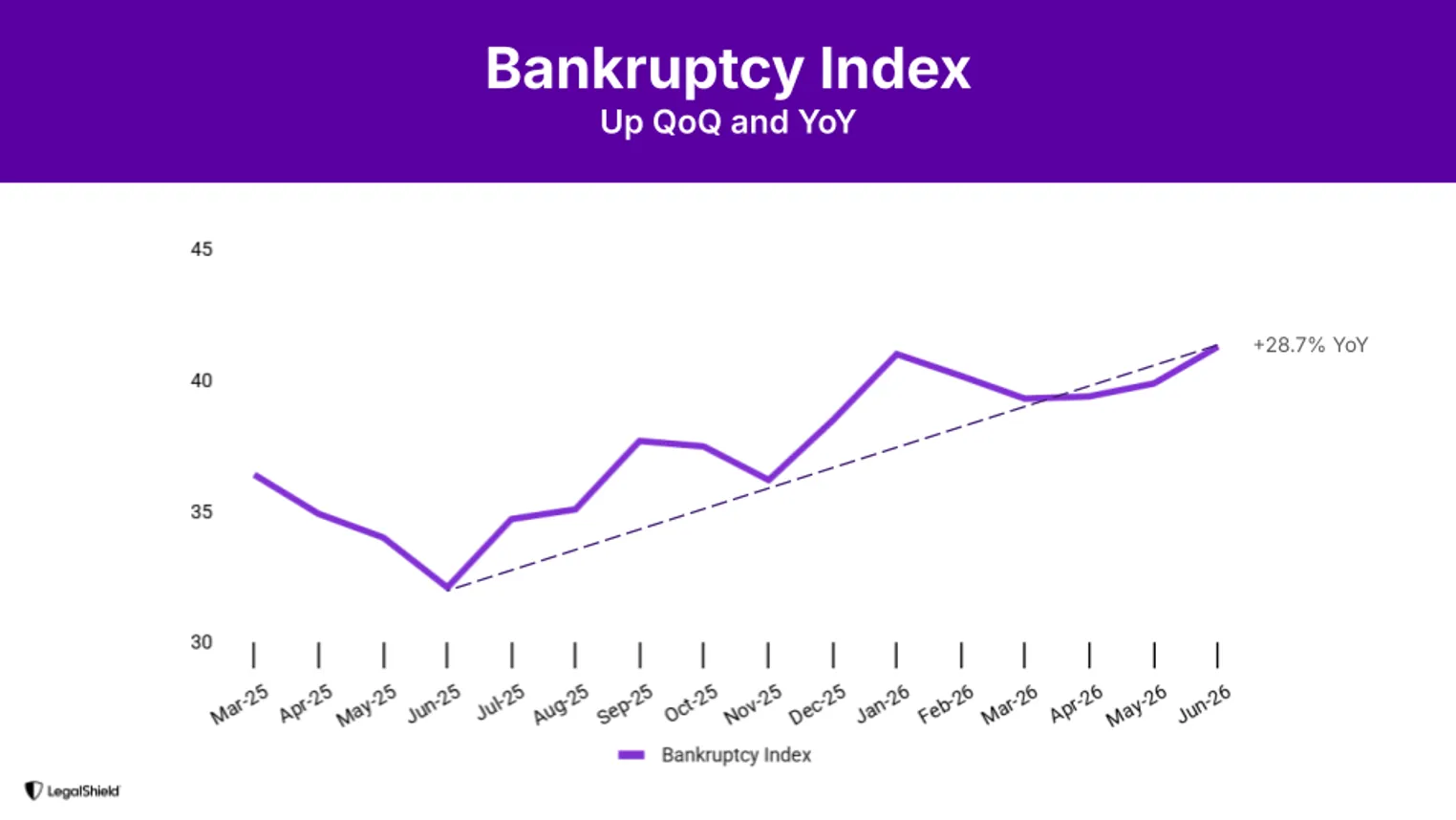
- Bankruptcy Index up 28.7% YoY, the largest annual increase of any category, rising every month of the quarter
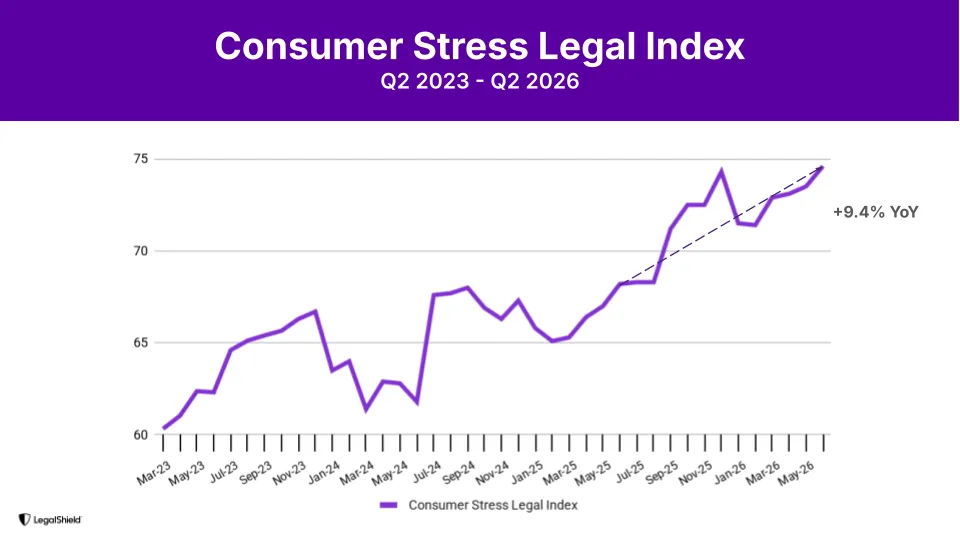
- Overall consumer legal stress up 9.4% YoY and 2.3% from the prior quarter, led by the South and Midwest
Ada, Okla., July 14, 2026 — Foreclosure inquiries rose for a third straight quarter to their highest level since March 2020, LegalShield said Monday. Actual filings have historically followed the index by one to two quarters.
The company ties the climb to the expiration of pandemic-era FHA relief programs last fall. Borrowers who lost those protections have spent the months since falling behind, exhausting loss-mitigation options, and — increasingly — calling a lawyer.
The composite CSLI rose 9.4% year over year and 2.3% from the first quarter, pushed higher by bankruptcy inquiries, which posted the largest annual increase of any category at 28.7%.
"The second quarter shows foreclosure pressure building, with homeowners contacting attorneys in numbers we haven’t seen in years," said Matt Layton, LegalShield senior vice president of Consumer Analytics. "This data tracks actual consumer behavior, not a survey. Foreclosure, combined with the fastest-rising bankruptcy inquiries in our index, shows consumers are struggling to manage debt and can’t pay the bills."
Q2 2026 at a Glance
LegalShield's CSLI measures consumers' actions to contact an attorney on financial issues including bankruptcy, foreclosure, and consumer finance. All indices ended the quarter higher:
- Consumer Stress Legal Index (composite): 74.6, up 9.4% YoY; up 2.3% QoQ
- Foreclosure Index: 52.5, up 12.2% YoY and 5.6% QoQ
- Bankruptcy Index: 41.3, up 28.7% YoY, the largest annual increase of any category; up 5.1% QoQ
- Consumer Finance Index: 107.7, up 1.2% YoY and essentially flat (down 0.1%) for the quarter
Foreclosure Pressure Rises for Third Straight Quarter
The Foreclosure Index peaked in May at 54.7, its highest reading since March 2020, before easing to 52.5 in June. Historically, LegalShield's Foreclosure Index is a one- to two-quarter leading indicator of actual residential foreclosure filings as reported by the Mortgage Bankers Association, with a .95 correlation.
LegalShield provider attorneys cite two trends driving the increase: FHA loans and rising escrow. Many consumers are facing issues with their monthly mortgage payment following pandemic relief options that expired last fall.
"We are hearing from folks who’ve fallen behind on FHA or government-backed loans," said Wayne Hassay, Managing Partner with Maguire Schneider Hassay, LLP, a LegalShield Provider Firm in Ohio. "The issues are usually incomplete loss-mitigation efforts, loan-modification disputes, or trial-payment problems."
"The FHA relief programs expired three quarters ago, and we’ve seen foreclosure calls rise ever since," said Layton. "We’ve tracked more than 36 million intakes since 2002. When we see the foreclosure index climb like this, actual filings tend to follow."
National mortgage data supports the connection to expired FHA relief:
- The FHA serious delinquency rate reached about 11.5% in late 2025, its highest since 2021 and roughly six times the conventional rate near 2%, according to the Mortgage Bankers Association.
- The increase follows the expiration of pandemic-era FHA relief options at the end of September 2025 and new trial-payment requirements.
The other drivers for foreclosure inquiries: taxes and insurance.
"Calls are often triggered by escrow shock," said Ben Farrow, LegalShield provider attorney with Anderson, Williams & Farrow in Alabama. "People want to know why it went up, and it’s usually taxes and insurance. The escrow statement can be confusing given it’s really three statements in one: last year’s projection, the actual account history, and a projection for the coming year. We help it make sense, but sometimes there’s not enough money to cover it."
Public data shows both climbing:
- Property taxes and homeowners insurance now average about 21% of a typical monthly mortgage payment, and more than a third in some metros, according to a March 2026 Neighbors Bank analysis of nearly 450 metros.
- Homeowners insurance premiums are projected to rise about 8% nationally in 2026, outpacing inflation, according to Cotality.
Bankruptcy Inquiries Post Largest Annual Jump as Household Debt Strains Widen
LegalShield's Bankruptcy Index has historically led actual consumer bankruptcy filings by two quarters, with a .98 correlation — and it rose every month of the second quarter, from 39.4 in April to 39.9 in May and 41.3 in June, ending at its high. The 28.7% annual increase was the largest of any category the index tracks.
The rise reflects a widening strain on household finances. In its most recent Household Debt and Credit Report, the Federal Reserve Bank of New York reported:
- Total household debt reached a record $18.8 trillion.
- Credit card balances stood at $1.25 trillion, up 5.9% from a year earlier, even after the usual seasonal first-quarter dip.
- 4.8% of outstanding debt was in some stage of delinquency, and transitions into serious mortgage delinquency ticked up from 1.4% to 1.5%.
"We are seeing an uptick in bankruptcy inquiries from middle-aged and older workers struggling to pay their mortgages, car payments, and credit card balances," said John Saltarelli, LegalShield provider attorney and Partner with Ross & Matthews, P.C. in Texas. "The strain is moving past the house. It is generally driven by the economy, higher prices, and employer cutbacks that mean lost jobs or lower wages."
Stress Concentrating in the South, West, and Midwest
The national numbers mask sharp regional differences. Stress is concentrating in the South, West, and Midwest, while the Northeast is easing.
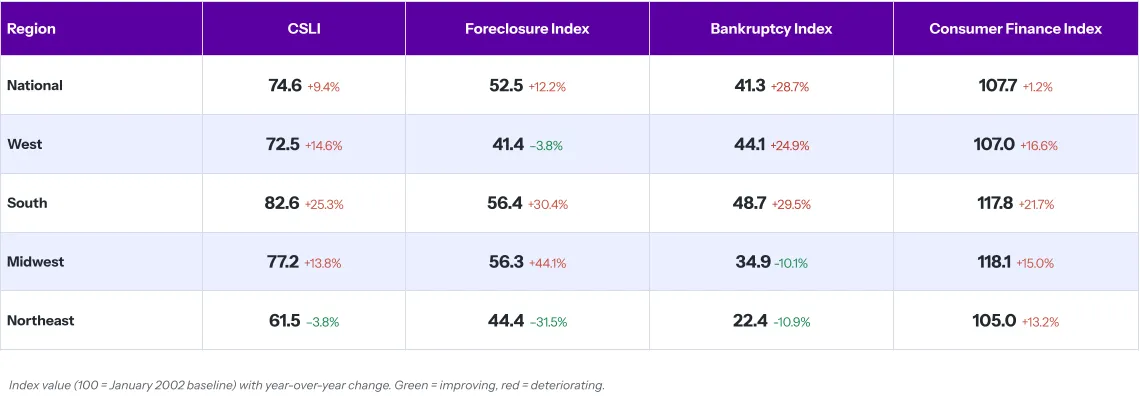
Index value (100 = January 2002 baseline) with year-over-year change in parentheses.
The Midwest tells a split story: the region posted the largest foreclosure increase in the country, up 44.1%, even as its bankruptcy inquiries declined — a pattern consistent with housing-specific pressure from taxes, insurance, and expired FHA relief rather than broad-based financial distress. The Northeast moved the opposite direction across the board, with foreclosure inquiries down 31.5%.
- West: the sharpest quarterly bankruptcy jump of any region at 18.2%
- South: highest overall stress in the country and the highest bankruptcy reading
- Midwest: the largest year-over-year regional foreclosure increase
- Northeast: moving the other way, with overall stress and foreclosure activity down
About the Consumer Stress Legal Index
The CSLI is a suite of leading indicators of the economic and financial status of U.S. households. CSLI is part of LegalShield Intelligence, a dataset of over 36 million consumer requests for legal assistance dating to 2002, with approximately 150,000 calls received monthly from U.S. consumers seeking legal help. CSLI examines intakes across categories including bankruptcy, foreclosure, and consumer finance. The index is tracked monthly and reported at the end of each quarter.
About LegalShield
For more than 50 years, LegalShield has provided everyday Americans with easy and affordable access to legal advice, counsel, protection, and representation. Serving millions, LegalShield is one of the world's largest platforms for legal, identity, and reputation management services protecting individuals and businesses across North America. Founded in 1972, LegalShield and its privacy management product IDShield equip individuals, families, businesses, and employers with the tools they need to affordably live a just and secure life. Through technology and innovation, LegalShield is transforming how people access legal guidance, with hundreds of qualified attorneys and law firms across the country. To learn more, visit LegalShield.com and IDShield.com.
Media Contact
Cameron Penn
Director of Communications, LegalShield