Depending on your state and the type of violation, you may be able to fight a traffic ticket without going to court. Your options include contesting it by mail, having a trial by written declaration, completing traffic school, arranging a deferred disposition, or having a lawyer appear on your behalf.
Did you just get hit with a traffic ticket? You might be tempted to just pay a fine to get it over with, but traffic tickets can have a much bigger impact. They can add penalties to your driving license and cause higher insurance rates, which can interfere with your life long-term.
The good news is that there are often alternatives. You may be able to enter into agreements with the court to avoid getting points on your license. You can also fight the ticket in court.
Before you decide what to do, take a breath and seek some advice. Every situation is different, so ask a lawyer to explain your options. With a LegalShield® Personal Plan, you can connect with a provider law firm to help you navigate the process. Let’s take a look at some of the most common options for fighting or mitigating traffic tickets.
Your options for responding to a traffic ticket
We’re going to focus on moving violations, which occur while your vehicle is in motion (as opposed to other non-moving violations, such as an expired registration or illegal parking). A ticket like this can result in penalties beyond fines. In some circumstances, this could even cause your license to be suspended or force you to pay higher insurance rates.
You’re being accused of breaking the law, and you have to respond. But you have some options and may not have to actually appear in court.
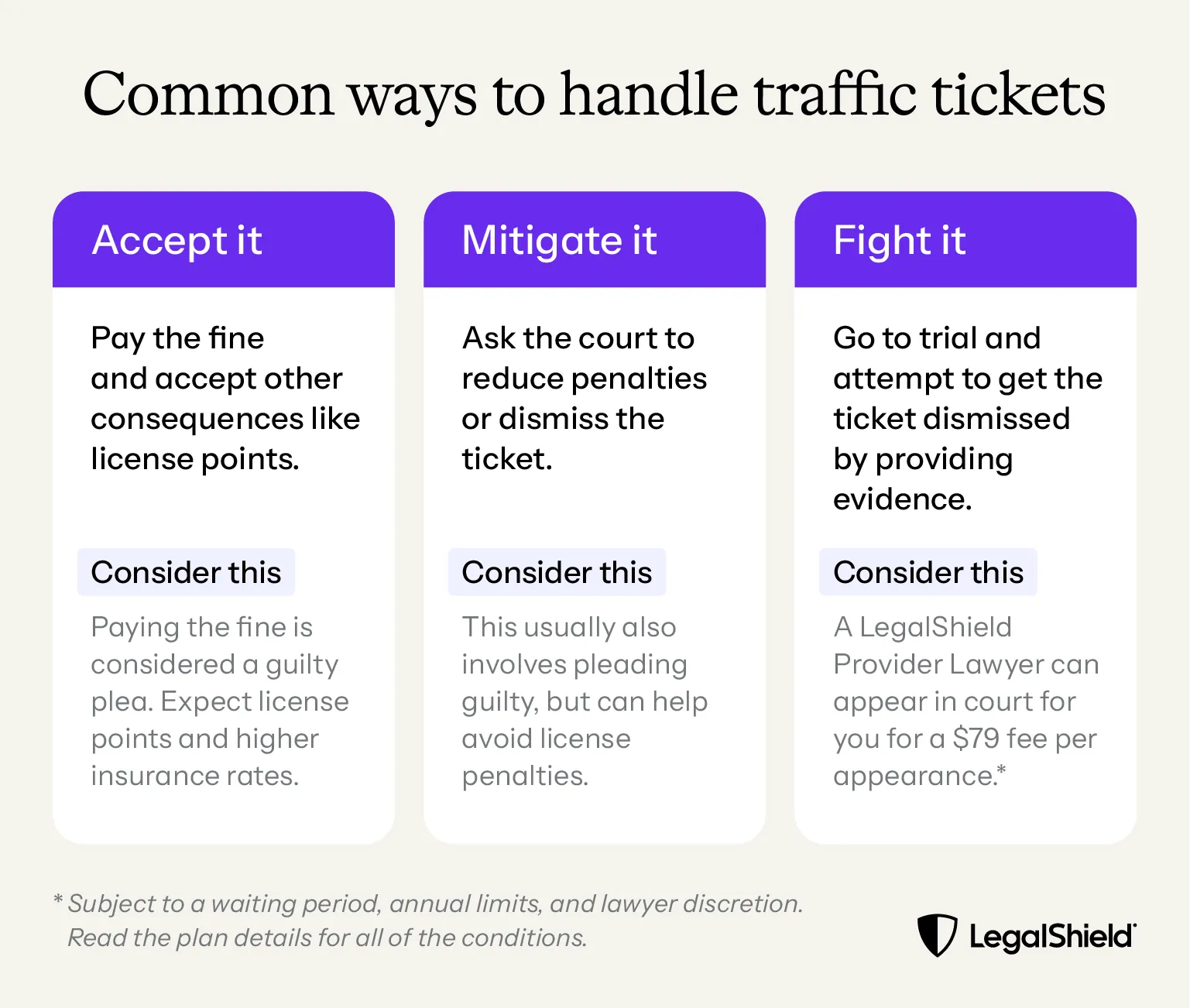
Pay the fine and accept the consequences. This is essentially a guilty plea. Consequences could include penalty points on your license, and insurance companies may increase your rates. Repeat violations can have more serious consequences.
Negotiate a lower penalty. You might be able to get a charge dismissed or have the penalties reduced if you fulfill certain conditions set by the court, like taking a driving class. You'll probably still have to pay the fine, but you could avoid license penalties.
Fight the traffic ticket. You can try fighting the ticket by arguing that you’re not guilty, but you'll need to be prepared to prove it. You may have to appear in court, or you may be able to argue your case in writing instead.
No matter how you respond to your ticket, your decisions and conduct matter from the moment you get pulled over.
What paying a traffic ticket fine actually means
Paying your ticket is the quickest option, but it may not be the smartest. In most cases, paying a traffic ticket is effectively pleading guilty. That means you accept any consequences that follow, like points on your license.
Depending on the severity of the moving violation and if you already have penalties on your record, this could mean your driving license gets suspended. Reinstating your license likely means more fees and additional requirements imposed by the court.
Before you pay, explore your options and speak to a lawyer. You may be able to defend against a ticket and reduce or remove some of the penalties.
Fighting a ticket without going to court
It’s possible to fight a ticket without going all the way to trial, but you’ll still need to make statements to the court in writing or in person, and may need to go through the preliminary steps of a trial.
You can sometimes contest tickets by mail
Depending on the ticket, some states allow you to dispute a traffic ticket in writing instead of showing up in court. This is sometimes called a "trial by written declaration" or a "trial by declaration."
You’ll submit your statements and documentation, and the court will also request a statement from the officer who issued the ticket. While this avoids a physical court appearance, it also means you won’t have an opportunity to speak directly to the judge.
You can often mitigate tickets to reduce penalties
Mitigating a traffic ticket isn’t really fighting it; it means entering an agreement with the court or the prosecution to reduce the ticket’s severity. This usually involves pleading guilty and accepting reduced consequences.
What’s available and what the court will agree to depends on the court and the circumstances, but there are a few different options you can consider.
Negotiating with the prosecutor. You may be able to negotiate a lower charge with a reduced fine or license penalty. Then you would plead guilty and pay the fine.
Taking a defensive driving course to remove penalty points. Some states allow you to remove penalty points from your driving license after you complete a driving course. In this case, you still pay the fine and have a conviction on your record.
Entering a deferred disposition agreement. You accept the judgment against you, pay the fine, and enter into an agreement with the court that you won’t commit any other infractions for a period of time. If you fulfill the requirements, then the judge may dismiss the charge. The agreement usually has conditions, such as community service or driving school. Your eligibility is often up to the judge’s discretion, and can vary depending on the type of infraction, whether you’ve received a similar agreement in the past, and other factors.
How to fight a traffic ticket in court
You can present your argument to the court that you are not guilty of the violation. This involves entering a not guilty plea and arguing your case.
In a trial, the prosecutor has to convince the judge that you did what you’re accused of. If you can successfully defend yourself, then you can avoid both the fine and other penalties. If you lose in court, you’ll face the original consequences of the ticket.
You might have heard stories about people winning their trial because the officer who ticketed them didn’t respond to the court or appear on the trial date. While this can happen, it’s best not to count on it.
If you’re going to try to fight a ticket, you should speak with a lawyer. A lawyer can help you by explaining what evidence you should bring and what you should ask to see from the officer who ticketed you. You can also have the lawyer you during negotiations and in court.
Why it’s important to have a lawyer represent you
Even for minor violations, speaking with a lawyer is a good way to understand how to fight traffic tickets. As Wayne Hassay, Managing Partner at LegalShield® Provider Law Firm Maguire Schneider Hassay, explains, you should talk to a lawyer even if you don’t end up taking your ticket to court. A lawyer is the best person to help you make that decision.
A lawyer will handle communicating with the court and can also appear in court in your place. They know how to identify procedural issues with the ticket and make your case. A lawyer experienced in negotiating tickets can help you reduce the consequences or secure a dismissal.
After a waiting period, LegalShield Members on the Basic Legal Plan can get assistance with one traffic ticket per membership year, and a provider lawyer can attend traffic court for a $79 fee. Advanced Plan members can get support with two tickets per year, and Premium Plan Members get three.
What to think about before deciding what to do about the ticket
Before you decide on a plan, it helps to ask yourself a few questions:
What could it cost you long-term? If the ticket includes penalty points, the consequences could be much greater than a fine, including insurance rate hikes or license suspension. The expense of fighting a ticket might be preferable to ongoing difficulties with your license.
What’s the impact on your time, work, and family? Weigh the time commitments of court, traffic school, or other penalties like community service. Having a lawyer help you in court could be better than the time required for those other outcomes.
Do you have a history of previous infractions? The number of prior charges and how recent they are can affect your options.
What’s the likelihood of winning your case? Getting your ticket dismissed is the best-case scenario, but it isn’t always possible. You should talk to a lawyer about the consequences of going to court and losing vs negotiating the ticket.
A LegalShield Provider Law Firm can help you fight a traffic ticket
A traffic ticket can be extremely disruptive to your life. As a LegalShield Member, you can connect with your provider law firm to better understand your rights and options based on your situation and state laws.
Depending on your plan and the type of violation, a provider lawyer can review your ticket, explain possible outcomes, communicate with the court, negotiate on your behalf, or help you decide whether contesting the ticket makes sense.
When you’re a LegalShield Member, you have a provider law firm in your corner you can call after a traffic ticket or accident.
Frequently Asked Questions
Depending on the jurisdiction and ticket, it may be possible to resolve it outside of court. You can contest some tickets by mail. You may be able to negotiate lower penalties in exchange for pleading guilty and paying the fine, which can mean you don’t get points on your license.
In many cases, yes. Some courts allow you to contest a ticket by mail or have a lawyer appear on your behalf, which can be especially helpful if you received a ticket while traveling. Check with the court listed on your ticket for the specific options available.
If the judge rules against you in a trial by declaration, you may be able to request a trial de novo (this is legalese for a new in-person hearing), depending on your court and state. However, some courts may not allow this, so check your local rules.
It depends on the outcome. If your ticket is dismissed or reduced, it may not affect your auto insurance rates. But there’s no guarantee, and results vary by case and by state.
Your ticket should list a deadline, usually a court date or a “respond by” date. It’s important to act before that date. If you miss it, you could face additional fines or consequences for your license. When in doubt, contact the court listed on your ticket as soon as possible.
Ignoring a traffic ticket can lead to more serious consequences than the original violation. Depending on your state, missing a payment deadline or failing to respond to the ticket could result in an automatic judgment against you, additional fines, a suspended driver’s license, or other penalties.
If you’re unsure how to handle a ticket, it’s usually better to respond early rather than wait until the issue becomes more urgent. Even if you plan to contest the violation, paying attention to deadlines and understanding your options can help you avoid unnecessary penalties.
How long a traffic violation stays on your driving record depends on your state and the type of offense. Some states use point systems, where points from violations can affect your license status and insurance rates.
Even after points are removed, the violation itself may still appear on your record for a period of time. Because insurance companies often review driving history when setting rates, a ticket could potentially affect what you pay for coverage long after you’ve paid the fine.
Communications Director at LegalShield overseeing content creation designed to make legal protection simple and approachable. He focuses on offering straightforward, trustworthy guidance that empowers people to make informed decisions about their legal rights and responsibilities.
En Estados Unidos, un divorcio sin oposición generalmente cuesta al menos $1,500, mientras que un divorcio con oposición puede empezar en $5,000 y superar los $20,000 en casos complejos. El costo total depende de los honorarios de abogados, los costos judiciales y el nivel de conflicto entre los cónyuges.
Decidir tramitar el divorcio ya es bastante difícil sin tener que preguntarte si estás llenando el formulario correcto. Cada estado maneja el proceso de manera un poco distinta, y es normal sentir dudas acerca de dónde empezar. Reunimos información sobre lo que puede suceder durante el trámite, incluyendo perspectivas de una abogada de verdad, para darte más claridad en este camino.
La mayoría de nosotros sabemos que deberíamos tener un testamento. Simplemente seguimos encontrando razones para posponerlo. Si eso te suena familiar, no estás solo/a. Sigue leyendo para aprender qué puedes hacer al respecto.
Prepararse para un divorcio implica reunir documentos financieros y personales, hacer un presupuesto de tus gastos mensuales, asegurar tus cuentas digitales e inventariar tus bienes. También es importante decidir qué tipo de divorcio se adapta a tu situación y consultar con un abogado antes de presentar la petición para proteger tus derechos.
¿Necesitas un poder notarial pero te preocupa el costo? Es natural preocuparse por pagar servicios legales, pero es importante no quedarse atrapado/a en dólares y centavos. Después de todo, no le puedes poner precio a la tranquilidad, y eso es exactamente lo que ofrece un poder notarial.
Ya sea que te estés casando, pasando por un divorcio o simplemente estés listo para un nuevo comienzo, cambiar tu nombre es un gran paso. Puede ser un proceso sorprendentemente difícil, y las tarifas varían mucho.
Planificar el futuro de tu familia toma tiempo y reflexión. Una herramienta que puede ayudar es el fideicomiso familiar: un arreglo legal que te permite decidir cómo se administra y se comparte tu propiedad con las personas que te importan.
A veces la gente tiene reacciones emocionales fuertes a la palabra "prenupcial" porque sienten que su pareja no confía en ellos. Pero un contrato prenupcial trata de establecer confianza y justicia. Puede ser una forma prudente y cariñosa de comenzar un matrimonio. Un contrato prenupcial es una manera en que dos personas resuelven cómo manejarán el dinero y los bienes antes de decir "acepto".
•
10 min read
Author Name
,
Author Title
September 28, 2026
Thank you! You're subscribed!
Oops! Something went wrong while submitting the form.