
How a Non-Disclosure Agreement Helps Protect Your Business


Get the legal advice you need without the hourly legal fees
Key Takeaways
Non-disclosure agreements (NDAs) are contracts that can help keep sensitive information, like financial data, client lists, and processes, private.
Non-disclosure agreements (NDAs) are often a necessary and unavoidable part of doing business. NDAs can be a single contract or the terms may be included in contracts ranging from job offers to vendor deals. You might need to create or sign an NDA to share or receive certain information that the involved parties would rather keep private, like financial data and client lists.
Before creating or signing an NDA, it’s important that you understand what kinds of information they cover and ways you can include them in a contract. With a LegalShield® Small Business Plan, you can get affordable legal review of NDAs and other legal documents from a provider law firm so that you can sign or collect signatures with confidence. To help you gain more knowledge, we discuss different types of NDAs, what makes them enforceable, and options for when someone breaks one.
What is a non-disclosure agreement?
A non-disclosure agreement is a contract where the parties agree to keep certain information confidential. In other words, they agree not to disclose it. NDAs create an obligation between the signers. They’re also called confidentiality agreements, confidential disclosure agreements, or proprietary information agreements.
People commonly use NDAs to protect:
- Business plans
- Financial data
- Client information
- Manufacturing techniques
- Technologies
- Intellectual property details
- Sensitive research
- Business relationships
When do businesses use NDAs?
NDAs are often part of the anatomy of a small business contract strategy. Companies use them when they form and when conducting day-to-day operations.
For example, businesses often need to share confidential information with employees so they can do their jobs. This may include price lists, client lists, internal processes, and marketing plans. When terminating employment, severance pay is often confidential as part of the severance agreement.
Businesses may also need to share pricing, client information, and financial data to create vendor/contractor relationships. Mergers, acquisitions, and investments are other areas that often involve the sharing of private info, especially financials.
Even in the very early stages, businesses may need NDAs when sharing ideas with others, such as consultants. NDAs can also be useful during early discussions.
Types of NDAs
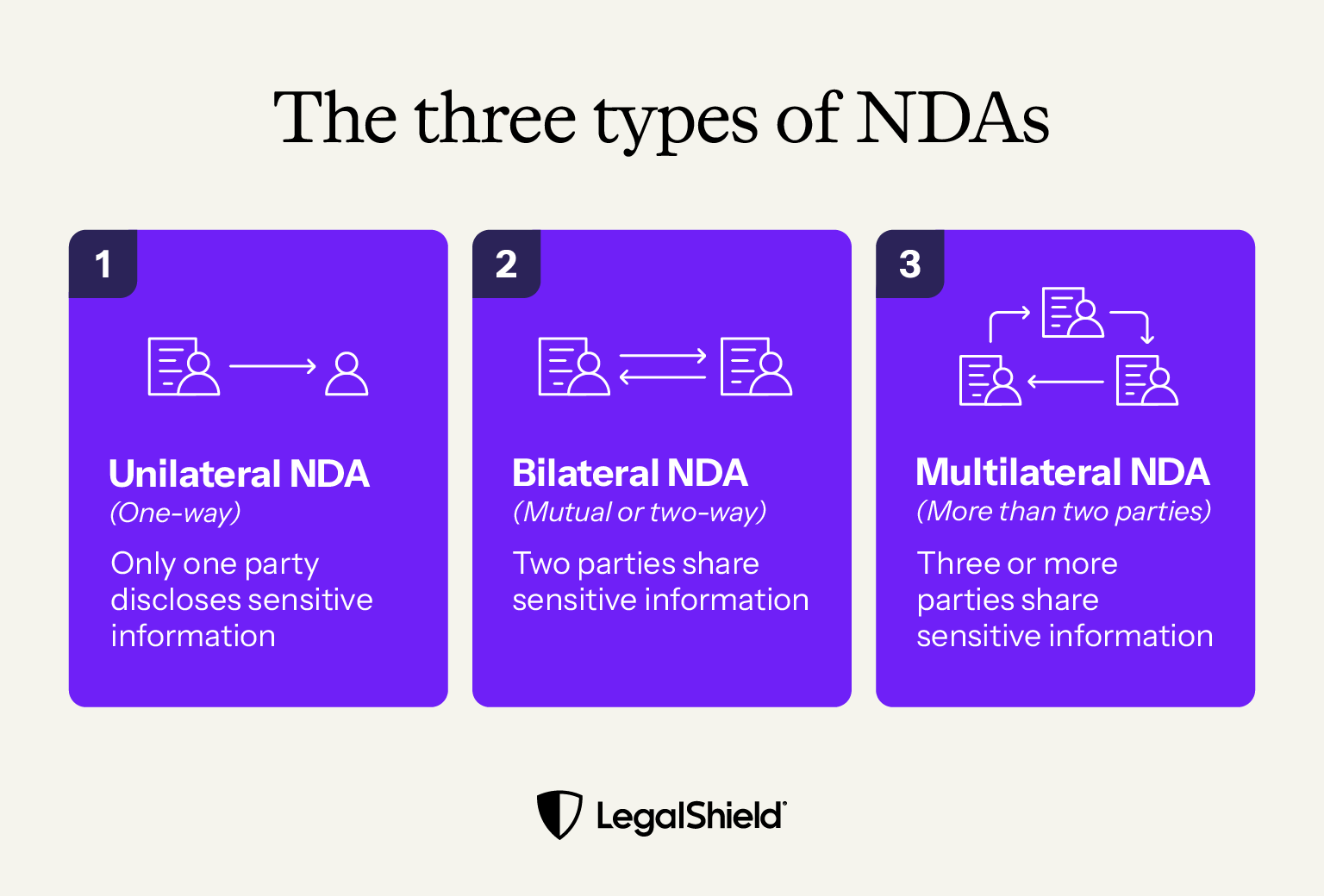
NDAs can cover a wide range of information and situations. Depending on their needs, parties generally choose between three main types of NDAs:
- Unilateral (One-Way) NDA: Only one party discloses information. The receiving party agrees to keep it confidential. Many employment and work agreement NDAs are unilateral and may be part of employment contracts or independent contractor agreements.
- Bilateral (Mutual or Two-Way) NDA: Both parties share and receive information and agree to keep it confidential. Businesses commonly use mutual NDAs to facilitate open discussions, and they are also used for joint ventures, mergers, and acquisitions.
- Multilateral NDA: Involves three or more parties. All parties agree to receive and share confidential information. These NDAs can be useful for combining multiple bilateral NDAs into one.
Things small businesses commonly include in an NDA
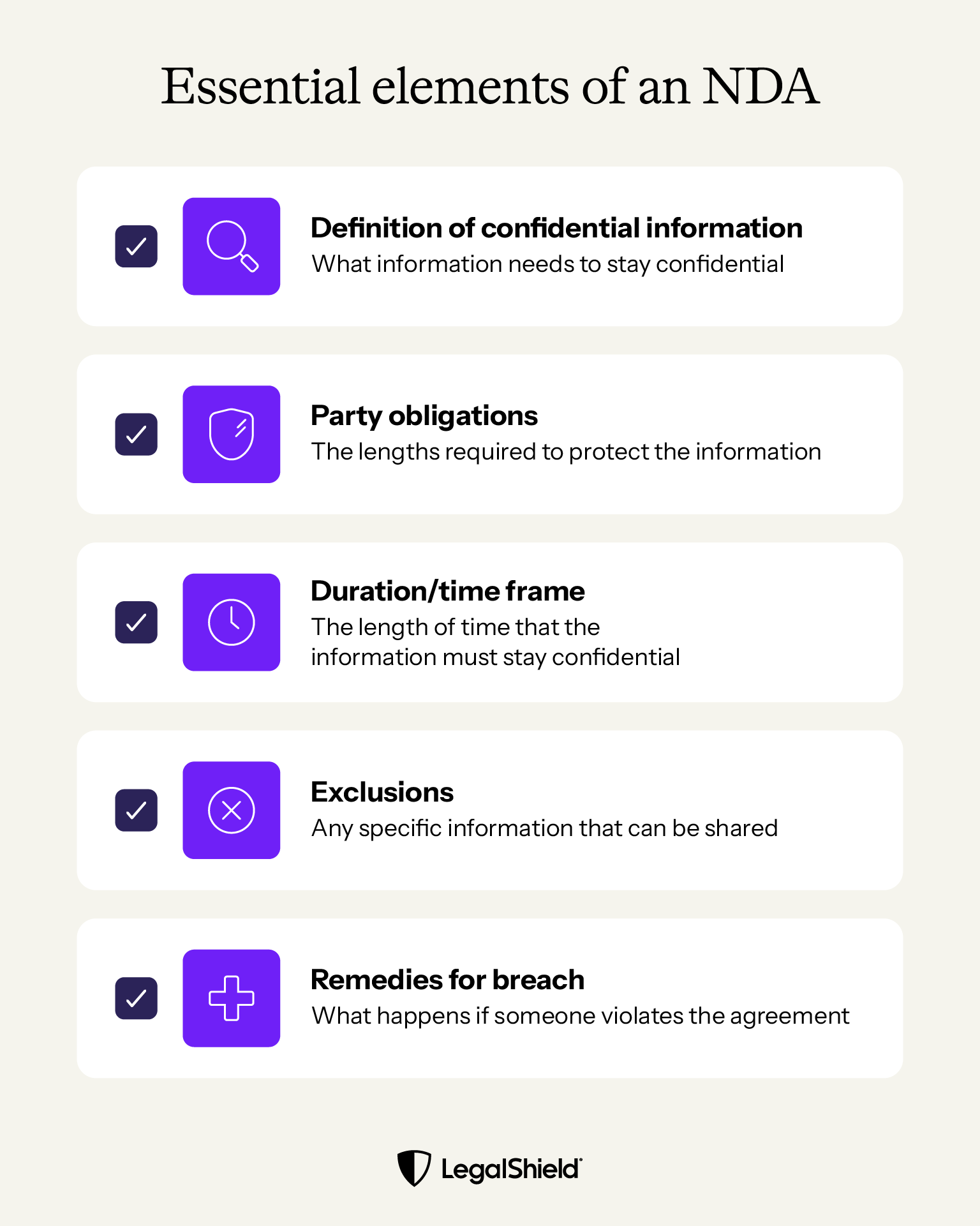
Non-disclosure agreements are legal contracts. As such, they usually include certain the parties understand their roles and responsibilities.
For starters, the information in an NDA needs to actually be private. If it’s information that’s already common knowledge or publicly available, parties may not need the agreement. Most NDAs specify the confidential information they cover, as well as each party’s obligations.
NDAs also typically have a set time frame for sharing information. The duration of the NDA is often included in the contract. How long it lasts may depend on the situation it covers and local laws. Another common element of an NDA is exclusions, which clearly state what the NDA doesn’t cover, such as already published reports.
Finally, most NDAs outline remedies for breaches of the terms. One is usually a court order to stop the spread of information, called an injunction. If the NDA is in an employment contract, the remedy could be termination. Sometimes, NDAs state that the party in breach must pay the other party monetary damages.
Working with a legal professional can help you understand more about how to write an NDA and what they include. With a LegalShield® Small Business Membership, you can get assistance with NDAs and other business contracts for an affordable monthly fee.
When an NDA may not be enforceable
Sometimes, common mistakes and certain situations can make an NDA unenforceable. When the language in an NDA is too vague, it can be harder to enforce. Clearly stating each party’s responsibilities and what is confidential can make it stronger, as can clearly outlining exclusions and remedies. Also, if an NDA includes info that isn’t really confidential, it might be unenforceable.
Vague or overly broad time frames can also make NDA enforcement more difficult. Additionally, some NDAs have location restrictions that can also be too broad. These can cover things like whether parties can store information digitally or share it internationally.
Another issue with some NDAs is general legality under state and federal laws. For example, if an NDA requires either party to act illegally or attempt to protect illegal activities, it’s probably not enforceable. The same is true in most situations involving NDAs and instances of sexual harassment.
One of the things lawyers can do for a small business is help strengthen NDAs, which can increase their enforceability. When creating an NDA, a LegalShield Plan can make consulting with a legal professional easy and affordable.
Considerations if you have a dispute about an NDA
NDAs are legal contracts, and the parties involved need to take them seriously. If you have any questions about an NDA or the enforcement of its terms, you might want to talk to a lawyer.
A breach could lead to court action. The court may order the party that violated the NDA to pay financial damages, including the other parties’ legal fees. In many cases, the breach harms the business relationship. It could even lead to its end.
Get legal advice about contracts/documents like NDAs
If you’re one of the many small businesses that need an affordable way to create NDAs, you might be tempted to DIY them using online templates. But it can be all too easy to end up with a poorly drafted NDA with overbroad language or unenforceable terms.
A LegalShield Small Business Plan could give you access to provider lawyers who can review NDAs before you sign. You can also get help with debt collection, employment law, and business licenses.
Additionally, LegalShield Small Business Plans offer document checks and e-signature collection to help with your contract needs. Basic plans include six document checks per year (25 pages each) and one e-signature. Upgrade to a Premium Plan and receive 100 document checks per year (50 page each) and unlimited e-signatures. When disputes arise, plans include trial defense services.
Sign up for a LegalShield Membership and get guidance on business legal contracts from a knowledgeable provider law firm.
Frequently Asked Questions

Signing an NDA can be risky if you don’t clearly understand its terms. When you don’t understand, you could make a mistake that could lead to enforcement remedies. Or if an NDA is overbroad, it could restrict you in unfair ways.
NDAs usually expire on the end date stated within. When the time frame is too long or unclear, it can make the NDA harder to enforce.
NDAs are usually enforceable when drafted properly. They typically hold up in court when they clearly outline the confidential information, the signers’ obligations, exclusions, remedies, and other terms.
The cost of an NDA usually depends on the legal fees you pay a lawyer to create it. Lawyer fees can vary based on the firm you choose and where you live.
Get the Answers You Need, When You Need Them
Communications Director at LegalShield overseeing content creation designed to make legal protection simple and approachable. He focuses on offering straightforward, trustworthy guidance that empowers people to make informed decisions about their legal rights and responsibilities.