Severance pay is a package of money and benefits that an employer can give an employee after a layoff. Employers don’t always offer it, but if they do, they have a variety of policy options to choose from.
Editor's note: This post was originally published on September 19, 2024, and has been updated for accuracy, comprehensiveness, and freshness on August 13, 2026.
As hard as a firing or layoff can be for an employee, it can also be difficult on the employer’s side. Besides letting go of a valued team member, employers also need to figure out the logistics for a smooth transition.
Severance pay, the pay an employee receives after a layoff, is one such logistic. A LegalShield® Provider Law Firm can provide legal help with contracts as you create a severance agreement.
How severance pay contracts work
Writing and using a severance agreement often involves these details:
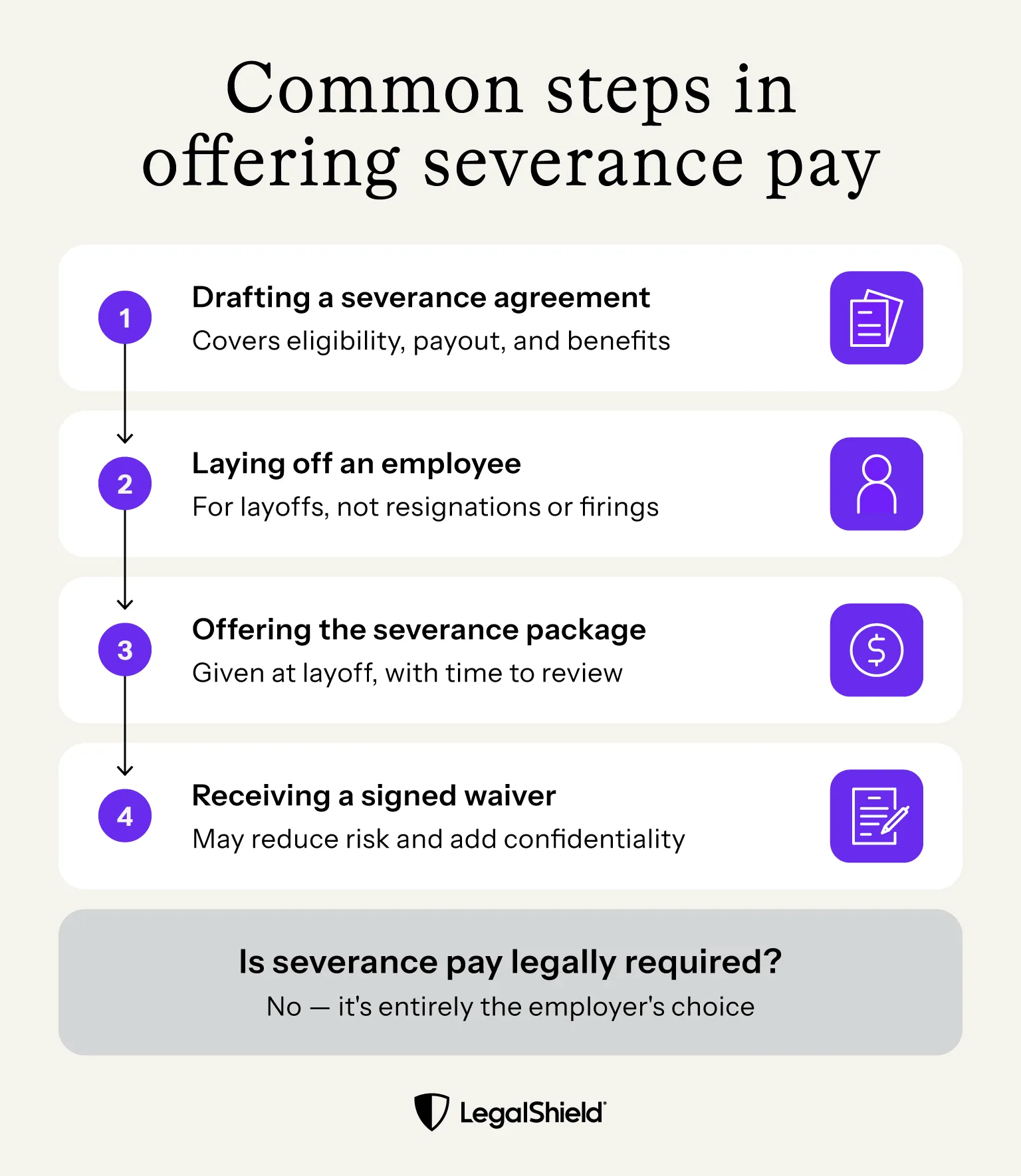
Drafting a severance agreement
Severance agreements typically explain who's eligible, how to calculate the payout, and how other benefits, such as health coverage or unused vacation, apply. You can include your severance policy in your employee handbook and it may be detailed in an employment contract, but you may also have a separate contract for employees to sign when they leave.
Laying off an employee
Severance pay is usually offered to laid-off employees rather than team members who leave due to resigning, retiring, or getting fired for cause. For example, firing someone for poor performance generally wouldn’t trigger severance pay, but letting them go because the company is closing might result in a severance package for the employee.
Offering the severance package to an employee
When you lay off an employee, you can give them the applicable severance agreement to sign. This agreement includes the time the employee has to review the contract and sign it. Time frames allowing for signature can be controlled by Federal Law, so it’s a good idea to check with a lawyer before setting the time frame.
Receiving a signed waiver from the employee
Severance contracts often ask the employee to sign a waiver that can reduce the risk of wrongful termination claims for the business. The waiver might also require that the employee agree to keep company information confidential or a waiver of certain claims.
Does the law require severance pay?
No, federal law doesn’t require employers to pay severance pay. It’s up to you whether you want to offer severance pay to your employees. However, a LegalShield Provider Law Firm can provide legal guidance for this decision to help you create an agreement that could reduce legal risk.
Typical parts of a severance agreement
While severance agreements don’t all have the same terms, some are more common than others.
For example, most of them spell out how the employer will pay out the severance, such as how much they’ll pay and in how many installments. Depending on the contract, it might also explain what benefits the employer will continue to pay and for how long.
The contract will also outline what the employee agrees to do in exchange for the severance package, such as whether they will return company property like computers before getting their payout.
How much is typical severance pay?
Since federal law doesn’t require employers to give severance pay, there are also no rules for the minimum payment you should provide. It’s up to you to set a number that makes sense according to your agreement terms and budget. A lawyer can also advise on what a fair agreement would look like for your business.
Employers may pay a severance over a period of weeks, while others pay everything in one lump sum.
How employers pay severance
After the employee signs a severance agreement, the employer provides certain types of compensation:
A lump sum: A one-time payment made when the employee leaves
Salary and/or benefits continuation: Continuing the employee's regular pay, insurance, or retirement contributions for a set period after their last day
Career support: Access to career support services that help the employee find a new job
Unused paid time off: Paying out any PTO the employee has banked but hasn't used
You get to decide what elements will protect your company while staying within your budget.
What are the pros and cons of severance pay?
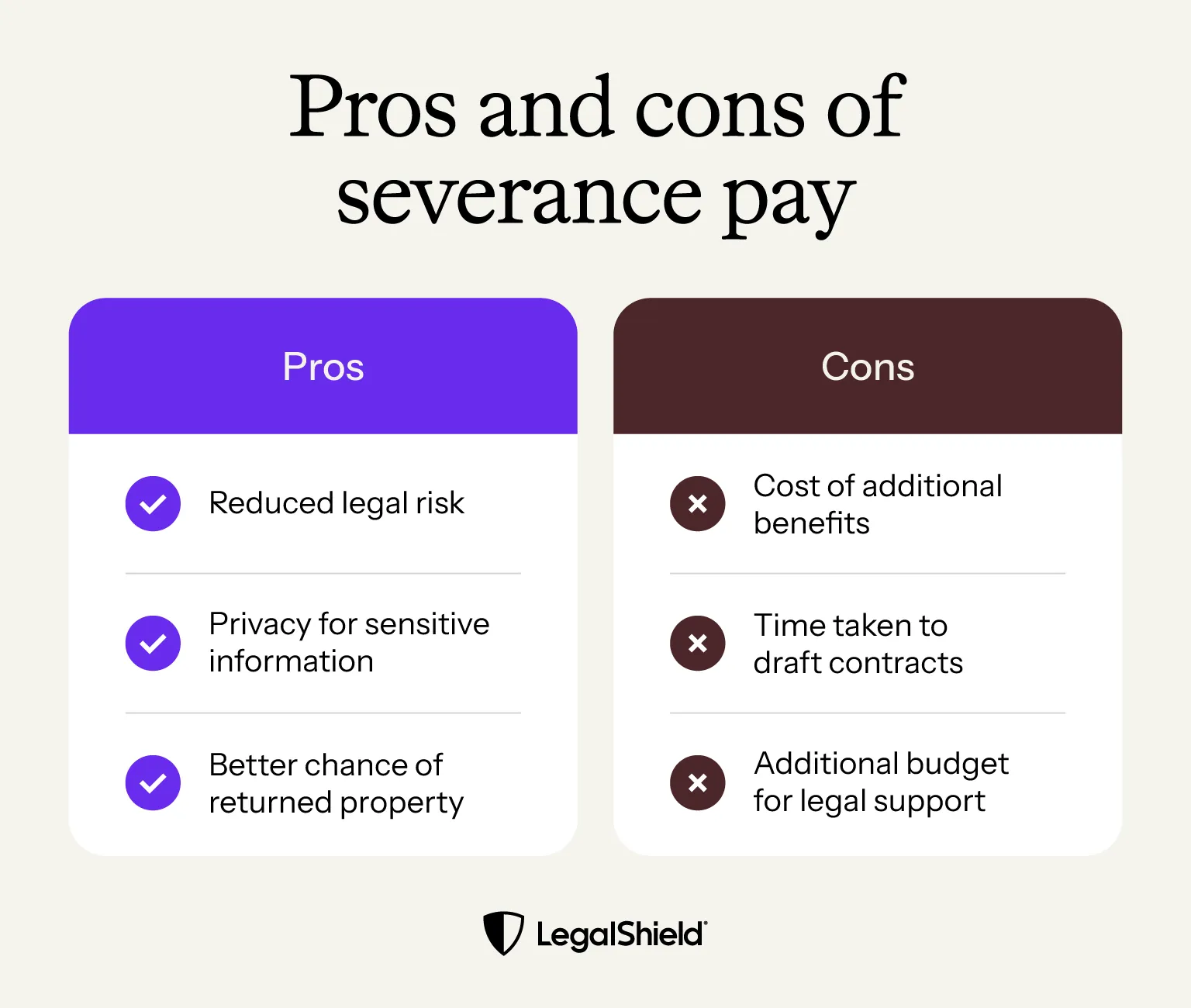
Severance pay is a give-and-take between the employer and employee. Employers have a few pros and cons to consider when deciding whether to offer severance pay to employees.
Pros of severance pay
The main benefit of severance pay for employers is potential legal protection. When an employer has to lay off employees, they can lower the risk of team members suing based on that layoff. Severance packages can also defend your brand reputation or company assets when you specify that an employee can’t take your property, criticize your company in public, or share sensitive information.
Cons of severance pay
In exchange for these benefits, employers have to commit to paying the severance package during harder economic times. There may be legal expense for drafting and negotiating the severance agreement as well as other administrative expenses.
Get guidance with a LegalShield Business Plan
Since there aren’t many federal guidelines on how to create a severance agreement, it can be hard to write one on your own. If you aren’t sure how to write a policy that protects your business, a lawyer can offer the guidance you need.
LegalShield Business Plans make the cost of legal guidance for this support more predictable and affordable with a consistent monthly fee. Depending on the plan, you can get help with a variety of legal issues ranging from advice on drafting a severance agreement to defense against a wrongful termination claim. With a LegalShield Provider Law Firm’s help, you can navigate employment legal issues with confidence.
Frequently Asked Questions
Yes, severance pay is taxable just like regular wages. As an employer, you’ll typically withhold and report severance pay in a W-2 form.
Even though there is no federal law requiring severance pay, severance agreements must follow all other laws as well. For example, you can’t ask an employee to get rid of their right to make certain discrimination claims or the ability to organize with other employees to get their severance package.
Since employers don’t have to offer any employee severance pay under federal law, they aren’t required to give it to independent contractors, either. Independent contractors are not employees and should have a contract defining their relationship with a company.
It ultimately depends on how confident you feel in your severance agreement, but a lawyer can help you design a document that protects your business.
Content Specialist at LegalShield, creating educational resources about legal and consumer protection topics. She focuses on making complex legal and financial concepts accessible to readers and has contributed to various educational articles on consumer rights and protections.
Dissolving an LLC can be tricky, and doing it without guidance can lead to unnecessary stress and delays. We’ve put together some helpful information so you can start the LLC dissolution process with more peace of mind.
An employment contract is an important piece of paperwork because it defines the working relationship, your expectations, and conditions. Here are some of the common components included.
Virtual business addresses can be a practical option for those forming an LLC from home, working remotely, or trying to keep their business and personal mail separate.
By the end of this blog, you’ll get a high-level summary of trademarking a name and logo, how logos differ from business names and artwork, and how much it all costs.
A DBA is a name registration that lets you run your business under a name other than your personal legal name or legal business entity. While a DBA offers branding flexibility and market expansion opportunities without creating a new legal structure, it does not provide legal liability protection, tax benefits, or function as a business license.
An indemnity agreement settles the “who is responsible” question ahead of time. One party promises, in writing, to cover certain losses tied to the work, so the other isn't left with the bill. These promises appear in construction contracts, leases, and business sales.
A certificate of good standing is official proof from your state that your business is registered and current on its requirements. Most lenders and agencies want a recent one, so it helps to know how to get it before someone asks.
Whether the goal is selling a company, bringing in a business partner, or passing it to a family member, the LLC ownership transfer often involves reviewing the LLC's operating agreement and the applicable state's rules.
•
11 min read
Author Name
,
Author Title
August 4, 2026
Thank you! You're subscribed!
Oops! Something went wrong while submitting the form.