In the business world, the public-facing name of your business is your DBA, which stands for “Doing Business As.” You might need a DBA if you’re a sole proprietor and don’t want to do business under your personal name. Or you might need a DBA to help grow your current operation.
It can be hard to run your business while keeping up with all the legal necessities and details that are required to operate. LegalShield® Small Business Plans give you access to affordable legal guidance and consultations on several business matters.
To help you get started with a DBA, we’ve provided a basic overview of what DBAs are, how they differ from LLCs, and how businesses apply for and use them.
What is a DBA?
A DBA is a name registration that lets you run your business under a name other than your personal legal name or legal business entity. It's also often called a fictitious name, trade name, or assumed name. Often, it’s the name publicly associated with your business or brand. A DBA does not create a new business structure or legal entity.
For example, say Jane wants to open a flower shop called Rosie Days as a sole proprietor. She would need to get a business name and register the DBA to open bank accounts under it and not her own. For more protection, she might also register her company as a Limited Liability Corporation (LLC) under Jane Doe LLC d/b/a Rosie Days.
The LLC creates a legal business entity, while the DBA simply allows Jane to do things, like banking and marketing, as Rosie Days. Sole proprietors, LLCs, partnerships, and corporations can all apply for DBAs. Not all banks will open an account as a DBA, so you will want to check the requirements before filing for your DBA.
Why do businesses file a DBA?
A business might need or want to file for a DBA for many reasons:
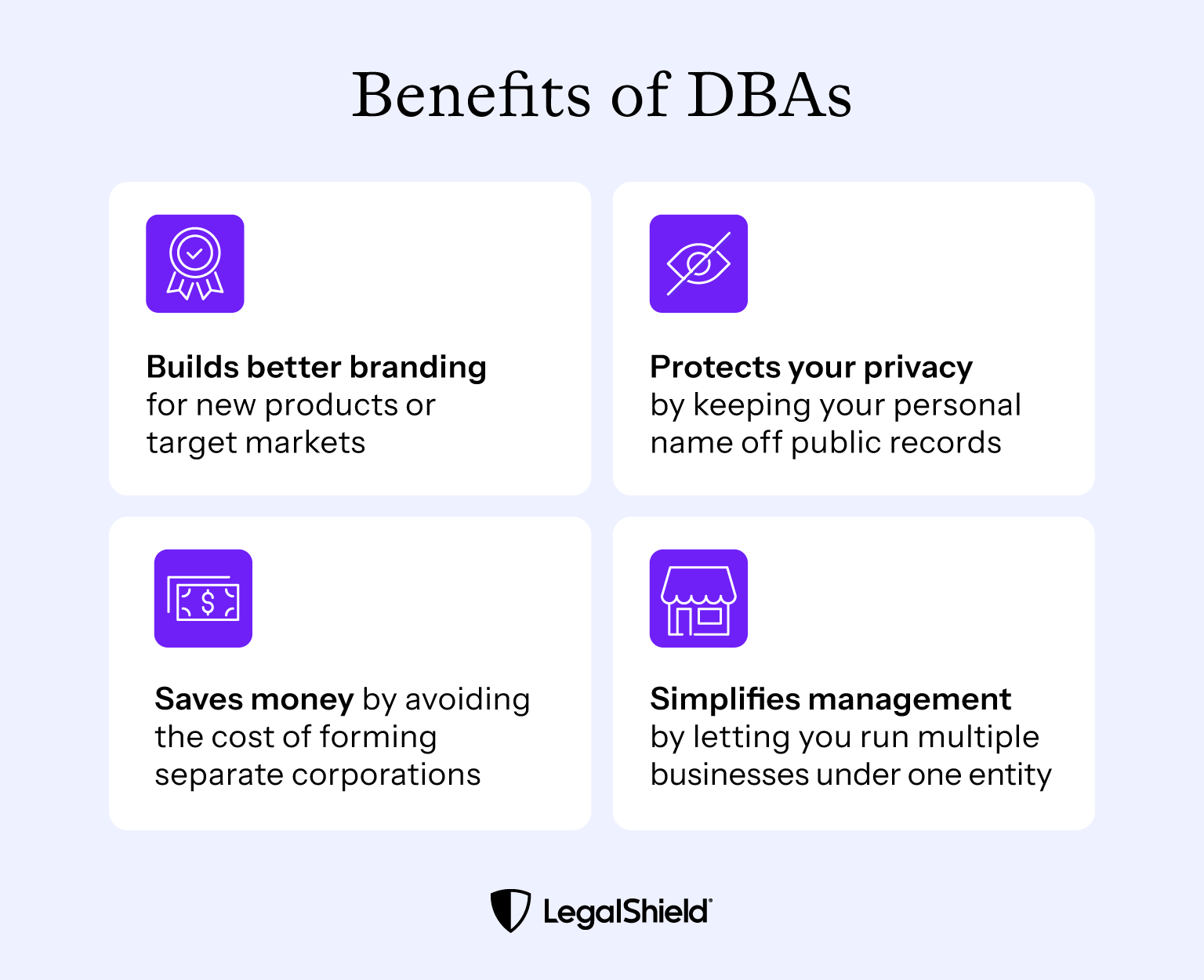
Sole proprietors need a DBA to open bank accounts under a professional name rather than their own name.
DBAs are often more memorable or marketable than personal, LLC, or corporate names.
If a business already has a legal entity, such as an LLC, it can add a DBA to start new product lines or market different services under different names without forming a new legal entity. Consult with a lawyer before doing this.
DBA can allow businesses to test out new markets under a different name.
DBAs let franchisees form their own legal entities while operating under the franchise’s brand name.
Knowing what you need for your business can be confusing. A LegalShield Small Business Membership gives you consultations on an unlimited number of business legal matters with a provider law firm. You can ask questions about DBAs and get answers for a fraction of the typical law firm hourly rates.
What a DBA doesn’t do
A DBA doesn’t create a separate business entity, so it doesn’t offer tax benefits or personal protection from legal liability. A DBA is merely a registered name you use to do business, nothing more.
Without a legal business structure, like an LLC, businesses have less tax flexibility. Sole proprietors report business taxes on their personal income tax return. And if the business gets sued or owes debts, the owner may be personally responsible.
Additionally, a DBA may not prevent other businesses from using your name. To legally protect your business name and other brand elements, you may need to pair the DBA with a trademark. Getting a trademark requires a different filing process than getting a DBA.
Is it the same as an LLC?
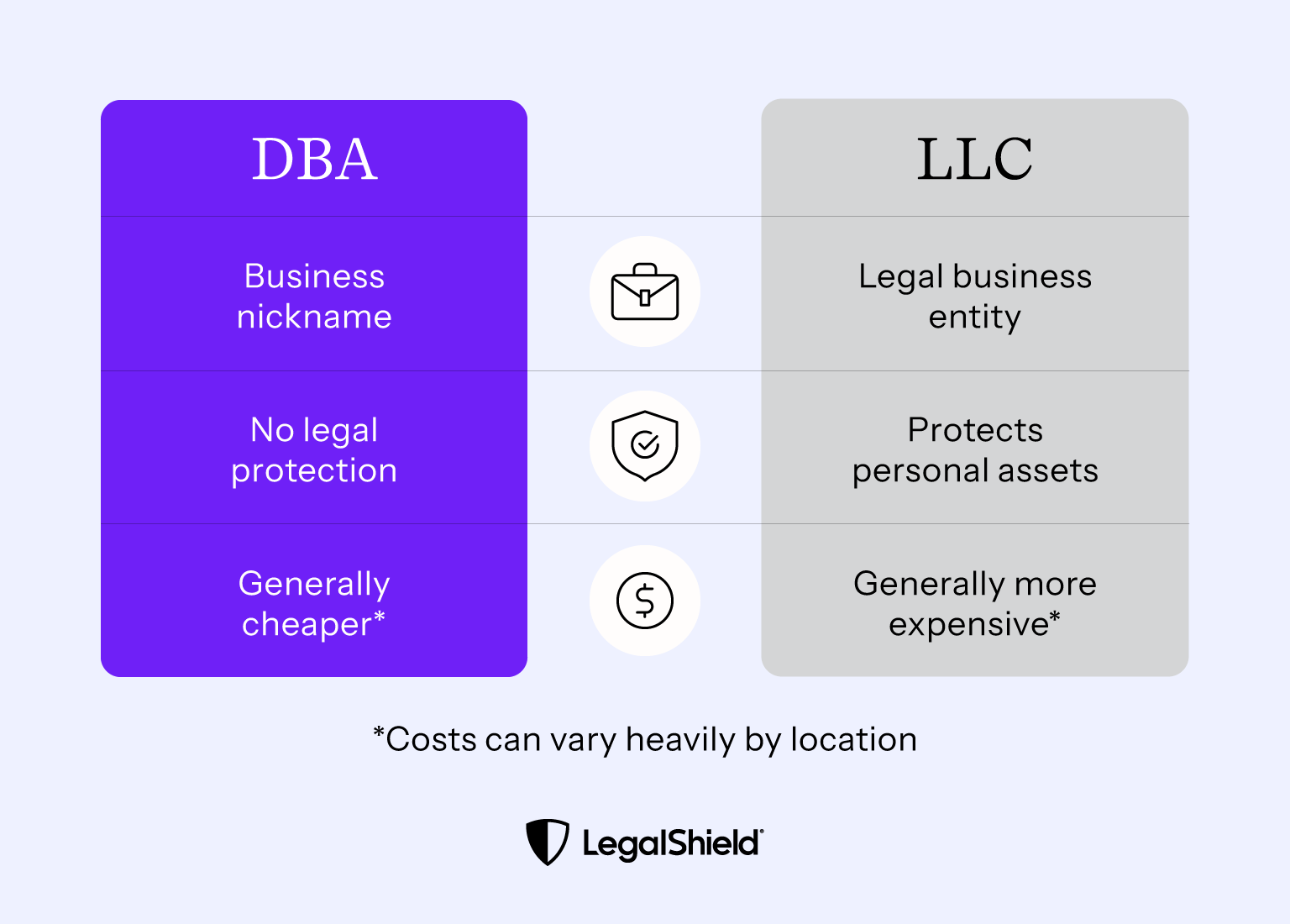
A DBA isn’t the same as an LLC. The main difference between an LLC and a DBA is that an LLC is a legal business structure. As such, it can provide legal protections that a DBA can’t.
Forming an LLC can give a business more tax options. It can also protect business owners from personal legal liability or personal responsibility for business debt.
Considerations for filing a DBA
Rules for DBA filing typically vary significantly by state, county, or city. So, the best way for you to file will usually depend on your business's location and its current legal structure. Some tasks you may need to take on:
Checking whether a DBA is available: This usually involves searching local, state, and federal databases to see whether anyone else is already using it. For stronger protection of a business name, owners may consider doing a trademark search and filing for a trademark.
Getting the correct DBA forms: Business owners typically need to obtain and complete forms to apply for a DBA.
Figuring out where to file: This depends on where a business is located and the type of business structure it has, this could be a local, state, or federal office. In some states, it’s the Secretary of State’s Office. If you already have an LLC, you will connect your DBA to the LLC registration(s).
Paying filing fees: There are often fees to register a DBA. Costs can vary based on location.
Taking care of any other obligations: Businesses may need to respond to requests from the government agency where the DBA filing is made. Local laws may require additional steps, such as filing a public notice or renewing a DBA every few years.
A lawyer in your area could give you more details about DBA filings where you live. An affordable LegalShield Subscription Service pairs you with a provider law firm that can answer business legal questions.
Get legal advice for your business
Getting a DBA can benefit many types of small business owners.
Whether you’re starting a business or growing, you can get affordable legal help with a LegalShield Small Business Plan. You can ask provider lawyers about issues like DBAs and applying for a business license. Adding a LegalShield Business Plus Supplement gives you even more resources and expanded consultations.
Wherever you are on your business journey, a LegalShield Membership has something to offer. Get help with legal matters around taxes, debt collection, and business contracts.
Frequently Asked Questions
Businesses may need a DBA and an LLC if they want to do business under a different name than the LLC. An LLC might also need a new or additional DBA to branch out under a new name.
No, a DBA doesn’t count as a business license. A business license grants permission to operate from a state or federal agency. A DBA doesn’t do this. All a DBA does is register a business name.
Communications Director at LegalShield overseeing content creation designed to make legal protection simple and approachable. He focuses on offering straightforward, trustworthy guidance that empowers people to make informed decisions about their legal rights and responsibilities.
Dissolving an LLC can be tricky, and doing it without guidance can lead to unnecessary stress and delays. We’ve put together some helpful information so you can start the LLC dissolution process with more peace of mind.
An employment contract is an important piece of paperwork because it defines the working relationship, your expectations, and conditions. Here are some of the common components included.
Virtual business addresses can be a practical option for those forming an LLC from home, working remotely, or trying to keep their business and personal mail separate.
By the end of this blog, you’ll get a high-level summary of trademarking a name and logo, how logos differ from business names and artwork, and how much it all costs.
An indemnity agreement settles the “who is responsible” question ahead of time. One party promises, in writing, to cover certain losses tied to the work, so the other isn't left with the bill. These promises appear in construction contracts, leases, and business sales.
A certificate of good standing is official proof from your state that your business is registered and current on its requirements. Most lenders and agencies want a recent one, so it helps to know how to get it before someone asks.
Whether the goal is selling a company, bringing in a business partner, or passing it to a family member, the LLC ownership transfer often involves reviewing the LLC's operating agreement and the applicable state's rules.
If you want to do business under a name that isn't your own legal name or your LLC's registered name, you need a trade name, also known as a doing business as (DBA) name.
•
6 min read
Author Name
,
Author Title
July 28, 2026
Thank you! You're subscribed!
Oops! Something went wrong while submitting the form.