Some websites advertise online divorce services without lawyers. But starting a divorce without a lawyer can lead to complications later on.
If your divorce is uncontested, you may be able to complete it without showing up in a courtroom. But even if you begin filing online, there isn’t a guarantee that you’ll be able to complete the whole process that way. It’s best to speak with a lawyer to understand the options available to you.
Let's talk about online divorce filing and how you can get started. With a LegalShield® Personal Plan, a provider law firm can provide divorce guidance, and on the LegalShield Advanced and Premium Plans, help with uncontested divorce after a 180-day waiting period.
What does it mean to divorce online?
In an uncontested divorce, where both spouses agree on all the terms, you may be able to divorce without in-person court appearances. Each court will have different requirements. For example, if children are involved, some courts might require each spouse to attend an educational program (which may or may not be available online).
The important part is that you have no disagreements. Simple divorces have three general steps: filing, serving, and finalizing. You and your spouse can cooperate at each stage, and if you do, you may be able to do everything online.
Most divorce service websites only help you with the first stage. They might help you find the right forms, guide you in filling them out, or file them for you. You might be tempted to use an online service that says you can skip the lawyer, but it doesn’t mean your entire case will stay online.
You should seek a lawyer’s advice early in the process because they can help you avoid unnecessary mistakes or disagreements that could make your divorce more complicated later. If there’s any chance of disagreement between you and your spouse, then handling a divorce without a lawyer isn’t a good idea.
Filing an uncontested vs. contested divorce
To start a divorce, you need to file a summons and serve it to your spouse.
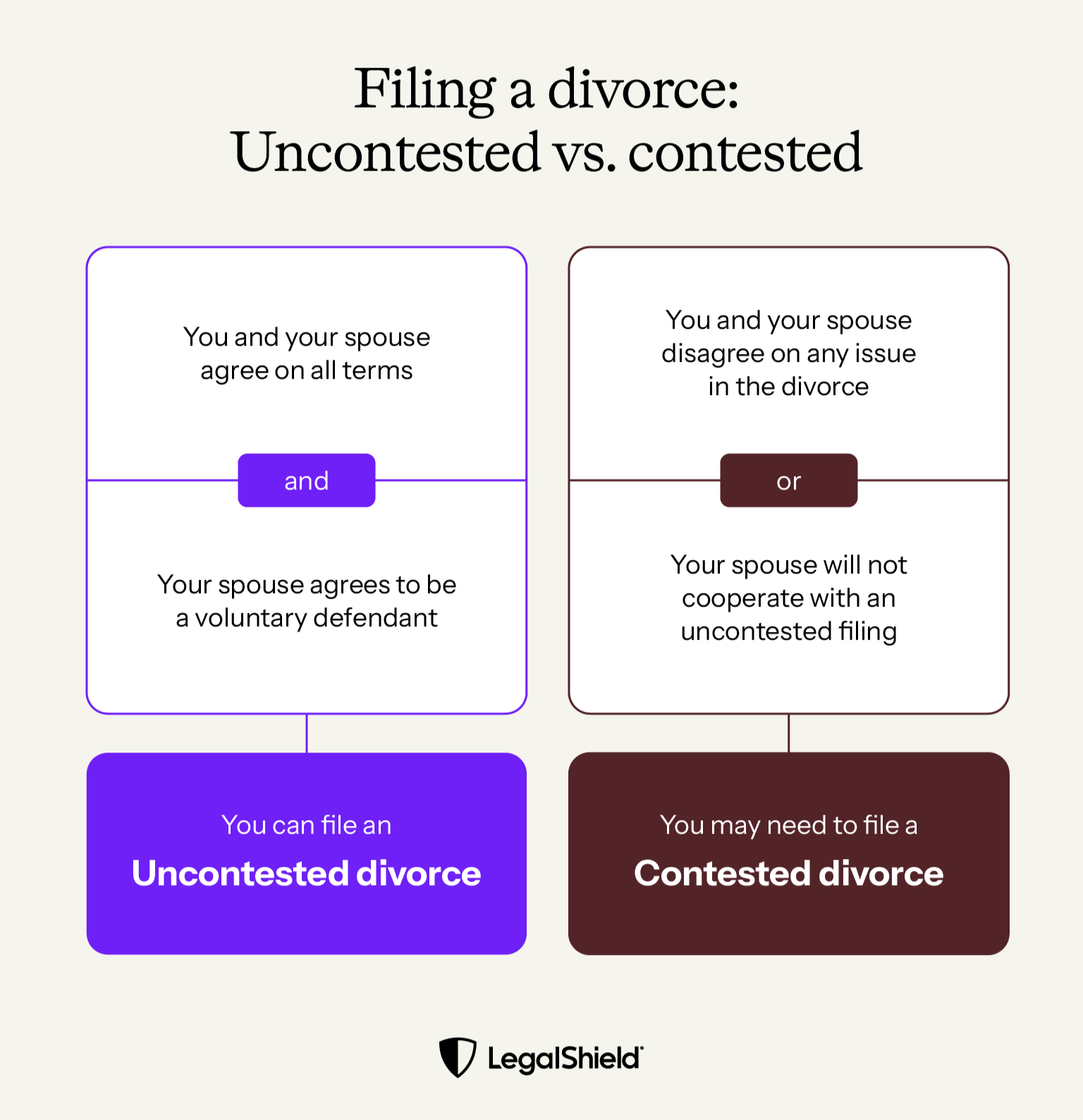
In an uncontested divorce, your spouse can accept the service of divorce papers and become a voluntary defendant. The exact process differs by state, and may involve you filing cooperatively, or your spouse signing an affidavit. This is the easiest and fastest path, and may allow you to avoid physical service of process by a sheriff or other official party.
If your spouse doesn’t agree to even one of the terms, the divorce gets much more complicated. Contested divorces often require additional legal steps like mediation, depositions, or even a trial.
While you may still be able to file some initial paperwork online in a contested case, you'll likely need more support from a lawyer to work through the disagreements. Check with your state's court website or self-help center to confirm the rules where you live. With a LegalShield Membership, you can ask a provider lawyer for state-specific guidance.
How to file for divorce online
Many courts have e-filing systems and instructions you can use to file for divorce online. This is the easiest part to do online.
People often need to complete these tasks while filing for a divorce online:
Confirm your state's requirements. Check residency rules, waiting periods, and whether your state's courts offer e-filing for divorce cases.
Fill out your divorce forms. Even in uncontested cases, it’s best to have a lawyer prepare these forms. As part of a LegalShield Personal Plan, starting at the Advanced tier, a provider law firm can prepare your uncontested divorce documents for you after a waiting period. See a plan for your state for details.
File your paperwork with the court. Submit your forms through the court's e-filing system and pay the fee.
Serve your spouse with divorce papers. In uncontested divorces, you can file cooperatively, which makes the process easier. In a contested divorce, you may not be able to proceed online, and you should discuss your options with a lawyer.
If your divorce is uncontested and the paperwork is in order, the court may grant your divorce without you needing to attend hearings.
How much does it cost to file for divorce online?
In an uncontested divorce, the main costs are document preparation and court filing fees.
Court filing fees vary by location — for example, $260 in Colorado and $355 (for an uncontested divorce) in New York. If you can't afford the fee, you may be able to apply for a fee waiver. Online document preparation services charge their own fees in addition to court costs. These services aren't a substitute for legal advice, and they can't tell you whether the terms of your agreement are fair.
If you decide to speak with a traditional divorce lawyer, costs can add up quickly. Many law firms have an average hourly rate of about $300. An uncontested divorce may cost roughly $1,790* in most cases, though exact costs vary by law firm and situation.
If they’re contested, divorces can become financially draining. Speak to a lawyer to understand more about the process and costs for contested divorces.
* Disclaimer: Amount based on LegalShield Provider Law Firm average rates. Law firms determine exact costs.
How LegalShield can help with divorce
Filing for divorce online can simplify the paperwork, but it doesn't replace the value of having a lawyer in your corner. It can be difficult to defend your best interests when you’re going through something as emotionally exhausting as divorce. Legal support can help you protect yourself and make sure the agreements are fair.
If you have a LegalShield Personal Membership, you can connect with a provider law firm to help you understand your state requirements, answer questions about filing, and make sure you're not overlooking anything important.
Learn more about LegalShield Personal Plans and how they could help you through the divorce process. With a LegalShield Advanced or Premium Plan, a provider law firm will help you navigate an uncontested divorce, separation, or annulment after a waiting period. See a plan for your state for details.
Frequently Asked Questions
No. Although you can often file paperwork online, a fully online process is only possible with uncontested divorces and in certain states. If you and your spouse disagree on issues like property division, custody, or support, you may need mediation, a collaborative process, or representation in court.
You're not required to have a lawyer, but working with one can help you avoid costly mistakes. Online document preparation services can fill out your forms, but they can't give you legal advice or tell you if the terms of your agreement are in your best interest.
Although you can often file paperwork online, a fully online process is only possible with uncontested divorces and in certain states.
It depends on your state. Some states allow uncontested divorces to be finalized without a court appearance or through a brief video hearing. Others may require at least one in-person hearing before a judge signs the final order. Check with your local court to find out what to expect.
In many cases, yes — if the divorce is uncontested and both spouses agree on custody, support, and how to divide property. The forms may be more detailed, and the court will review the arrangements more closely to make sure they're fair.
If your spouse won't agree to a divorce, then you will need to go through a formal service of process, which means a third party delivers the summons directly to your spouse. If you can't locate them, you may still be able to move forward without your spouse's participation. A lawyer can help you understand your options in this situation.
The time it takes to finalize a divorce depends on the state, court schedule, waiting periods, and how many issues you and your ex need to resolve. Cases that involve property, custody, support, or hard disagreements often take more time.
Communications Director at LegalShield overseeing content creation designed to make legal protection simple and approachable. He focuses on offering straightforward, trustworthy guidance that empowers people to make informed decisions about their legal rights and responsibilities.
We’ll provide more information about the trustors vs. trustees comparison, what to consider when filling these roles, and how they work together in Revocable and Irrevocable Trusts.
A power of attorney with springing powers is a legal document that grants someone else the authority to act on your behalf only after a specific event occurs.
There’s no rule that says a lawyer has to set up your Trust for it to be valid. However, Trusts are complex and doing it yourself without a lawyer's help comes with risks.
A Certificate of Trust proves your Trust is real and names who can act for it, while your beneficiaries and assets stay private. It lets your Trustee handle Trust business, like opening accounts or transferring property.
A limited power of attorney often comes in handy when you need help for a short time or for a single purpose. This legal document can help in situations like when you’re traveling, serving in the military, caring for an aging parent, or sending a child to study abroad.
We’ll cover some of the most common scams, the red flags that give them away, how to protect yourself, and what to do if you’ve already been caught out.
An executor is responsible for ensuring your final wishes get carried out, so it’s important that you choose someone who is responsible and can bear the emotional burden.
An employer identification number is a nine-digit number the IRS uses to identify a taxpayer. The estate needs its own, and getting one is usually simpler than it sounds. Learn more about estate EINs.
•
5 min read
Thank you! You're subscribed!
Oops! Something went wrong while submitting the form.