A springing power of attorney is a legal document that grants someone the authority to act on your behalf after a certain future event occurs. Often, that event is a serious illness, cognitive decline, or some other form of incapacitation.
A sudden medical emergency, a serious accident, or an unexpected diagnosis happens fast. Changes like that often leave people unable to manage bills and many other personal affairs. Often, family members are left trying to help without the benefit of clear legal authority to do so.
A power of attorney (POA) with springing powers is one way to plan for situations like this. This estate planning document lets you name someone now to act on your behalf, but delay that authority until a specific event happens later. Springing powers are included in a power of attorney, whether durable or not, but you will not see a document called a springing power of attorney.
LegalShield® Provider Lawyers can help members understand their power of attorney options and prepare related documents. Here’s what to know before you decide whether a POA with springing powers belongs in your estate plan.
What is a springing power of attorney?
A power of attorney with springing powers is a legal document that grants someone else the authority to act on your behalf only after a specific event occurs. A power of attorney may contain springing powers or may be effective immediately, regardless of capacity. With a springing POA, the agent’s power stays inactive until the triggering event happens.
These events can look like illnesses, injuries, and cognitive decline that leave you unable to manage your affairs or make decisions. For the springing POA to work as you intend, the trigger language must be 100% clear. A LegalShield® Membership can connect you with a provider law firm that can help with that.
How do springing POAs work?
You create a springing power of attorney before you need one. While there are some nuances from one springing POA to the next, these documents all work in a similar basic way.
You choose a trusted person called an “agent” to handle certain affairs for you if you become unable to handle them on your own. The POA explains the powers you’re granting to the agent and, importantly, what must happen before those powers take effect.
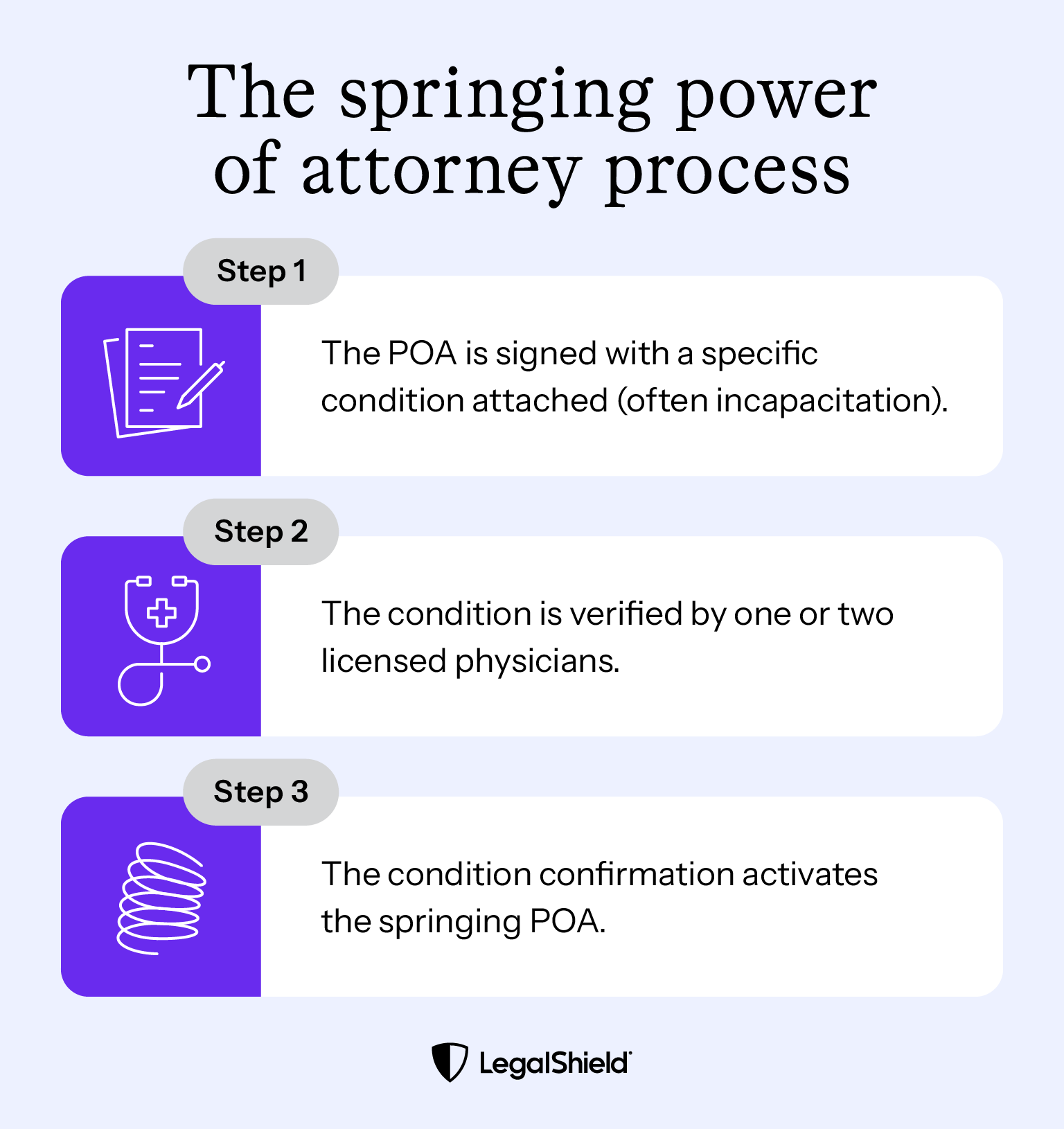
The triggering event is another essential detail that you must include in your springing power of attorney. Often, it boils down to some kind of incapacity. The POA language might require a doctor to confirm, for instance, that illness, injury, or cognitive decline has truly left you unable to make decisions or manage your affairs.
The exact requirements depend on the document itself and the state you live in. But once the criteria in the POA are met, the agent can then step in and act within the bounds of the springing POA. Until that moment, though, the agent has no authority unless you give it to them.
Advantages of a springing POA
A springing POA offers a way to plan ahead without immediately giving someone else authority over your affairs. That balance is the main attraction for many people. Here are some other advantages of springing POAs:
You keep control as long as you’re capable. You keep control over financial, legal, and personal decisions until you’re incapacitated.
They may protect against misuse. Clearly defining the onset of the agent’s powers reduces the likelihood that the POA will be used before it’s truly needed.
You have a worst-case-scenario plan. Your loved ones already know who can step in if you’re left unable to manage your affairs due to an illness or injury.
They can give peace of mind. For you and your family, a springing POA can reduce confusion during what’s likely to be a stressful time. That’s thanks to the clarity these documents can provide.
Disadvantages of a springing POA
The same features of springing POAs that protect your control can also create problems like these:
Proving incapacity can take time. Before the agent can help with anything, they might have to wait for written proof of incapacity from a doctor or two.
Family disputes can slow things down. Whether you’re truly unable to manage your own affairs might be a point of debate for your loved ones. Those disputes slow the process, especially when the POA document is unclear.
Courts may step in if there’s unclear language. A poorly defined trigger event can be an invitation for a court to step in. A lawyer can draft clearer language so the document is more effective when it matters.
Financial institutions might ask for more proof. Before they accept the agent’s authority, banks and other financial institutions might want to review the POA and medical confirmations.
They might not fit convenience-related needs. Other types of POAs can be a better fit for times when you need someone to handle convenience tasks while you’re, for example, traveling, studying abroad, or otherwise unavailable.
Durable vs. springing power of attorney
Durable and springing powers of attorney aren’t exact opposites. “Durable” and “springing” are just modifiers that describe how the POA works, and sometimes you have a POA that is both durable and springing:
The POA can stay effective if you become incapacitated.
Durable POAs often take effect as soon as they’re signed, unless the document says otherwise.
Because the agent may be able to act right away, you need a high level of trust in the person you choose.
Springing power of attorney
The POA doesn’t take effect until a specific trigger event happens.
It takes effect only after the event named in the document (such as incapacity).
This may feel safer to some people, but it can cause delays if incapacity has to be proven before the agent can act.
Springing durable power of attorney
The POA has both features. It springs into effect after a trigger event and can stay effective after incapacity.
It takes effect at the time or event named in the doc.
The document should explain what triggers the agent’s authority and how that trigger is to be confirmed.
The types affect how your affairs are handled during your lifetime, and, generally speaking, neither can allow your agent to change a Will. POAs are part of an overall estate plan, such as a revocable trust, and working with a lawyer ensures that all of your documents work together.
Get a LegalShield Membership for help navigating a POA
A springing POA can give your loved ones a plan for an emergency, but it needs clear language to work the way you intend. If you’re comparing POA costs and options, updating older estate planning documents, or deciding who should act as your agent, LegalShield Provider Lawyers can help you understand whether a springing POA fits your situation.
Getting legal guidance early can help your family avoid confusion later. Review LegalShield pricing to compare plan options and see how affordable legal support can fit into your estate planning process.
Frequently Asked Questions
A springing POA doesn’t take effect right away. The agent only gets authority after the specified triggering event happens (usually incapacity). A regular POA can give the agent authority as soon as the document is signed.
A POA with springing powers becomes effective when certain conditions are met. For instance, the POA might require one or two doctors to confirm that illness, injury, or cognitive decline has left you unable to manage your own affairs.
While you still have the legal capacity to do so, it’s most often possible to revoke a power of attorney. The process might require written notice and/or informing the agent or anyone who has a copy of the document.
Communications Director at LegalShield overseeing content creation designed to make legal protection simple and approachable. He focuses on offering straightforward, trustworthy guidance that empowers people to make informed decisions about their legal rights and responsibilities.
We’ll provide more information about the trustors vs. trustees comparison, what to consider when filling these roles, and how they work together in Revocable and Irrevocable Trusts.
There’s no rule that says a lawyer has to set up your Trust for it to be valid. However, Trusts are complex and doing it yourself without a lawyer's help comes with risks.
A Certificate of Trust proves your Trust is real and names who can act for it, while your beneficiaries and assets stay private. It lets your Trustee handle Trust business, like opening accounts or transferring property.
A limited power of attorney often comes in handy when you need help for a short time or for a single purpose. This legal document can help in situations like when you’re traveling, serving in the military, caring for an aging parent, or sending a child to study abroad.
We’ll cover some of the most common scams, the red flags that give them away, how to protect yourself, and what to do if you’ve already been caught out.
An executor is responsible for ensuring your final wishes get carried out, so it’s important that you choose someone who is responsible and can bear the emotional burden.
An employer identification number is a nine-digit number the IRS uses to identify a taxpayer. The estate needs its own, and getting one is usually simpler than it sounds. Learn more about estate EINs.







.jpg)