A Certificate of Trust, sometimes called a Memorandum of Trust, is a short, signed summary that proves your Trust exists and shows who has authority to act for it. It lets your Trustee handle Trust business, like opening accounts or transferring property, without revealing private details such as your beneficiaries or assets.
You created a Trust to take care of the people you love, and part of that care is privacy. It can feel unsettling when a bank or title company asks to see the whole document just to complete a single task. A Certificate of Trust, sometimes called a Memorandum of Trust, exists to solve exactly that problem.
This certificate provides the bank just enough to move forward and keeps everything else private. But estate planning tools like a Certificate of Trust require some knowledge, which is why we’ve made this guide to help you understand how they work.
What is a Certificate of Trust?
A Certificate of Trust proves your Trust is real and names who can act for it, while your beneficiaries and assets stay private. It’s the public face of a private document. Formats vary a bit by state, but if you've seen one Certificate of Trust example, you have a fair idea of what yours might contain.
What a Certificate of Trust may include:
Trust name and date: The Trust's full legal name and the date it was created.
Trustee details: The current Trustee or Trustees, plus named successor Trustees.
Relevant powers: The Trustee's powers relevant to the transaction at hand, such as opening accounts or selling property.
Revocable or irrevocable status: Whether the Trust can be changed, and who holds that power if so.
A statement of validity: Confirmation that the Trust hasn't been revoked or amended in a way that would make the certificate inaccurate.
Signature and notarization: The Trustee's signature, often notarized.
When do you need a Certificate of Trust?
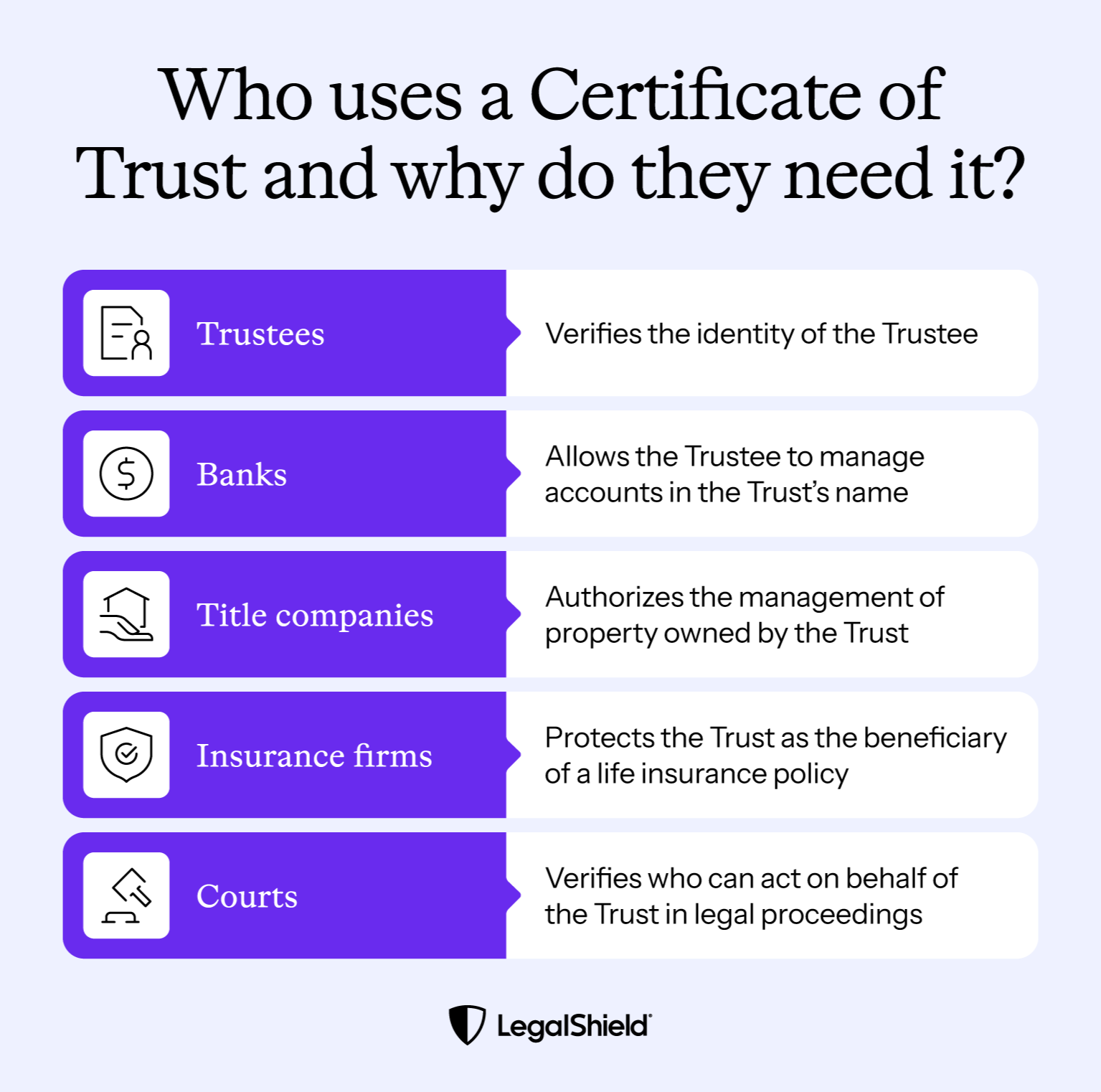
A Certificate of Trust is usually required when your Trust interacts with the outside world. Common triggers include opening or managing a bank account in the Trust's name, moving assets into or out of the Trust, and real estate deals involving Trust-owned property.
If you're putting your house in a Trust, for example, the title company may want proof of the Trust and your Trustee's authority before closing. Institutions, like the title company, must confirm that the Trust exists and that you can act on its behalf.
You could hand over the full Trust document instead, but the certificate answers those questions while helping protect your family's privacy. If you serve as your own Trustee, as many people with revocable living Trusts do, you may be the one presenting it.
Filing your certificate with the county clerk in which you live is a common practice, especially if you plan to transfer real estate to your Trust.
Keep in mind, though, that even if you have a Certificate of Trust, banks or other entities may still require the entire Trust or parts of the Trust (like the pages with the Trust name, Trustees, and signature pages). They may want you to bring them your original Trust so they can scan or make copies. It’s a good idea to ask before assuming a Certificate of Trust is all that is required.
How the Certificate of Trust differs from the Trust document
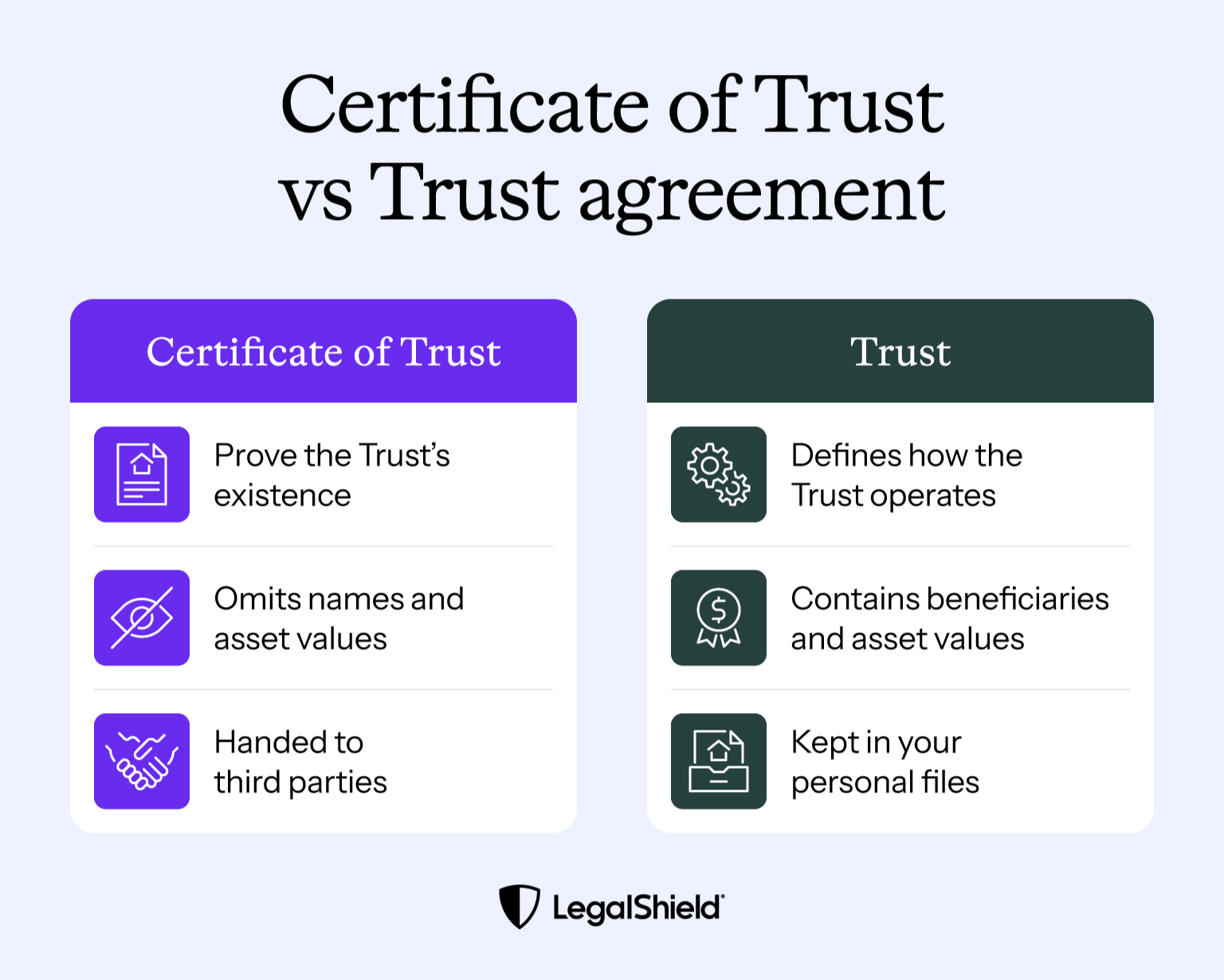
Your full Trust document specifies your beneficiaries, the property the Trust holds, and how it should be managed. Those details stay private, with you or your Trustee deciding who sees them.
On the other hand, a Certificate of Trust is a brief excerpt created to show outside parties, sharing just enough for a bank or title company to move forward. Your beneficiaries' names and the Trust's assets stay out of it. Formats vary by state and by who prepares it, but most follow the same pattern.
How the different states treat Certificates of Trust
Certificates of Trust aren't governed by one national rule. Many states have adopted a version of the Uniform Trust Code, which sets out what a certificate may include and how third parties may rely on it.
Other states follow their own statutes, and some have few specific rules on the books. Because requirements vary, the certificate should be prepared in accordance with the rules of the state where you plan to use it.
You don't have to sort those rules out alone. With a LegalShield Personal Plan, you can get legal guidance about how your state handles Certificates of Trust before you sign anything.
How to get a Certificate of Trust
There's more than one path to getting a Certificate of Trust, and the right one often depends on where you are in the process. Most people get a Certificate of Trust in one of three ways:
A lawyer prepares it: Many people have a lawyer draft the certificate at the same time the Trust is created, so the work is often folded into the cost of a living Trust. A lawyer can also prepare one later if your Trust already exists.
The institution provides a form: Some banks and financial companies keep their own Certificate of Trust form on hand and ask the Trustee to complete it. They may require this form even if you have your own.
You start from a template: A free Certificate of Trust form found online may look convenient, but generic templates don't necessarily meet your state's legal requirements.
However it's prepared, the certificate typically needs the Trustee's signature, and sometimes the grantor (the person who created the Trust) signs as well. Many states expect notarization, and a few may call for witnesses.
The certificate also needs to stay current. If you amend your Trust, the old certificate may no longer be accurate, so it's usually a good idea to prepare a new one. Some banks also prefer a recently signed copy or may ask for an original.
Plan your estate with confidence with a LegalShield Personal Plan
A Certificate of Trust lets your Trust do business while your private choices stay private. It works best when it's prepared correctly for your state. If you’re still working on the rest of your estate plan, you can start by learning the difference between a living Trust and a Will.
With a LegalShield Personal Plan, you can speak with a provider law firm about your estate planning questions and have documents reviewed before you sign. Premium members can also have a revocable living Trust prepared. You don’t have to pay the high rates that lawyers charge, which average $300 an hour.
LegalShield® is a trademark of Pre-Paid Legal Services, Inc. (“LegalShield”). LegalShield provides access to legal services offered by a network of provider law firms to LegalShield members through membership-based participation. Neither LegalShield nor its officers, employees or sales associates directly or indirectly provide legal services, representation, or advice. Small Business Legal Plans and certain benefits are not available in all states. See a Small Business Legal Plan contract for a specific state for complete terms, coverage, amounts, and conditions. The information made available in this blog is meant to provide general information and is not intended to provide legal advice, render an opinion, or provide a recommendation as to a specific matter. The blog post is not a substitute for competent legal counsel from a licensed professional lawyer in the state or province where your legal issues exist, and you should seek legal counsel for your specific legal matter. Information contained in the blog may be provided by authors who could be a third-party paid contributor. All information by authors is accepted in good faith, however, LegalShield makes no representation or warranty of any kind, express or implied, regarding the accuracy, adequacy, validity, reliability, availability, or completeness of such information.
Frequently Asked Questions
Usually not. The certificate is typically shown to the party requesting it rather than filed with a government office. The common exception is real estate: when a Trust holds or transfers property, the certificate may be recorded with the county land records, and those requirements vary by state.
A lawyer typically prepares it, often alongside the Trust itself. Some banks offer their own version for the Trustee to complete, and templates are available online, though they may not comply with your state's rules.
In most states, the certificate itself doesn't expire. Even so, banks and title companies often want one signed recently. Amending your Trust generally also requires preparing a new certificate.
Communications Director at LegalShield overseeing content creation designed to make legal protection simple and approachable. He focuses on offering straightforward, trustworthy guidance that empowers people to make informed decisions about their legal rights and responsibilities.
We’ll provide more information about the trustors vs. trustees comparison, what to consider when filling these roles, and how they work together in Revocable and Irrevocable Trusts.
A power of attorney with springing powers is a legal document that grants someone else the authority to act on your behalf only after a specific event occurs.
There’s no rule that says a lawyer has to set up your Trust for it to be valid. However, Trusts are complex and doing it yourself without a lawyer's help comes with risks.
A limited power of attorney often comes in handy when you need help for a short time or for a single purpose. This legal document can help in situations like when you’re traveling, serving in the military, caring for an aging parent, or sending a child to study abroad.
We’ll cover some of the most common scams, the red flags that give them away, how to protect yourself, and what to do if you’ve already been caught out.
An executor is responsible for ensuring your final wishes get carried out, so it’s important that you choose someone who is responsible and can bear the emotional burden.
An employer identification number is a nine-digit number the IRS uses to identify a taxpayer. The estate needs its own, and getting one is usually simpler than it sounds. Learn more about estate EINs.








.jpg)