A limited power of attorney is a legal document that lets you give another person permission to act for you for a specific, limited reason, like signing closing documents, transferring a vehicle title, or managing a financial matter. That designated person is your “agent” or “attorney-in-fact.”
A limited power of attorney often comes in handy when you need help for a short time or for a single purpose. This legal document can help in situations like when you’re traveling, serving in the military, caring for an aging parent, or sending a child to study abroad.
When you need one of these documents, you might be wondering how to reduce any confusion or delays. State rules can also guide how to sign, witness, notarize, and use the limited POA.
A lawyer can help you understand what powers to include, the limits to add, and how to avoid giving more authority than you meant to give. And with an active LegalShield® Personal Plan, members can get durable power of attorney review or drafting through a provider law firm. Keep reading to learn more.
What is a limited power of attorney (LPOA)?
A limited power of attorney (LPOA) is a legal document that allows you to give another person authority to act for you in a specified way. The person who creates the document is the “principal.” And the person the document names to act for the principal is the “agent” or “attorney-in-fact.”
It’s common to see a limited POA referred to as a special power of attorney, too. Whatever you call it, unlike a broader power of attorney, it only gives the agent the specific powers it lists, not broad legal powers.
That authority may extend to a single transaction, like signing papers for a real estate closing. Or it might apply over a period of time, like handling financial tasks while the principal is abroad. Typically, the principal can revoke the LPOA if they have legal capacity, but the terms in the document, as well as state law, can affect the specifics of such a revocation.
Why would you want a limited POA?
More than other types of POAs, limited POAs allow you to give precisely the level of authority you intend to give to someone who is going to act on your behalf in a legal matter. That means LPOAs are common tools in these situations:
Real estate closings: If you can’t attend a closing in person, a limited POA can let someone sign the closing documents for you.
Financial and investment matters: You can give authority to an agent to handle specific transactions, accounts, or financial issues for a time.
Tax issues: Sometimes, LPOAs grant an agent authority to deal with the IRS on certain tax matters.
Military service: During deployment, service members sometimes use LPOAs to authorize someone else to handle finances or legal matters.
Studying abroad:College students going overseas to study might want a parent to deal with banking, school paperwork, and similar issues while they’re away.
Vehicle transfers: Limited POAs can help when someone can’t be present for a title transfer, vehicle sale, or task related to vehicle registration.
Child care: Some parents use an LPOA for their child’s care while they are on vacation.
Family assistance: Older adults who want help with specific issues, such as money or property, can use a limited POA.
A limited POA spells out what the agent can do for the principal. If the doc doesn’t say the agent can do it, the agent probably can’t do it. For example, a limited POA that says the agent can sign documents for a car sale wouldn’t let that agent access the principal’s bank account.
In other words, the LPOA draws boundaries around the agent’s authority:
Boundary
Description
Task-based limits
The POA ends when the task is done. Example: You authorize someone to sell your old car, sign the paperwork, and transfer the title. Then it’s over.
Time limits
The POA ends on a certain date. Example: You authorize someone to handle a personal financial issue while you’re out of the country from June 1 to July 15.
Revocation
The LPOA describes the principal’s power to revoke it.
Some LPOAs end if the principal gets incapacitated, in contrast to a durable power of attorney, which remains effective in the event of incapacitation.
Limited POA vs. springing power of attorney
A limited POA and springing power of attorney describe two different features of POAs.
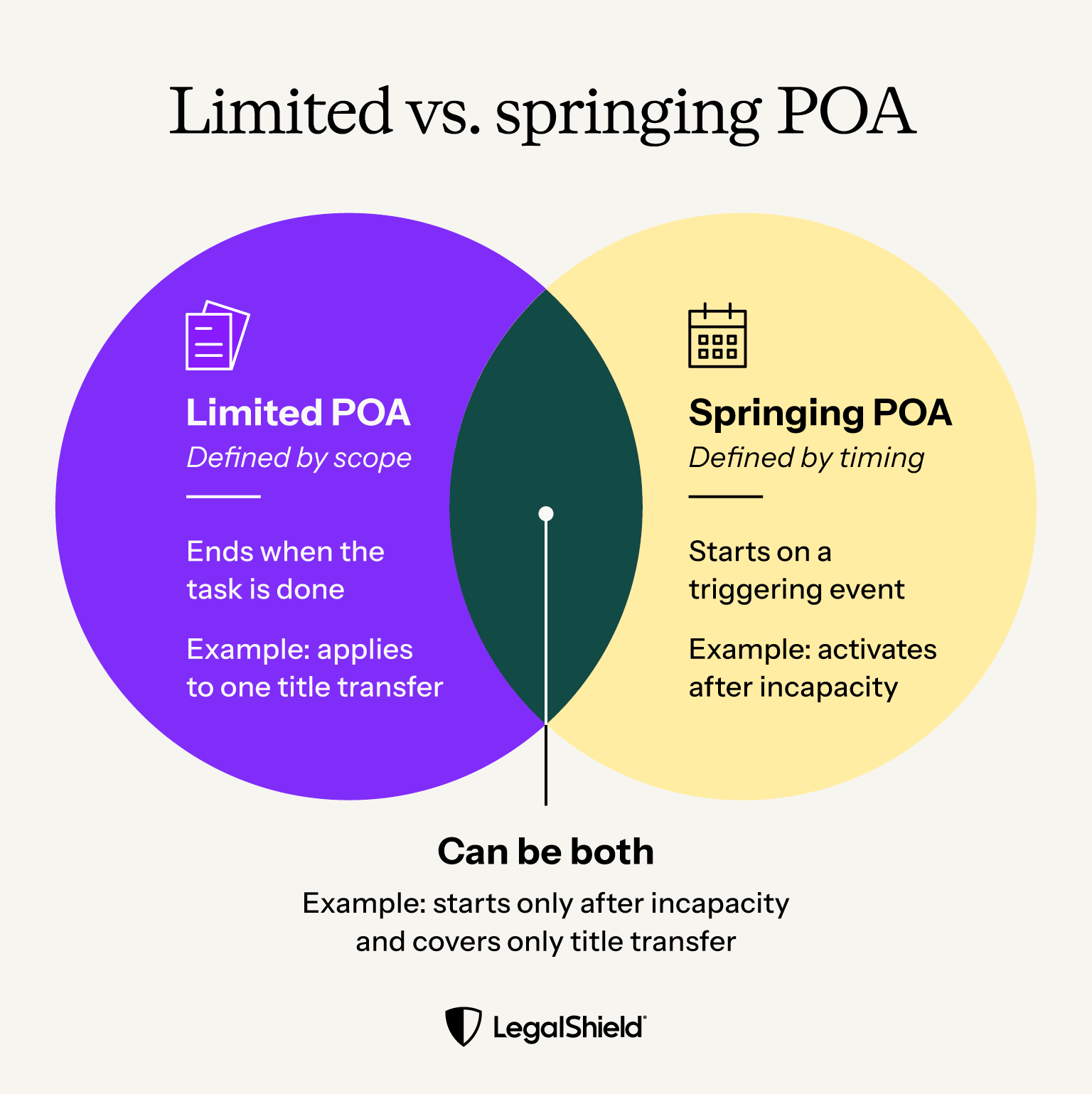
The limited POA is about scope. It gives the agent authority only for the specific task, transaction, or time period the document describes.
A springing power of attorney is more about timing. It “springs” into effect after something specific happens. That’s often when the principal becomes incapacitated.
There can be a bit of overlap here. A POA can be both limited and springing. For instance, the document might say the agent’s authority only starts after the principal becomes incapacitated (springing) and only applies to certain financial tasks (limited).
How do you make an LPOA?
Limited power of attorney forms are widely available online. But filling one out with no legal guidance can cause problems. Tiny wording issues can give the agent a level of authority that third parties like title companies and banks won’t accept.
In any case, here’s what the general process for making a limited power of attorney might look like:
Choosing your agent. This is your agent or attorney-in-fact. It’ll typically be someone you trust to handle the specific task you need handled.
Drafting the document. Any set of instructions on how to fill out a limited power of attorney form will tell you to name the principal and the agent and explain the powers being granted. Because there’s a lot more nuance than just naming parties, though, this is the part where legal guidance can be particularly helpful.
Setting the limits. Does the authority apply to one task? Is this a temporary power of attorney form? Drawing clear boundaries around the powers ensures that no one gets more power than you intend.
Signing and notarizing. Depending on the state, the document might need signatures, a witness or witnesses, and notarization. A lawyer can help you understand what your state requires, specifically.
A lawyer can narrow down what the document needs to say and how narrow the agent’s authority ought to be. But, of course, traditional lawyers can cost a lot.
Get advice on a limited power of attorney
A limited power of attorney can be useful, but the document needs to be clear. If it doesn’t specify the powers appropriately, the agent might be unable to exercise their granted power when the moment comes.
A lawyer’s review or preparation of your LPOA can reduce that risk. A LegalShield Personal Plan can connect members with a provider law firm that can give advice on POA documents. Depending on the plan and the legal issue at hand, a provider law firm might be able to review your LPOA, explain how it works, or prepare one for you.
Frequently Asked Questions
A regular power of attorney can give an agent broader authority to act for the principal. A limited power of attorney, on the other hand, gives the agent authority only for the time period or task(s) listed in the document.
Limited POAs can last until certain tasks are complete, until specific times, or until the principal revokes them. In other words, the “validity” of the limited POA can vary and depends entirely on what the document actually says.
You can create a limited POA, but a lawyer knows how to create one that reduces legal risk. Generally, you choose an agent, write out the exact powers you want them to have, and sign the document according to your state’s rules. Many people work with a lawyer because the wording needs to be extremely clear, and state requirements can vary.
The cost varies, but the average cost for a LPOA is $280. (Amount based on LegalShield Provider Law Firm average rates. Exact costs are determined by law firms.)
Factors that influence the cost of an LPOA include your state, the complexity of the document, and whether you use an online form, a lawyer, or lower-cost legal plan services.
Content Specialist at LegalShield, creating educational resources about legal and consumer protection topics. She focuses on making complex legal and financial concepts accessible to readers and has contributed to various educational articles on consumer rights and protections.
Yes, an HOA can foreclose on your house. If you fall behind on dues, it can put a lien on the house and, depending on your state, sell it, sometimes without a judge. Losing the house doesn't erase your mortgage, so you can still owe the bank. If you get a lien or foreclosure letter, call a lawyer that day.
We’ll provide more information about the trustors vs. trustees comparison, what to consider when filling these roles, and how they work together in Revocable and Irrevocable Trusts.
A power of attorney with springing powers is a legal document that grants someone else the authority to act on your behalf only after a specific event occurs.
There’s no rule that says a lawyer has to set up your Trust for it to be valid. However, Trusts are complex and doing it yourself without a lawyer's help comes with risks.
A Certificate of Trust proves your Trust is real and names who can act for it, while your beneficiaries and assets stay private. It lets your Trustee handle Trust business, like opening accounts or transferring property.
We’ll cover some of the most common scams, the red flags that give them away, how to protect yourself, and what to do if you’ve already been caught out.
An executor is responsible for ensuring your final wishes get carried out, so it’s important that you choose someone who is responsible and can bear the emotional burden.
An employer identification number is a nine-digit number the IRS uses to identify a taxpayer. The estate needs its own, and getting one is usually simpler than it sounds. Learn more about estate EINs.
•
5 min read
Author Name
,
Author Title
September 16, 2026
Thank you! You're subscribed!
Oops! Something went wrong while submitting the form.



.jpg)





.jpg)