There are many online marketplaces that allow people to buy and sell from one another. Unfortunately, they’re attractive for scammers because there are few protections, and some platforms are anonymous. Anyone can fall victim to a scam, whether you’re buying or selling. The best way to protect yourself is to stay up to date on common tricks and scams.
It’s important to act quickly if you suspect you’ve been in contact with a scammer and seek legal help for consumer issues.
We’ll cover some of the most common scams, the red flags that give them away, how to protect yourself, and what to do if you’ve already been caught out.
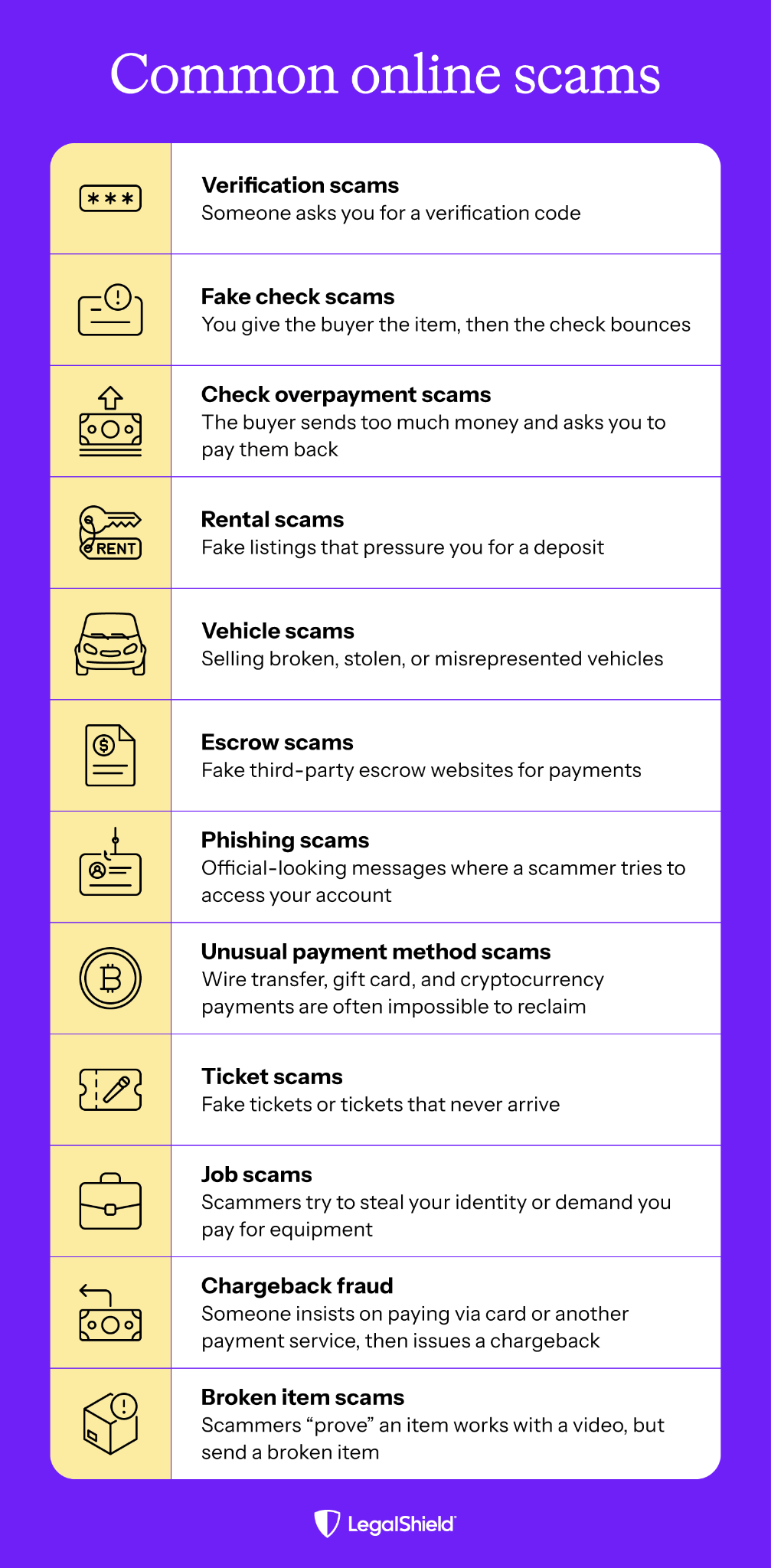
12 Common scams to watch for
Getting your money back from a scam can be difficult, but scammers typically reuse the same tricks. If you recognize the patterns, most are easy to spot before any money changes hands.
Keep some notes about the types of scams and their warning signs and read every message carefully.
1. Verification scams
A supposed buyer or seller asks you to verify that you’re real by sharing a code they just texted you. This is a psychological trick that puts you in a defensive position, making you feel you need to prove your authenticity.
That code is a login or account-verification code, and handing it over lets them hijack your phone number or accounts to scam other people.
If you lose access to your email, banking, or other accounts, you may be a victim of identity theft. If you’re an IDShield® Member, you can access emergency support to help limit the damage and begin recovering your identity.
2. Fake check scams
A scammer pays by check, which clears at first but bounces days later. By then, the item and the buyer are gone.
The problem is that while your bank might make the funds available in your account right away, they haven’t collected the money from the other party yet. This delay is what gets people in trouble, because they assume everything is fine. If the check is fake, then you end up responsible for the discrepancy.
3. Check overpayment scams
These scams involve fake checks, but also ask you to send money back. The buyer sends a check for more than your asking price, then asks you to refund the difference. After you send them the money back, the original check bounces. So instead of paying them back, you’ve sent them your own money, and the bank takes back the full amount of the original check.
4. Rental scams
A rental scam uses photos from a real listing and advertises it, but the scammer doesn’t own the property and doesn’t give you a real lease. They pressure you to send a deposit or first month's rent before you have seen the unit in person, then vanish once the money lands.
For example, someone might run an apartment scam on an online platform, going so far as to meet you and give you a key. When you try to move in, though, you won’t be able to access the building.
Tenants have legal rights, but these vary by state. Laws are complex, so a lawyer can help you understand your rights and responsibilities. With a LegalShield® Advanced or Premium Personal Plan, a provider law firm can help you review a lease to identify issues.
5. Vehicle scams
Vehicle listings attract scammers because the dollar amounts are high. The scammer might try to sell a broken or stolen vehicle, or misrepresent a vehicle by rolling back the odometer.
Similar to a rental scam, a scammer may use a photo from another listing and advertise it. The scammer may then ask you to pay a deposit to “hold” the vehicle until you can look at it. Once you send the money, the scammer and the listing disappear.
To help prevent getting scammed when you’re buying a vehicle, inspect it in person, confirm the title matches the seller's ID, and treat a rock-bottom price as a warning rather than a win. Don’t pay any money to hold a vehicle until you are sure it actually exists.
6. Escrow scams
If someone insists on using a specific "escrow service" to hold a payment, it might be time to take a step back. Scammers often build fake escrow sites to fraudulently collect funds and then disappear.
7. Phishing scams
Some scammers use phishing messages that look like official emails or texts from platforms or representatives. These communications ask you to click a link, download an attachment, or provide information like a login or code. Some try to rush you by claiming your account has already been flagged or taken over, hoping panic overrides caution.
8. Unusual payment method scams
Requests to pay by wire transfer, cryptocurrency, or gift card can be red flags. These methods are fast, nearly impossible to trace, and unlikely to be reversible once the money is gone. Legitimate buyers and sellers won’t likely need payment in gift cards.
9. Ticket scams
Event tickets are easy to fake and resell, which makes them a favorite for scammers. You pay for tickets that are counterfeit or never arrive, and the seller is gone by the time you realize.
It’s best to buy tickets from official channels to avoid the risk of getting scammed.
10. Job scams
Job and gig listings can be bait. These scammers often use a job as a facade for classic check or identity theft scams. A scammer offers work with unusually high pay. Then, they send you a check "to buy equipment" or overpay you and ask for some of the money back. They might press you for your Social Security number without using proper tax forms.
Fake job scams come in many forms, so if you’re looking for work, it’s good to examine listings closely for red flags. You can limit your risk by using dedicated job search platforms or using the company’s actual job board, but scams can appear anywhere.
11. Chargeback fraud
Chargeback fraud targets sellers who accept electronic payments. The buyer pays through an instant payment service or credit card, receives the item, and then disputes the charge. This lets them claw the money back while keeping what they bought.
Some payment services specify in the terms and conditions that you should not use them to transact with people you don’t know.
If you sell, understand that "paid" is not always final with reversible payment methods. It’s a good idea to keep records of your transactions and of the items themselves.
12. Broken item scams
Some scammers sell a real item that does not actually work. They send a video of it "working," then hand over something broken once you have paid.
In-person testing is the best way to protect against this, but particularly dedicated scammers might demo a defective unit just long enough to convince you. It’s important to stay alert and watch for all of the signs of scam behavior so you can avoid people who aren’t genuine.
Let’s look at a few of those common signs that you can use to identify scammers, even if you’re not sure what specific scam they’re trying to do.
Red flags that signal a scam
Scams often share the same warning signs. If a listing or conversation trips one or more of these, you might be at risk of falling victim. Before you commit to a transaction, check for red flags like these:
Prices are far below market value.
Urgent or pressuring language that creates an emotional response.
A reply within seconds of you listing an item for sale.
Requests codes or account information.
Requests for you to click links or download attachments.
Someone claiming to be a platform representative, a bank, a religious leader, or an official.
Checks and money orders are some of the easiest payment methods for scammers and fraudsters to use.
Asking to send movers to pick an item up is a common cover for overpayment and check scams.
Push to move off-platform into texts or emails.
Payment requested sight unseen.
Unusual payment methods like wire transfers, crypto, escrow websites, and gift cards.
Requests for personal or financial information like your SSN.
People who claim to be outside your local area or who refuse to meet in person.
Sloppy spelling and grammar.
How to avoid online shopping scams
Getting into a few good habits can help prevent you from falling victim to most scams.
Keep these best practices in mind, whether you’re buying or selling.
Deal locally and meet in person when dealing with used goods
Making transactions face-to-face is one of the best ways to avoid scams, but it’s important to consider your personal safety. Meet in a busy public place during the day, not at your home or a secluded spot, and bring someone with you. Many police stations now offer designated "safe exchange" zones for exactly this purpose.
“The most significant challenge to buying online is that, for most items purchased, the buyer does not have a good opportunity to inspect the product before buying it,” Daniel F. Mantzaris, a partner at LegalShield Provider Law Firm de Beaubien Knight Simmons Mantzaris & Neal LLP, pointed out.
“Therefore, if something is wrong with the item or the item is stolen, then the buyer is forced to try and seek a refund or replacement product after the fact, which can be extremely difficult, especially if the seller is in another state or out of the country.”
Use verified platforms with clear policies when buying from online sellers
Some platforms exist to facilitate transactions between independent businesses and their customers. When these platforms have clear terms of service, recognizable sellers, and dispute resolution processes, you’re less likely to be scammed.
Choose payment methods carefully
Cash, exchanged in person in a safe public place, is the standard for used goods and peer-to-peer sales. If you sell, it can be a good idea to take exact cash and not make change to avoid last-minute negotiations. When you’re buying, don’t give out information like credit card numbers.
Think carefully before you decide to accept electronic payments; it could result in chargeback fraud after the item is gone. Use caution whenever someone asks to buy with checks, wire transfers, gift cards, or cryptocurrency.
When you’re making purchases online, don’t give out your credit card information over messages, emails, or DMs. If you’re dealing with someone directly, consider a virtual credit card or payment app. On the other hand, if the platform offers a unified cart and payment system, feel free to pay with your preferred method.
Inspect before you pay
A great way to protect yourself as a buyer is to see the item in person and confirm it works before any money moves. For a rental or a vehicle, that means touring the unit or test-driving the car and checking that the paperwork matches the seller. If someone will not let you inspect first, that’s a red flag.
Understand risk factors
Scams commonly target people whom the scammer perceives to be vulnerable. People with disabilities, people in emotionally difficult situations, young people, and the elderly are common targets of scams.
Use in-platform communication methods
Keep your real phone number and email private by using the platform's built-in relay until you are confident the other party is legitimate. If a deal feels off at any point, it’s okay to end contact. A missed sale is cheaper than a scam.
What to do if you've been scammed
If a scam gets past you, act quickly. You might feel doubtful or embaressed, but don’t let that stop you from taking action. Fast reporting can limit damage and help others avoid the same trap, so follow these tips:
Stop responding to the scammer, even if you’re angry or tempted to try and get back at them. Protect yourself first.
If you shared financial information or sent a payment using a bank account or card, contact your bank or card issuer right away to see what can be stopped or reversed.
File a police report, which can help give you documentation for your bank or other claims.
If you need legal assistance and you’re a LegalShield Member, you can contact a provider law firm to talk through your options.
If you’re an IDShield Member and your identity was compromised, get in touch right away to figure out next steps.
Get legal advice when you need it with a LegalShield Personal Plan
It can be extremely difficult to recover money or items from a scam, which is why prevention is so important. But if you have issues with another person using an online platform, legal advice is a great place to start.
With a LegalShield Personal Plan, you can call a provider law firm to ask about topics like signed agreements, chargebacks, or misrepresented items. Even if you’re not in a crisis, having a lawyer look over a contract ahead of time is far easier than untangling a bad deal afterward.
Get steady legal guidance when you need it, whether you think you might have been scammed or want to learn about avoiding them. A LegalShield Personal Plan gives you consumer law support, plus assistance with other important things in your life, from estate planning to marriage.
Disclaimer: LegalShield® and IDShield® are registered trademarks of Prep-Paid Legal Services, Inc. (“LegalShield”). LegalShield provides access to legal services offered by a network of provider law firms to LegalShield members through membership-based participation. Neither LegalShield nor its officers, employees or sales associates directly or indirectly provide legal services, representation, or advice. IDShield provides access to identity theft services through membership-based participation. IDShield is a product of LegalShield. Some of the services provided under the plan by third party providers are subject to change without notice. All Licensed Private Investigators are licensed in the state of Oklahoma. The information made available in this blog is meant to provide general information and professional advice and is not intended to provide legal advice, render an opinion, or provide a recommendation as to a specific matter. The blog post is not a substitute for competent legal counsel from a licensed professional lawyer in the state or province where your legal issues exist, and you should seek legal counsel for your specific legal matter or professional advice. Information contained in the blog may be provided by authors who could be third-party paid contributors. All information by authors is accepted in good faith; however, LegalShield makes no representation or warranty of any kind, express or implied, regarding the accuracy, adequacy, validity, reliability, availability, or completeness of such information.
Frequently Asked Questions
Listings with below-market rent and photos that appear on other sites are tells that they might be rental scams. A landlord who wants a deposit before letting you see the place in person is also a potential red flag.
Car listings can be safe with the right precautions. Inspect and test-drive the vehicle in person, confirm the title matches the seller's ID, and be wary of a price well below market or pressure to pay before you have seen the car.
It’s best not to pay for an item you have not seen if you’re buying it used and the seller is anonymous. Don’t give away financial information like your credit card number.
When using platforms to sell items online, it’s best not to accept a check or an overpayment, ship an item before payment has fully cleared, or share personal or financial information. Take care not to meet buyers or sellers where they could find you again, such as at your home or in your neighborhood.
Content Specialist at LegalShield, creating educational resources about legal and consumer protection topics. She focuses on making complex legal and financial concepts accessible to readers and has contributed to various educational articles on consumer rights and protections.
We’ll provide more information about the trustors vs. trustees comparison, what to consider when filling these roles, and how they work together in Revocable and Irrevocable Trusts.
A power of attorney with springing powers is a legal document that grants someone else the authority to act on your behalf only after a specific event occurs.
There’s no rule that says a lawyer has to set up your Trust for it to be valid. However, Trusts are complex and doing it yourself without a lawyer's help comes with risks.
A Certificate of Trust proves your Trust is real and names who can act for it, while your beneficiaries and assets stay private. It lets your Trustee handle Trust business, like opening accounts or transferring property.
A limited power of attorney often comes in handy when you need help for a short time or for a single purpose. This legal document can help in situations like when you’re traveling, serving in the military, caring for an aging parent, or sending a child to study abroad.
An executor is responsible for ensuring your final wishes get carried out, so it’s important that you choose someone who is responsible and can bear the emotional burden.
An employer identification number is a nine-digit number the IRS uses to identify a taxpayer. The estate needs its own, and getting one is usually simpler than it sounds. Learn more about estate EINs.







.jpg)