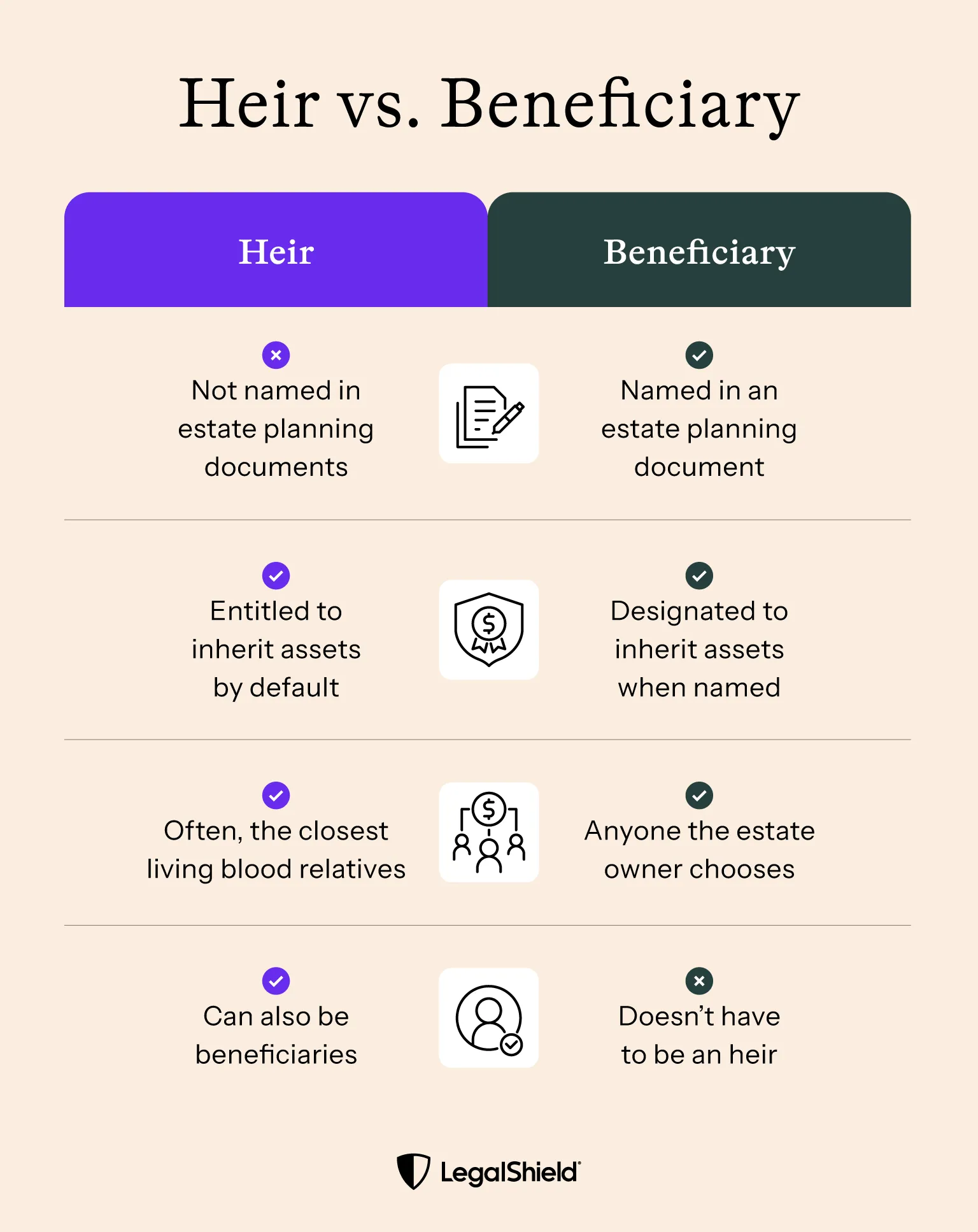
An heir is usually a family member who can inherit from someone’s estate under state law when there’s no valid Will. A beneficiary is a person or organization named in a Will, Trust, insurance policy, or retirement account to receive certain assets. An heir can also be a beneficiary.
The main difference is how the person gets the right to inherit assets from the deceased.
When you start hearing words like “heir,” “beneficiary,” and “intestacy” after a loved one dies, it can feel like an unimaginably difficult experience is getting piled on.
As tempting as it is to ignore all the legal jargon, these aren’t interchangeable terms, and they can matter a lot as you settle your loved one’s estate. The distinction between an heir and a beneficiary is particularly important because they may receive estate assets in different ways.
You don’t choose whether you’re an heir or a beneficiary. You simply are one and/or the other based on your relationship to the person you lost or how they named you in a legal document. Learning the details helps you fully understand the difference between a beneficiary and an heir and how it impacts you.
What is an heir?
An heir is a person who can inherit from someone’s estate under state law when that person dies without a valid Will. Dying without a valid Will is called “intestacy.” Each state has its own rules for who inherits what and in what order in these cases.
Heirs are often the deceased person’s closest relatives. A surviving spouse and children usually come first. Other family members, like parents or siblings, tend to follow. And stepchildren are not commonly treated like heirs unless the person who died legally adopted them.
Intestacy laws vary by state, though, so the precise order and share of an inheritance can depend on where the person was living when they passed.
LegalShield® Members can connect with a provider law firm for estate planning guidance. With your plan, you can have a Will, a Durable Power of Attorney, and a Living Will prepared at no additional cost.
Different types of heirs
There’s more than one type of heir to an estate. Which you are depends on state law and the family relationships involved.
Here are the main categories of heirs:
Heir apparent: A person who is first in line to inherit. They usually wouldn’t be displaced by another heir’s birth. Practically, this often means a surviving spouse or child.
Adoptive heir: A legally adopted child. For inheritance purposes, they’re usually treated the same as a biological child.
Presumptive heir: Based on the current facts, this person may inherit. But that could change based on circumstances. For example, this person might lose their place as a presumptive heir if a next-in-line close relative to the deceased party is identified or born.
Ascendant heir: These are ancestors — parents, grandparents, or other direct ancestors. In some cases, they may inherit if there’s no surviving spouse, child, or other direct descendant.
Collateral heir: Often siblings, nieces, nephews, aunts, uncles, and cousins. They’re blood relatives who aren’t in the direct line of descent.
What is a beneficiary?
A beneficiary is a person or organization named in a legal document to receive certain assets upon a person's death. That legal document could be a Will, a trust, a life insurance policy, a retirement account, or another estate planning document.
You can be both a beneficiary and an heir, but not all beneficiaries need to be heirs. Here’s a real-world example: Someone leaves a collection of prized watches to a close friend who’s also a watch collector. That friend isn’t an heir, but they’re still a beneficiary because the deceased named them to receive those watches. You can also have an heir who is not a beneficiary. While this is a question for the probate court, a Will, Trust or other designation could specifically exclude an heir as a beneficiary.
Beneficiaries don’t have to be individual people, either, although heirs typically are. Here's how Michael E. Fiffik, Esquire, a LegalShield Provider Lawyer with Fiffik Law Group, explains it: "In essence, all heirs can be beneficiaries, but not all beneficiaries are heirs. For example, a charity named in a Will would be a beneficiary but not an heir."
Heirs vs. beneficiaries: Who benefits first
In most cases, the beneficiaries named in a Will get assets before heirs who aren’t named. That concept is deceptively simple, though, because there are many details and steps between being an heir vs. a beneficiary and actually inheriting.
Fiffik frames the general rule this way: "If a decedent died and had a Will or a Trust governing disposition of their assets, the beneficiaries named in either the Will or Trust would take priority over someone who would be considered an heir under the laws of intestate succession."
Here’s a deeper look at that process:
How Wills work for heirs and beneficiaries
A Will can give clear instructions on who gets property after someone dies. But even with clear instructions, that Will may need to go through a court process called probate.
Through probate, the courts decide how to handle an estate, pay valid debts, and distribute what remains. The executor — a person designated to be in charge of the deceased’s estate — may have to pay creditor claims, funeral costs, and other estate expenses before beneficiaries can receive any money or property.
And in cases where the estate owes more than it owns, the named beneficiaries may get less than the Will states. But after the executor has handled debts and expenses and the court has given its approval, the executor can transfer money or property to the beneficiaries.
In that whole process, heirs who aren’t named in the Will may not be considered to receive the estate’s assets. That is, unless state law or a court decision gives them the right to something.
How Trusts work for heirs and beneficiaries
Like a Will, a Trust can also name beneficiaries. The key difference is that assets in a Trust don’t go through probate. Instead, a trustee (similar to an executor, but for a Trust) follows the terms the Trust lays out to distribute the assets.
These terms can be as specific as, “Child X gets X property and Child Y gets Y property” or as general as, “My children may use the money to pay for their education.”
Some Trusts give the trustee a little more power, too. The trustee might decide when and how to use the funds (within the scope of the Trust’s terms). For instance, the trustee could make payments specifically for a beneficiary’s education.
Fiffik points out that the timing of any payout can vary widely from one Trust to the next, as well. "A Trust might provide that a beneficiary's share of the Trust be held until the beneficiary reaches a certain age. They would not be paid until reaching that age, even if that date is years after the decedent's death."
Heirs may also be Trust beneficiaries, like they can be for Wills. But if the Trust doesn’t name the heir and the terms of the Trust don’t otherwise include that person, they may not receive Trust assets during administration.
When can omitted heirs be paid from an estate anyway
Non-beneficiary heirs in Wills and Trusts may still get something from an estate under certain circumstances. For example, here are some instances when an heir who is not specifically named as a beneficiary might get estate assets:
If the named beneficiary dies before the person who named them in the Will or Trust, the gift might go to someone else. The result here can depend on the wording of the document — particularly, whether it uses terms like per stirpes or per capita — and whether there is a contingent beneficiary.
If there’s an account with no valid beneficiary, it might get rolled into the estate. From that point, it could pass under the Will. In the absence of a Will, state intestacy laws would determine who gets it.
If a person acquires property or accounts after creating their Will or Trust, those assets may not be covered in those legal documents. Without a valid beneficiary designation on those assets, they could pass through a Will or state law, which could include an heir in some cases.
If an heir is accidentally omitted or is born after an estate plan is created. A well-drafted Will and Trust includes children/grandchildren post-estate plan formation by including special language.
Get a LegalShield® Membership today to get legal guidance before questions come up
The heir vs. beneficiary distinction affects who gets property, how those assets move, and whether family members will have questions or objections later.
A LegalShield Membership can help you connect with a provider law firm for legal guidance during stressful family situations. With your plan, you can get answers about estate documents, beneficiaries, or family disputes after a loved one’s death.
Learn more about a LegalShield Personal Plan and how a membership can help you better understand the complexities of estate planning.
Frequently Asked Questions
In many cases, a beneficiary does come before an heir. If someone is named as a beneficiary in a valid Will, Trust or in a beneficiary designation, that beneficiary may receive the asset rather than an unnamed heir.
Without a valid Will, state intestacy laws determine who is first in line for inheritance. Often, this will be a surviving spouse or children. Without a spouse or child, other common inheritors are parents, siblings, and other relatives.
Communications Director at LegalShield overseeing content creation designed to make legal protection simple and approachable. He focuses on offering straightforward, trustworthy guidance that empowers people to make informed decisions about their legal rights and responsibilities.
We’ll provide more information about the trustors vs. trustees comparison, what to consider when filling these roles, and how they work together in Revocable and Irrevocable Trusts.
A power of attorney with springing powers is a legal document that grants someone else the authority to act on your behalf only after a specific event occurs.
There’s no rule that says a lawyer has to set up your Trust for it to be valid. However, Trusts are complex and doing it yourself without a lawyer's help comes with risks.
A Certificate of Trust proves your Trust is real and names who can act for it, while your beneficiaries and assets stay private. It lets your Trustee handle Trust business, like opening accounts or transferring property.
A limited power of attorney often comes in handy when you need help for a short time or for a single purpose. This legal document can help in situations like when you’re traveling, serving in the military, caring for an aging parent, or sending a child to study abroad.
We’ll cover some of the most common scams, the red flags that give them away, how to protect yourself, and what to do if you’ve already been caught out.
An executor is responsible for ensuring your final wishes get carried out, so it’s important that you choose someone who is responsible and can bear the emotional burden.
An employer identification number is a nine-digit number the IRS uses to identify a taxpayer. The estate needs its own, and getting one is usually simpler than it sounds. Learn more about estate EINs.
•
5 min read
Thank you! You're subscribed!
Oops! Something went wrong while submitting the form.







.jpg)