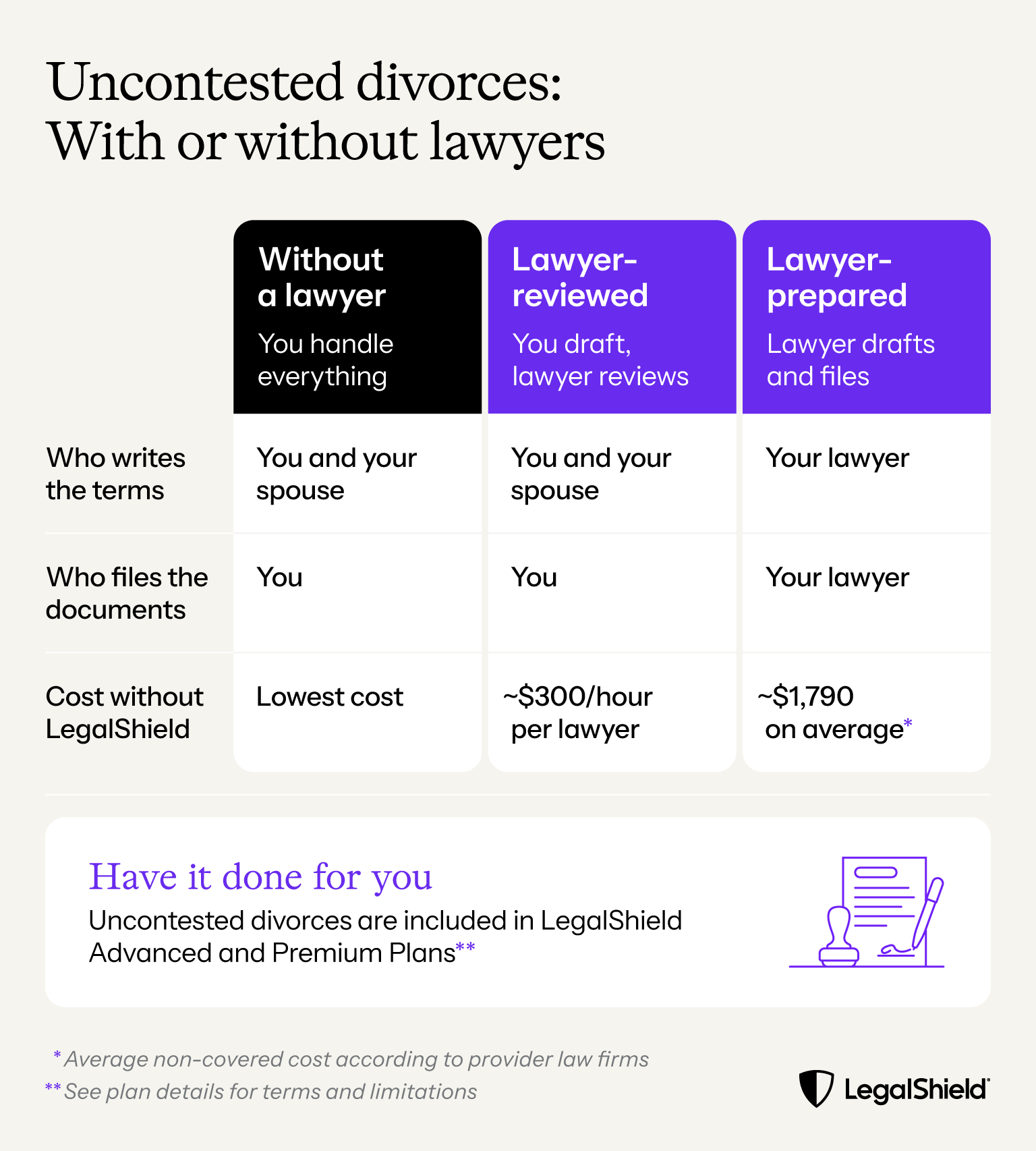
An uncontested divorce means that you and your spouse agree on all of the terms. You submit documents that you’ve both signed to the court, and a judge reviews them. These may be much faster and less expensive than contested divorces.
Sometimes you need to fight for your rights in a divorce. But sometimes, you’d rather reach an agreement and part ways quickly than drag out the painful end of a relationship. While getting a divorce is almost never fun, an amicable parting of ways is usually the least complicated way to do it.
If you’re both focused on moving forward, and you don’t have disagreements about how your lives should be separated, an uncontested divorce could be the right choice.
Even if the process is relatively amicable, it’s a good idea to talk to a lawyer because decisions you make now about custody and finances can affect the rest of your life. If you need professional advice about uncontested divorces, LegalShield® Provider Law Firms can offer guidance.
First, we’ll talk about the requirements for uncontested divorces to help you understand whether you can use this process.
The potential requirements for an uncontested divorce
Uncontested means that there are no issues on which you disagree. You need to resolve the divorce terms amongst yourselves and reach a mutual agreement that you both sign.
Requirements vary by state, but they commonly include these important details:
Residency requirements
Serving papers
Waiting periods
Total agreement on all matters
A parenting plan
Uncontested vs. contested divorce: What’s the difference?
In an uncontested divorce (sometimes called a no contest divorce), you make the decisions between you. Unless there’s a paperwork issue or a judge thinks the agreements are unfair, the judge may approve the divorce without the need for you to appear in court.
If there are aspects of your separation that you can’t come to terms on, like alimony, then you’ll have to use a contested divorce process. You each make your arguments, but the court makes the final decision.
When a divorce becomes contested, it will likely require hearings, extended legal representation for each party, or even a trial. Contested divorces can cost tens of thousands of dollars, and potentially more if there’s a lot at stake.
What the uncontested divorce process can look like
Uncontested divorces may be easier and less expensive than contested proceedings, but you must meet specific requirements to qualify for one.
Mutually agreeing with your spouse
Before you start filing for an uncontested divorce, the primary requirement is that you both agree on each issue. Any later disagreements could force you to use a contested process.
Many couples sort out the terms informally and then create a contract. If you have differing opinions, then you could hire a mediator at this stage to help create an agreement. This is a great way to ensure you’ve thought of everything and discussed everything before it’s time to file.
This part can take as long as you need it to. Some couples choose to get a legal separation before a divorce. This gives you time to think and come to terms without the pressure of living in close proximity.
Understanding your state’s requirements
Divorce requirements vary by state law, so the rules that apply to you depend on where you file. Different states may have different residency requirements and other specific rules, such as filing parenting plans.
Check your state court's self-help pages to learn about the process, fees, and forms.
Creating the paperwork
You’ve agreed and checked what forms the state you’re filing in requires. Before you file for divorce, you need to create the official agreements that describe how you both want to distribute assets and debts, as well as plans for custody if you have children.
The language you use is important when you file forms with a court, and so is ensuring that you’re compliant with state laws. If you need help, a LegalShield® Provider Law Firm can prepare the forms for you. The Advanced and Premium plan tiers cover uncontested divorces after a 180-day waiting period.
Filing a petition and serving papers
Even if you both agree completely, one of you needs to begin the process and serve the other with papers. Then the person served must officially respond.
When you’re ready, you’ll file a petition with the court first. After that, you serve papers to the other person.
Serving papers sounds adversarial and might conjure images of a sheriff knocking on your door. That’s because this process, formally called “service of process,” can’t be done by the person initiating an action. It has to be a third party, who is often part of a professional service or a sheriff.
In an uncontested situation, you could ask a friend to do the service, as long as they’re over 18 and not related to either of you. You might have the option to perform service online with the court.
Signing an agreement
The other spouse then signs paperwork confirming they are not contesting anything. The forms and their names differ from state to state.
Once the papers are served and accepted, the uncontested divorce goes into the court system, and you wait for a judge to review your case.
5 things to consider about uncontested divorces vs. contested divorces
Some issues may not be worth contesting given the financial and emotional toll and the time involved. It could be worth taking extra time or hiring a mediator before starting a divorce to ensure all your ducks are in a row.
A LegalShield Provider Lawyer can advise you on resolving issues before filing so that you can proceed with an uncontested divorce.
On the other hand, some issues may force you to consider a contested process. These decisions affect your life long-term, so it’s important that the final agreement is clearly written and fair.
Weigh these elements when you’re considering whether to contest a divorce:
1. Your relationship with your spouse
Coming to an agreement that you both sign is the most important part of an uncontested divorce. There are ways you can do this without being in the same room, such as using a mediator or communicating electronically. But a good-faith agreement is the baseline.
If you don’t think you’ll be able to come to an agreement, or if the other party is not negotiating reasonably, you may want to speak with a lawyer about contested divorce processes.
2. Privacy
A contested case puts your disagreements in front of a judge. You might have to detail private, potentially embarrassing parts of your life. This could be quite painful to go through in a public court process.
On the other hand, it might be necessary to reveal private information in order to reach a fair agreement. Only you can decide whether it’s worth it.
3. Time and emotional strain
Divorces put strain on you, your finances, and your other relationships, but the pain of a contested divorce can make the stress much worse. It also takes much longer, which can make it difficult to move on with your life.
There’s value in reaching an agreement so that you can move forward with an uncontested divorce.
It’s not possible to predict how long divorces take, in general, according to Rebecca A. Carter, a LegalShield Provider Lawyer with Friedman, Framme & Thrush, P.A. She says, “it is impacted by many factors, including the court itself.”
Uncontested divorces usually take less time than contested ones, but it depends on waiting periods and whether the court has delays.
4. Expense
Speaking of value, contested divorces can be expensive. If there are many complex issues, there’s really no upper limit on how much it could cost.
On the other hand, an uncontested divorce costs approximately $1,790, according to a survey of average non-plan rates from LegalShield Provider Law Firms. And if you’re a LegalShield Member at the Advanced or Premium tier, an uncontested divorce is included in your plan without the additional fee after a 180-day waiting period.
5. Child custody
Child custody is often the most contentious issue in a divorce. Custody agreements are difficult to change, so it’s important to consider what childcare will look like years into the future.
Courts often expect to see a formal parenting plan and child support computation in addition to child custody and other child-specific obligations. If you have doubts about your ability to come to an agreement that is fair for both you and your children, that might make an uncontested divorce difficult.
Get help choosing a direction with a LegalShield Membership
If you both come to the table with good intentions, uncontested divorces could save months of work and a lot of money. On the other hand, a desire to avoid conflict or get it over with might not be in your best interests. That’s why it’s important to get legal advice. A lawyer can help you decide whether you’re being treated fairly and prepare for divorce.
If you both choose an uncontested divorce, a LegalShield Provider Law Firm can create the paperwork for you and help you through the process after a waiting period as part of an Advanced or Premium LegalShield Personal Plan. Getting legal assistance helps you move through this part of your life with more confidence, so you can start thinking about the future.
Get help choosing a direction with a LegalShield Membership
If you both come to the table with good intentions, uncontested divorces could save months of work and a lot of money. On the other hand, a desire to avoid conflict or get it over with might not be in your best interests. That’s why it’s important to get legal advice. A lawyer can help you decide whether you’re being treated fairly and prepare for divorce.
If you both choose an uncontested divorce, a LegalShield Provider Law Firm can create the paperwork for you and help you through the process after a waiting period as part of an Advanced or Premium LegalShield Personal Plan. Getting legal assistance helps you move through this part of your life with more confidence, so you can start thinking about the future.
Frequently Asked Questions
A prenuptial agreement and an uncontested divorce can work together because a prenup proactively settles many of the issues that may otherwise turn into disputes, but both of you must still agree to the terms of the divorce when it is filed.
Yes, many states allow you to represent yourself and get an uncontested divorce without a lawyer. However, each state is different, and it’s a good idea to get a lawyer’s help to ensure you’re submitting correct, complete forms.
Content Specialist at LegalShield, creating educational resources about legal and consumer protection topics. She focuses on making complex legal and financial concepts accessible to readers and has contributed to various educational articles on consumer rights and protections.
En Estados Unidos, un divorcio sin oposición generalmente cuesta al menos $1,500, mientras que un divorcio con oposición puede empezar en $5,000 y superar los $20,000 en casos complejos. El costo total depende de los honorarios de abogados, los costos judiciales y el nivel de conflicto entre los cónyuges.
Decidir tramitar el divorcio ya es bastante difícil sin tener que preguntarte si estás llenando el formulario correcto. Cada estado maneja el proceso de manera un poco distinta, y es normal sentir dudas acerca de dónde empezar. Reunimos información sobre lo que puede suceder durante el trámite, incluyendo perspectivas de una abogada de verdad, para darte más claridad en este camino.
La mayoría de nosotros sabemos que deberíamos tener un testamento. Simplemente seguimos encontrando razones para posponerlo. Si eso te suena familiar, no estás solo/a. Sigue leyendo para aprender qué puedes hacer al respecto.
Prepararse para un divorcio implica reunir documentos financieros y personales, hacer un presupuesto de tus gastos mensuales, asegurar tus cuentas digitales e inventariar tus bienes. También es importante decidir qué tipo de divorcio se adapta a tu situación y consultar con un abogado antes de presentar la petición para proteger tus derechos.
¿Necesitas un poder notarial pero te preocupa el costo? Es natural preocuparse por pagar servicios legales, pero es importante no quedarse atrapado/a en dólares y centavos. Después de todo, no le puedes poner precio a la tranquilidad, y eso es exactamente lo que ofrece un poder notarial.
Ya sea que te estés casando, pasando por un divorcio o simplemente estés listo para un nuevo comienzo, cambiar tu nombre es un gran paso. Puede ser un proceso sorprendentemente difícil, y las tarifas varían mucho.
Planificar el futuro de tu familia toma tiempo y reflexión. Una herramienta que puede ayudar es el fideicomiso familiar: un arreglo legal que te permite decidir cómo se administra y se comparte tu propiedad con las personas que te importan.
A veces la gente tiene reacciones emocionales fuertes a la palabra "prenupcial" porque sienten que su pareja no confía en ellos. Pero un contrato prenupcial trata de establecer confianza y justicia. Puede ser una forma prudente y cariñosa de comenzar un matrimonio. Un contrato prenupcial es una manera en que dos personas resuelven cómo manejarán el dinero y los bienes antes de decir "acepto".
•
10 min read
Thank you! You're subscribed!
Oops! Something went wrong while submitting the form.