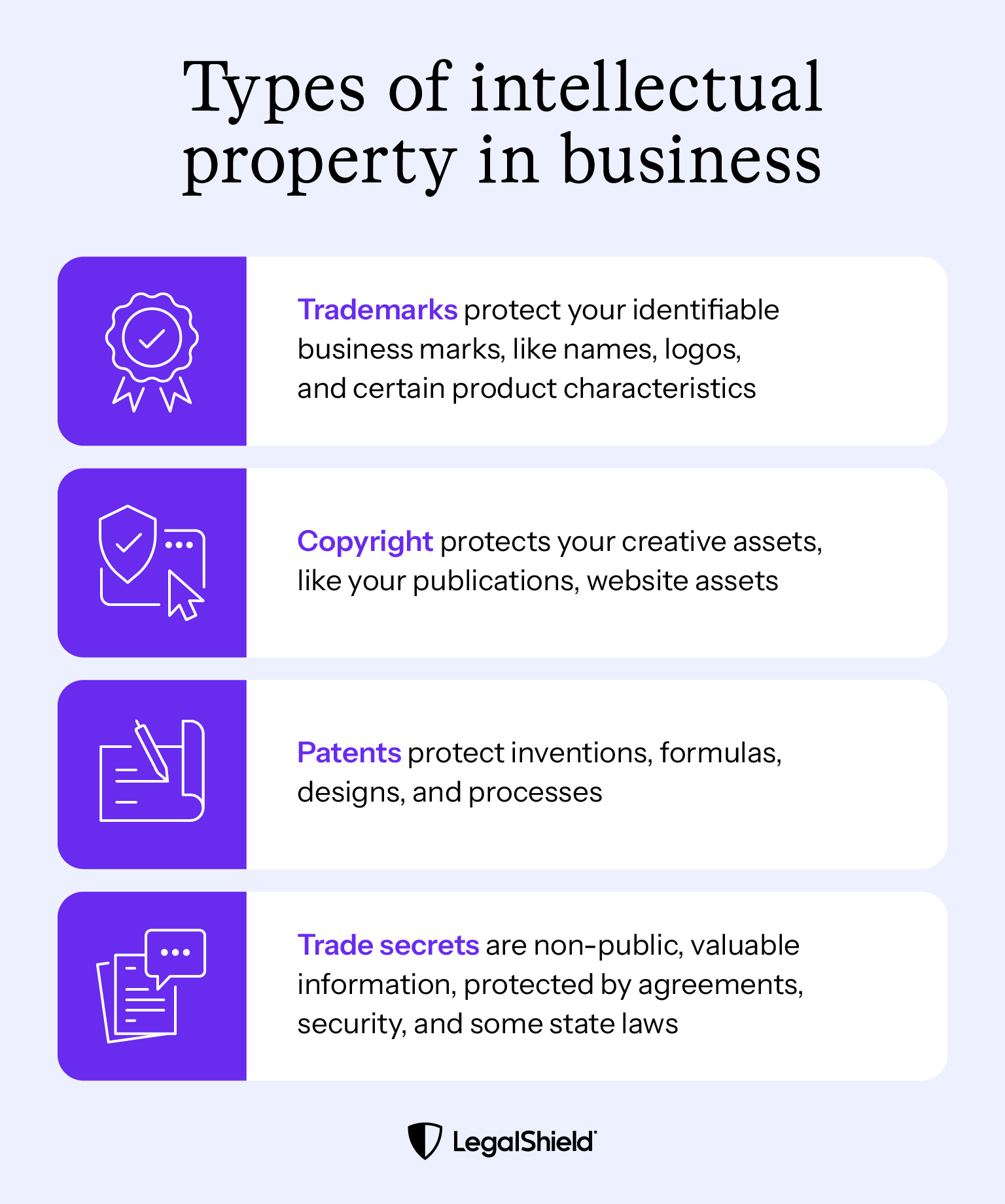
Trademarks, copyrights, and patents are different ways to protect intellectual property. Trademarks protect brand elements, copyrights protect original works, and patents protect inventions.
When you start a business, its name, logo, slogan, and more are all part of the brand. When you don’t protect these elements, you risk losing your identity or creations to competitors. Trademarks, copyrights, and patents are legal tools that can help businesses safeguard their intellectual property (IP).
A LegalShield® Small Business Plan gives you access to a provider law firm that can help with your business, and with the Preferred and Premium plans, discuss intellectual property. You get affordable legal guidance, including consultations on business legal issues and help reviewing documents.
Read more about the different ways businesses protect IP, the similarities between them, and what can happen when violations occur.
The key differences between registered trademarks, copyright filings, and granted patents
```html
Trademarks
Copyrights
Patents
What's typically covered
A word, phrase, or design (like a logo) that identifies your business, goods, or services
Artistic, literary, or intellectually created works
Technical inventions, formulas, mechanical processes, designs, and plants
Duration of protection
Indefinitely, as long as a business is actively using the trademark in commerce and files maintenance documents when required
Fees are due if trademarks are filed as "intent to use". $125–$325 per class
Currently, no ongoing expenses
Fees are due during examination, issuance, and maintenance for years 3.5, 7.5 and 11.5.
Enforcement complexity
Often requires legal action, including filing a civil lawsuit in court or with the USPTO Trademark Trial and Appeal Board
Option to file a claim with the Copyright Claims Board (CCB), but may need to file a lawsuit in federal court
Often requires legal action, including filing a lawsuit in court or with the Patent Trial and Appeal Board
```
Trademarks, copyrights, and patents are all ways to protect a business’s intellectual property rights. The main difference is what type of IP they protect — brand elements, creative works, or inventions.
The amount of time each lasts is another difference, and so is the cost to apply with the U.S. Patent and Trademark Office (USPTO). Businesses and individuals may need to take further steps to keep these protections active. Additionally, costs can go up based on factors such as an application's completeness and complexity.
A LegalShield Preferred or Premium Plan allows you to have limited consultations about filing for IP protections by provider lawyers. With a LegalShield Small Business Legal Plan, you pay a fraction of the typical law firm hourly rates.
What is a trademark?
A trademark can protect a business’s brand elements. They cover words, designs, and phrases. Trademarking a business name or brand is common. So is trademarking a logo. But in general, businesses can apply for a trademark for almost any symbol tied directly to their brand, including:
Specific product names
Mascots
Slogans and catchphrases
Signature sounds, scents, and colors (these are subtypes of trademarks known as trade dress)
For example, Target has trademarked its name, bullseye logo, and the phrase “retail department store services." And Coca-Cola has registered its logo in multiple formats, as well as the shape of its bottles.
With a LegalShield Small Business Preferred or Premium Plan, you can get limited consultation from provider lawyers on ways to check if your business name is taken. You can also get a small business health check. Plan options start at around $2/day.
Trademark vs. copyright: The biggest difference is that a trademark protects brand elements, while a copyright protects original creative works. The purpose of a trademark is to prevent confusion between products and services on the market. The purpose of a copyright is to prevent someone from stealing someone else’s work.
To be able to seek a copyright, the work needs to be fixed in a tangible medium. That’s a lot of words that basically mean it must be permanently recorded in some type of physical format. For example, you can copyright a painting done on paper or canvas, but you can’t copyright the idea for a painting.
A LegalShield Provider Law Firm also offers help with other business protections, including employment and independent contractor agreements.
Patent vs. copyright: The biggest difference is that copyrights protect creative works, while patents protect functional inventions. Patents give creators the exclusive right to make, use, or sell what they invent.
What is a patent?
A patent gives a business or a person the government-granted right to an invention. This right allows the owner or assignee to exclusively make, use, offer, or sell the patented invention. There are three types of patents:
Utility: For processes, machines, manufactured items, and chemical compounds and mixtures
Design: For designs for manufactured items
Plant: For new varieties of plants
To get a patent, an application is made to the United States Patent and Trademark Office (USPTO). You’ll need to show the USPTO that your invention is new, that it works, and that it is “not-obvious,” i.e., related to something that’s already invented. In exchange for the rights, you’ll also have to disclose the details of the invention to the public.
Patent vs. trademark: The biggest difference is that patents protect inventions, while trademarks protect brand elements. For example, if your business invents a new type of plastic, you could patent the formula, but you can’t patent the name. To protect that, you’d need a trademark.
Why businesses need an intellectual property strategy
Businesses often have much more than a brand name to protect, and yours may acquire many types of IP as it grows. This may include everything from product names and label designs to photos and blog copy on your website. And questions can come up during discussions about licensing, marketing, or working with freelancers and consultants.
Using a trademark, copyright, or patent is one way to help keep your intellectual property safe. It can also help prepare your business for what's ahead.
Businesses may also need to seek IP protections when working with freelancers. Doing so can help clarify which IP belongs to the business and which might belong to the creator. This can help businesses avoid legal battles over these rights.
Getting legal guidance can help you take the proper steps to put these protections in place.
Trade secrets
Trade secrets are valuable, confidential pieces of information that a business keeps private. Trade secrets can be inventions, but they can also be things like processes, financial information, and strategy. Trademarks and Patents are public-facing and, if filed with the USPTO, publicly available.
However, trade secrets are often part of an overall IP strategy that usually involves choosing privacy vs. exclusive rights.
Enforcement plans
Having IP protections doesn’t necessarily mean you won’t have problems with infringement. What trademarks, copyrights, and patents do is help businesses be prepared to enforce their intellectual property rights
Say you want to open a restaurant. You’ll probably choose a name and have a sign made. You may print menus with your logo or the names of special dishes. You decide to apply for trademarks to protect your brand assets and product names.
Imagine you then find out six months later that there is another restaurant two towns over with the same name and signature menu items. If you have trademarks on your brand elements, you’ll have legal options. If you don’t, it can be harder to respond.
Get advice on intellectual property with a LegalShield Small Business Preferred or Premium Plan
A name, logo, or catchphrase can seem so much a part of a business that you’d never imagine it could be at risk. But without trademarks, copyrights, and patents, IP could be open to infringement, or you could accidentally infringe on someone else. Both could cost a business and lead to legal action.
A LegalShield Small Business Plan gives you legal help when starting a business and growing your company. With a LegalShield Small Business Preferred or Premium Plan, provider lawyers can answer questions about IP strategy, review business documents, and consult on an unlimited number of other business matters.
Get legal guidance for an affordable monthly fee with a LegalShield Membership.
Adding a LegalShield Business Plan Plus Supplement gives you expanded business consultations so you can discuss your IP protection strategy with a provider law firm.
LegalShield® is a trademark of Pre-Paid Legal Services, Inc. (“LegalShield”). LegalShield provides access to legal services offered by a network of provider law firms to LegalShield members through membership-based participation. Neither LegalShield nor its officers, employees or sales associates directly or indirectly provide legal services, representation, or advice. Small Business Legal Plans and certain benefits are not available in all states. See a Small Business Legal Plan contract for a specific state for complete terms, coverage, amounts, and conditions. The information made available in this blog is meant to provide general information and is not intended to provide legal advice, render an opinion, or provide a recommendation as to a specific matter. The blog post is not a substitute for competent legal counsel from a licensed professional lawyer in the state or province where your legal issues exist, and you should seek legal counsel for your specific legal matter. Information contained in the blog may be provided by authors who could be a third-party paid contributor. All information by authors is accepted in good faith, however, LegalShield makes no representation or warranty of any kind, express or implied, regarding the accuracy, adequacy, validity, reliability, availability, or completeness of such information
Content Specialist at LegalShield, creating educational resources about legal and consumer protection topics. She focuses on making complex legal and financial concepts accessible to readers and has contributed to various educational articles on consumer rights and protections.
En Estados Unidos, un divorcio sin oposición generalmente cuesta al menos $1,500, mientras que un divorcio con oposición puede empezar en $5,000 y superar los $20,000 en casos complejos. El costo total depende de los honorarios de abogados, los costos judiciales y el nivel de conflicto entre los cónyuges.
Decidir tramitar el divorcio ya es bastante difícil sin tener que preguntarte si estás llenando el formulario correcto. Cada estado maneja el proceso de manera un poco distinta, y es normal sentir dudas acerca de dónde empezar. Reunimos información sobre lo que puede suceder durante el trámite, incluyendo perspectivas de una abogada de verdad, para darte más claridad en este camino.
La mayoría de nosotros sabemos que deberíamos tener un testamento. Simplemente seguimos encontrando razones para posponerlo. Si eso te suena familiar, no estás solo/a. Sigue leyendo para aprender qué puedes hacer al respecto.
Prepararse para un divorcio implica reunir documentos financieros y personales, hacer un presupuesto de tus gastos mensuales, asegurar tus cuentas digitales e inventariar tus bienes. También es importante decidir qué tipo de divorcio se adapta a tu situación y consultar con un abogado antes de presentar la petición para proteger tus derechos.
¿Necesitas un poder notarial pero te preocupa el costo? Es natural preocuparse por pagar servicios legales, pero es importante no quedarse atrapado/a en dólares y centavos. Después de todo, no le puedes poner precio a la tranquilidad, y eso es exactamente lo que ofrece un poder notarial.
Ya sea que te estés casando, pasando por un divorcio o simplemente estés listo para un nuevo comienzo, cambiar tu nombre es un gran paso. Puede ser un proceso sorprendentemente difícil, y las tarifas varían mucho.
Planificar el futuro de tu familia toma tiempo y reflexión. Una herramienta que puede ayudar es el fideicomiso familiar: un arreglo legal que te permite decidir cómo se administra y se comparte tu propiedad con las personas que te importan.
A veces la gente tiene reacciones emocionales fuertes a la palabra "prenupcial" porque sienten que su pareja no confía en ellos. Pero un contrato prenupcial trata de establecer confianza y justicia. Puede ser una forma prudente y cariñosa de comenzar un matrimonio. Un contrato prenupcial es una manera en que dos personas resuelven cómo manejarán el dinero y los bienes antes de decir "acepto".
•
10 min read
Thank you! You're subscribed!
Oops! Something went wrong while submitting the form.