New businesses can’t use a name that already belongs to someone else in their state or one protected by a federal trademark. A quick business name search first helps you avoid legal trouble and expensive rebranding later. It’s worth the effort.
Starting a new business is exciting. Choosing the perfect name plays a big role in helping your business stand out and building a solid brand identity. But what should you do if someone else has already claimed the name you want to register in your state? Or what if the name is already federally trademarked?
Before you start ordering business cards or designing your logo, you need to find out if the business name you want to use is actually available. Changing your name later can cost money, confuse customers, and hurt your credibility. We’re here to help you learn how to check if a business name is taken.
Why you must verify your business name availability
Trying to use an unavailable business name can land you in unexpected trouble. The name’s owner could file a trademark infringement claim. You might have to stop using the name and even pay damages. Legal expenses or forced rebranding costs can put a huge strain on your finances. And as a result of all these headaches, your new business’s reputation could suffer.
Verifying your name is also important for your company’s long-term growth. A unique name helps customers find you online, improves search engine visibility, and makes it easier for people to recognize your brand. That helps you form a stronger connection with your target audience.
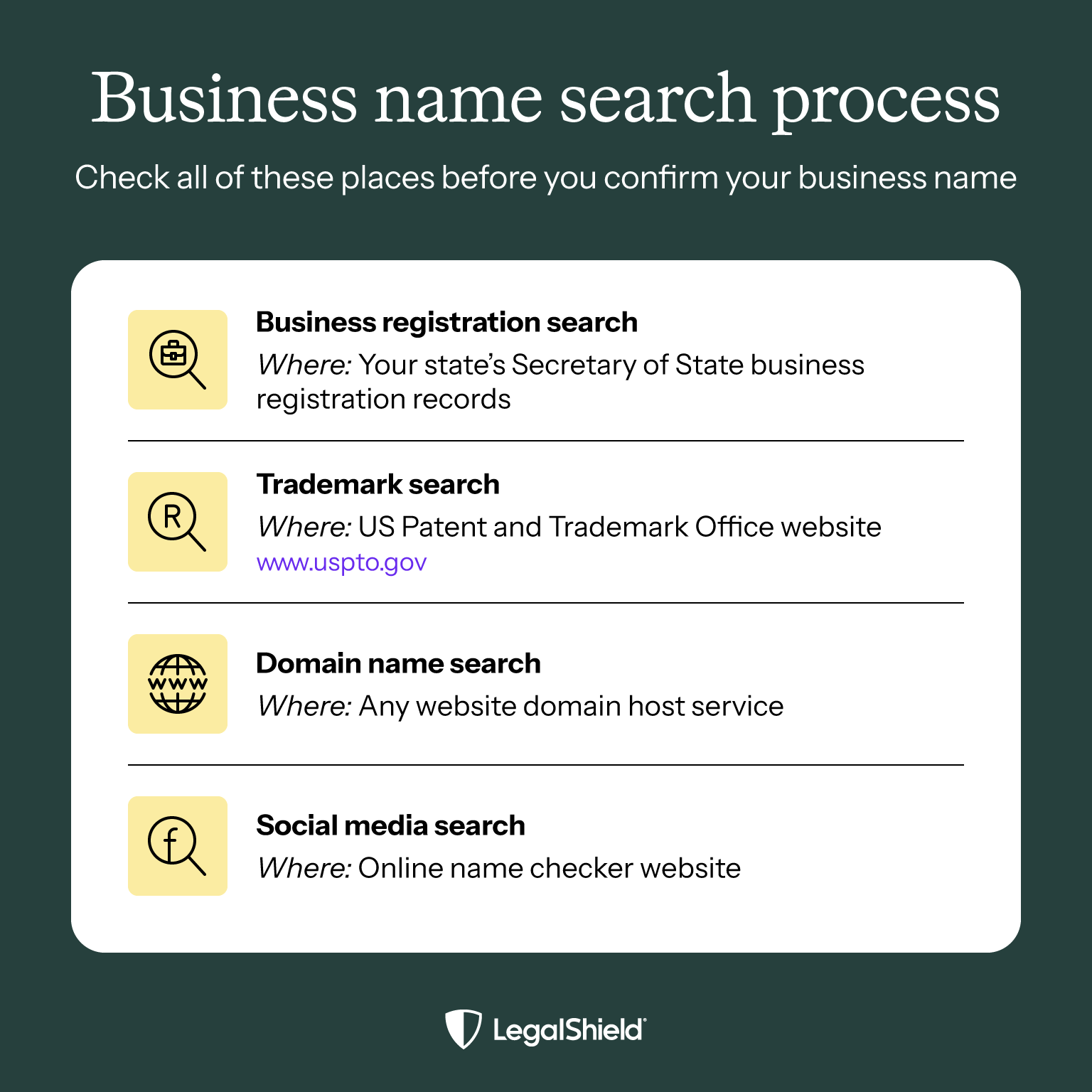
To verify and fully protect your business name, you need to search in three areas.
State business entity records
Federal trademark databases
Website domain names and social media handles
Let’s find out how to do that.
How to search state business entity records
Look for the government agency in your state that handles business registrations. In most cases, that’s the Secretary of State.
Then, find the business search or entity search tool. The search results will show companies in the state with identical or similar names. If you get results, you’ll probably need to try another name.
You might think that a variation on your chosen name will be fine, but that’s not always the case. States use strict standards when reviewing business names. Small changes, like adding punctuation, numbers, or switching one word, usually don’t work.
Please keep in mind that while you may not see anything problematic in your search, the state may reject your name based on other criteria related to your name, such as using derogatory or misleading terms. Also, someone may be filing a similar name at the same time as you are, so it would not show during the search.
If you want to be sure whether your name would be accepted by the state, you can file a name reservation. There is a small fee, and the name will be reserved for your use for a specific timeframe set by the state, or until you form your business, whichever occurs first.
Even if a name is available in your state, you still need to check the federal trademark database. State name availability doesn’t give you trademark rights or national protection.
How to use the USPTO federal trademark database
The U.S. Patent and Trademark Office (USPTO) protects names, logos, and brands at the national level. A federal trademark can help you protect a business name better than just a state formation or state trademark registration.
Follow these steps to check if a business name is trademarked using the Trademark search tool:
Read the details to find out each result’s usage and status
The USPTO considers the likelihood of confusion when it reviews trademarks. That means your business name can’t sound or look similar to a trademarked name in a related field. You may see some names marked as dead. They don’t have protection but they still might be used in commerce and you will have to decide if you want to risk the confusion with your own brand. You may also notice a trademark application that is pending. If the trademark is really similar to your business name and industry, you may want to discuss this with a lawyer to consider your options.
After your name is approved during the filing of your Articles of Organization or Articles of Incorporation, you may want to consider filing a trademark application. You may also be able to trademark your logo or key marketing phrases. A successful trademark registration gives you certain rights to keep others from using it, especially if it creates confusion in the same industry or market as your business.
How to check domain availability and social media handles
In today’s market, businesses need a website and social media accounts. A strong online presence matters. Using the same name across all marketing channels builds trust and brand recognition. It makes it easier for customers to find you, no matter which platform they’re using. And, it helps create a professional image for your company.
First, find out if the .com domain is available. There are various domain registrar search tools to choose from. Another step is to check social media for your business name. Additional resources can be found online to search for names across several sites at once.
How to check business names in each state
We’ve made it easy for you to search state databases for your business name. Find your state, click the link, and follow the instructions.
LegalShield® Memberships can help with lots of business startup concerns
Making sure that the business name you want to use is available is incredibly important. It can save you time, money, and frustration. Be sure to check your state’s database, the USPTO database, website domains, and social media handles.
Your business name isn’t the only thing you need to do right. In fact, it’s probably a good idea to get legal help for your business startup concerns. That way, you could avoid costly mistakes.
LegalShield Business Plans start from $39.95 per month. Get access to a provider lawyer in your state for advice, help with intellectual property concerns, document review, and more today.
Pre-Paid Legal Services, Inc. (“LegalShield”) provides access to legal services offered by a network of provider law firms to LegalShield members through membership-based participation. Neither LegalShield nor its officers, employees or sales associates directly or indirectly provide legal services, representation, or advice. Small Business Legal Plans and certain benefits are not available in all states. See a Small Business Legal Plan contract for a specific state for complete terms, coverage, amounts, and conditions. The information made available in this blog is meant to provide general information and is not intended to provide legal advice, render an opinion, or provide a recommendation as to a specific matter. The blog post is not a substitute for competent legal counsel from a licensed professional lawyer in the state or province where your legal issues exist, and you should seek legal counsel for your specific legal matter. Information contained in the blog may be provided by authors who could be a third-party paid contributor. All information by authors is accepted in good faith, however, LegalShield makes no representation or warranty of any kind, express or implied, regarding the accuracy, adequacy, validity, reliability, availability, or completeness of such information.
Communications Director at LegalShield overseeing content creation designed to make legal protection simple and approachable. He focuses on offering straightforward, trustworthy guidance that empowers people to make informed decisions about their legal rights and responsibilities.
Dissolving an LLC can be tricky, and doing it without guidance can lead to unnecessary stress and delays. We’ve put together some helpful information so you can start the LLC dissolution process with more peace of mind.
An employment contract is an important piece of paperwork because it defines the working relationship, your expectations, and conditions. Here are some of the common components included.
Virtual business addresses can be a practical option for those forming an LLC from home, working remotely, or trying to keep their business and personal mail separate.
By the end of this blog, you’ll get a high-level summary of trademarking a name and logo, how logos differ from business names and artwork, and how much it all costs.
A DBA is a name registration that lets you run your business under a name other than your personal legal name or legal business entity. While a DBA offers branding flexibility and market expansion opportunities without creating a new legal structure, it does not provide legal liability protection, tax benefits, or function as a business license.
An indemnity agreement settles the “who is responsible” question ahead of time. One party promises, in writing, to cover certain losses tied to the work, so the other isn't left with the bill. These promises appear in construction contracts, leases, and business sales.
A certificate of good standing is official proof from your state that your business is registered and current on its requirements. Most lenders and agencies want a recent one, so it helps to know how to get it before someone asks.
Whether the goal is selling a company, bringing in a business partner, or passing it to a family member, the LLC ownership transfer often involves reviewing the LLC's operating agreement and the applicable state's rules.
•
11 min read
Thank you! You're subscribed!
Oops! Something went wrong while submitting the form.