A consulting agreement is a written contract between a consultant and a client that explains the work, payment terms, deadlines, work ownership rights, and rules for the business relationship.
A written agreement can reduce scope creep, payment disputes, and confusion.
A lawyer can review your agreement to make sure it fits your goals and the applicable laws.
Far too many projects go bad because of mismatched expectations. Maybe the client expects extra work. Maybe the consultant expects faster payment. In a verbal agreement, these issues are difficult to resolve.
Written agreements are a necessity of doing business, but writing an agreement doesn’t guarantee that it’s clear. You need a contract that sets expectations, reduces payment disputes, and explains who owns the final work product.
Consultants should have their contracts reviewed by a lawyer to ensure they provide adequate protection. Keep reading for an in-depth look at consulting agreements, how to create them, and what makes them successful.
What is a consulting agreement?
A consulting agreement is a contract between a service provider, such as an independent contractor, and a recipient. It sets the ground rules for the project and gives both sides a clear record of what was promised. This helps to reduce misunderstandings and disputes.
The contract usually covers what work will be delivered, on what schedule, when payment is due, and how additional work should be requested.
A written agreement can also explain how to handle important business assets, like intellectual property, physical materials, private data, and financial interests. If the relationship comes to an early end, the agreement can outline notice periods and final payments. It can also include terms for what happens to unfinished work.
Essential parts of a consulting agreement
A strong consulting agreement works like a roadmap for the business relationship. The exact terms will vary by industry and project, and you should get a lawyer’s help whenever you send or receive a new contract.
You can find templates for service provider agreements and specific freelance agreements, like writing and design, in the LegalShield® forms library, which you can access with a free account.
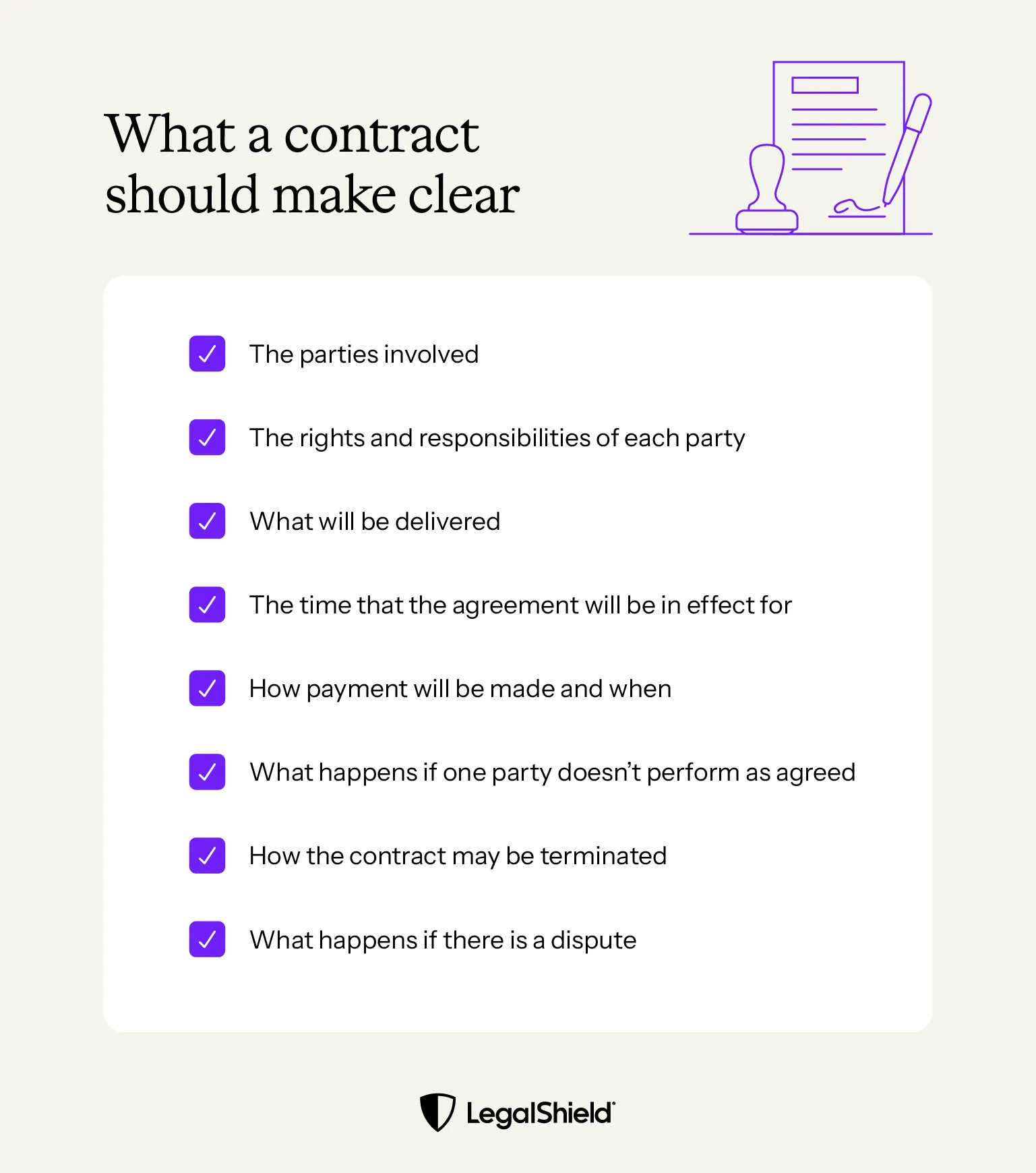
Typically, you’ll want to include these common contract terms:
Scope of work: This section explains the specific tasks the service provider will perform, the deliverables they’ll produce, and the milestones to be met. Clarity around what work will be done and what the final results will look like helps both sides understand what’s included, what’s not, and when the work is complete.
Payment terms: This is the part that explains how the service provider will be paid (e.g., hourly rate, flat project fee, or monthly retainer). It can list the total cost, payment deadlines, invoice timing, and payment method (bank transfer, check, etc.)
Ownership of work: This part explains who owns the final work, such as reports, code, designs, research, and similar materials. Some agreements use “work for hire” language, which just means the recipient owns the finished work after the final payment.
Confidentiality and non-disclosure: This section explains how private business info is going to be handled. Customer lists, trade secrets, pricing, internal processes, marketing plans, and all kinds of other sensitive information can be covered by this section.
Planning for changes or extra work: A consulting contract should cover how both sides will handle any added work, missed deadlines, or changes in direction.
Termination clause: If either party wants to end the agreement, this section covers when and how they can do so. A notice period can give both sides time to hand off files, send final invoices, and close down the project in an organized way.
Having a lawyer review before signing can help ensure that the agreement is comprehensive and effective. A LegalShield Small Business Membership can connect you with a provider law firm for legal guidance on business documents, including questions about business contracts.
Additional terms to check for
Disputes can arise even when there’s a contract, which is why it’s best to have a lawyer help you. Every agreement is different, but there are common items both parties should check contracts for. Besides its specific terms, consulting agreements can also have these general contract terms:
Late payment terms: What happens if a payment deadline is missed? What’s the penalty? Is there a grace period?
Indemnification: Is there a risk of liability, and do either (or both) of the parties in the contract agree not to hold the other responsible for certain risks?
Breach of contract measures: What happens if one party doesn’t hold up their side of the agreement? There should be clear rules for what happens next.
Dispute resolution: How will a dispute be adjudicated, and what are the timeframes for bringing and responding to disputes?
Get legal guidance to help protect your business
A consulting agreement can determine payments, ownership rights, deadlines, confidentiality, and what happens if the project ends early. Before you sign, reuse, or send such an agreement to a client, it can help to get a lawyer’s feedback and perspective.
A LegalShield Small Business Membership can connect you with a provider law firm for reviewing a consulting contract and answering questions about the scope of work and payment terms. Take a look at the LegalShield Small Business Plan for more details.
Frequently Asked Questions
A consulting agreement template could be a helpful starting point, but the service provider will need to customize it for the project, the parties, the payment terms, the work you’re delivering, and the laws that apply. A lawyer can help by reviewing any online template you’re thinking about using.
In some cases, verbal agreements can be legally binding. But they’re (really) hard to prove. With no written record, the consultant and client can disagree about the work, deadline, price, and more. A written consulting agreement gives both parties a clear record to rely on.
If a consultant doesn’t finish the work, the breach of contract, termination, and payment clauses in the consulting agreement will determine what happens. These sections can explain what happens if work is incomplete, deadlines are missed, or the project comes to an early end.
You don’t always need a new agreement for every project. For ongoing work, some businesses use a Master Service Agreement (MSA) with separate Statements of Work (SOWs) for each project. General legal terms are in the MSA, while each SOW explains the specific work being performed, deadlines, and payment terms for that individual project.
Communications Director at LegalShield overseeing content creation designed to make legal protection simple and approachable. He focuses on offering straightforward, trustworthy guidance that empowers people to make informed decisions about their legal rights and responsibilities.
Dissolving an LLC can be tricky, and doing it without guidance can lead to unnecessary stress and delays. We’ve put together some helpful information so you can start the LLC dissolution process with more peace of mind.
An employment contract is an important piece of paperwork because it defines the working relationship, your expectations, and conditions. Here are some of the common components included.
Virtual business addresses can be a practical option for those forming an LLC from home, working remotely, or trying to keep their business and personal mail separate.
By the end of this blog, you’ll get a high-level summary of trademarking a name and logo, how logos differ from business names and artwork, and how much it all costs.
A DBA is a name registration that lets you run your business under a name other than your personal legal name or legal business entity. While a DBA offers branding flexibility and market expansion opportunities without creating a new legal structure, it does not provide legal liability protection, tax benefits, or function as a business license.
An indemnity agreement settles the “who is responsible” question ahead of time. One party promises, in writing, to cover certain losses tied to the work, so the other isn't left with the bill. These promises appear in construction contracts, leases, and business sales.
A certificate of good standing is official proof from your state that your business is registered and current on its requirements. Most lenders and agencies want a recent one, so it helps to know how to get it before someone asks.
Whether the goal is selling a company, bringing in a business partner, or passing it to a family member, the LLC ownership transfer often involves reviewing the LLC's operating agreement and the applicable state's rules.
•
11 min read
Author Name
,
Author Title
August 4, 2026
Thank you! You're subscribed!
Oops! Something went wrong while submitting the form.