A certificate of good standing is an official state document confirming that a business is registered and has kept up with state requirements, like filing reports and paying fees. Lenders, buyers, and licensing agencies often request one.
As a business owner, you will likely find yourself needing a certificate of good standing. A bank, investor, or another third-party might ask you for one to prove your business’s legitimacy. If you've never heard of it, don't worry. This is usually one of the easier business documents to track down, and it often costs less than the filings you've already done.
A certificate of good standing is official proof from your state that your business is registered and current on its requirements. Most lenders and agencies want a recent one, so it helps to know how to get it before someone asks.
What’s the meaning of “good standing” for a business?
The definition of good standing varies by state, but it generally means your company is registered and up to date on its filing and franchise tax obligations. When evaluating your business’s good standing, your state may check for documents related to business registration, state fees, and yearly reports.
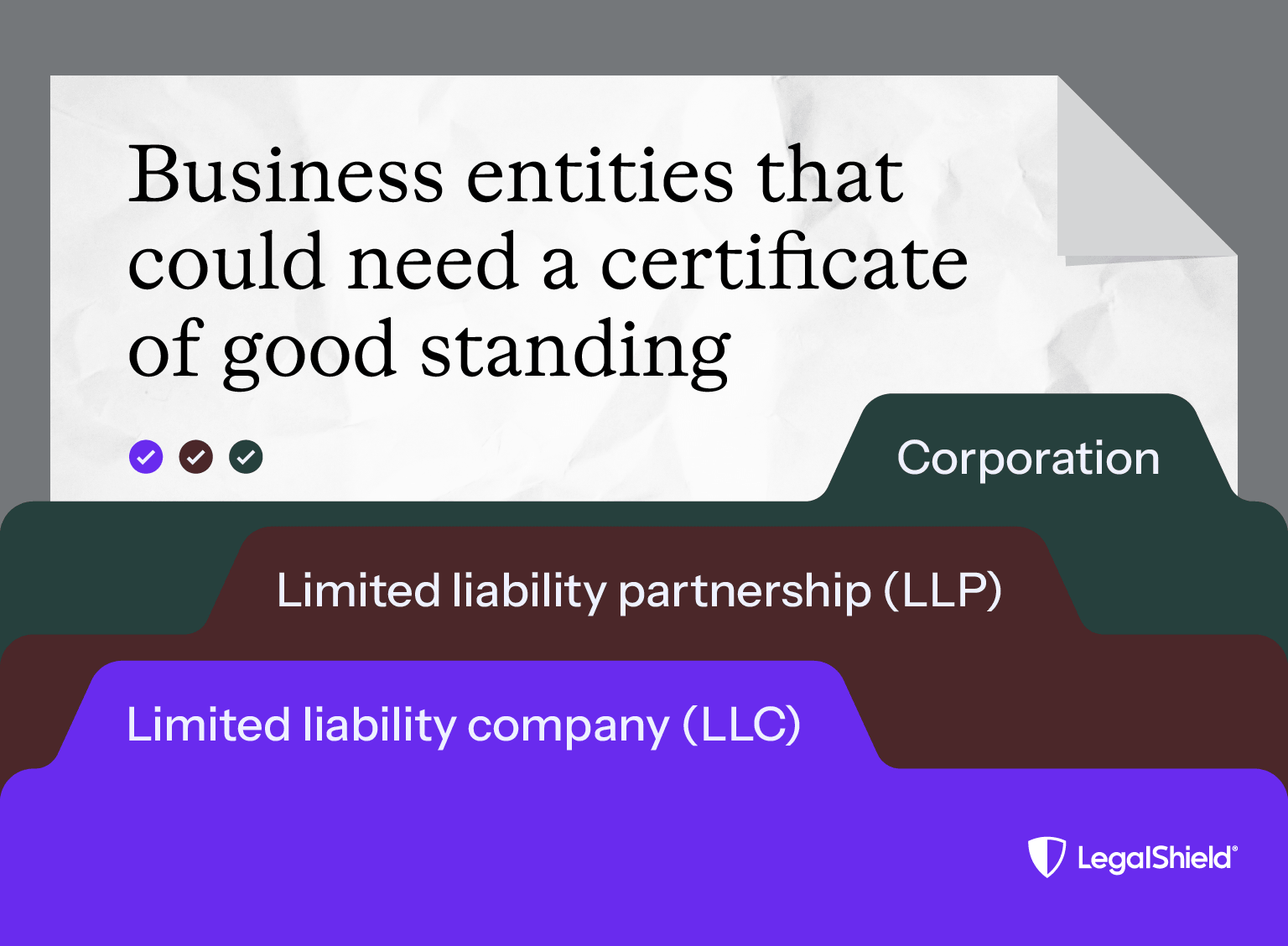
These requirements can change with your business structure, too. You can look into how an LLC works compared to a corporation to understand which filings apply to your company.
How do I know if my business is currently in good standing?
Certain states have a search tool on their business services website where you can type in your company’s name to see its current status. The terms for each status can also vary by state, and a lawyer can help you understand them if you aren’t sure.
What situations typically involve a certificate of good standing?
Third parties usually ask for this certificate as proof that your business is legitimate and current with the state. They may request it along with other documents needed for an LLC or small business, such as your operating agreement.
Below we’ve listed some common situations where someone might ask you to provide a certificate of good standing:
Applying for a business loan, bank account, or credit card
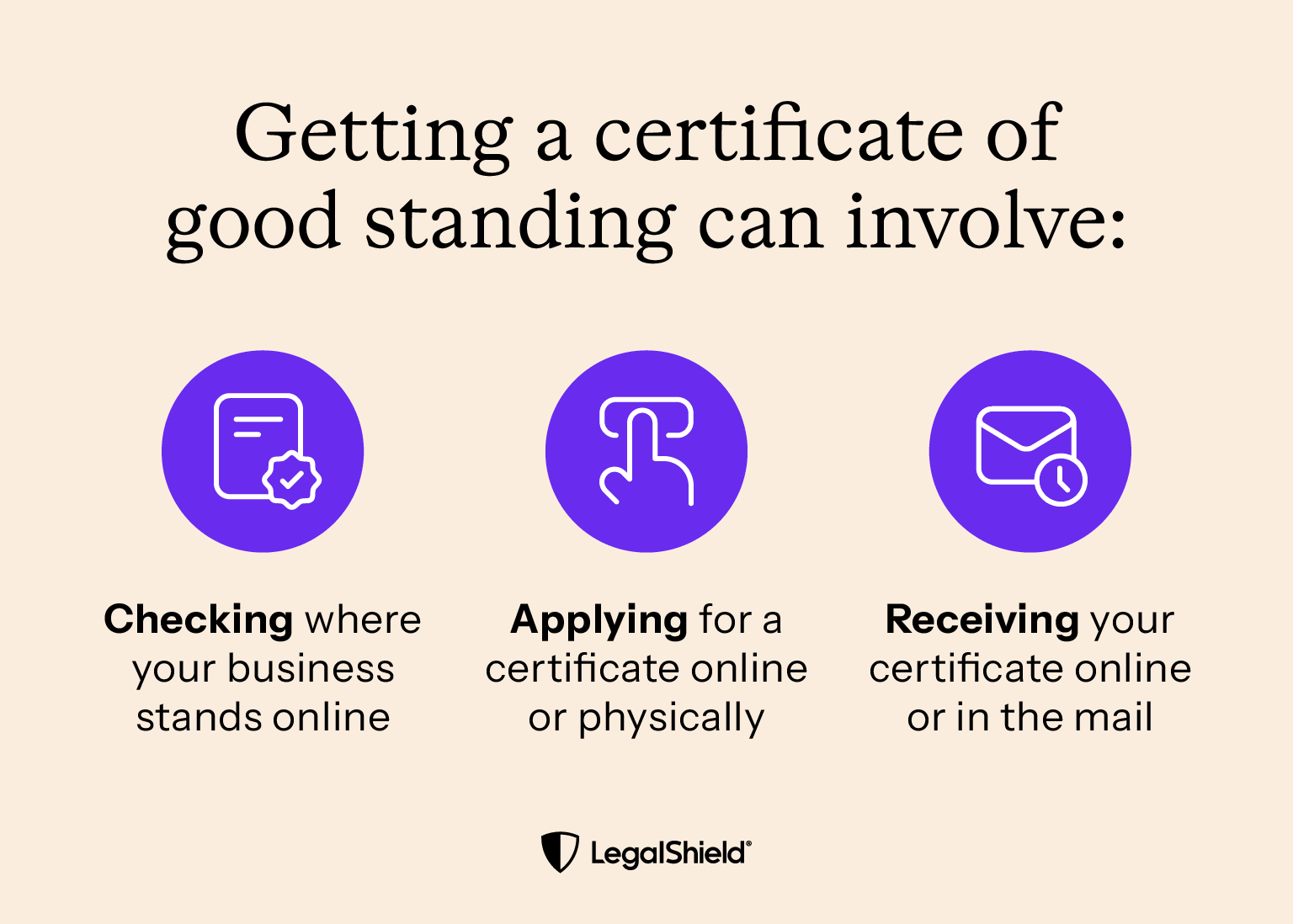
Owners can start by checking the state's business search to confirm the company is active. If something is off, like an unpaid fee, clearing it up first helps prevent a rejected request later.
With no unresolved paperwork, a business owner can then request the certificate from the state. Many states accept requests online, by mail, or in person, and online is often the fastest route. Once the request goes through, the state typically issues the certificate as a downloadable file or a mailed paper copy.
What can happen if the state denies my request?
If the state denies your request for a certificate of good standing, it’ll sometimes let you know which documents or fees to address.
Reinstatement, or the process behind returning to good standing, varies by state. It can involve filing past-due paperwork and paying outstanding fees. Some states also ask you to submit a separate reinstatement form.
If you’re not sure where to start, a lawyer can explain why your business doesn’t have good standing and how to reinstate it. A LegalShield® Small Business Plan connects you with a provider law firm that can answer questions about reinstatement in your state.
Keep your business compliant with a LegalShield Membership
A certificate of good standing is one piece of staying compliant as a small business owner. Licenses and annual filings each have their own deadlines, and it's a lot to track on your own. A lawyer can offer advice on keeping your business in good standing.
With a LegalShield Small Business Plan, you can speak with a provider law firm about your specific situation. Depending on your plan, that can include a set number of document reviews each year and consultation on an unlimited number of business legal matters.
Once your certificate is in hand, the next step is getting it to the party that requested it. In situations involving contracts, such as a new business partnership, LegalShield Provider Law Firms can review them to help you move forward with confidence.
Frequently Asked Questions
Turnaround depends on your state and how you file. Many states have online systems with fast turnarounds, while mailed requests take longer. Some states also offer expedited handling for an added fee.
Many include the company's legal name and a statement that it's registered or allowed to do business in the state. You might also see the issue date, plus the state seal or an official's signature.
Some alternative names for a certificate of good standing include letter of good standing, certificate of status, and certificate of existence.
Each state issues its own certificate, so a business registered in several states may need one from each. Some states also request a certificate of good standing from out-of-state businesses that want to register.
Content Specialist at LegalShield, creating educational resources about legal and consumer protection topics. She focuses on making complex legal and financial concepts accessible to readers and has contributed to various educational articles on consumer rights and protections.
Dissolving an LLC can be tricky, and doing it without guidance can lead to unnecessary stress and delays. We’ve put together some helpful information so you can start the LLC dissolution process with more peace of mind.
An employment contract is an important piece of paperwork because it defines the working relationship, your expectations, and conditions. Here are some of the common components included.
Virtual business addresses can be a practical option for those forming an LLC from home, working remotely, or trying to keep their business and personal mail separate.
By the end of this blog, you’ll get a high-level summary of trademarking a name and logo, how logos differ from business names and artwork, and how much it all costs.
A DBA is a name registration that lets you run your business under a name other than your personal legal name or legal business entity. While a DBA offers branding flexibility and market expansion opportunities without creating a new legal structure, it does not provide legal liability protection, tax benefits, or function as a business license.
An indemnity agreement settles the “who is responsible” question ahead of time. One party promises, in writing, to cover certain losses tied to the work, so the other isn't left with the bill. These promises appear in construction contracts, leases, and business sales.
Whether the goal is selling a company, bringing in a business partner, or passing it to a family member, the LLC ownership transfer often involves reviewing the LLC's operating agreement and the applicable state's rules.
If you want to do business under a name that isn't your own legal name or your LLC's registered name, you need a trade name, also known as a doing business as (DBA) name.
•
6 min read
Author Name
,
Author Title
July 28, 2026
Thank you! You're subscribed!
Oops! Something went wrong while submitting the form.