Editor's note: This post was originally published May 26, 2022 and has been updated for accuracy, comprehensiveness, and freshness on May 15, 2026
As a new business owner, you may be wondering whether creating an operating agreement is worth it. Not all states require it, but if you have an LLC, the answer is yes. An operating agreement is a legal document that protects your company. It lists rules for managing and running your business, owner rights and responsibilities, and other important details.
Have you been wondering how to write an operating agreement? You need to follow several steps to protect your business interests. Running your LLC without an operating agreement — or using a poorly written one — can make it harder to define roles and avoid disputes down the road. We’ll go over how to create an operating agreement, why you need one, and what you should include to keep your business running smoothly.
Think of it as a rulebook. If anyone has questions, just look at the operating agreement for answers. When creating yours, be sure to check your state’s requirements.
California, Delaware, Maine, and Missouri LLCs must have operating agreements. In New York, LLCs must adopt one within 90 days of creation. Even in states where an operating agreement is optional, creating one for your LLC just makes good sense because it:
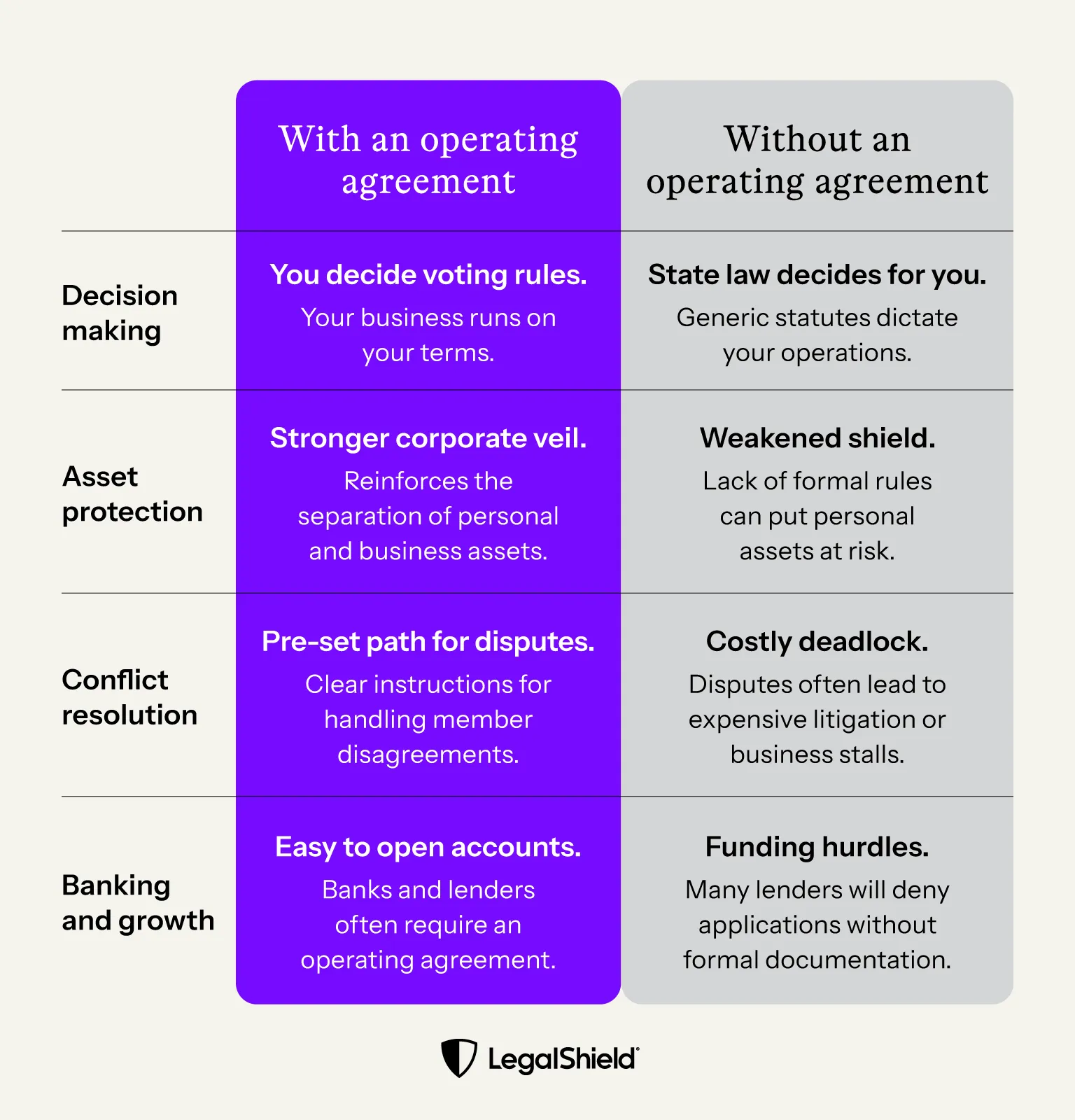
Keeps people on the same page: Company rules and procedures are clearly documented in the operating agreement. This rulebook can help prevent uncertainty and arguments.
Helps protect your personal assets: One of the main benefits of LLCs is keeping personal and business finances separate. An operating agreement reinforces that separation and helps give you another layer of protection, if you follow it.
Beats your state’s default rules: Without an operating agreement, your state’s default laws govern your business. Laws about profit distribution and management options are examples. Your operating agreement can replace those generic rules.
Meets bank requirements: Banks may require an operating agreement to open business bank accounts or borrow money.
Gives you rules to grow your business: Your operating agreement can set rules for finances, adding or removing members, expansion, and making decisions. These rules make scaling simpler.
Key choices to make before forming your business
Even before forming your LLC, owners need to make a few decisions, as it will affect your business registration and how your business will be taxed. Some decisions you make before you form your business with the state will be things you include in your operating agreement.
Will my LLC be member-managed or manager-managed?
In a member-managed LLC, all owners make daily decisions and take part in running the business. In a manager-managed LLC you can choose one or more managers to handle those tasks. In your operating agreement, list how management decisions will be made and who has the authority to make them.
How will decisions really get made?
Some business decisions are routine. Others can change your company. If you have more than one member, think about what kinds of decisions you’ll want to vote on. Thinking about expansion? Need a loan? Ready to add or remove members? Considering selling or closing the business? Will you need a simple majority vote or a unanimous decision? Clear voting rules can reduce conflict if members disagree on major business actions.
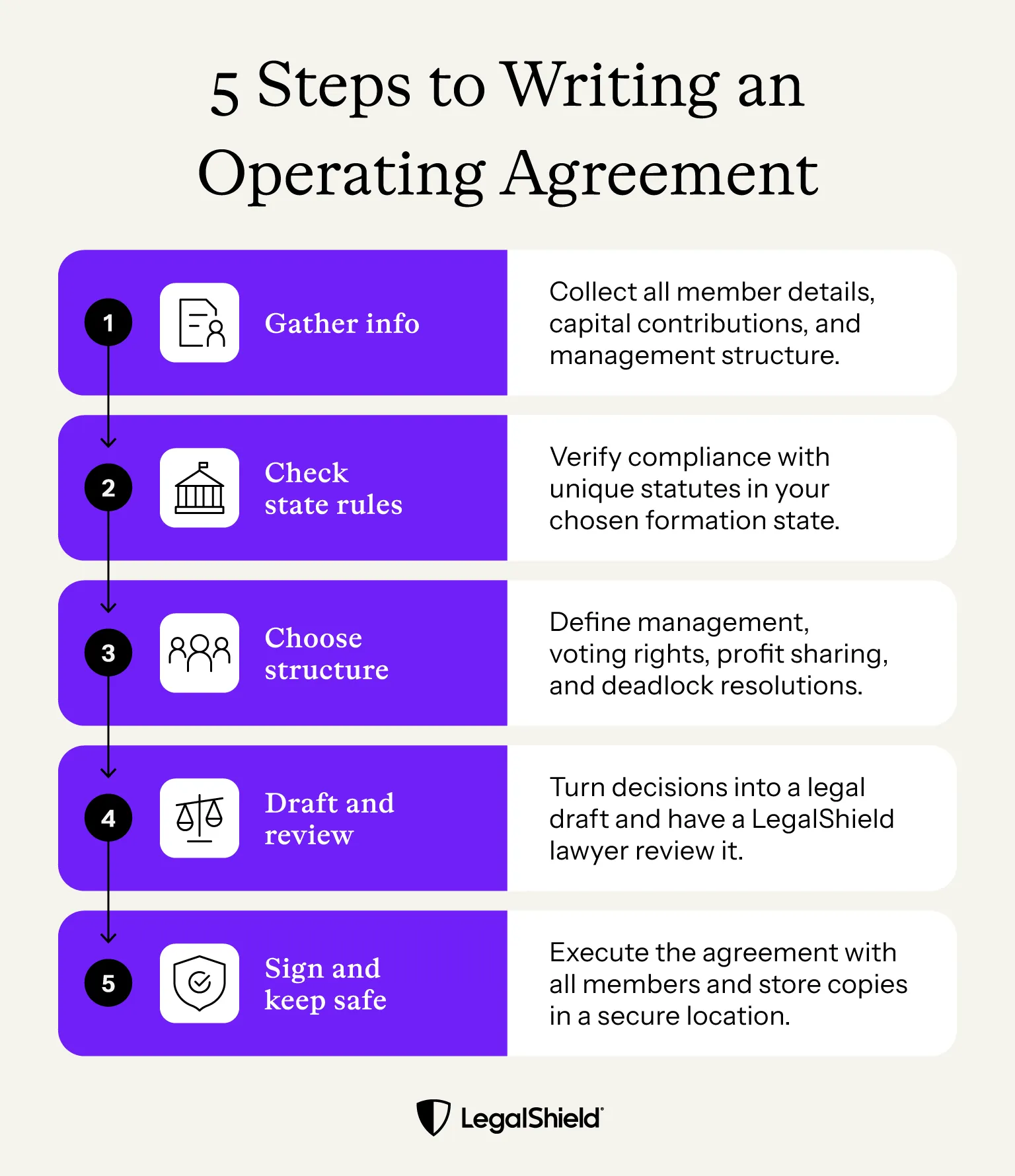
Write an operating agreement using these 5 steps
An operating agreement is a written guide that explains how your business operates. Many business owners choose to create their own operating agreement, especially for simpler LLCs. However, one of our LegalShield® Business Plans can support you in this process by providing access to an experienced provider lawyer for legal advice and consultation.
Step 1: Gather your business info
Before you start creating an operating agreement, you need to collect several key details about your company. Having this information ready ensures your document matches the details you used when forming your business with the state.
Be sure to gather the following:
LLC details: Collect your legal business name, the address of your main office, and your specific business purpose.
Member information: List the full names, physical addresses, and contact details for every owner involved in the company.
Ownership and contributions: Note each member’s ownership percentage and the value of what they put in, such as cash, property, services, or intellectual property.
Management structure: Decide if all owners will manage daily operations or if you will choose specific managers to handle those tasks.
Step 2: Check your state’s rules
You might form your LLC in your home state, but you don’t necessarily have to. Every state has its own rules about LLC formation and operations, so choose the state that’s best for you. Whichever state you select, it’s very important to check its laws to ensure you comply. Most states give LLC members lots of flexibility, but some have specific requirements. For example:
California allows written, oral, or implied operating agreements. However, California isn’t as flexible as some states when it comes to allowing LLC operating agreements to override state statutes.
Delaware lets members customize most of the terms they include in an operating agreement. This maximum flexibility attracts many LLCs to the state.
New York requires LLCs to adopt a written operating agreement. The LLC entity itself has to sign the document in addition to member signatures to be legally binding.
Step 3: Choose your structure and rules
You need to decide how your business will handle daily tasks, voting, and financial distributions. Clearly state if the LLC is member-managed or manager-managed and if decisions need a simple majority or a unanimous vote to pass. Your agreement should also explain how members will share profits and losses to prevent unexpected disagreements down the road
Step 4: Draft and review the agreement
Are you finished discussing what you want to include in your operating agreement? While templates can be a helpful starting point, a generic form may not cover complex items like buy-sell provisions or specific tax classifications.
A well-written document helps to protect your interests. Gain peace of mind with a LegalShield plan which covers a provider attorney’s review of your operating agreement. Know that your operating agreement will cover key details and clearly reflect your goals.
Step 5: Sign it and keep it safe
Once you’ve drafted and reviewed your operating agreement, all members need to sign it. Each member should have a copy, and the primary copy should be kept with other business documents.
When to update your operating agreement
Over time, things can change. You may want to review your operating agreement periodically, especially after major changes. That ensures that everything is up-to-date, in writing. Common major changes include:
Changes in ownership (members joining or leaving)
Management changes
Changes in tax classification
Updating profit and loss distributions
New or updated laws go into effect
Business model changes
Expansion, including doing business in new states
Not every situation is as clear-cut as those we just mentioned. Your governance procedures might require a unanimous decision for certain changes, but that requirement could be creating bottlenecks and slowing things down.
You’d probably want to ask a lawyer for advice in complicated situations. But keep in mind that most of them have high fees for a few hours of consultation. LegalShield members get access to legal advice and consultation as part of their subscription, as well as document review.
How can LegalShield support your small business?
Creating a strong operating agreement establishes clear rules and protects your LLC. Get legal guidance from our provider lawyers, as well as document review. You can also get answers to other small business questions, debt collection letters, and an annual Business Health Check. ,
With a LegalShield Small Business Plan, you’ll get access to a provider firm in your state at a fraction of the price you’d pay other lawyers. Choose from three affordable plans.
Frequently Asked Questions
If your LLC is based in California, Delaware, Maine, Missouri, or New York, the answer is yes. Those states require LLCs to have operating agreements. Other states don’t make you create one, but a well-written and legally binding operating agreement has several benefits.
No laws prevent you from writing your own agreement, and many owners choose to do so for simple LLCs. However, just because you can write it yourself doesn't mean you should go it alone. Getting advice and a document review from an experienced lawyer helps ensure your personal assets are truly protected.
Content Specialist at LegalShield, creating educational resources about legal and consumer protection topics. She focuses on making complex legal and financial concepts accessible to readers and has contributed to various educational articles on consumer rights and protections.
En Estados Unidos, un divorcio sin oposición generalmente cuesta al menos $1,500, mientras que un divorcio con oposición puede empezar en $5,000 y superar los $20,000 en casos complejos. El costo total depende de los honorarios de abogados, los costos judiciales y el nivel de conflicto entre los cónyuges.
Decidir tramitar el divorcio ya es bastante difícil sin tener que preguntarte si estás llenando el formulario correcto. Cada estado maneja el proceso de manera un poco distinta, y es normal sentir dudas acerca de dónde empezar. Reunimos información sobre lo que puede suceder durante el trámite, incluyendo perspectivas de una abogada de verdad, para darte más claridad en este camino.
La mayoría de nosotros sabemos que deberíamos tener un testamento. Simplemente seguimos encontrando razones para posponerlo. Si eso te suena familiar, no estás solo/a. Sigue leyendo para aprender qué puedes hacer al respecto.
Prepararse para un divorcio implica reunir documentos financieros y personales, hacer un presupuesto de tus gastos mensuales, asegurar tus cuentas digitales e inventariar tus bienes. También es importante decidir qué tipo de divorcio se adapta a tu situación y consultar con un abogado antes de presentar la petición para proteger tus derechos.
¿Necesitas un poder notarial pero te preocupa el costo? Es natural preocuparse por pagar servicios legales, pero es importante no quedarse atrapado/a en dólares y centavos. Después de todo, no le puedes poner precio a la tranquilidad, y eso es exactamente lo que ofrece un poder notarial.
Ya sea que te estés casando, pasando por un divorcio o simplemente estés listo para un nuevo comienzo, cambiar tu nombre es un gran paso. Puede ser un proceso sorprendentemente difícil, y las tarifas varían mucho.
Planificar el futuro de tu familia toma tiempo y reflexión. Una herramienta que puede ayudar es el fideicomiso familiar: un arreglo legal que te permite decidir cómo se administra y se comparte tu propiedad con las personas que te importan.
A veces la gente tiene reacciones emocionales fuertes a la palabra "prenupcial" porque sienten que su pareja no confía en ellos. Pero un contrato prenupcial trata de establecer confianza y justicia. Puede ser una forma prudente y cariñosa de comenzar un matrimonio. Un contrato prenupcial es una manera en que dos personas resuelven cómo manejarán el dinero y los bienes antes de decir "acepto".
•
10 min read
Author Name
,
Author Title
September 28, 2026
Thank you! You're subscribed!
Oops! Something went wrong while submitting the form.