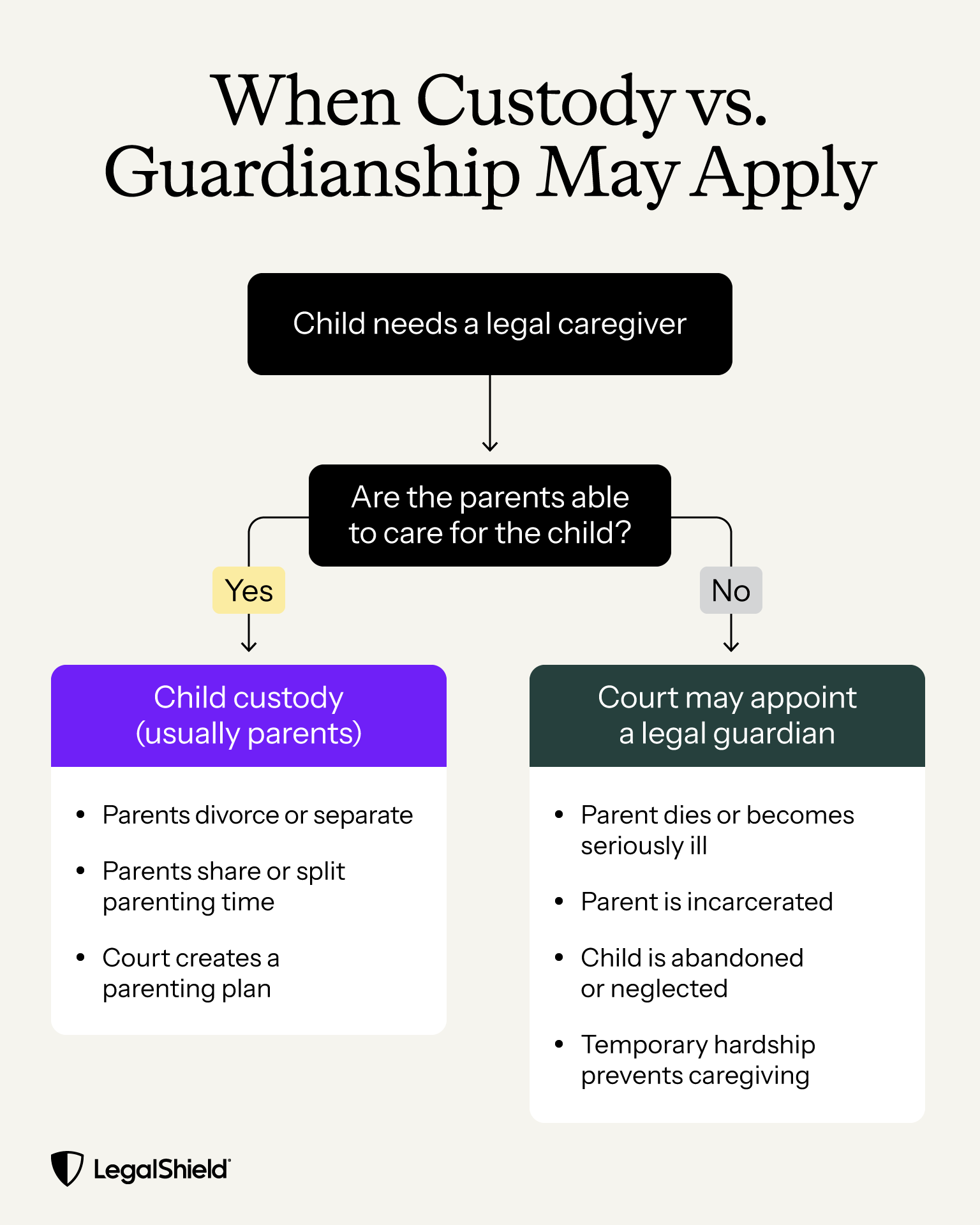
Custody and guardianship are two different legal relationships between a child and an adult. Custody describes the rights of parents, and can become an issue during separations or other court proceedings. Guardianship can be granted by the court to non-parents and isn’t mutually exclusive with custody.
Custody and guardianship are both ways to describe the rights and responsibilities of an adult caring for a child. Custody usually describes the rights of parents. A court may grant guardianship in certain situations to adults who are not a child’s parents. Guardianship doesn’t necessarily remove the custody rights of parents.
Custody issues are complex and can be traumatic for everyone involved. Until a child reaches the age of majority in their state (typically 18 years old), a custodian or legal guardian must be responsible for their care. The adult also has the right to make important decisions that affect the child’s life.
If you feel confused about your parental rights, it can be helpful to seek the advice of a lawyer.
What is custody?
Parents have custody of their children together with the other parent. Child custody consists of both legal custody (the authority to make decisions such as education, healthcare, and religion) and physical custody (where your child will live). Parents share the rights and responsibilities of custody unless a court says otherwise.
Custody disputes
Custody can become complicated during a divorce or separation. If the split is amicable, parents might agree on custody decisions and present a parenting plan to the court for approval. If they can’t agree or the court doesn’t approve of the plan, the court typically decides who gets physical and legal custody.
Separated parents might have joint custody on equal terms, or the court might decide that the child should live primarily with one parent and grant the other parent more limited rights.
It’s also possible to seek sole custody, in which one parent assumes all custody rights and responsibilities.
The court typically decides based on the “best interests of the child” standard. It’s up to individual courts to define what that means. Courts may also determine the financial contributions the parents should make.
If a child is old enough and mature enough, the court may ask which parent he or she wants to live with. But that preference is usually only one of the factors that courts consider. The court may also appoint an advocate for the child, called a Guardian ad Litem. This is a neutral party who advocates for the child’s interests.
Can parents lose custody?
Under some circumstances, like a custody dispute, a court might limit or remove a parent’s rights to custody of their child. These decisions, and how the courts approach them, depend on the state. Many states have guidelines that courts follow that consider the rights of parents and children. Separating families is often seen by courts as an unfavorable outcome.
What is legal guardianship?
A guardian is an adult appointed by a court to care for a child. While not necessarily a parent, a guardian has many of the same legal rights and responsibilities as a custodial parent, including caregiving and decision-making. A guardianship can be temporary or last until the child reaches the age of majority.
Custodial parents facing unforeseen hardships, like a long-term hospitalization, can arrange for a temporary guardianship of their children. The courts might also choose a guardian if both parents can’t care for their children.
Sometimes, a child might have biological parents and different guardians at the same time. During guardianship, parents may be given visitation or other rights and responsibilities. Every guardianship case is unique.
Rights and obligations of guardians
A child’s legal guardian has both rights and responsibilities.
Legal guardian rights
Legal guardian responsibilities
Can decide where the child lives and make decisions about daily care
Caring for the child's medical, dental, and mental health
Can make major decisions about the child's healthcare, education, and overall upbringing
Providing the child's basic necessities (food, shelter, and clothing)
Can give consent for school activities and medical care
Providing supervision and discipline for the child, including that the child attends school
Has access to medical and school records
Cooperating with social services if applicable
May receive financial assistance toward the child's care from parents
Updating the court about the child's status when required
Naming guardians in a Will
You can elect to name a guardian for your children when you write a Will. It’s not pleasant to think about, but naming a guardian helps to ensure your children are cared for in the way that you want if you should pass away. Courts will make the final decision, but your written wishes will be given a lot of weight.
Who is financially responsible for a child under guardianship — the parent or guardian?
There isn’t a one-size-fits-all answer to that question. If you appoint a guardian temporarily, you’re likely still financially responsible as the parent.
Court orders and state laws can also affect who is required to financially support a child. The bottom line is that decisions about financial support vary from case to case. A LegalShield® Provider Law Firm can help you understand the specifics of your situation.
What courts handle custody and guardianship?
A family or juvenile court usually handles child custody and guardianship matters, but circuit and chancery courts can also deal with them. If your children are minors and you pass away, the probate court will probably preside.
Each type of court has a different focus, evidence requirements, and scope of authority. A LegalShield Provider Law Firm can help you understand which court may handle your case and what to expect.
Understand your parental rights and guardianship issues
If you’re facing difficult decisions about custody or guardianship, a lawyer can help you understand and advocate for your rights. Every situation is unique, so it’s important that you involve a professional when facing family law issues.
A LegalShield Personal Plan gives you affordable access to legal advice and guidance. Talking to a provider lawyer is a good place to start; they can help you understand what to prepare for and what additional services you may need.
LegalShield® is a trademark of Pre-Paid Legal Services, Inc. (“LegalShield”). LegalShield provides this blog as a public service and for general information only. The information made available in this blog is meant to provide general information and is not intended to provide legal advice, render an opinion, or provide a recommendation as to a specific matter. The blog post is not a substitute for competent legal counsel from a licensed professional lawyer in the state or province where your legal issues exist, and you should seek legal counsel for your specific legal matter. All information by authors is accepted in good faith. However, LegalShield makes no representation or warranty of any kind, express or implied, regarding the accuracy, adequacy, validity, reliability, availability, or completeness of such information. The materials contained herein are not regularly updated and may not reflect the most current legal information. No person should either act or refrain from acting on the basis of anything contained on this website. Nothing on this blog is meant to, or does, create an attorney-client relationship with any reader or user. An attorney-client relationship may be formed only after the execution of an engagement letter with an attorney and after that attorney has confirmed that no conflicts of interest exist. Nothing on this website, or information contained or transmitted by this website, is intended to be an advertisement or solicitation. Information contained in the blog may be provided by authors who could be a third-party paid contributor. LegalShield provides access to legal services offered by a network of provider law firms to LegalShield members through membership-based participation. LegalShield is not a law firm, and its officers, employees or sales associates do not directly or indirectly provide legal services, representation, or advice.
Content Specialist at LegalShield, creating educational resources about legal and consumer protection topics. She focuses on making complex legal and financial concepts accessible to readers and has contributed to various educational articles on consumer rights and protections.
En Estados Unidos, un divorcio sin oposición generalmente cuesta al menos $1,500, mientras que un divorcio con oposición puede empezar en $5,000 y superar los $20,000 en casos complejos. El costo total depende de los honorarios de abogados, los costos judiciales y el nivel de conflicto entre los cónyuges.
Decidir tramitar el divorcio ya es bastante difícil sin tener que preguntarte si estás llenando el formulario correcto. Cada estado maneja el proceso de manera un poco distinta, y es normal sentir dudas acerca de dónde empezar. Reunimos información sobre lo que puede suceder durante el trámite, incluyendo perspectivas de una abogada de verdad, para darte más claridad en este camino.
La mayoría de nosotros sabemos que deberíamos tener un testamento. Simplemente seguimos encontrando razones para posponerlo. Si eso te suena familiar, no estás solo/a. Sigue leyendo para aprender qué puedes hacer al respecto.
Prepararse para un divorcio implica reunir documentos financieros y personales, hacer un presupuesto de tus gastos mensuales, asegurar tus cuentas digitales e inventariar tus bienes. También es importante decidir qué tipo de divorcio se adapta a tu situación y consultar con un abogado antes de presentar la petición para proteger tus derechos.
¿Necesitas un poder notarial pero te preocupa el costo? Es natural preocuparse por pagar servicios legales, pero es importante no quedarse atrapado/a en dólares y centavos. Después de todo, no le puedes poner precio a la tranquilidad, y eso es exactamente lo que ofrece un poder notarial.
Ya sea que te estés casando, pasando por un divorcio o simplemente estés listo para un nuevo comienzo, cambiar tu nombre es un gran paso. Puede ser un proceso sorprendentemente difícil, y las tarifas varían mucho.
Planificar el futuro de tu familia toma tiempo y reflexión. Una herramienta que puede ayudar es el fideicomiso familiar: un arreglo legal que te permite decidir cómo se administra y se comparte tu propiedad con las personas que te importan.
A veces la gente tiene reacciones emocionales fuertes a la palabra "prenupcial" porque sienten que su pareja no confía en ellos. Pero un contrato prenupcial trata de establecer confianza y justicia. Puede ser una forma prudente y cariñosa de comenzar un matrimonio. Un contrato prenupcial es una manera en que dos personas resuelven cómo manejarán el dinero y los bienes antes de decir "acepto".
•
10 min read
Author Name
,
Author Title
September 28, 2026
Thank you! You're subscribed!
Oops! Something went wrong while submitting the form.