A patent is a legal intellectual property right from the U.S. government. It gives you the right to stop other people from recreating or profiting from your invention for a set number of years. If you've built something useful, and you don't want a competitor selling their own version of it, a patent can help you.
You solved a business problem with an invention. Maybe it’s a process fix for a production bottleneck or a part that helps two machines work together. Showing the invention could open up new business opportunities, but you’re concerned about competitors.
The U.S. Patent and Trademark Office (USPTO) grants patents, which allow you to protect inventions by revealing their details. You can also try to keep inventions a secret (officially called a “trade secret”), and many businesses do, but secrets can be difficult to enforce.
Patents are complex, so it’s a good idea to get legal advice about how to protect your business assets. With a LegalShield® Small Business Preferred or Premium Plan, you can get limited consultation with a provider law firm about intellectual property concerns. If you prefer to make an invention public, let’s look at the three kinds you can apply for and the requirements.
What is a patent?
A patent is a legal right granted to you for an invention. It allows you to pursue action to stop other people from making, using, offering for sale, or importing your invention for a limited time. This isn’t the same as your right to use or sell an invention.
According to the USPTO, "What is granted is not the right to make, use, offer for sale, sell or import the invention, but the right to stop others from doing so. If someone infringes on your patent, you may initiate legal action."
You could apply for a patent for many different kinds of inventions, like a machine, process, composition of matter, plant variety, or design.
The USPTO says that for a patent to be issued, your invention must meet four conditions:1
The invention is new and novel (something not done before).
The invention is useful and works, as opposed to a theory.
There is a clear description of how to use and [LR2] make the invention.
The invention is not obvious.
USPTO site has “and”
You are basically using USPTO language here, just modifying it ever so slightly. I think it probably needs to be properly cited.
As part of gaining and keeping a patent, you must make the details of the invention public. The USPTO publishes granted patents on their issue date and most applications on or after 18 months from the filing date. Anyone, including your competitors, can access the information, and you might find that public figures in your industry talk about it.
Different types of patents
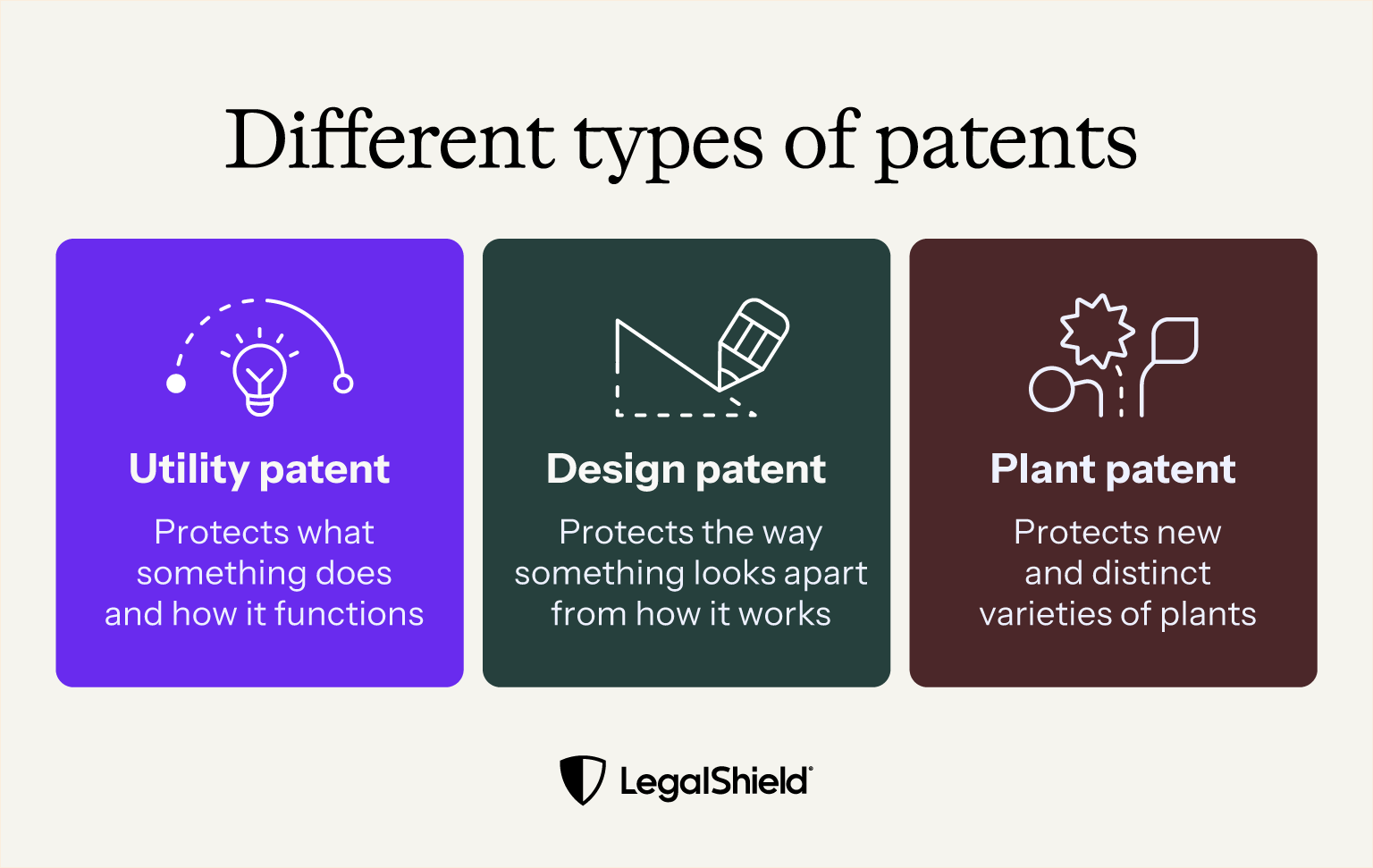
The USPTO issues three types of patents that protect inventions, depending on their purpose and function. Each category describes a different class of inventions and has different requirements. Let’s dive into the details of these three types.
Utility
The USPTO describes a utility patent as being for a “useful process, machine, article of manufacture, or composition of matter.” This covers a variety of inventions, from soft drink formulas to computer algorithms.
Design
A design patent consists of the “visual ornamental characteristics” of a tangible item made by humans or machines. A utility patent protects what something does, while a design patent only protects the way it looks.
Whether you can get one is a complicated question; you could apply if the design is applied to an item or changes it in some way. For example, the way a watch looks and the way it functions are two different things, so you may want both utility and design patents.
Plant
Plant patents are granted for new and distinct varieties of plants. These patents have complex rules and conditions about how the plant must differ from other plants, as well as where and how it’s grown. For example, a plant must be invented or discovered in a cultivated area and asexually produced by the individual.
How patents compare with trademarks and copyrights
Patents, trademarks, and copyrights are all intellectual property rights. However, they grant different, distinct rights and apply to different kinds of intellectual property.
Many businesses need trademarks to protect their brand names and identities, and others need to protect their published content. Patents are for specific inventions.
How the patent process works
To check whether your invention has been previously published, the USPTO suggests that you perform a patent search before you get started.
Successfully registering patents requires knowing patent law and USPTO rules. A lawyer can prepare the application and communicate with the USPTO on your behalf.
You’ll need to decide which category of patent to apply for, and in the cases of utility and plant patents, whether you want to make a provisional or non-provisional application. Here’s the difference:
Provisional applications are simplified processes that allow you to establish a filing date for a future nonprovisional application, as well as use the “patent pending” term. You have one year to convert a provisional application to a non-provisional application, or the application will expire.
Non-provisional applications are full patent applications with requirements such as formal claims, drawings, and potentially oaths.
Your lawyer can help you make the decisions, prepare your drawings and disclosures, and submit the application. If you choose to do this yourself, you’ll also be responsible for responding to the USPTO if they take action or make requests.
Sign up for a LegalShield Small Business Plan for legal advice
Intellectual property is a complex area of law, especially for businesses. You may need legal advice to develop a comprehensive plan for your business’s intellectual property assets. And if you’re releasing a new product or process, patenting might just be the beginning of your legal concerns.
With a LegalShield Small Business Plan, you can get much more than just limited consultations on patents. You get access to knowledgeable provider lawyers licensed in your state. They can review documents and contracts, prepare business license applications, and communicate on your behalf. Plus, every plan tier comes with a business health check to flag legal or compliance issues.
Sign up for a LegalShield Small Business Plan to get legal support for an affordable monthly fee.
Anyone can get a patent; there isn’t a limit based on who you are. The invention must meet the qualifications set by the USPTO. It must be new and novel, useful, and non-obvious, among other requirements.
You can’t patent ideas, theories, and basic physical phenomena. Plus, there are other intellectual property laws that handle published works, designs, and names.
Keeping a formula secret could protect its value and prevent competitors from accessing it. Patents require you to publish the information publicly, and the legal rights they grant you expire after a while. However, the disadvantage of secrets is that they can be difficult to maintain and enforce.
To get a patent for an invention, it needs to meet certain requirements (novel, useful, and non-obvious). Applications and fees are required, and you must also publish the invention’s information.
Communications Director at LegalShield overseeing content creation designed to make legal protection simple and approachable. He focuses on offering straightforward, trustworthy guidance that empowers people to make informed decisions about their legal rights and responsibilities.
En Estados Unidos, un divorcio sin oposición generalmente cuesta al menos $1,500, mientras que un divorcio con oposición puede empezar en $5,000 y superar los $20,000 en casos complejos. El costo total depende de los honorarios de abogados, los costos judiciales y el nivel de conflicto entre los cónyuges.
Decidir tramitar el divorcio ya es bastante difícil sin tener que preguntarte si estás llenando el formulario correcto. Cada estado maneja el proceso de manera un poco distinta, y es normal sentir dudas acerca de dónde empezar. Reunimos información sobre lo que puede suceder durante el trámite, incluyendo perspectivas de una abogada de verdad, para darte más claridad en este camino.
La mayoría de nosotros sabemos que deberíamos tener un testamento. Simplemente seguimos encontrando razones para posponerlo. Si eso te suena familiar, no estás solo/a. Sigue leyendo para aprender qué puedes hacer al respecto.
Prepararse para un divorcio implica reunir documentos financieros y personales, hacer un presupuesto de tus gastos mensuales, asegurar tus cuentas digitales e inventariar tus bienes. También es importante decidir qué tipo de divorcio se adapta a tu situación y consultar con un abogado antes de presentar la petición para proteger tus derechos.
¿Necesitas un poder notarial pero te preocupa el costo? Es natural preocuparse por pagar servicios legales, pero es importante no quedarse atrapado/a en dólares y centavos. Después de todo, no le puedes poner precio a la tranquilidad, y eso es exactamente lo que ofrece un poder notarial.
Ya sea que te estés casando, pasando por un divorcio o simplemente estés listo para un nuevo comienzo, cambiar tu nombre es un gran paso. Puede ser un proceso sorprendentemente difícil, y las tarifas varían mucho.
Planificar el futuro de tu familia toma tiempo y reflexión. Una herramienta que puede ayudar es el fideicomiso familiar: un arreglo legal que te permite decidir cómo se administra y se comparte tu propiedad con las personas que te importan.
A veces la gente tiene reacciones emocionales fuertes a la palabra "prenupcial" porque sienten que su pareja no confía en ellos. Pero un contrato prenupcial trata de establecer confianza y justicia. Puede ser una forma prudente y cariñosa de comenzar un matrimonio. Un contrato prenupcial es una manera en que dos personas resuelven cómo manejarán el dinero y los bienes antes de decir "acepto".
•
10 min read
Thank you! You're subscribed!
Oops! Something went wrong while submitting the form.