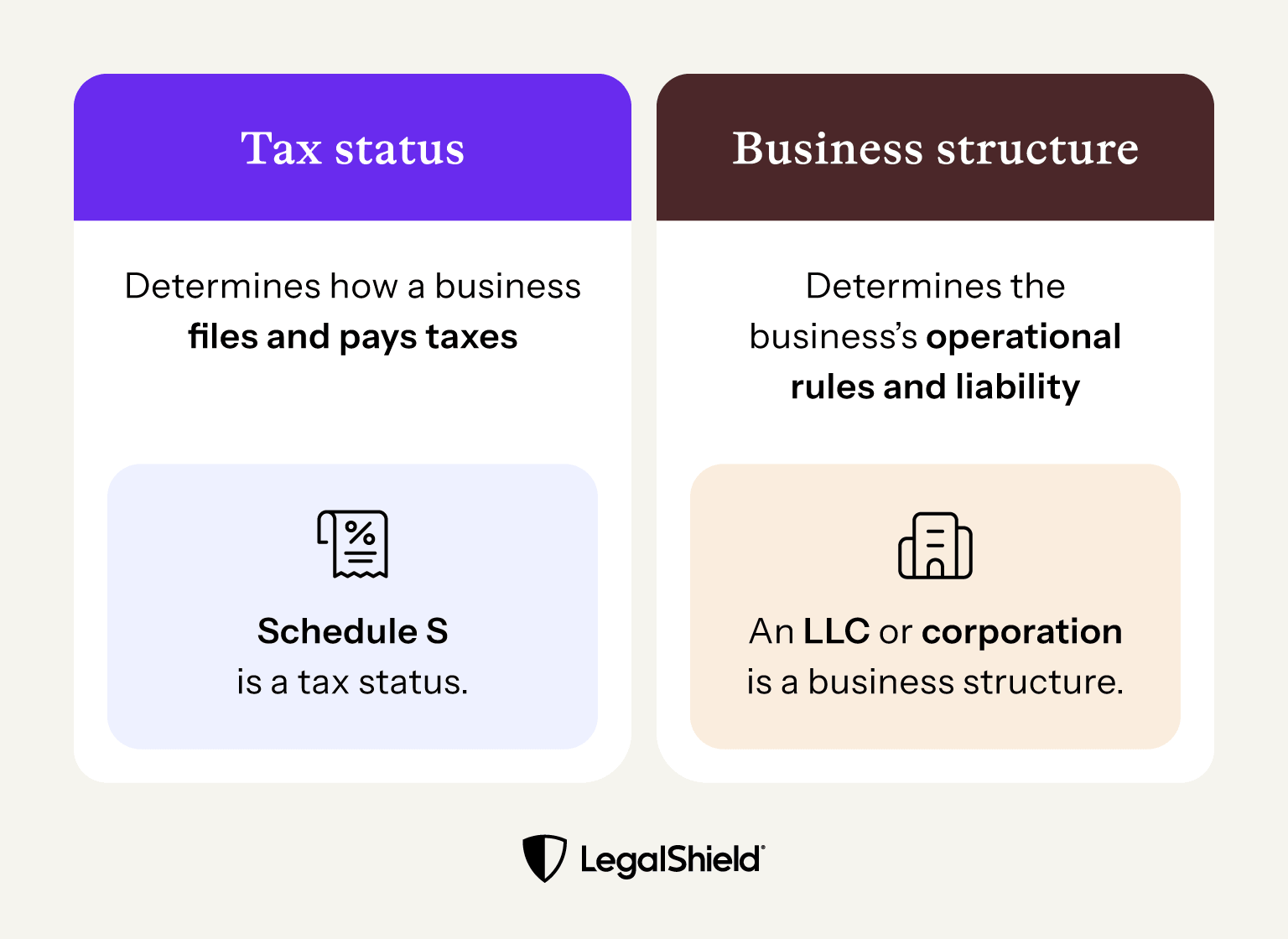
An S corporation is a federal tax status, not a type of business. An LLC or corporation that meets IRS requirements can elect it, letting profits and losses pass through to the owners' personal tax returns instead of being taxed at the company level.
Business owners usually hear about S corporations from a banker, an accountant, lawyer, or another owner, and the pitch is almost always about taxes. For the right company, this status can lower the yearly tax bill and give owners a cleaner way to take home profits.
"There is no such thing as an 'S' corporation. It's a myth," says Michael E. Fiffik, Esquire, a lawyer at a LegalShield® Provider Law Firm. "The S refers to a corporation that's made an election with the taxing authorities for a type of tax treatment, called pass-through taxation."
In other words, you don't form an S corporation. You form an LLC or a corporation, then ask the IRS to tax it a certain way.
How S corporations work
The official S corporation definition comes from the IRS: a company that elects to pass its income, losses, deductions, and credits through to its shareholders for federal tax purposes.
"Pass-through taxation refers to a business structure where the income or losses of the business are 'passed through' directly to the owners' personal income tax returns," Fiffik says. "The business itself does not pay corporate income tax."
Compare that with a C corporation, the default tax setup for corporations. A C corporation pays tax on its profits. Then the owners can pay tax again when those profits come out as dividends. Choosing S status can help a business avoid that second layer of tax.
If you work in your business, the IRS generally expects you to pay yourself a reasonable salary. That salary runs through payroll, with normal payroll taxes, before you take extra profit distributions.
At tax time, the company typically files Form 1120-S. Each owner gets a Schedule K-1 showing their share of the results.
S corporation eligibility requirements
To qualify, a business must be a U.S. company with no more than 100 shareholders and only one class of stock. That means every share carries the same rights to profits.
The rules also limit who can own a piece of the company. Individuals, certain trusts, and estates can hold shares. Partnerships, corporations, and nonresident aliens can't. A few business types, like certain banks and insurance companies, are shut out entirely. These limits never expire, and they can shape who invests in your company later.
How to elect S corporation status
You form an LLC or corporation under state law. Then, if the company qualifies, you can apply to the IRS for S status.
The request is submitted on IRS Form 2553. File within the first 2 months and 15 days of the tax year or from your entity’s formation, and the election generally counts for that year. For calendar-year companies, that's around March 15. File later, and it typically starts the following year.
The election can offer tax upsides for some businesses.
Profits may be taxed once, on the owners' personal returns, rather than at the company level and again at payout. More of each earned dollar may reach the people who built the business.
Because pay gets split between salary and distributions, the distribution portion generally isn't subject to self-employment tax. For a profitable company, that split may trim the yearly tax bill.
In a rough year, business losses pass through to your personal return. Within IRS limits, those losses may reduce the tax you owe on other income, like wages from a second job. That can soften the early years.
Liability protection stays the same: The election changes taxes only, not your legal structure. Your entity still helps protect your personal assets, which is a big part of what it means to be an LLC.
Disadvantages of S corporations
The eligibility rules never stop applying, so selling shares to a partnership or adding a second class of stock later could end the election. That can complicate plans to bring in investors. A reasonable owner salary also means running payroll, with withholding and filings, even in a company of one. The company’s operating agreement or shareholder agreement (depending on whether it is an LLC or corporation) may prohibit transactions that would automatically forfeit a company’s S-election. Or it may require a unanimous vote.
The election adds paperwork, including a separate business tax return each year. And states don't all follow the federal rules. Some tax these companies differently, which can decrease the benefit. A LegalShield Business Plus Supplement can expand a small business membership with more business consultation when the tradeoffs get complicated.
S corporations vs. other tax structures
Each federal tax treatment handles taxation, owner pay, and eligible company types a little differently:
S corp
C corp
Disregarded entity
Partnership
Taxation type
Pass-through
Business and personal
Pass-through
Pass-through
Owner compensation
Salary and distributions
Salary and distributions
Self-employed owner's draw
Self-employed owner's draw
Possible business types
LLC, corporation
LLC, corporation
Single-member LLC
Multi-member LLC, LLP, limited partnership
LLCs and corporations are business structures. They're the legal entities you form with the state. The differences between a corporation and an LLC involve ownership and how the company runs. Tax classifications are a different thing. Disregarded entity, partnership, S corporation, and C corporation describe how the IRS taxes the income.
Choosing between C corporation and S corporation treatment is a tax decision, not a choice between two business structures.
“Electing ‘S’ tax status is not limited to corporations,” Fiffik says. “The election is also available to limited liability companies.”
Each starts from a different default. A single-owner LLC starts as a disregarded entity. A multi-owner LLC starts as a partnership. A corporation starts as a C corporation.
Is an S corporation right for your business?
That question usually comes down to profit, paperwork, and plans, and it's one a lawyer can help you think through. "Usually S status does not convey practical benefits to business owners until the business has more than $30,000 of net annual revenue," Fiffik says. Below that point, the cost of running payroll and filing a separate return can eat up the savings.
Timing plays a role, too. "The deadline for filing the documents to elect 'S' tax status is 75 days after the business entity is formed, or it can be elected by March 15 of each calendar year," Fiffik says. Ownership plans matter as well. Companies courting outside investors sometimes stay with C status, since many investment funds can't hold S corporation shares.
The numbers side of the decision is a job for a tax professional. "Every business owner should have a relationship with an accountant, attorney, and banker," Fiffik says. A lawyer can walk you through the documents and obligations that follow the choice.
Get legal advice as your business grows
Electing S corporation status affects how you pay yourself, what you file, and who can own part of the company. Before you commit, it helps to have a lawyer review your situation.
With a LegalShield Small Business Plan, you can consult a provider law firm on employment law, contract law, and other important business concerns. Owners who want deeper, ongoing guidance as the company grows can add the Business Plus Supplement for expanded business consultation.
LegalShield® is a trademark of Pre-Paid Legal Services, Inc. (“LegalShield”). LegalShield provides access to legal services offered by a network of provider law firms to LegalShield members through membership-based participation. Neither LegalShield nor its officers, employees or sales associates directly or indirectly provide legal services, representation, or advice. Small Business Legal Plans and certain benefits are not available in all states. See a Small Business Legal Plan contract for a specific state for complete terms, coverage, amounts, and conditions. The information made available in this blog is meant to provide general information and is not intended to provide legal advice, render an opinion, or provide a recommendation as to a specific matter. The blog post is not a substitute for competent legal counsel from a licensed professional lawyer in the state or province where your legal issues exist, and you should seek legal counsel for your specific legal matter. Information contained in the blog may be provided by authors who could be a third-party paid contributor. All information by authors is accepted in good faith, however, LegalShield makes no representation or warranty of any kind, express or implied, regarding the accuracy, adequacy, validity, reliability, availability, or completeness of such information.
Communications Director at LegalShield overseeing content creation designed to make legal protection simple and approachable. He focuses on offering straightforward, trustworthy guidance that empowers people to make informed decisions about their legal rights and responsibilities.
Dissolving an LLC can be tricky, and doing it without guidance can lead to unnecessary stress and delays. We’ve put together some helpful information so you can start the LLC dissolution process with more peace of mind.
An employment contract is an important piece of paperwork because it defines the working relationship, your expectations, and conditions. Here are some of the common components included.
Virtual business addresses can be a practical option for those forming an LLC from home, working remotely, or trying to keep their business and personal mail separate.
By the end of this blog, you’ll get a high-level summary of trademarking a name and logo, how logos differ from business names and artwork, and how much it all costs.
A DBA is a name registration that lets you run your business under a name other than your personal legal name or legal business entity. While a DBA offers branding flexibility and market expansion opportunities without creating a new legal structure, it does not provide legal liability protection, tax benefits, or function as a business license.
An indemnity agreement settles the “who is responsible” question ahead of time. One party promises, in writing, to cover certain losses tied to the work, so the other isn't left with the bill. These promises appear in construction contracts, leases, and business sales.
A certificate of good standing is official proof from your state that your business is registered and current on its requirements. Most lenders and agencies want a recent one, so it helps to know how to get it before someone asks.
Whether the goal is selling a company, bringing in a business partner, or passing it to a family member, the LLC ownership transfer often involves reviewing the LLC's operating agreement and the applicable state's rules.
•
11 min read
Thank you! You're subscribed!
Oops! Something went wrong while submitting the form.