A trademark identifies your business and the goods or services you sell. They can be words, phrases, designs, or multiple elements combined. Owning a trademark gives you the right to take legal action against those who misuse it.
Customers recognize your business by its name and symbols, and these marks are part of your reputation. It’s important that you protect them from misuse. Controlling your trademarks helps you avoid confusing customers and could even prevent legal issues.
In the U.S., the right to protect your identifying marks comes from trademark law and is managed by the U.S. Patent and Trademark Office. To help you understand this complex area of intellectual property law, we’ll walk through what trademarks mean, the specific rights they grant, and what they can apply to. We’ll also explain how a LegalShield® Small Business Plan gives you access to the legal advice you need to handle trademark issues with confidence.
What a trademark does
A trademark acts as an identifier, often tying a brand and company together. These marks, used in specific contexts, help your customers recognize you and tell you apart from other businesses.
Trademarks might be brand names, taglines that you use in advertising, logos, and combinations of words and imagery. For example, when you see many popular soft drink logos, you are seeing a unique, trademarked combination of words and graphic design. Businesses often hold trademarks for the entire logo, as well as separate ones for the words and designs.
As soon as you start using unique words and designs for business identification purposes, you gain limited trademark rights. If you want nationwide rights or need to take infringers to court, the USPTO states that you need to apply to register your trademarks.
How trademarks benefit your business
When you register a trademark, you gain a legal presumption of ownership. That makes it easier to pursue legal action if others use your trademarks in ways you don’t want.
For example, trademarking your business name limits other people’s ability to start similar businesses with the same name. Trademarking a logo gives you the right to stop other businesses from using it in their marketing.
Trademarks also become official business assets, which have monetary value. This means that you can use them in the following ways:
Establish and defend your position in the marketplace.
Gain revenue from licensing them.
Include them in negotiations to sell your business.
Expense costs related to the registration and enforcement.
If you want to turn your branding into true assets, you can talk to a provider lawyer for advice on making a formal application.
What you can trademark
Trademarks can be a variety of different identifiers of your identity, business, products, or services. The USPTO states that “almost anything” can be a trademark if it specifically identifies the source of goods or services.
There are two different formats for trademarks: standard character and special form.
Standard character formats protect the words identifying a business, product, or service. Special form format trademarks can protect logos and designs that contain words, or designs that don’t contain words. They can also protect certain product characteristics like packaging design.
As an individual, you can trademark your name, image, and likeness (NIL), which is common among celebrities and online influencers. In this case, your NIL is the service you provide through endorsements and other agreements.
What businesses generally can’t trademark
You must combine trademarks with specific descriptions of the business categories they represent. If the words or design aren’t directly representative of your business relationship to consumers, then it may be difficult to get a trademark. Trademarks should be inherently distinctive, meaning that your trademark quickly and clearly identifies you as the source of your goods or services. This can get tricky if common place words are most or all of your brand.
Creative work also may not qualify for trademarks when it’s not directly related to business activities. Works of art and literature are protected by copyright, not trademarks.
Inventions are also not protected by trademarks; they are protected by patents. Trademarks, copyrights, and patents are all intellectual property rights covering different types of property.
Businesses often need all three kinds of rights, and a provider lawyer can advise you on an intellectual property strategy for your business.
Registered vs. unregistered trademarks
When you start using words or designs to identify your business, you gain some rights automatically, often referred to as common law trademark rights. However, your right to assert the trademark may be limited to your state. It may also be more difficult to enforce your rights if someone is misusing or copying your brand. Also, if you are using someone else’s trademarks, registered or not, the same restrictions may apply to you.
If you register a trademark, your rights apply for the entire U.S., and there’s an official record that you can use if you need to go to court. Registration creates a public record that other businesses check when registering their own trademarks.
What the TM, SM, and ® symbols mean
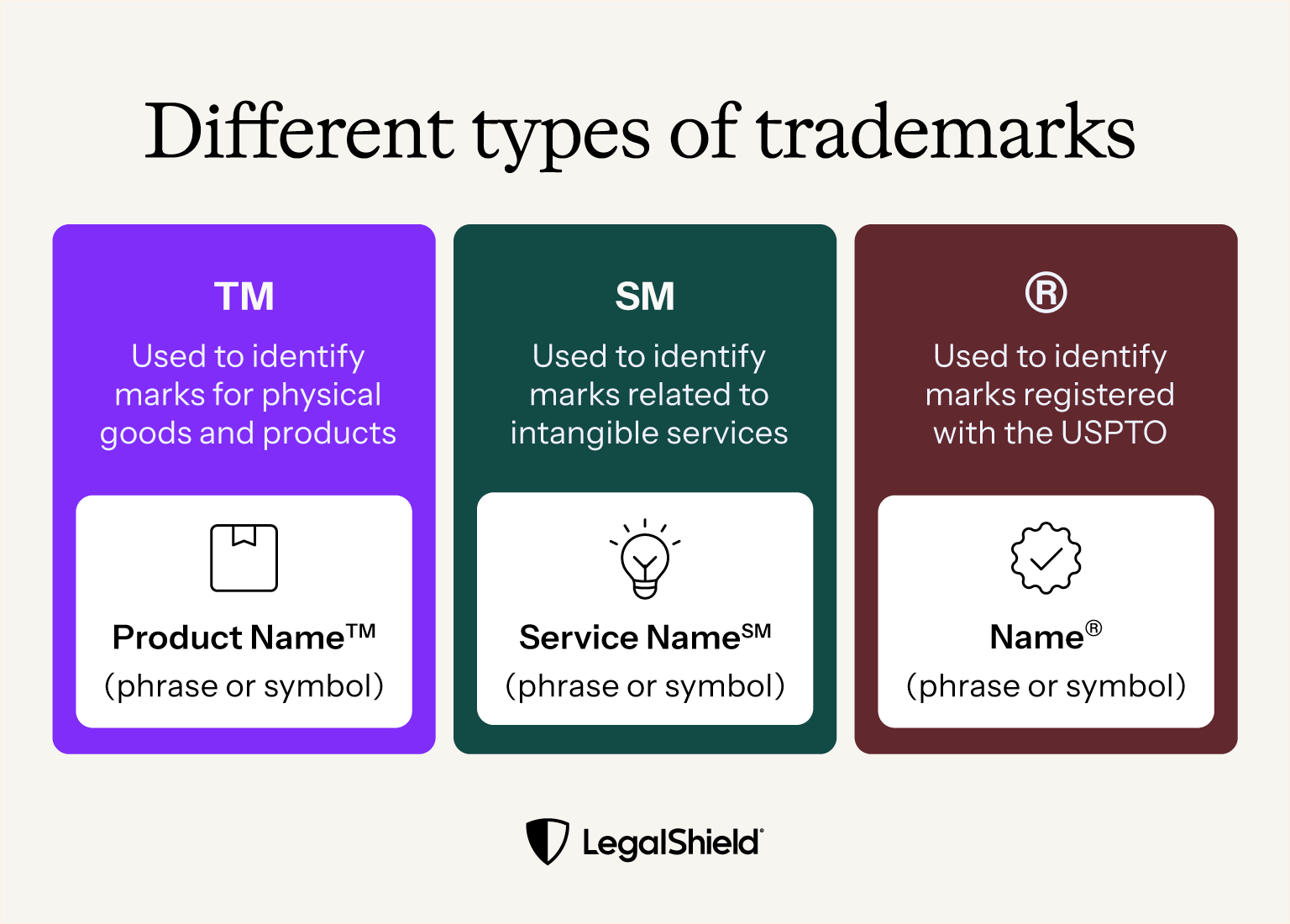
Anytime you use a trademark, you can add a symbol to it in order to identify it. If you haven’t registered a trademark, you can use ™ to identify goods and SM to identify services.
When you have a registered trademark, you can identify it with the ® symbol. You cannot use a ® without registration, as doing so can result in fines and penalties for false or misleading representation.
These symbols are most commonly placed after words in text, or in the corner of a design.
What is trademark infringement?
Trademark infringement happens whenever someone uses a trademark without permission within the same business category.
Trademark infringement is a complex area of law. It’s helpful to seek legal advice before taking action.
Get legal advice for your business with a LegalShield® Small Business Plan
Trademarks are an important part of launching your business because they help you create a space in the market that you can defend. People come to recognize you through your trademarks. This is a huge reason why trademarks are business assets you may want to control.
If you have questions about how to apply for trademarks or how to handle infringement, you can get legal advice from provider law firms through a LegalShield Small Business Advanced or Premium Plan. Included in your membership is limited consultation time with provider lawyers for trademarks.
LegalShield® is a trademark of Pre-Paid Legal Services, Inc. (“LegalShield”). LegalShield provides access to legal services offered by a network of provider law firms to LegalShield members through membership-based participation. Neither LegalShield nor its officers, employees or sales associates directly or indirectly provide legal services, representation, or advice. Small Business Legal Plans and certain benefits are not available in all states. See a Small Business Legal Plan contract for a specific state for complete terms, coverage, amounts, and conditions. The information made available in this blog is meant to provide general information and is not intended to provide legal advice, render an opinion, or provide a recommendation as to a specific matter. The blog post is not a substitute for competent legal counsel from a licensed professional lawyer in the state or province where your legal issues exist, and you should seek legal counsel for your specific legal matter. Information contained in the blog may be provided by authors who could be a third-party paid contributor. All information by authors is accepted in good faith, however, LegalShield makes no representation or warranty of any kind, express or implied, regarding the accuracy, adequacy, validity, reliability, availability, or completeness of such information.
Frequently Asked Questions
Trademark costs include application fees plus hourly legal fees if you use a traditional lawyer. The base fee for trademark applications is $350, but trademark applications cover narrow classes of products and services. If you need a trademark that crosses multiple classes, the fees add up per class.
Trademarks last for as long as you use them in commerce, and you must file documents at regular intervals to prove that they remain in use.
While it may not be required, the USPTO encourages applicants to use a lawyer. Trademark law is complex, and legal advice helps you get applications right.
No, U.S. trademarks don’t apply in other countries. Trademark rights are federally recognized in the U.S. and do not extend internationally.
Communications Director at LegalShield overseeing content creation designed to make legal protection simple and approachable. He focuses on offering straightforward, trustworthy guidance that empowers people to make informed decisions about their legal rights and responsibilities.
Copyright is an intellectual property right that gives the creator of a work the exclusive legal rights to it. These rights let creators sell and license the work they create, and it’s an important area of law for small business owners to understand.
Dissolving an LLC can be tricky, and doing it without guidance can lead to unnecessary stress and delays. We’ve put together some helpful information so you can start the LLC dissolution process with more peace of mind.
An employment contract is an important piece of paperwork because it defines the working relationship, your expectations, and conditions. Here are some of the common components included.
Virtual business addresses can be a practical option for those forming an LLC from home, working remotely, or trying to keep their business and personal mail separate.
By the end of this blog, you’ll get a high-level summary of trademarking a name and logo, how logos differ from business names and artwork, and how much it all costs.
A DBA is a name registration that lets you run your business under a name other than your personal legal name or legal business entity. While a DBA offers branding flexibility and market expansion opportunities without creating a new legal structure, it does not provide legal liability protection, tax benefits, or function as a business license.
An indemnity agreement settles the “who is responsible” question ahead of time. One party promises, in writing, to cover certain losses tied to the work, so the other isn't left with the bill. These promises appear in construction contracts, leases, and business sales.
•
6 min read
Thank you! You're subscribed!
Oops! Something went wrong while submitting the form.