A trademark application usually costs at least $350 per class to file with the federal government. Potential costs don’t end there, but legal assistance can help you minimize your expenses.
Creating your brand identity is hard work, and the last thing you want is for another company to use what you build. A trademark gives you legal options if someone else uses your brand name, logo, and slogans. You’re probably wondering if you can afford trademark costs. The real question is, can you afford not to trademark your intellectual property? We’re here to help you decide.
There’s no simple answer to how much a trademark costs. You’ll pay a base application fee. The total cost to trademark a name can increase based on how many trademark classes you want to enter and whether you get professional advice. A trademark class is a category that groups related goods or services, determining the scope of protection for a registered trademark. You may have to pay extra fees during the application process, along with ongoing renewal fees to keep your trademark protection active.
No need to stress, though. We’ll dive into the United States Patent and Trademark Office’s (USPTO) updated fee schedule for 2026.1 And, with a LegalShield® provider lawyer’s guidance, you can file for your trademark with confidence.
The mandatory government filing fees
Early in 2025, the USPTO increased trademark fees and changed the filing structure. The new Trademark Center replaced the Trademark Electronic Application System (TEAS).2 Those changes are still in effect for 2026. The fees you pay aren’t refundable — you pay them for the USPTO to review your trademark application.
You have two main trademark filing options. If you choose the $350 option, you have to follow strict rules. You’ll need to use pre-approved descriptions, found in the USPTO’s ID Manual3, for your names. You can select a more flexible application method, but it will cost you $550.
Includes an extra fee for writing your own descriptions in the free-form text box
Insufficient information (in Sections 1 and 44*)
$100
Charged if your application is missing required information
Surcharge for extra characters in the free-form text box (for Sections 1 and 44*)
$200
Each group of 1,000 characters past the first 1,000 in the text box
Amendment to allege use (AAU)
$150
Filed after a trademark application but before approval, certifying that you are already using the trademark in commerce
Statement of use (SOU)
$150
Proves that you are actively using your trademark in commerce after approval
Request for an SOU filing 6-month extension
$125
Paid to keep your application active until you're ready to file an SOU, can use up to 5 times, extensions 2-5 require you to show that you have a good cause for the delay and is subject to denial by the USPTO
Extension for delayed response to an office action during the trademark process (for Sections 1 and 44*)
$125
A one-time, 3-month deadline extension request
*Section 1 is “use in commerce,” and Section 44 is a “foreign application.”
How trademark fees can add up
What a trademark covers is necessarily limited. You may need separate trademarks for names, logos, advertising slogans, and products.
Products and services are separated into distinct categories called trademark classes, and each class requires a separate filing fee.5
Making mistakes on your trademark application can cost more and lead to rejection
Filing for a trademark doesn’t mean you’ll get it. The USPTO reviews every application carefully before it approves or denies them. Many rejections are due to preventable mistakes.
You may have the chance to correct minor errors like typos and address changes. But, if the office doesn’t approve your application, you’ve spent the money with nothing to show for it. Getting legal assistance early is a great way to avoid mistakes, but here are a few to watch for.
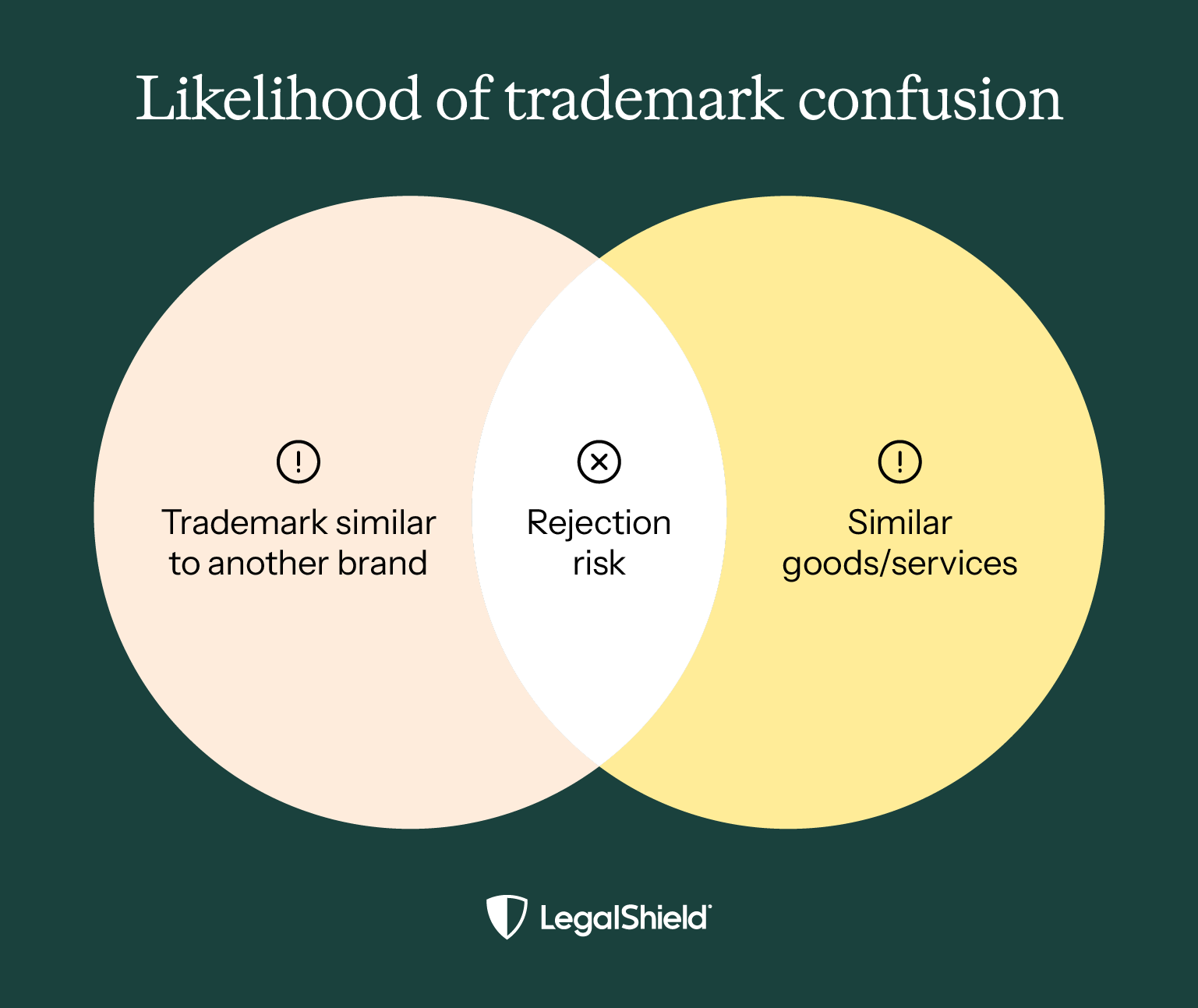
Likelihood of confusion
The most common reason for rejection is that the name you want is too much like another brand in your industry. The USPTO checks spelling and sounds. They also look at whether customers might mix up the two brands. For example, changing “charms” to “charmz” probably isn’t enough to get your application accepted.
Generic or descriptive names
The USPTO won’t let you trademark a generic name or one that just describes something. For example, “Freshly Brewed Coffee” isn’t creative or unique enough. You need to find a name that distinguishes your product, service, or company from others. That’s a big part of building a strong brand identity.
Technical errors
If you use incorrect descriptions or the wrong class on your trademark application, the USPTO may ask you to fix those mistakes. The same goes for submitting an incomplete application. You’ll pay a fee, or those errors could even cause a denial.
Legal help vs. filing on your own
You have three paths toward filing for a trademark: Hire a traditional law firm, use a legal service, or do it yourself. The cost and level of support are different for each option. You need to understand what’s involved before you decide.
LegalShield and affordable legal access
You want legal advice, but you don't want to pay a lot to get it. Working with LegalShield provider lawyers gives you the best of both worlds. You get experienced legal guidance and document reviews to help you catch errors.
LegalShield Business Plans cover a variety of business issues. On the Advanced and Premium Plans, you can consult with a LegalShield provider lawyer to ask questions about trademarks.
Hire your own law firm
It’s understandable that you may want legal help with your trademark application. If you hire a lawyer on your own, you need to be aware of how much it can cost.
Your total cost could be well over $1,000 per basic application. If there are complications, the firm may charge you an extra $300 to $400 per hour to help you resolve them. On top of those hourly fees, they usually charge for every email and phone call. Not knowing exactly how much the services will cost makes budgeting hard.
File it yourself
Filing your application on your own is definitely the cheapest option initially, but it is also the riskiest option. If you make a mistake, the USPTO will either charge you to let you fix it or deny your application. You won’t get your money back for a denied application.
Extra costs you might face later
You could face more costs during the examination process, and you’ll also have ongoing fees to keep a trademark active.
During the approval process, you might need to respond to an Office Action. That’s a USPTO notice that explains why it can’t approve your trademark yet. You have the chance to fix your mistakes, and you’ll usually have a default 3-month deadline. If needed, you can pay $125 for a one-time, 3-month extension. You may also need to hire a lawyer to help you fix the mistakes if you aren’t clear about how to do it on your own.
If your company hasn’t started using a trademark in commerce yet, you can file a trademark application based on your intent to use it. This holds your place in line. If the USPTO accepts your application, it will issue you a Notice of Allowance, which will have an associated fee. You’ll need to pay $150 to file a Statement of Use (SOU) within 6 months of your Notice of Allowance to prove actual use. If the trademark is not yet in use, you can also request 6-month extensions for up to 3 years, with each costing an extra $125.
If you start using the trademark before approval, you can file an Amendment to Allege Use. That costs $150.
Your trademark has an expiration date. You have to file documents and pay fees to keep it active. Your maintenance schedule typically follows this pattern:
Between years 5 and 6 after the registration date: filing a Declaration of Use and/or Excusable Nonuse and paying $325
Between years 9 and 10 after registration: filing a Declaration of Use and/or Excusable Nonuse and an Application for Renewal, and paying $575
Every 10 years thereafter: filing a Declaration of Use and/or Excusable Nonuse and an Application for Renewal, and paying $575
Missing those deadlines comes with a high cost. You could lose your trademark, and others could start using the name you had been protecting.
Is the cost of a trademark worth it for a small business?
The trademark cost seems like a lot, but it could save you money in the long run. A registered trademark is a business asset, so the cost is an investment. If you decide to expand or sell your business, the trademark can add to your company’s value.
If someone else trademarks your name first, you may have to rebrand. That would mean paying for new marketing materials, and it could also lead to lost sales and customer mistrust. It could even result in legal fees as you resolve the issue.
Protecting your brand early helps prevent costly legal fees later. It also gives you more control over your brand identity.
Turn trademark costs into a smart investment with LegalShield
Trademarking your intellectual property helps to protect your brand. Knowing how much a trademark costs helps you plan your budget. It also helps you make smart business choices.
Your LegalShield Membership lets you talk to an experienced provider law firm. Plans start around $2/day. You can ask for advice about trademarks, business taxes, and more. Help protect your brand early with a LegalShield Membership.
Pre-Paid Legal Services, Inc. (“LegalShield”) provides access to legal services offered by a network of provider law firms to LegalShield members through membership-based participation. Neither LegalShield nor its officers, employees or sales associates directly or indirectly provide legal services, representation, or advice. Small Business Legal Plans and certain benefits are not available in all states. See a Small Business Legal Plan contract for a specific state for complete terms, coverage, amounts, and conditions. The information made available in this blog is meant to provide general information and is not intended to provide legal advice, render an opinion, or provide a recommendation as to a specific matter. The blog post is not a substitute for competent legal counsel from a licensed professional lawyer in the state or province where your legal issues exist, and you should seek legal counsel for your specific legal matter. Information contained in the blog may be provided by authors who could be a third-party paid contributor. All information by authors is accepted in good faith, however, LegalShield makes no representation or warranty of any kind, express or implied, regarding the accuracy, adequacy, validity, reliability, availability, or completeness of such information.
Content Specialist at LegalShield, creating educational resources about legal and consumer protection topics. She focuses on making complex legal and financial concepts accessible to readers and has contributed to various educational articles on consumer rights and protections.
Dissolving an LLC can be tricky, and doing it without guidance can lead to unnecessary stress and delays. We’ve put together some helpful information so you can start the LLC dissolution process with more peace of mind.
An employment contract is an important piece of paperwork because it defines the working relationship, your expectations, and conditions. Here are some of the common components included.
Virtual business addresses can be a practical option for those forming an LLC from home, working remotely, or trying to keep their business and personal mail separate.
By the end of this blog, you’ll get a high-level summary of trademarking a name and logo, how logos differ from business names and artwork, and how much it all costs.
A DBA is a name registration that lets you run your business under a name other than your personal legal name or legal business entity. While a DBA offers branding flexibility and market expansion opportunities without creating a new legal structure, it does not provide legal liability protection, tax benefits, or function as a business license.
An indemnity agreement settles the “who is responsible” question ahead of time. One party promises, in writing, to cover certain losses tied to the work, so the other isn't left with the bill. These promises appear in construction contracts, leases, and business sales.
A certificate of good standing is official proof from your state that your business is registered and current on its requirements. Most lenders and agencies want a recent one, so it helps to know how to get it before someone asks.
Whether the goal is selling a company, bringing in a business partner, or passing it to a family member, the LLC ownership transfer often involves reviewing the LLC's operating agreement and the applicable state's rules.
•
11 min read
Author Name
,
Author Title
August 4, 2026
Thank you! You're subscribed!
Oops! Something went wrong while submitting the form.