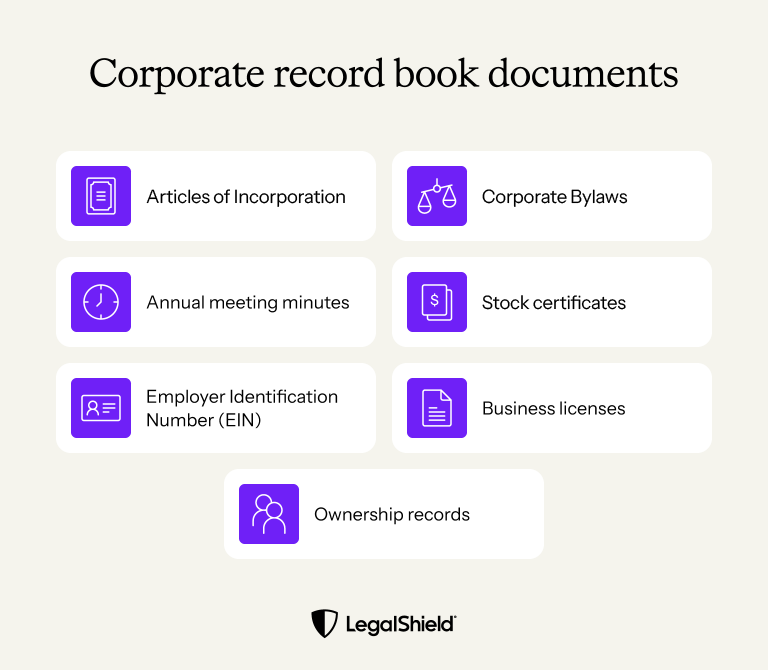
A corporate record book is a collection of important company documents. Some of these include Articles of Incorporation, shareholder meeting minutes, and corporate Bylaws.
You might think that incorporating your business is a “one-and-done” task. But running a corporation, no matter how small, requires ongoing documentation. Without a comprehensive record book, it’s harder to find and follow your corporate rules and meet reporting requirements.
A strong record book can also help you avoid disputes and liability. We’re here to go over what documents you need, how to keep the book updated, and how legal assistance makes the whole process easier.
What exactly is a corporate record book?
A corporate record book is a collection of important corporate papers. This includes documents such as Articles of Incorporation, meeting minutes, and Corporate Bylaws. Sometimes referred to as a “corporate kit,” you can think of this book as a diary or journal of the “life” of a corporation.
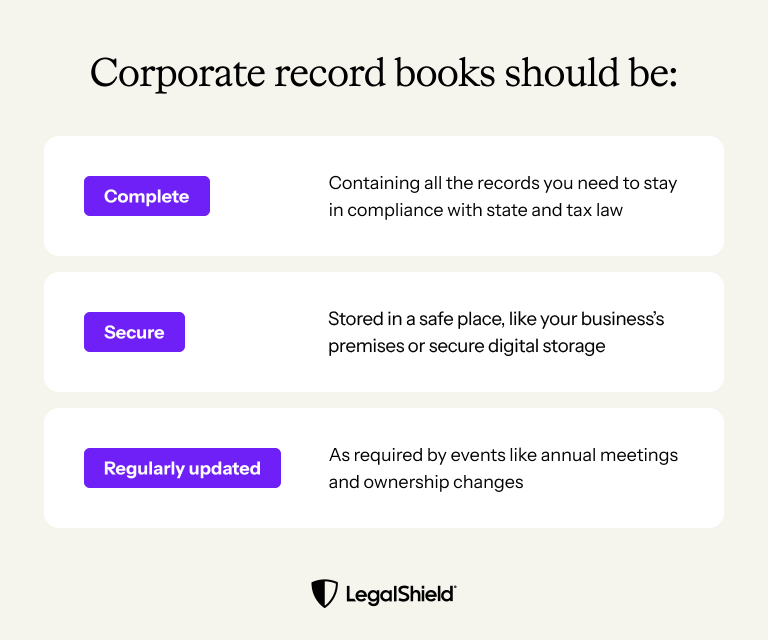
Keep in mind that creating a corporate record book isn’t usually a legal requirement. Corporations are just required to keep accurate records of their internal operations. Having these records organized and kept in a corporate book is important for demonstrating these essential facts:
In the past, most incorporating businesses would create a physical book. It would often have leather binding, premium paper, and a fancy seal.
Today, many corporations forgo the physical corporate kit. Instead, they keep their important documents in electronic form. If using a physical form, it may be less formal, such as a three-ring binder.
Why keeping these records matters
Having a corporate record book can offer two important benefits. The first is to protect the owner’s personal assets during a lawsuit or other challenge to the company. The second is to verify financial transactions. Together, they can provide a nice protective barrier for your company.
Records support business compliance
An important benefit of incorporating is reducing personal liability for its owners. This is because the law frequently treats companies as separate legal entities from individuals. But to enjoy this benefit, business owners must meet certain obligations to maintain this separation.
These include financial obligations, such as tax reporting and separating individual and business funds. They also include state legal compliance obligations, like documenting bylaws and annual meeting minutes.
They also include state legal compliance obligations, like documenting bylaws and annual meeting minutes.
Keeping a corporate book helps document the business’s activities to demonstrate that you’re doing everything you’re supposed to do. Documentation helps to resolve internal disputes and helps you keep liability protection by demonstrating that you’re following the rules.
Corporate verification
Banks and investors are more comfortable transferring money to a business that can prove it is properly formed and operated.
Any significant business transaction, like an investment, sale of your business, or a merger, requires “due diligence.” This is a process in which the people involved investigate your business to make sure you’re accurately representing it.
Documents you might need for your corporate record book
Every corporate book will be as unique as the people who own and run the company.While this article is focused on corporate record books, LLCs can also have company record books. However, you can expect most record books to include the following documents:
Articles of Incorporation. They establish the business as a separate legal entity. They also provide the business’s name, structure, and other key characteristics.
Corporate Bylaws. This document is like the business's instruction manual. It lists the rules and procedures for how the business operates.
Meeting minutes. These are notes from important business meetings. They often serve as a record of important decisions.
Stock certificates. A corporation must maintain detailed, accurate ownership records. They identify the owners and each owner's interest in the company.
Employer Identification Number (EIN). You’ll want to have a copy of the EIN confirmation letter from the IRS readily available.
Business licenses. It’s helpful to have all copies of the business’s licenses in a single location that’s easy to access.
Ownership records. Not all corporate record books will include a historical record of prior owners. However, having a list of current and past owners, officers, and directors can be convenient, especially during litigation.
How to get your record book started
You’ll need to choose the type of record book to make and how to store it.
Creating a corporate record book
Ideally, you’ll create one with the help of a lawyer when you set up your corporation. Your lawyer will also advise you on the best way to compile and store it.
Alternatively, you can take a more do-it-yourself approach. In either case, this will involve choosing between a physical book and a digital one.
Corporate record book form
If selecting the physical route, there are pre-made corporate kits available. Or you can use a basic three-ring notebook or folder and loose-leaf pages. The most important thing is to make sure it’s complete and updated. It doesn’t hurt to make it as presentable as possible.
If you choose digital, develop a system to keep all files organized and easy to access. The last thing you want is a single folder with hundreds of randomly named files. You don’t want users to have to click on each file to see what’s inside. If possible, use an electronic storage system that is keyword searchable.
Record book storage
Whichever form you use, store it in a secure and easily accessible place. This might be a fireproof safe at the office or in encrypted digital files in the cloud.
Before storing corporate records, it’s a good idea to have a lawyer review them. Not only does this make sure the book isn’t missing anything, but if you need business advice from that lawyer in the future, they’ll have some familiarity with your business.
Keeping your records fresh and updated
Corporate record books should change with your business. You may want to designate someone to update it when certain changes occur with your company. You should add notes after meetings or major votes. This will make updating the record book feel less burdensome.
Depending on the size of your business, you can choose a dedicated person to make these changes. For a corporation, that person is usually the corporate secretary. Other triggers might also require a change to your corporate record book include:
Changing the business’s name
Moving to a new office
Adding new owners
Filing a business tax return
Updating Articles of Incorporation
Amending the corporate Bylaws
Making resolutions or other important decisions
Entering into contracts
Entering into employment agreements with executives or other key personnel
It’s a good idea to review the corporate record book at least once a year.
Protect your business today for a more secure tomorrow
A LegalShield® Small Business Plan makes the task of creating and updating a corporate record book easier. Enrollment offers access to a provider lawyer who can review your corporate Bylaws to confirm they meet state requirements.
A LegalShield provider lawyer may also offer additional legal services. This could include offering advice if you want to register another business. They can answer questions about a board or shareholder meeting. They’ll help you make sure your corporate liability shield remains strong and able to protect your business.
Pre-Paid Legal Services, Inc. (“LegalShield”) provides access to legal services offered by anetwork of provider law firms to LegalShield members through membership-basedparticipation. Neither LegalShield nor its officers, employees or salesassociates directly or indirectly provide legal services, representation, oradvice. Small Business Legal Plans and certain benefits are not available inall states. See a Small Business Legal Plan contract for a specific state forcomplete terms, coverage, amounts, and conditions. The information madeavailable in this blog is meantto provide general information and is not intended to provide legal advice, render an opinion, orprovide a recommendation as to a specific matter. The blog post is not asubstitute for competent legal counsel from a licensed professional lawyer inthe state or province where your legal issues exist, and you should seek legalcounsel for your specific legal matter. Information contained in the blog maybe provided by authors who could be a third-party paid contributor. Allinformation by authors is accepted in good faith, however, LegalShieldmakes no representation or warranty of any kind, express or implied, regardingthe accuracy, adequacy, validity, reliability, availability, or completeness ofsuch information.
Content Specialist at LegalShield, creating educational resources about legal and consumer protection topics. She focuses on making complex legal and financial concepts accessible to readers and has contributed to various educational articles on consumer rights and protections.
Dissolving an LLC can be tricky, and doing it without guidance can lead to unnecessary stress and delays. We’ve put together some helpful information so you can start the LLC dissolution process with more peace of mind.
An employment contract is an important piece of paperwork because it defines the working relationship, your expectations, and conditions. Here are some of the common components included.
Virtual business addresses can be a practical option for those forming an LLC from home, working remotely, or trying to keep their business and personal mail separate.
By the end of this blog, you’ll get a high-level summary of trademarking a name and logo, how logos differ from business names and artwork, and how much it all costs.
A DBA is a name registration that lets you run your business under a name other than your personal legal name or legal business entity. While a DBA offers branding flexibility and market expansion opportunities without creating a new legal structure, it does not provide legal liability protection, tax benefits, or function as a business license.
An indemnity agreement settles the “who is responsible” question ahead of time. One party promises, in writing, to cover certain losses tied to the work, so the other isn't left with the bill. These promises appear in construction contracts, leases, and business sales.
A certificate of good standing is official proof from your state that your business is registered and current on its requirements. Most lenders and agencies want a recent one, so it helps to know how to get it before someone asks.
Whether the goal is selling a company, bringing in a business partner, or passing it to a family member, the LLC ownership transfer often involves reviewing the LLC's operating agreement and the applicable state's rules.
•
11 min read
Thank you! You're subscribed!
Oops! Something went wrong while submitting the form.