Franchising lets you grow your brand by letting others run your business. They pay you fees and ongoing royalties to use your name and systems.
You built something that works. Now you want to build it everywhere. But knowing how to franchise your business takes more than enthusiasm. It takes documented systems, legal preparation, and the right partners.
The benefits of franchising your business are real. Your brand can grow faster, reach new markets, and build a royalty income stream that compounds as your network grows. The six steps below outline what to keep in mind when building a franchise system.
Step 1: Assess your business for franchise readiness
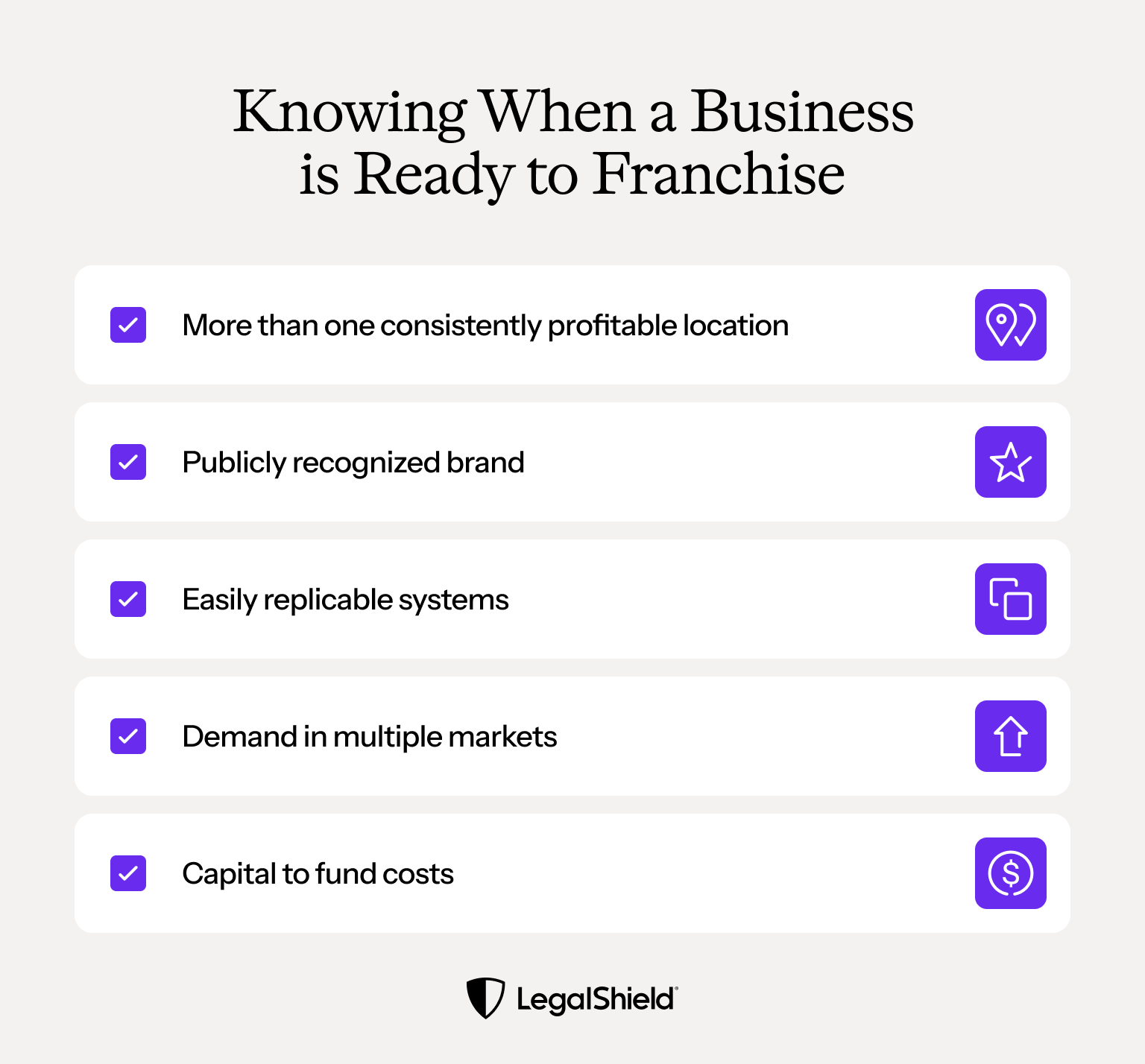
A great business and a franchise-ready business are not always the same thing. Before you decide how to franchise your business, ask whether it passes the readiness test. As you're assessing whether your business is ready to franchise, honestly ask yourself if you've achieved:
Consistent profitability across multiple periods or existing locations
A strong, recognizable brand with a clear identity
A replicable model that doesn't depend on you personally to work
Easily replicable systems, or a clear path to building them
A unique selling proposition with proven, ongoing market demand
Working capital to fund the cost to franchise your business ($50,000 to $500,000 or more)
Common mistakes to avoid before you franchise
Even well-prepared business owners can stumble at this stage. Here are the most common mistakes to watch for:
Franchising before the model is fully documented and tested at scale
Underestimating how much time and money the franchising process actually requires
Skipping trademark registration before licensing your brand to others
Failing to thoroughly check out potential franchisees
Treating franchisees like employees rather than independent business owners with contractual rights
Selling the first franchise before the support infrastructure is in place to back it up
Rushing into registration states without understanding their specific requirements
Speaking with a lawyer before you begin can help you catch these issues early and make sure your contracts and trademark registrations are in order.
Step 2: Develop a comprehensive franchise business plan
Territory rights are one of the first decisions you'll make as a franchisor. Geographic exclusivity matters greatly to franchisees. They want protection from both outside competitors and other franchisees in your own system.
Your business plan also needs a realistic development schedule. How many new franchisees do you plan to bring on in year one? Year three? What staffing and infrastructure do you need to support each new cohort?
Most new franchise systems start small and grow gradually before accelerating. Growing faster than your support capacity is one of the fastest ways to damage a young franchise brand.
Brand standards are the final piece of your plan and typically cover things like:
Signage
Uniforms
Product or service specifications
Customer experience protocols
Pricing guidelines
Marketing materials
A LegalShield® Membership gives you access to provider law firms that can review your franchise plan and advise on compliance requirements from the start. Getting legal guidance early helps you avoid costly revisions later.
Step 3: Document your systems in a detailed operations manual
Writing an operations manual is probably not your idea of a good time. But it is the document that turns your business into a business someone else can run.
The operations manual is the written blueprint for replicating everything you have built. It tells a franchisee exactly how to open, run, and close your business every single day, without you there to explain it.
Your manual needs to cover every critical area of the operation:
Standard operating procedures (SOPs) for every key process
Customer service protocols and scripts
Marketing guidelines and brand standards
Technology system instructions and login protocols
Financial reporting requirements and templates
Quality control processes and audit checklists
Opening and closing procedures
HR and staffing guidelines
A well-drafted operations manual does two important things. First, it protects your brand. Every customer gets the same experience regardless of which location they visit. Second, it can protect you legally. The manual is documented proof of what franchisees are instructed to do.
Step 4: Navigate legal requirements and the FDD
The Franchise Disclosure Document (FDD) is the legal centerpiece of your franchise offering. You must provide every prospective franchisee with a complete FDD at least 14 days before they sign anything or pay any money. The FDD must contain 23 specific items about you and your business, including:
Background information
Litigation history
Financial performance
Franchise agreement terms, fees, and royalties
The Federal Trade Commission (FTC) requires that franchisors prepare FDDs with the support of legal counsel. The legal review time helps ensure your brand structure is ready for launch.
State franchise registration requirements depend on where you plan to sell. Here is how states break down:
Registration states (FDD review and approval required before selling): California, Hawaii, Illinois, Indiana, Maryland, Michigan, Minnesota, New York, North Dakota, Rhode Island, South Dakota, Virginia, Washington, Wisconsin
Filing states (notice filing and fee required, no FDD review): Connecticut, Florida, Kentucky, Maine, Nebraska, North Carolina, Oregon, South Carolina, Texas, Utah
Federal states (FDD disclosure required, no state filing needed): Alabama, Alaska, Arizona, Arkansas, Colorado, Georgia, Idaho, Iowa, Kansas, Louisiana, Massachusetts, Mississippi, Missouri, Montana, Nevada, New Hampshire, New Jersey, New Mexico, Ohio, Oklahoma, Pennsylvania, Tennessee, Vermont, West Virginia, and Wyoming.
Franchise disclosure document requirements are complex. FTC violations can force you to rescind franchise agreements and return every dollar a franchisee paid you.
Step 5: Establish your franchise fee and royalty structure
The initial franchise fee is the one-time payment a franchisee makes upon signing the franchise agreement. According to the Small Business Administration, the average initial franchise fee for most businesses ranges from $20,000 to $50,000. Popular or established brands can charge significantly more.
Long-term income from franchises comes from royalties. Most franchisors charge a monthly royalty based on a percentage of the franchisee's gross revenue. The typical range is 5% to 9%.
You'll also want to establish a marketing fund contribution of 1% to 2% of gross revenue to fund shared advertising. Some franchise systems also add flat technology fees where applicable.
Step 6: Recruit and onboard the right franchise partners
Not everyone who wants to buy your franchise should be approved. A bad franchisee reflects on your entire brand, not just their location. Look for candidates with sufficient capital, relevant business experience, and genuine alignment with your values.
Help your franchisees set up their businesses properly from the start and provide the training they need to succeed. A strong onboarding program covers:
Initial training at your corporate location or headquarters
Operational training on all SOPs and systems
Marketing and customer acquisition training
Financial management and reporting training
HR training to include employee management
Technology system training
On-site support during the franchisee's opening period
Ongoing refresher training as your systems evolve
Franchisors who build strong ongoing support systems produce stronger franchisees. That means marketing assistance and regular operational audits. Plan on providing regular technology updates. Consider hiring a dedicated support person whom franchisees can actually reach.
Get legal assistance to start a franchise
But each step, from building your operations manual to filing your FDD to registering your trademark, carries real legal weight. Skipping steps or moving too fast can cost you far more than the time you saved.
Getting legal guidance early makes the entire process smoother and protects your brand as it grows. A LegalShield Membership connects you with provider law firms that can provide consultations and review your franchise documents.
Communications Director at LegalShield overseeing content creation designed to make legal protection simple and approachable. He focuses on offering straightforward, trustworthy guidance that empowers people to make informed decisions about their legal rights and responsibilities.
Dissolving an LLC can be tricky, and doing it without guidance can lead to unnecessary stress and delays. We’ve put together some helpful information so you can start the LLC dissolution process with more peace of mind.
An employment contract is an important piece of paperwork because it defines the working relationship, your expectations, and conditions. Here are some of the common components included.
Virtual business addresses can be a practical option for those forming an LLC from home, working remotely, or trying to keep their business and personal mail separate.
By the end of this blog, you’ll get a high-level summary of trademarking a name and logo, how logos differ from business names and artwork, and how much it all costs.
A DBA is a name registration that lets you run your business under a name other than your personal legal name or legal business entity. While a DBA offers branding flexibility and market expansion opportunities without creating a new legal structure, it does not provide legal liability protection, tax benefits, or function as a business license.
An indemnity agreement settles the “who is responsible” question ahead of time. One party promises, in writing, to cover certain losses tied to the work, so the other isn't left with the bill. These promises appear in construction contracts, leases, and business sales.
A certificate of good standing is official proof from your state that your business is registered and current on its requirements. Most lenders and agencies want a recent one, so it helps to know how to get it before someone asks.
Whether the goal is selling a company, bringing in a business partner, or passing it to a family member, the LLC ownership transfer often involves reviewing the LLC's operating agreement and the applicable state's rules.
•
11 min read
Author Name
,
Author Title
August 4, 2026
Thank you! You're subscribed!
Oops! Something went wrong while submitting the form.