A trade name (sometimes called a "doing business as" name, “DBA”, assumed name, or fictitious business name) is the name a business uses with customers instead of the individual owner's legal name or registered entity name.
If you want to do business under a name that isn't your own legal name or your LLC's registered name, you need a trade name, also known as a doing business as (DBA) name. The hardest part is the registration process, which varies by state and sometimes by county. It's also easy to confuse a trade name with a trademark, which is a different thing entirely.
This blog is for small business owners and sole proprietors who want a brand identity that is separate from their legal entity. We'll cover what a trade name is, how it differs from a trademark, and the steps to add a DBA to an LLC or corporation if you decide you need one.
What is a trade name?
A trade name lets you operate a business using a different name than the one you registered, without setting up a whole new company to do it. It's what shows up on your storefront sign and your invoices instead of what’s on your tax forms.
A trade name might sometimes be called a "doing business as" name, “DBA”, assumed name, or fictitious business name.
If you register a DBA with your state or county, you're registering a trade name. The terms are used interchangeably in most jurisdictions. Let’s take a look at some examples:
A sole proprietor named Jane Smith offers freelance design services. Instead of sending invoices that read "Jane Smith," she registers the trade name Jane's Graphic Design so her marketing and billing look more established, It also protects the name from someone else using it as their entity name in her state or the states in which she has formed her business.
An LLC called Midwest Hospitality LLC owns a small coffee shop. The LLC files a trade name, The Cozy Cafe, so customers see a clean brand on the door instead of the company’s formally filed name.
In both cases, the legal entity stays the same, and the trade name is just what the customer sees.
Trade name vs. legal name vs. trademark: key differences
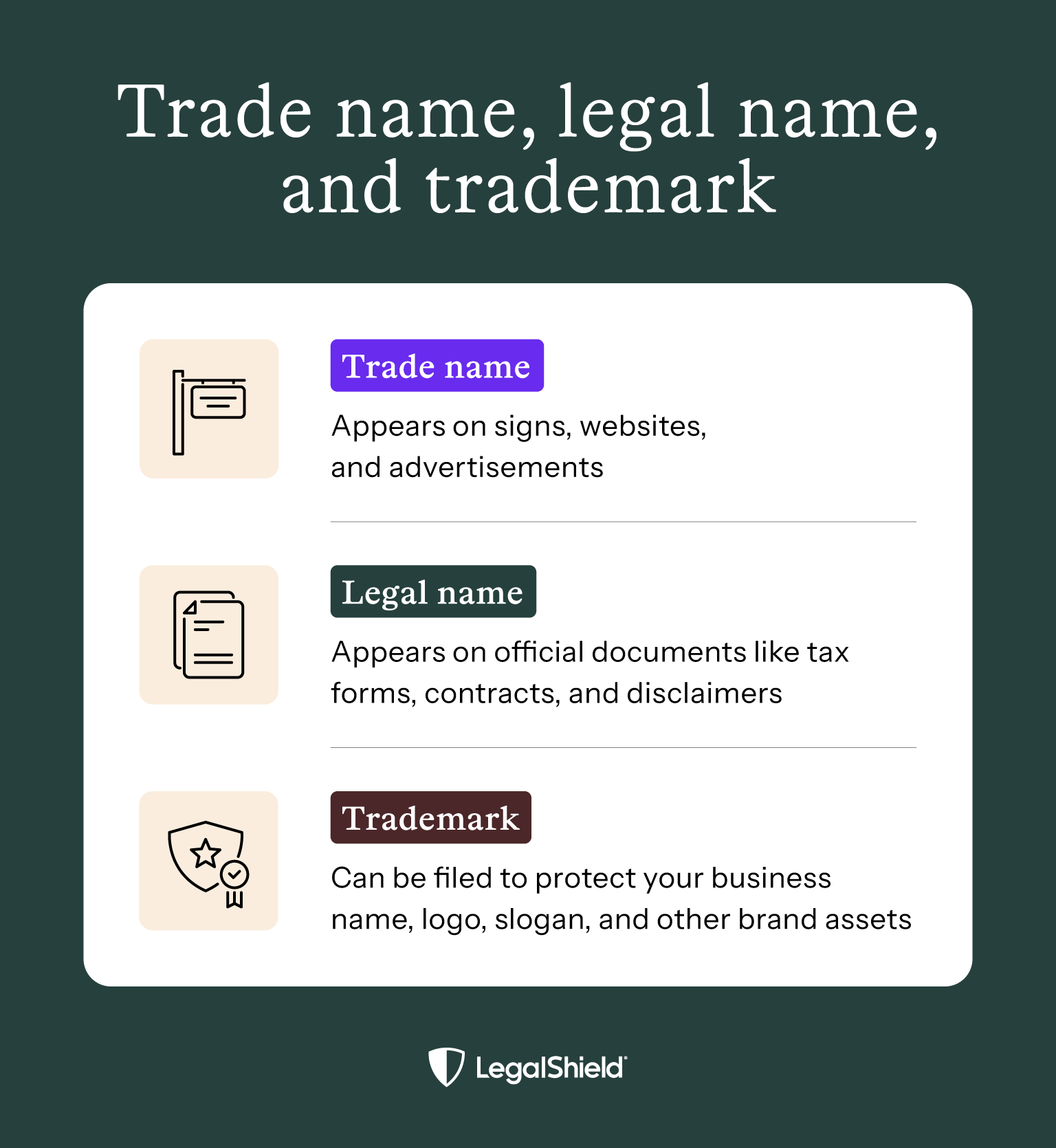
The terms trade name, legal name, and trademark sometimes get used interchangeably , but they refer to three different things.
A trade name is who you are to the public, a legal name is who you are to the government, and a trademark is how you defend your brand.
Registering a trade name does not give you exclusive nationwide rights. It just notifies the state or county that you are using the name. For stronger protection, you may need to consider a federal trademark.
Check out how the three compare to each other:
Trade name (DBA)
Legal name
Trademark
Definition
The public-facing name used for marketing and sales
The official name used for government and tax purposes
A legal protection for brand assets (names, logos, slogans)
Purpose
Building a brand identity that is distinct from the legal entity
Identifying the legal entity for contracts, lawsuits, and taxes
Preventing competitors from using similar marks and confusing customers
Scope of protection
Very limited; allows you to operate under the DBA and may have some protections against others registering a similar name (however, this is up to the State's discretion)
Prevents others in the same state from using that exact name
Strongest protection; provides exclusive rights nationwide
If you already have an LLC and want to know whether you also need a trade name, learning the difference between a DBA and LLC can help you decide which filings actually matter for your business.
4 reasons businesses use a trade name
Even when your state doesn't legally require one, most small business owners end up filing a trade name anyway. There are four main reasons they register a DBA:
Banking requirements
To open a business checking account in a name other than your own, banks need to see a registered trade name on file. For sole proprietors, this is usually the first reason to file.
If you want checks made out to "Jane's Graphic Design" going into a business account, you need paperwork showing that the name is yours. Mixing personal and business funds also creates bookkeeping problems at tax time. A separate bank account in the DBA name helps keep records organized.
Professional branding
A trade name lets a sole proprietor look more like an established company rather than a person freelancing. Customers tend to see a branded name as more trustworthy, and it gives you something to build a website and marketing around. It can also help you outgrow your own name. If your business eventually expands and you bring on investors, "Jane's Graphic Design" is a much easier sell than "Jane Smith LLC."
Business expansion
Forming a separate company for every new product line gets expensive. A trade name lets you launch new offerings under your existing business, without the extra filing fees or paperwork. However, before you rely on trade names for different business lines, it’s a good idea to consult with a lawyer.
Legal compliance
Many states legally require you to register a DBA that will be in public-facing operations and is not the owner's full legal name or the exact registered entity name. Operating under an unregistered trade name could result in fines or leave you unable to enforce contracts in court. Even if your state’s laws are looser, registering creates a paper trail that proves when you started using the name, which can help if someone else later tries to claim it.
How to register a trade name
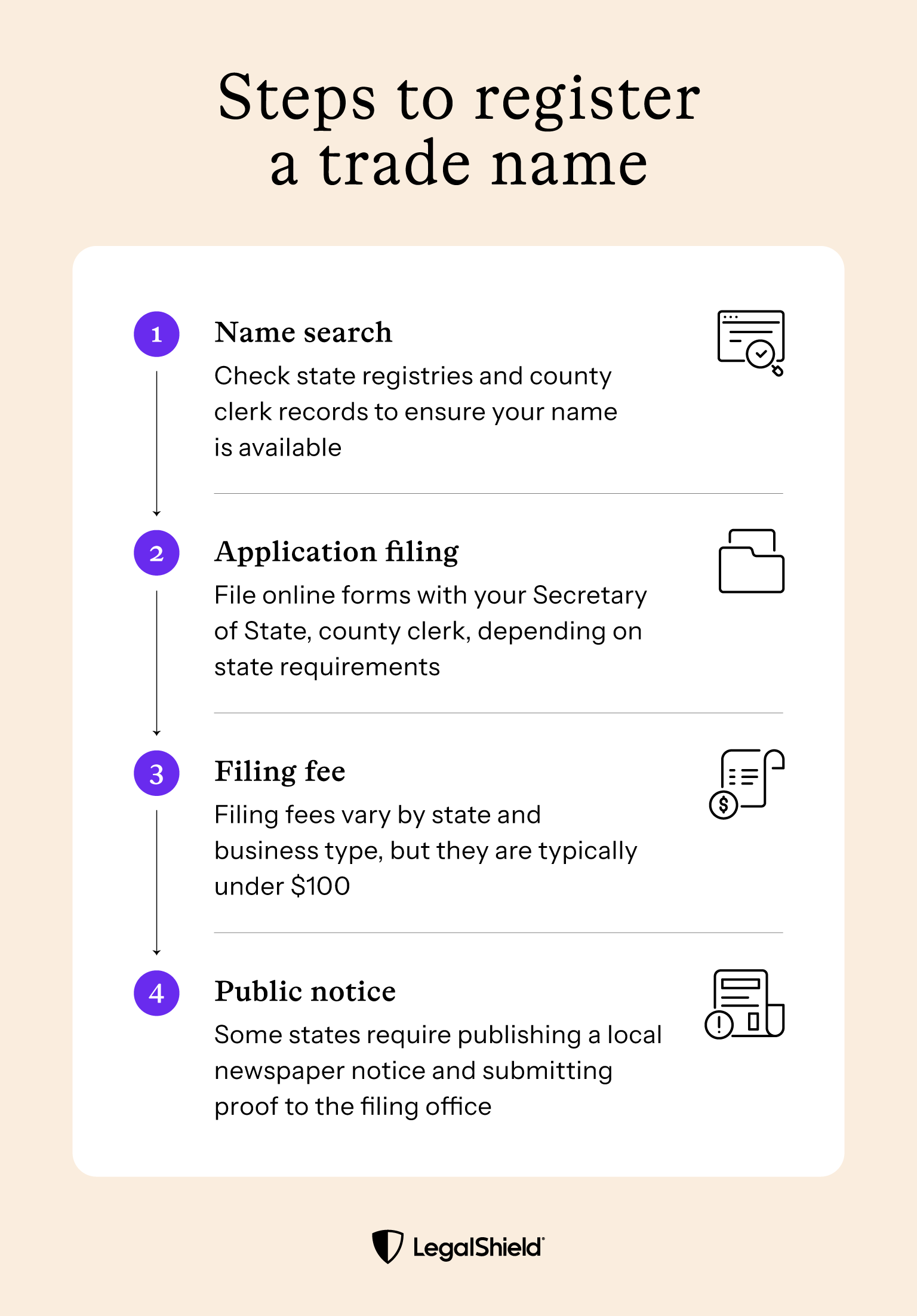
Exact requirements vary by state, but here's what the process often involves:
Name search: Most states require a search of the business registry and county clerk records to confirm the name is available. It's also worth checking the USPTO trademark database for any trademarks that match your desired trade name and running a web search.
Application filing: The application typically goes to the Secretary of State or county clerk, depending on the state. Some states require both. Forms are usually available online.
Filing fee: Fees vary, but they’re typically under $100, depending on the state and business type. Some states charge separate fees for each county where the business operates.
Public notice: A handful of states still require publishing a notice in a local newspaper for a set number of weeks, then submitting proof of publication to the filing office.
A LegalShield Small Business Plan connects you with a provider law firm to provide guidance on DBA registration. You also get phone consultations, document review for contracts and vendor agreements, and consultation on collection issues if a customer doesn't pay.
State-specific trade name requirements and rules
Trade name rules vary from state to state. Look out for some of these important differences:
Where to file: In many states, you file with the Secretary of State, while in others, you file at the county or even city level.
Digital vs. paper systems: Some states have modern online portals, while others still require mail-in forms and notarization. Delaware, for instance, moved its DBA registration to a single online portal (Delaware One Stop) in February 2026, replacing the old county-by-county system.
Publication requirements: Several states still follow older rules requiring you to publish a notice of your new trade name in a local newspaper for multiple weeks, then submit proof of publication to the state. If you skip this step, the state can reject your filing.
Renewal cycles: Some states make you renew every five or ten years, while others don't require renewal at all. If you miss a deadline, you can lose your name rights to a competitor who files for the same name.
Check your county clerk and Secretary of State websites to confirm filing requirements and renewal deadlines. A LegalShield Provider Law Firm can help you ensure you’re meeting all the requirements.
Help protect your brand with professional legal support
Registering a trade name is one of the easier legal tasks a small business owner can take. Most of the others come up as you actually run the business.
If you want help with small business legal issues, a LegalShield Small Business Plan gives you access to a provider law firm for consultation.
Frequently Asked Questions
Sometimes, yes. Trade name registration is usually state-specific, so two businesses in different states can often use the same name without issue.
The trouble starts when two businesses with the same name are in the same industry or market. That's when you get customer confusion and the potential for a trademark fight, especially if one of them has a federal trademark on the name.
No. A trade name is just a name. It doesn't create the legal separation between you and your business that an LLC or corporation does. That separation, often called the "corporate veil," is why an LLC owner usually doesn't have personal assets on the line in a business lawsuit, while a sole proprietor does.
No. Your trade name operates under the EIN of the entity or Social Security number of the person who registered it. The IRS sees the legal entity or owner behind the trade name, not the trade name itself. You'd only need a new EIN if you also form a new legal entity to go with the new name.
Yes. If you decide to rebrand, you can change or withdraw the existing registration and file a new one.
The process varies by state. Some let you change the existing filing, while others want you to cancel the old name and start fresh. Once you've landed on a name you plan to stick with, it's worth looking at trademarking your business name for stronger long-term protection.
Content Specialist at LegalShield, creating educational resources about legal and consumer protection topics. She focuses on making complex legal and financial concepts accessible to readers and has contributed to various educational articles on consumer rights and protections.
Dissolving an LLC can be tricky, and doing it without guidance can lead to unnecessary stress and delays. We’ve put together some helpful information so you can start the LLC dissolution process with more peace of mind.
An employment contract is an important piece of paperwork because it defines the working relationship, your expectations, and conditions. Here are some of the common components included.
Virtual business addresses can be a practical option for those forming an LLC from home, working remotely, or trying to keep their business and personal mail separate.
By the end of this blog, you’ll get a high-level summary of trademarking a name and logo, how logos differ from business names and artwork, and how much it all costs.
A DBA is a name registration that lets you run your business under a name other than your personal legal name or legal business entity. While a DBA offers branding flexibility and market expansion opportunities without creating a new legal structure, it does not provide legal liability protection, tax benefits, or function as a business license.
An indemnity agreement settles the “who is responsible” question ahead of time. One party promises, in writing, to cover certain losses tied to the work, so the other isn't left with the bill. These promises appear in construction contracts, leases, and business sales.
A certificate of good standing is official proof from your state that your business is registered and current on its requirements. Most lenders and agencies want a recent one, so it helps to know how to get it before someone asks.
Whether the goal is selling a company, bringing in a business partner, or passing it to a family member, the LLC ownership transfer often involves reviewing the LLC's operating agreement and the applicable state's rules.
•
11 min read
Author Name
,
Author Title
August 4, 2026
Thank you! You're subscribed!
Oops! Something went wrong while submitting the form.