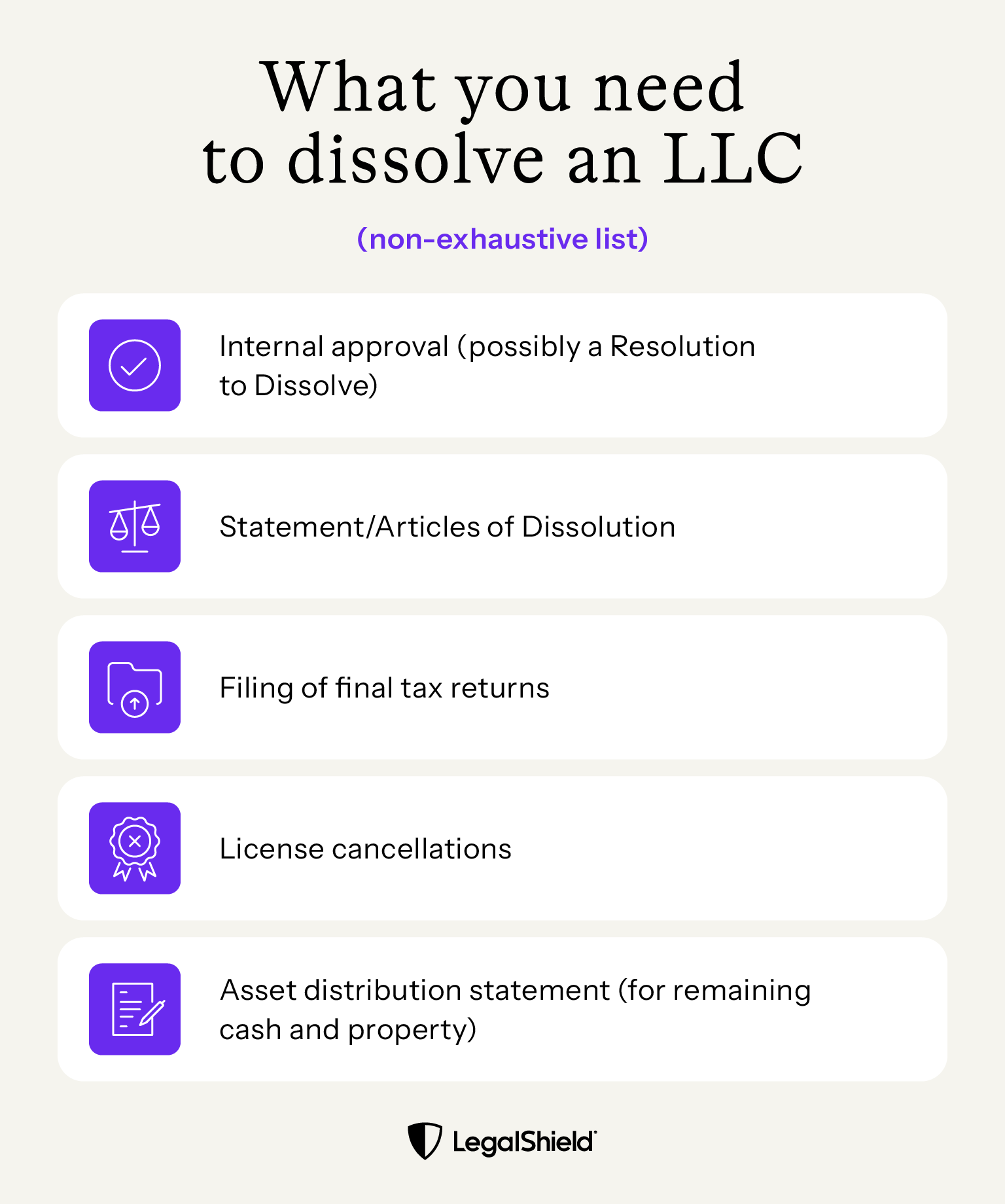
If you’re closing a business, you may also need to dissolve an LLC. There are some basic steps involved, including winding down your business and filing paperwork with your state.
If you have a business, you might need to dissolve a Limited Liability Company (LLC) for financial reasons or to streamline and focus your operations. Whatever the cause, ending something you’ve worked to build can be tough — both emotionally and practically.
Dissolving an LLC can be tricky, and doing it without guidance can lead to unnecessary stress and delays. With an affordable LegalShield® Plan, you can get access to provider lawyers who can review your closing documents. This could help you avoid errors that often slow things down. We’ve put together some helpful information so you can start the LLC dissolution process with more peace of mind.
Types of Dissolutions
There are three types of dissolutions for an LLC. The type you use will usually depend on your situation and the state in which your business operates.
Voluntary: This type of dissolution happens when members of an LLC choose to dissolve the business. Members can also set an end date when they create an LLC.
Administrative (involuntary): This is a state-forced dissolution. It can occur when businesses fail to complete administrative responsibilities, such as filing reports or paying taxes.
Judicial: A judicial dissolution is forced by the courts. It happens when the court finds that a party formed an LLC for illegal or fraudulent reasons.
What happens when you dissolve an LLC will depend on the type of dissolution. For the sake of clarity and consistency, we will only focus on voluntary dissolutions in this blog.
Voting to dissolve the LLC
To cancel an LLC with multiple members, you usually need to hold a vote. The percentage of members who need to vote in favor should be in your business’s operating agreement.
If you don’t have an operating agreement, state laws typically determine how the vote must go. Usually, states mandate one of three ways:
A unanimous vote
A vote by a majority of the members
A vote by a majority percentage of the business’s held interests
Winding up the business, notifying creditors, and distributing assets
When you decide to close an LLC, you’ll usually need to start taking care of any unfinished business, including paying any accounts you owe.
Some states require that you notify your creditors, but not all do. Even if it’s not required, it can be a good idea to do it anyway. It can protect you from surprise claims down the line. Giving notice and setting a deadline means claims filed after the deadline are usually invalid, so take this step just for good measure.
You may need to notify and pay employees, vendors, lenders, landlords, or utility companies. You could also have active business contracts that you may need to close.
After you’ve paid everything, you can usually distribute remaining assets to the LLC's members, according to your operating agreement or your state’s laws if you don’t have one.
Filing final tax returns and writing to the IRS
Filing a final tax return is part of closing a business. This includes state, federal, and local returns. When you file, you check the box marked “final return.” If your LLC had employees, you’ll also need to file final payroll taxes and issue a final wage statement.
You may also need to close your business account by canceling your Employment Identification Number (EIN) — the IRS doesn’t do it automatically. According to the IRS’s instructions for closing a business, to cancel an EIN for an LLC, you must write to them. You might need to provide the following information:
The complete legal name of your business
Your EIN
The business address
The reason you want to close/deactivate the account.
A copy of your original EIN Assignment Notice (CP575 or CP575A), if available
You may also need to cancel business licenses, permits, and any registered DBAs (“doing business as”) to avoid renewal charges. It’s a good idea to review your insurance policies before you dissolve your LLC. If you have claims pending or you think you might need coverage beyond dissolution, talk to your insurance agent.
Once you finish your taxes and close your accounts, you probably don’t want to throw anything away. Your LLC may not be operational, but you could still be audited or face tax questions later, so keeping your records, even if just electronically, is necessary.
With a LegalShield Business Membership, you get consultations on an unlimited number of business legal matters, so you can ask questions about business issues and more.
Submitting paperwork to the state
When you created your LLC, you filed Articles of Organization with your state. Dissolving an LLC usually involves filing Articles of Dissolution, sometimes called a Certificate of Dissolution. You typically do this with your Secretary of State’s office. If you are registered in other states to do business, you will need to file a withdrawal in those states as well.
Some states require multiple forms. Some require a tax clearance certificate before you can file. In some places, you file before winding down business; in others, you do it after. Often, there are filing fees.
With a LegalShield Membership, you can be paired with a provider law firm that understands your state's laws.
Things to consider before dissolving an LLC
Dissolving an LLC usually means tying up loose ends, paying outstanding financial obligations and taxes, and filing the required paperwork. It can be a lot, and mistakes can cause delays. Doing the following could help:
Getting a lawyer: It can help to have a lawyer review documents to be sure they're legally sound and meet specific guidelines that may apply to your business.
Checking your operating agreement: Carefully reading it can provide information you may need. Many agreements have instructions on how to dissolve an LLC, including on how members vote.
Notifying creditors and paying claims: Usually, you will need to notify your creditors and pay any claims your LLC owes.
Closing contracts: You may need to close active business contracts.
Paying employees: You may need to pay employees, file payroll taxes, and issue final wage statements.
Canceling licenses, permits, and registrations: You may want to do this promptly to prevent paying renewal fees. However, check before you cancel if there are ongoing claims or work to be performed.
Contacting your landlord and utilities: If you rent space for your business, you may need to inform your landlord that you’re closing your business. You will need to follow the terms of your lease and there may be additional costs if there is still rent due beyond your closing. If utilities are in your LLC’s name, you might need to do the same with the utility company.
Paying taxes: Businesses usually need to file a final tax return and pay the taxes. You may also need to write to the IRS to cancel your EIN.
Seeing if your state requires a tax clearance certificate: You might need a tax clearance certificate to file Articles of Dissolution. If you do, you will need a copy.
Filing Articles of Dissolution: You usually file with your Secretary of State’s office and pay any necessary fees.
Keeping records of all closing decisions: You may need these documents if you’re faced with tax questions, an audit, or surprise claims.
Review your business documentation with a LegalShield Business Membership
You might need to dissolve an LLC to close a business, consolidate LLCs, or reorganize into a PLLC instead of an LLC. Whatever your reasons, doing so can be confusing, but a LegalShield Provider Law Firm could make it easier.
With a LegalShield Small Business Plan, you can get help with business legal issues, like documentation review, debt collection, and IRS audits. And with three options, you can choose the plan that’s right for you.
Learn more about how you can get support for your small business with a LegalShield Membership
LegalShield® is a trademark of Pre-Paid Legal Services, Inc. (“LegalShield”). LegalShield provides access to legal services offered by a network of provider law firms to LegalShield members through membership-based participation. Neither LegalShield nor its officers, employees or sales associates directly or indirectly provide legal services, representation, or advice. Small Business Legal Plans and certain benefits are not available in all states. See a Small Business Legal Plan contract for a specific state for complete terms, coverage, amounts, and conditions. The information made available in this blog is meant to provide general information and is not intended to provide legal advice, render an opinion, or provide a recommendation as to a specific matter. The blog post is not a substitute for competent legal counsel from a licensed professional lawyer in the state or province where your legal issues exist, and you should seek legal counsel for your specific legal matter. Information contained in the blog may be provided by authors who could be a third-party paid contributor. All information by authors is accepted in good faith, however, LegalShield makes no representation or warranty of any kind, express or implied, regarding the accuracy, adequacy, validity, reliability, availability, or completeness of such information.
Frequently Asked Questions
The filing fees for dissolving an LLC vary by state, so the cost for that usually depends on where you live. Typically, you’ll have other expenses you’ll need to pay to close your businesses, such as taxes. You might have lawyer fees.
EINs are permanent federal taxpayer numbers. They don’t automatically cancel when you dissolve your LLC. And you can’t transfer an EIN to a new business. Your business account stays open, and your EIN remains in effect until you notify the IRS of its cancellation.
If you don’t close your LLC, it still exists as far as the state is concerned, which means you may need to keep filing taxes and annual reports. You might also get stuck paying renewal fees for licenses, permits, and registrations.
Communications Director at LegalShield overseeing content creation designed to make legal protection simple and approachable. He focuses on offering straightforward, trustworthy guidance that empowers people to make informed decisions about their legal rights and responsibilities.
An employment contract is an important piece of paperwork because it defines the working relationship, your expectations, and conditions. Here are some of the common components included.
Virtual business addresses can be a practical option for those forming an LLC from home, working remotely, or trying to keep their business and personal mail separate.
By the end of this blog, you’ll get a high-level summary of trademarking a name and logo, how logos differ from business names and artwork, and how much it all costs.
A DBA is a name registration that lets you run your business under a name other than your personal legal name or legal business entity. While a DBA offers branding flexibility and market expansion opportunities without creating a new legal structure, it does not provide legal liability protection, tax benefits, or function as a business license.
An indemnity agreement settles the “who is responsible” question ahead of time. One party promises, in writing, to cover certain losses tied to the work, so the other isn't left with the bill. These promises appear in construction contracts, leases, and business sales.
A certificate of good standing is official proof from your state that your business is registered and current on its requirements. Most lenders and agencies want a recent one, so it helps to know how to get it before someone asks.
Whether the goal is selling a company, bringing in a business partner, or passing it to a family member, the LLC ownership transfer often involves reviewing the LLC's operating agreement and the applicable state's rules.
If you want to do business under a name that isn't your own legal name or your LLC's registered name, you need a trade name, also known as a doing business as (DBA) name.
•
6 min read
Author Name
,
Author Title
July 28, 2026
Thank you! You're subscribed!
Oops! Something went wrong while submitting the form.