The Articles of Organization is a legal document that new limited liability companies (LLCs) file with their state governments. This document includes identifying information for the business and establishes the LLC as a separate legal entity.
The Articles of Organization is the main document you file with your state government (usually the Secretary of State) to form a limited liability company (LLC), which is a common business structure that offers several benefits. You must pay a one-time filing fee to obtain your Articles of Organization.
Your LLC won’t officially exist until the state accepts your Articles of Organization. You’ll need the filed document to open LLC bank accounts, apply for business licenses, and sign contracts. Let’s get into what kinds of information Articles of Organization include, how to prepare them, problems you could face, and other steps you’ll need to take as you start your business.
Important note: LLC formation rules and filing fees vary by state. Be sure to follow the state-specific rules.
What are Articles of Organization?
The Articles of Organization is the document that forms an LLC and is filed with your state government for the LLC to be recognized as a business entity. Once accepted, the state recognizes that the business is separate from its owners. That separation is one of the biggest pros of an LLC structure. It establishes limited liability, meaning that any financial problems should remain with the business. Owners usually won’t be personally responsible.
Articles of Organization have other purposes, too. They provide structure for your LLC. They also create a public record and list the business’s basic details.
What information do you need to file Articles of Organization?
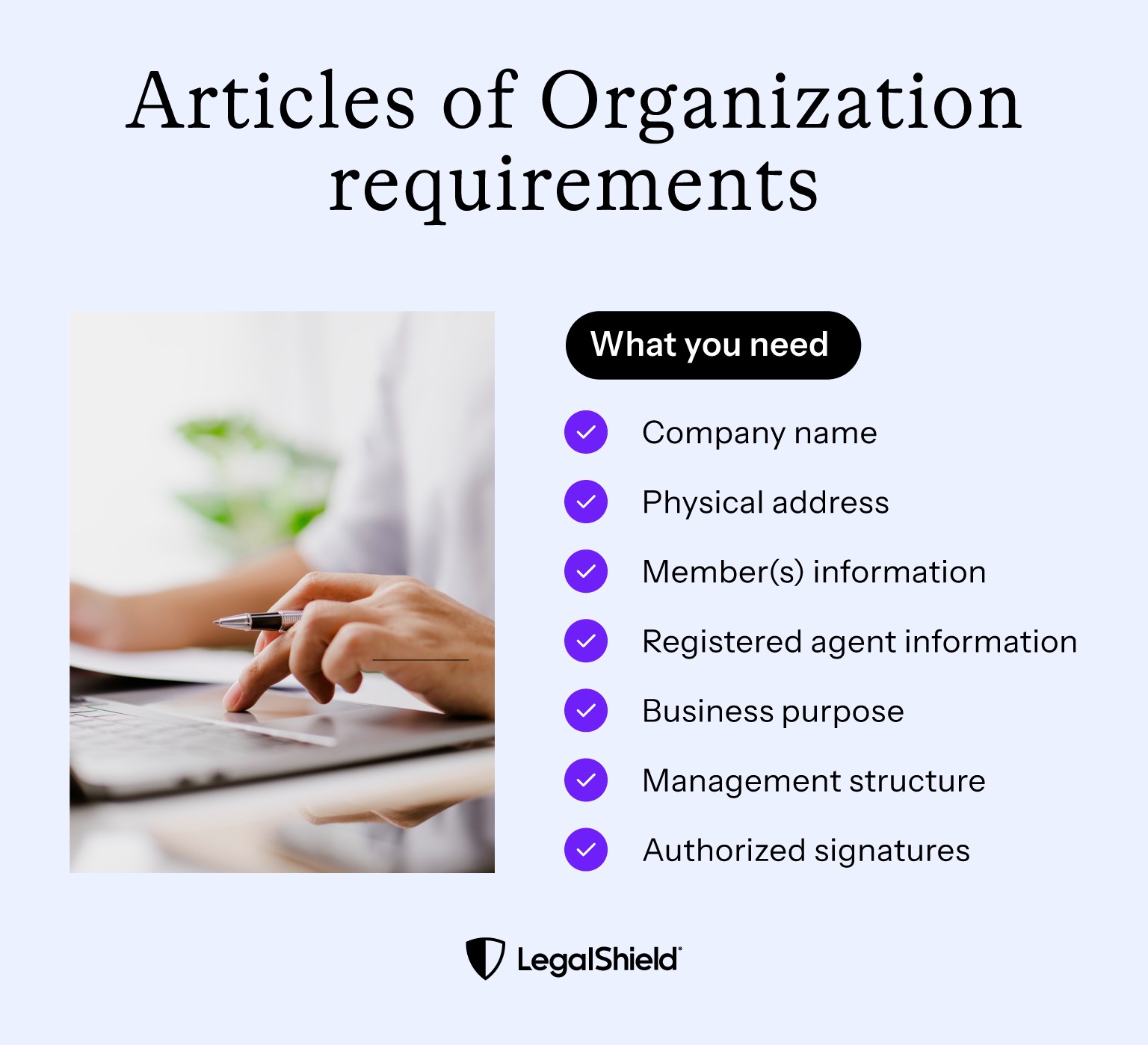
If you’re getting ready to file Articles of Organization, you’ll need to gather some information. What you’ll need varies by state, so check your state’s rules to be sure you include everything. States may ask for:
Your company’s legal name (can’t be the same as another company in your state, and it needs to follow state guidelines)
The address of your main location (generally a physical address, not a P.O. box)
The names of the LLC’s members (owners)
The name and contact information for your registered agent (the official contact person who represents the business for legal purposes)
The purpose of your business
How long you expect your business to operate (perpetual, or with a specified ending date)
Whether your LLC will be member-managed or manager-managed
An authorized signature
If you don’t follow your state’s requirements, the Secretary of State (or other government entity that handles business formations) could reject your Articles of Organization, and you must start the process over.
Why would a state reject your Articles of Organization?
Several issues could cause the state to reject your Articles of Organization, resulting in wasted time and money. Let’s look at some of the reasons a state might not accept your Articles of Organization.
Problems with your forms
Your Articles of Organization must be just right. The state could reject your document if:
It is incomplete
You don’t submit it correctly (your state might ask for online, in-person, or mailed submission)
The state can’t read your document
Your document doesn’t have an authorized signature
You don’t include the filing fee
You use the wrong form if one is required
The addresses you use don’t follow state requirements
Your effective date is invalid
Problems with your LLC’s name
You must follow the state’s specific rules when you name your LLC. Issues with the name could include:
Too close to another business’s name in your state
Not spelled the same across your form
Not following state-required formatting (like using specific words or not including “LLC” in the name)
Using words reserved for licensed professionals, such as “lawyer” or “doctor”, which can mislead the public as to the services your LLC provides.
The state has the final say about whether it accepts your business name and can reject any name it feels is misleading, derogatory, or not consistent with state laws.
Other problems
The issues we’ve already covered are common, but they aren’t the only possible problems that could mean the state rejects your Articles of Organization. Less common problems may still prevent you from forming your LLC, such as:
Home-state LLC status: You may want to register your LLC in other states. If your LLC isn’t in good standing in its home state, other states may reject your application.
Professional requirements: Lawyers, accountants, doctors, and other professionals can’t always form a “regular” LLC. They may have to form a professional limited liability company (PLLC) instead. The state’s regulatory board for that profession may have to approve the request before you can form your PLLC. Check your state’s requirements.
How to file Articles of Organization
While Articles of Organization and other LLC requirements vary by state, the process for filing your Articles of Organization is fairly similar no matter which state you’re in.
You should check your Secretary of State’s website for any general information and documents you need. Be sure to use the state’s form or template if required and follow your state’s rules for submitting your Articles of Organization and paying any filing fees.
Depending on your state’s rules, filing your Articles of Organization doesn’t necessarily mean your LLC is official yet. The state has to review your documents first. Then, the state will accept or reject your filing.
The filing and approval process can take hours or weeks, with online filing usually having the quickest turnaround. Some states offer expedited services for an additional fee. Be sure to find out how long it takes to get LLC approval in your state.
What to do after filing Articles of Organization
Filing your LLC’s Articles of Organization is a key step in registering your business. Once your Articles of Organization are approved, you may also need to:
Draft an operating agreement (mandatory in some states)
Submit additional documents to government agencies when/as needed
Cost of Articles of Organization
When you file your Articles of Organization, you must pay filing fees. The cost varies by state. Fees are usually between $50 and $500, covering the state’s costs for reviewing and recording your document.
Many states let you pay filing fees online. You may also be able to mail a check or money order. If you want faster processing or a certified copy, they might be available at an extra cost.
How and when to change your LLC’s Articles of Organization
Businesses change over time. Your LLC’s official documents need to say how things are now, not how they used to be. Otherwise, you may not have the full protection of the LLC structure.
In many cases, state law requires you to file amendments within a certain time frame of a change to information in your Articles. Major changes that might make amendments necessary include updates to things like:
Ownership
Management structure
Business purpose
Before you update your Articles of Organization, look at your LLC’s operating agreement. It should tell you how to handle voting and approvals for amendments.
Some states ask you to file a Certificate of Amendment or Articles of Amendment to update your Articles of Organization. In contrast, others let you restate your Articles rather than amend them. You may also have to pay a filing fee. Check your state’s rules for the amendment process.
Do you need Articles of Organization for your business?
If you're forming an LLC, you need Articles of Organization. Without them, you cannot say your business is a limited liability company and you may not have the liability protection that will help protect your personal assets from claims related to your business operations.
Get legal assistance for your business with a LegalShield® Membership
To form an LLC, your state government has to approve your Articles of Organization. We’ve covered what you need to include, common problems to avoid, and how to file your documents correctly. If you need to change them after you’ve filed, you can. Be sure to follow state-specific rules for filing and changing your Articles of Organization. Not sure if you are doing things correctly? LegalShield provider law firms can help with reviewing your Articles of Organization before you file them to help you avoid common issues that would cause your filing to be rejected.
LegalShield members also get access to a provider law firm for research, consultations, document reviews, and advice at an affordable monthly fee, rather than expensive hourly rates averaging $300/hour. You can get help with contracts, licenses, and more. Choose the LegalShield Small Business Plan that’s right for you to help you get your business questions answered today.
Pre-Paid Legal Services, Inc. (“LegalShield”) provides access to legal services offered by a network of provider law firms to LegalShield members through membership-based participation. Neither LegalShield nor its officers, employees or sales associates directly or indirectly provide legal services, representation, or advice. Small Business Legal Plans and certain benefits are not available in all states. See a Small Business Legal Plan contract for a specific state for complete terms, coverage, amounts, and conditions. The information made available in this blog is meant to provide general information and is not intended to provide legal advice, render an opinion, or provide a recommendation as to a specific matter. The blog post is not a substitute for competent legal counsel from a licensed professional lawyer in the state or province where your legal issues exist, and you should seek legal counsel for your specific legal matter. Information contained in the blog may be provided by authors who could be a third-party paid contributor. All information by authors is accepted in good faith, however, LegalShield makes no representation or warranty of any kind, express or implied, regarding the accuracy, adequacy, validity, reliability, availability, or completeness of such information.
Communications Director at LegalShield overseeing content creation designed to make legal protection simple and approachable. He focuses on offering straightforward, trustworthy guidance that empowers people to make informed decisions about their legal rights and responsibilities.
Dissolving an LLC can be tricky, and doing it without guidance can lead to unnecessary stress and delays. We’ve put together some helpful information so you can start the LLC dissolution process with more peace of mind.
An employment contract is an important piece of paperwork because it defines the working relationship, your expectations, and conditions. Here are some of the common components included.
Virtual business addresses can be a practical option for those forming an LLC from home, working remotely, or trying to keep their business and personal mail separate.
By the end of this blog, you’ll get a high-level summary of trademarking a name and logo, how logos differ from business names and artwork, and how much it all costs.
A DBA is a name registration that lets you run your business under a name other than your personal legal name or legal business entity. While a DBA offers branding flexibility and market expansion opportunities without creating a new legal structure, it does not provide legal liability protection, tax benefits, or function as a business license.
An indemnity agreement settles the “who is responsible” question ahead of time. One party promises, in writing, to cover certain losses tied to the work, so the other isn't left with the bill. These promises appear in construction contracts, leases, and business sales.
A certificate of good standing is official proof from your state that your business is registered and current on its requirements. Most lenders and agencies want a recent one, so it helps to know how to get it before someone asks.
Whether the goal is selling a company, bringing in a business partner, or passing it to a family member, the LLC ownership transfer often involves reviewing the LLC's operating agreement and the applicable state's rules.
•
11 min read
Thank you! You're subscribed!
Oops! Something went wrong while submitting the form.