An anonymous LLC is a limited liability company structured to keep the owner’s name off public state records. It’s not available in every state, but certain jurisdictions allow you to form an LLC without listing members or managers in publicly searchable records.
Here’s everything you need to know about how to create an anonymous LLC.
What to know about anonymous LLCs
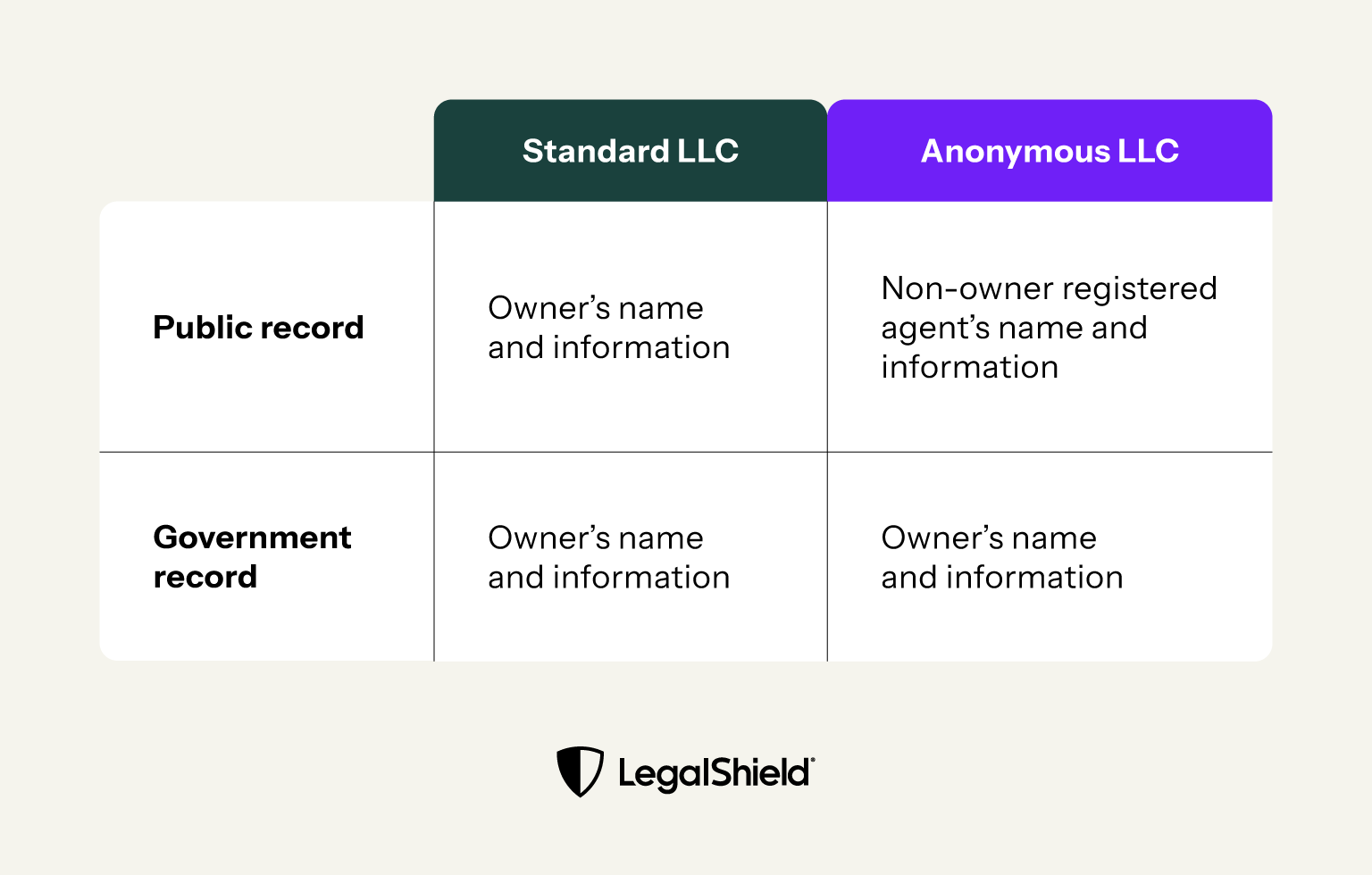
An anonymous LLC is a limited liability company (LLC) structured so your name is hidden from public state business filings. In 21 states, you don’t have to list owners in LLC formation documents. But only four (New Mexico, Nevada, Delaware, and Wyoming) are truly anonymous.
However, “anonymous” certainly does not mean untraceable. Although it’s possible to omit your ownership of your LLC in state records, you are still required to identify yourself to government agencies that oversee things like business regulations and taxes.
Also, keep in mind that even if you have an “anonymous” LLC:
A court can still require ownership information in a lawsuit.
Most banks will require some kind of ownership information.
Government agencies can access non-public records.
The point of anonymity in an LLC is generally privacy and some limited asset protection that may go beyond what typical LLCs provide. Anonymous LLCs typically do not work if the business is operating or customer-facing due to licensing and other requirements. Never use an anonymous LLC to evade taxes or legal obligations of any kind.
Step-by-step guide to creating an anonymous LLC
Many business owners feel overwhelmed when they start researching anonymous LLCs, but the process isn’t much more complex than creating a typical LLC.
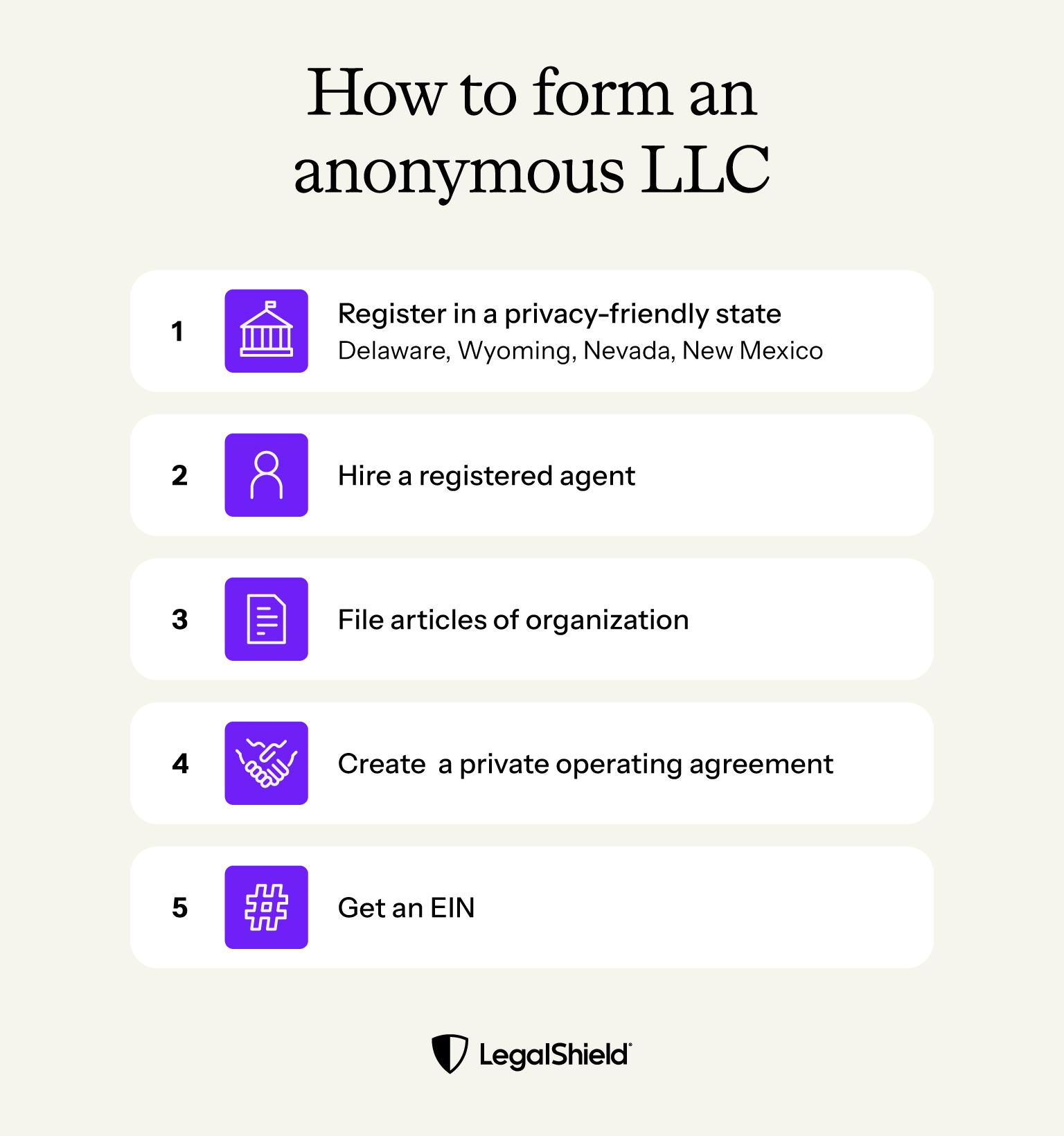
Here’s how to create an anonymous LLC:
1. Select a privacy-friendly state
Your first step is choosing which state to file in. You will likely need to choose one of the four states that allow anonymous LLC filings, but keep in mind that you may also need to register in the state where you actually do business.
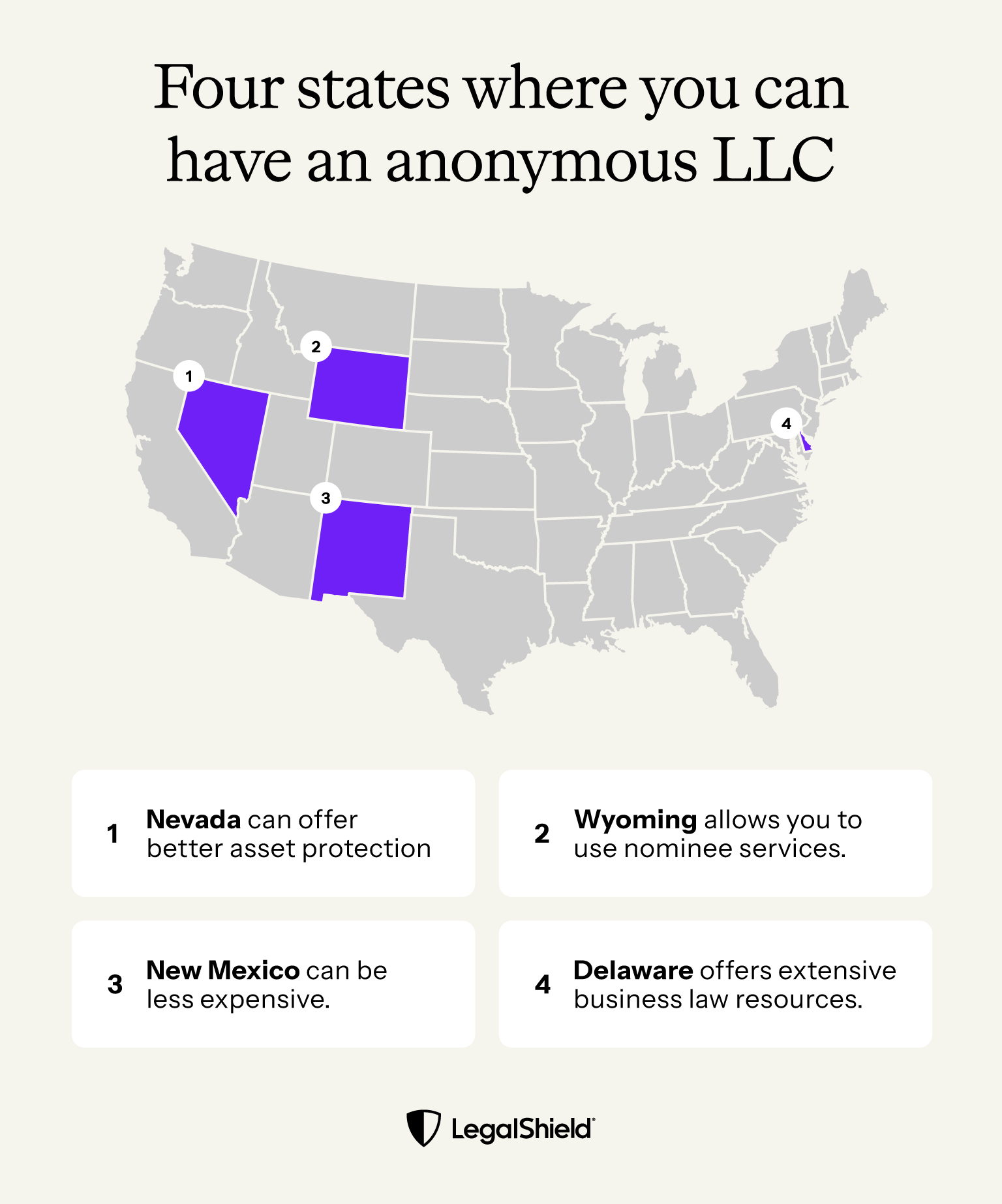
Make your choice based on your business needs. Here are four of the 21 states with slightly different protections, fees, and pros and cons:
New Mexico can be less expensive.
Nevada can offer better asset protection.
Delaware offers extensive business law resources.
Wyoming allows you to use nominee services.
Of course, the best choice will depend on your unique priorities, business type, where you live, and needs.
2. Hire a commercial registered agent
For all kinds of LLCs — including non-anonymous ones — you have to name a registered agent. This is the person in the state where you form your LLC who can receive government communications, service of process, and similarly important legal documents.
You can be the registered agent for your own business, but if you do so, your LLC won’t be anonymous. Thankfully, you don’t have to be a business owner to be a registered agent, meaning you can identify a trustworthy third party as one. That’s why people looking to form an anonymous LLC typically hire a commercial registered agent.
A commercial registered agent (sometimes called a “registered agent service”) uses their name and business address rather than yours. That information appears in public business filings, keeping you anonymous.
Registered agent services are available in most states and charge an annual fee of $100 to $300.
While a commercial registered agent helps protect your anonymity, you’ll still need to be identified for certain activities, such as federal reporting requirements, banking, and certain tax procedures.
3. File the articles of organization
Once you’ve chosen your privacy-friendly state and hired a registered agent service, you’re ready to file the articles of organization (sometimes called a “Certificate of Formation”) with the Secretary of State.
In privacy-friendly states, the articles of organization typically don't require identifying info about ownership. Instead, they’ll require basic information like the name of your LLC and your registered agent’s name and business address.
Some states even allow an “organizer” to do the filing for you. This could be your registered agent service or a professional filing service. They submit and sign the formation documents on your behalf. The organizer does not have to be the owner.
As you fill out your articles of organization, be mindful of when you can leave a section blank. Privacy-friendly states generally let you leave sections like member and manager names blank, but check with your state or a LegalShield provider lawyer to make sure you're meeting all requirements.
4. Draft a private operating agreement
An operating agreement describes how you own and operate your LLC. It’s important for all kinds of LLCs, but it takes on a deeper meaning for anonymous LLCs. That’s because this document helps prove that you own the company.
Importantly, you do not file the private operating agreement with the state, or else you’ll be openly identified as the owner. Thankfully, no state requires you to file an operating agreement.
You should keep the document secure alongside your copies of your articles of organization and other key business records.
Why does this matter? Because you may need to prove your ownership of your LLC in a variety of situations, and if your public filings do not show you as the owner, you need something that can prove it.
For example, banks legally have to know who owns an LLC before they create a bank account for that LLC. Lenders may also ask for proof of ownership.
5. Get an EIN from the IRS
In most cases, your LLC will need an Employer Identification Number (EIN). This is the number the IRS uses to identify your business for tax purposes, and it’s required for processes like opening a business bank account and hiring employees.
You can get an EIN from the IRS for free online. However, as you follow the steps on the IRS website, you may notice that the IRS wants you to provide identifying information about a “responsible party.” As the owner, this will most likely be you.
So, does that mean your LLC won’t be anonymous? Not to worry — while the IRS does collect this information, your EIN application is not going to be part of any public state business records.
To help with small business formation, a LegalShield Small Business Plan connects you with a provider law firm that guides you through compliance obligations and state filing requirements. With a bit of help, you can be sure that your operating agreements and articles of organization are compliant with whatever state you’re in.
Best states for anonymous LLC formation
Almost half of the states require owner or manager information when registering for an LLC, while the other half offer some privacy but do not require any or all of the owner information. But only four states — Delaware, Wyoming, Nevada, and New Mexico — specifically allow you to form a private LLC. Each state has different LLC filing requirements, fees, registered agent rules, and reporting requirements.
Let’s take a close look at these anonymous LLC states.
Delaware
In Delaware, you don’t have to include the names of members or managers of your LLC in the Certificate of Formation (Delaware’s version of the articles of organization you see in other states). In public filings, all you have to include is the name and address of your registered agent.
Delaware is a popular choice for business formation of all kinds — including anonymous LLCs — because of its business-friendly, highly sophisticated legal system.
The Delaware Court of Chancery, for example, specializes in business disputes. This court is one of the most important forums for resolving business disputes. And it’s why Delaware offers a relatively high degree of predictability in business law issues.
Keep in mind that, even if you form your anonymous LLC in Delaware, you may also need to register in another state if you’re doing business there. Delaware also requires LLCs to pay annual franchise taxes.
Wyoming
Wyoming doesn’t require you to identify yourself in your LLC filing, doesn’t impose personal or corporate income tax, and charges relatively low annual reporting fees. You just have to identify the registered agent, which doesn’t have to be you.
Wyoming allows you to use “nominee services” to form your private LLC. This simply allows you to name a “placeholder” person to satisfy state business requirements, but the nominee doesn’t own or control the business.
Nevada
Nevada is an attractive state for anonymous LLC formation, as it has no personal or corporate income or franchise taxes. Adding to that, Nevada offers strong asset protection provisions (known as “charging order protections”).
However, Nevada is a more expensive option than many other states. Its LLC filing fees are on the high end of normal, so you’ll have to maintain a business license and pay to file lists (called “Initial” and “Annual” lists) of members, managers, and/or owners.
While Nevada does offer strong privacy and asset protection rules, remember that these protections do not guarantee anonymity in all situations or immunity from lawsuits.
New Mexico
New Mexico is one of the least expensive places to file and keep your anonymous LLC. It doesn’t require you to list members or managers in your articles of organization. So ownership information doesn’t appear in a publicly searchable LLC ownership lookup.
New Mexico has relatively low filing fees, no annual franchise tax (unlike Delaware) or corporate income tax, and no yearly reporting requirement. However, New Mexico does have a personal income tax.
Benefits of forming an anonymous LLC
The privacy of an anonymous LLC has several benefits:
Increased personal privacy: If you’re not named as owner in publicly searchable records, that’s one less piece of information about you online. For some, such as high-profile individuals, this in itself is a benefit.
Reduced targeting for unwanted claims: If your ownership details aren’t easy to find, you may avoid some claims or so-called “frivolous” lawsuits that are based simply on how high someone thinks your net worth is.
Higher safety: If you work in a controversial or high-profile field, you may want to keep your LLC anonymous to reduce harassment and similar risks.
Real estate confidentiality: Some real estate investors use anonymous LLCs to keep their names out of public property records. This can help prevent artificial pricing based on perceived buying power and similar issues.
Common anonymous LLC challenges
Anonymous LLCs can have a lot of benefits for owners who place a premium on privacy, but they aren’t without their challenges:
Bank account troubles: Banks are required to identify the owners of LLCs they serve. They sometimes look to the articles of organization to determine whether you’re a legitimate business entity.
Ongoing expenses: If you want to hire a registered agent, rather than acting as your own, you will need to pay ongoing associated fees. Meanwhile, privacy-friendly states have their own taxes, fees, licensing, and reporting requirements. And if you are doing business in a state other than where you filed, you may need to consider foreign registration fees.
Maintaining privacy: If you’re doing business in a different state from where you formed your anonymous LLC, you may need to register in that state as a foreign entity. Doing so may require you to reveal identifying information about yourself. A lawyer can help you navigate this kind of situation.
Maintaining anonymity is difficult: It’s hard to keep your business information private. Data brokering sites constantly gather data on people and businesses and make that information publicly available. You will have to be diligent in keeping your business and personal information separate.
Discuss your LLC options with a LegalShield provider lawyer
Understanding how to create an anonymous LLC requires careful planning and an understanding of the nuances of the law that can truly protect your privacy while maintaining the protections of limited liability.
A LegalShield Small Business Plan connects you with a provider law firm that can help with guidance on state filing requirements and compliance obligations, contract review, employment issues, and more.
Content Specialist at LegalShield, creating educational resources about legal and consumer protection topics. She focuses on making complex legal and financial concepts accessible to readers and has contributed to various educational articles on consumer rights and protections.
Dissolving an LLC can be tricky, and doing it without guidance can lead to unnecessary stress and delays. We’ve put together some helpful information so you can start the LLC dissolution process with more peace of mind.
An employment contract is an important piece of paperwork because it defines the working relationship, your expectations, and conditions. Here are some of the common components included.
Virtual business addresses can be a practical option for those forming an LLC from home, working remotely, or trying to keep their business and personal mail separate.
By the end of this blog, you’ll get a high-level summary of trademarking a name and logo, how logos differ from business names and artwork, and how much it all costs.
A DBA is a name registration that lets you run your business under a name other than your personal legal name or legal business entity. While a DBA offers branding flexibility and market expansion opportunities without creating a new legal structure, it does not provide legal liability protection, tax benefits, or function as a business license.
An indemnity agreement settles the “who is responsible” question ahead of time. One party promises, in writing, to cover certain losses tied to the work, so the other isn't left with the bill. These promises appear in construction contracts, leases, and business sales.
A certificate of good standing is official proof from your state that your business is registered and current on its requirements. Most lenders and agencies want a recent one, so it helps to know how to get it before someone asks.
Whether the goal is selling a company, bringing in a business partner, or passing it to a family member, the LLC ownership transfer often involves reviewing the LLC's operating agreement and the applicable state's rules.
•
11 min read
Author Name
,
Author Title
August 4, 2026
Thank you! You're subscribed!
Oops! Something went wrong while submitting the form.