Separating two deeply connected lives feels overwhelming, especially if it’s not amicable. Every relationship is different, and your circumstances will determine how you file for divorce, divide property, and approach spousal support and child support.
If you need guidance with an uncontested divorce and you’re already a LegalShield® Member, your LegalShield provider law firm can advise you on how to start a divorce. Keep reading to learn more about how you can be prepared.
What is involved in the divorce process?
Get help from a professional as you prepare to file for divorce. You might be tempted to make sacrifices you’ll regret just to get through the process quicker. But this could have a permanent impact on your life. Someone who knows the law and has no emotional investment can help support you throughout the process.
Preparing for separation
Before you take any legal action, you can take steps to prepare for a divorce. You should follow this process as you get started:
Gather documents: You can make getting a divorce more efficient and cost-effective by gathering as much information as you can before you file. Documents you might need include, but are not limited to, tax returns, pay stubs, banking information, insurance information, retirement account statements, and mortgage paperwork.
Make a budget: List your monthly household expenses to see what it costs to maintain your lifestyle.
Secure digital profiles: You may want to change the passwords for digital accounts you solely own.
Inventory possessions: Make a detailed list of your valuable possessions. This may include household items, electronics, jewelry, and collectibles. If you can, take photos and videos.
Important note: This isn’t a good time to try to make any changes to accounts or things you own with your spouse. If you need help with anything jointly owned, talk to a lawyer before making any changes.
Filing a petition
Where and when you file for divorce matters. Speaking with a lawyer first to help you with these choices is a good idea.
The first person to file for divorce is the “petitioner.” Being the petitioner gives you some control. For example, the divorce starts on your timeline, and you get to some choice on where to file.
Different states have different divorce laws, and you have to petition for divorce in a state where either you or your spouse lives. If you live apart, there may be a meaningful choice to make, and even if not, you’ll want to be familiar with your local laws or get help.
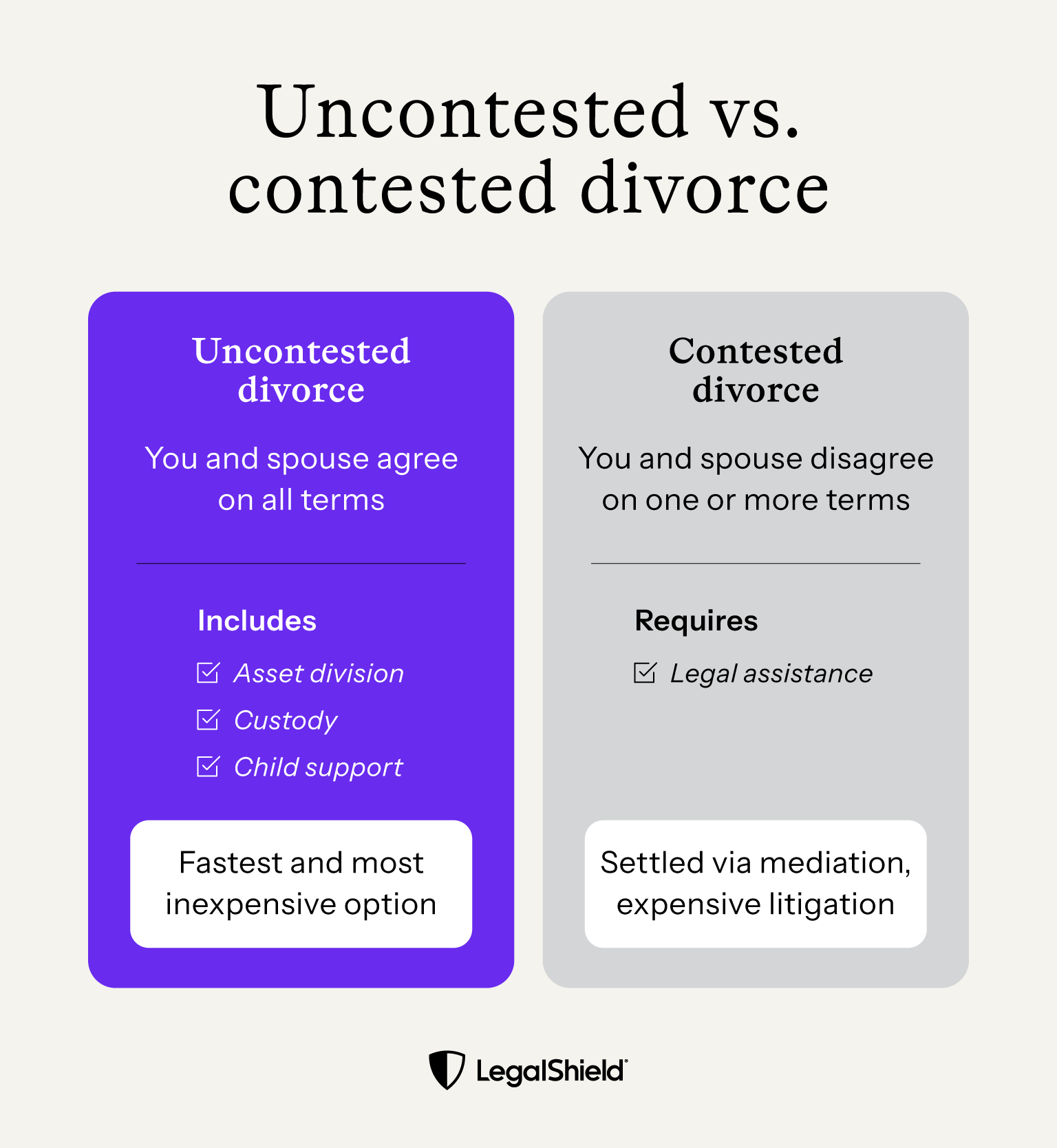
Uncontested vs contested An uncontested divorce involves co-submitting a Complaint (or Petition) for Absolute Divorce (or Dissolution of Marriage in some states). A contested divorce uses the same forms, but you'll submit the petition along with a summons for your spouse to your local district court. Filing fees vary by state.
Work out the divorce terms
After you file, you’ll need to work out the terms of your divorce with your spouse. This might be straightforward if your split is amicable and uncontested. But if you and your spouse disagree, settling on terms can become difficult and may require you both to get legal representation.
In an uncontested divorce, you and your spouse may agree to a set of terms, often called a divorce decree. Both of you should understand the terms; if not, speak to a lawyer. Those terms should be in writing and signed by both of you. This document may be what is entered into court and approved by a judge.
In a contested divorce, you and your spouse will need to work out the terms through negotiation, mediation, or collaborative law (outside the court). Settlement agreements may include asset and debt divisions, spousal support, and child custody.
Regardless of the type of divorce, you can ask your LegalShield provider lawyer to make sure the documents are in order before you file.
Child custody
Children come with custody considerations. You and your spouse will need to come up with a parenting plan and custody arrangement that is in your child’s best interests. This will likely also involve complying with your state’s child support laws.
Child custody typically focuses on two areas:
Legal custody: Who makes major decisions regarding education, healthcare, and religion
Physical custody: Where the child lives
Courts may make decisions regarding this time based on the best interest of the child statute. This statute varies by state, but generally focuses on aspects that best promote the child's stability and well-being.
Officially file
Finally, you’ll file your divorce decree with the court to officially end your marriage. You’ll do this in the court clerk’s office in the county where you filed the initial divorce petition.
Along with the divorce decree, you’ll have to file other divorce paperwork. This can vary by state and may include these documents:
Note: When you divide property in a divorce, you'll have to classify your assets as "marital" or "separate." A handful of states follow community property laws that mandate a 50/50 split of marital assets. Most states follow equitable distribution laws that seek to divide property in a way that is fair but not necessarily equal.
Awaiting approval
Your divorce is not final until a judge approves your divorce decree. A judge will review the decree for legality, fairness, and accuracy. If there are no problems, the judge will sign it. Your divorce is then legal, and the terms of the decree are legally binding.
Some states require a “cooling off” period between when you petition for divorce and when the court can grant your dissolution of marriage. This varies from state to state but is usually around 30 to 90 days.
Key considerations when filing for divorce
The choices you make during a divorce can affect your final settlement, your financial well-being, your children, and more. Things to consider include:
What type of divorce fits your situation
Will your financial situation change
Do you want legal representation
What type of divorce fits your situation?
There are different types of divorce scenarios that depend on your circumstances and ability to work through issues together.
Types of divorce include:
Uncontested: You and your spouse decide on the terms of your divorce together, with minimal help from lawyers or mediators.
Collaboration with lawyer involvement: You and your spouse each hire a collaborative divorce lawyer. These lawyers try to help you reach a settlement out of court.
Mediation: You and your spouse work through the terms of your divorce decree outside of court with help from a trained mediator. This person helps you communicate but doesn’t make decisions for you. You may hire a mediator at any time during a divorce, but both parties must agree to participate. The court may also order both parties to attend mediation as part of the process.
Litigation: Your divorce is settled in court through a trial. This is usually a last resort when spouses can’t settle their divorce another way.
Uncontested
Collaboration
Mediation
Litigation
Can help
Low-conflict divorces and couples who can communicate without outside help
Couples who are willing to work together but want assistance and legal advice
Couples who can cooperate but need help communicating
High-conflict divorces that the court must resolve
Cost
Around $100 to $400 in court filing fees, more if you hire a lawyer
Around $7,000 to $25,000 per couple
Around $3,000 to $8,000 per couple
Around $10,000 to $30,000 or more per couple
Timeline
Around 1 to 3 months, depending on your state's "cooling off" period
Around 3 to 8 months, possibly less
Around 3 to 6 months, possibly less
Around 6 to 12 months or longer
Control
High — you and your spouse decide on terms together
High — you and your spouse work with your lawyers to reach a settlement
High — you get a say in the terms and can decide to accept or reject them
Low — a family law judge issues a legally binding ruling you'll have to follow
Privacy
High — discussions involve only you and your spouse
High — the process is private and confidential
High — the process is private and confidential
Low — a trial typically makes your finances and other information public
Will your financial situation change?
Divorce can change your financial situation. Before getting divorced, it’s helpful to identify your monthly expenses and make a budget.
Before acting, you may want to speak to a lawyer about opening your own bank account, buying any assets like a house or car, or closing joint accounts.
To help protect your financial independence during a divorce, you could use an online service to monitor your credit during and for a while after your divorce or freeze accounts if necessary.
Do you want legal representation?
Hiring a traditional lawyer can give you legal advice and protection, but it also makes your divorce cost more. If you and your spouse can agree to the terms of divorce, you may be able to handle it without paying for expensive litigation.
But divorce is stressful enough without worrying about legal bills. With a LegalShield Membership, you get access to a provider law firm for a flat monthly fee. No hourly rates, no surprises.
Advanced and Premium plan members can receive uncontested divorce services after 180 days of service, with discounted rates from a provider law firm for other divorce matters.
And if you’re planning ahead, your provider law firm can also help with prenuptial and postnuptial agreements.
What documentation do you need to update after your divorce is final?
After a divorce is final, you may need to make some updates to your personal identification, accounts, and other documents:
Social Security card
Driver’s license
Passport
Voter registration
Bank and credit cards
Checks
Property deeds and titles
Insurance
Beneficiaries on your retirement, investment, and life insurance accounts
Estate planning documents, like your Will, Power of Attorney, and Advance Directive
You may also need to update your status from married to divorced and update your household income with financial institutions. Updating your emergency medical contacts and the people who can access your medical records could also be necessary.
Prepare your family with LegalShield
Ending a marriage is difficult. You and your spouse will have to resolve many issues, and the terms you come to will be legally binding. A LegalShield Membership can give peace of mind that you have legal access. Our provider lawyers can advise you on how to start an uncontested divorce and see you through the process.
Content Specialist at LegalShield, creating educational resources about legal and consumer protection topics. She focuses on making complex legal and financial concepts accessible to readers and has contributed to various educational articles on consumer rights and protections.
En Estados Unidos, un divorcio sin oposición generalmente cuesta al menos $1,500, mientras que un divorcio con oposición puede empezar en $5,000 y superar los $20,000 en casos complejos. El costo total depende de los honorarios de abogados, los costos judiciales y el nivel de conflicto entre los cónyuges.
Decidir tramitar el divorcio ya es bastante difícil sin tener que preguntarte si estás llenando el formulario correcto. Cada estado maneja el proceso de manera un poco distinta, y es normal sentir dudas acerca de dónde empezar. Reunimos información sobre lo que puede suceder durante el trámite, incluyendo perspectivas de una abogada de verdad, para darte más claridad en este camino.
La mayoría de nosotros sabemos que deberíamos tener un testamento. Simplemente seguimos encontrando razones para posponerlo. Si eso te suena familiar, no estás solo/a. Sigue leyendo para aprender qué puedes hacer al respecto.
Prepararse para un divorcio implica reunir documentos financieros y personales, hacer un presupuesto de tus gastos mensuales, asegurar tus cuentas digitales e inventariar tus bienes. También es importante decidir qué tipo de divorcio se adapta a tu situación y consultar con un abogado antes de presentar la petición para proteger tus derechos.
¿Necesitas un poder notarial pero te preocupa el costo? Es natural preocuparse por pagar servicios legales, pero es importante no quedarse atrapado/a en dólares y centavos. Después de todo, no le puedes poner precio a la tranquilidad, y eso es exactamente lo que ofrece un poder notarial.
Ya sea que te estés casando, pasando por un divorcio o simplemente estés listo para un nuevo comienzo, cambiar tu nombre es un gran paso. Puede ser un proceso sorprendentemente difícil, y las tarifas varían mucho.
Planificar el futuro de tu familia toma tiempo y reflexión. Una herramienta que puede ayudar es el fideicomiso familiar: un arreglo legal que te permite decidir cómo se administra y se comparte tu propiedad con las personas que te importan.
A veces la gente tiene reacciones emocionales fuertes a la palabra "prenupcial" porque sienten que su pareja no confía en ellos. Pero un contrato prenupcial trata de establecer confianza y justicia. Puede ser una forma prudente y cariñosa de comenzar un matrimonio. Un contrato prenupcial es una manera en que dos personas resuelven cómo manejarán el dinero y los bienes antes de decir "acepto".
•
10 min read
Author Name
,
Author Title
September 28, 2026
Thank you! You're subscribed!
Oops! Something went wrong while submitting the form.