A postnuptial agreement is a legal agreement you and your spouse make after you’re already married. It can explain what happens with certain assets, debts, and financial responsibilities should your marriage end. A lawyer can make sure the postmarital agreement is clear and durable.
A few years into marriage, life changes. You could start a business. Or your spouse may get an inheritance. Any big change easily raises some money questions that would be difficult to answer even in a strong marriage.
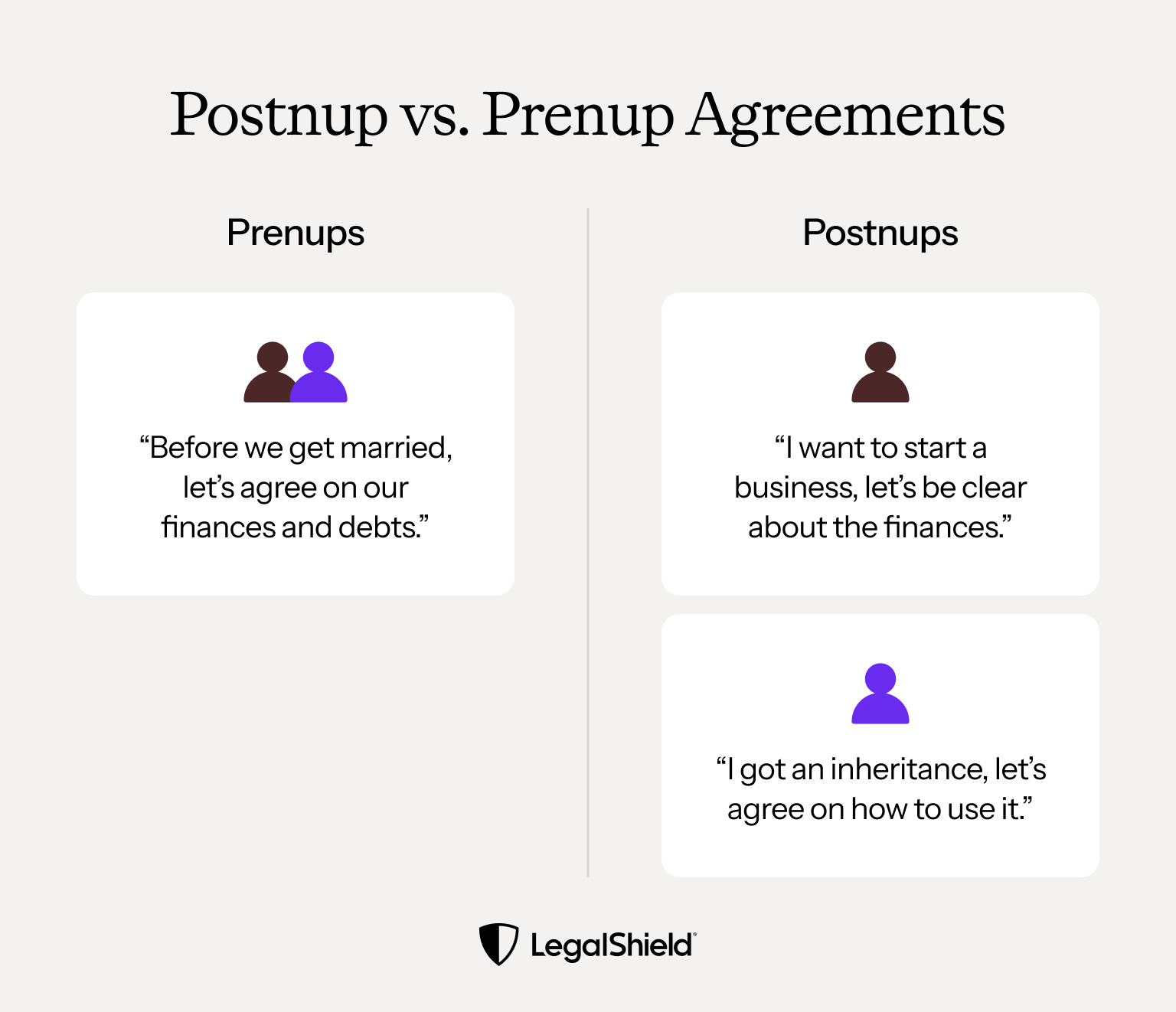
A postnuptial agreement can answer those questions. This is similar to the more famous “prenup,” but the timing is different. You sign this one after the marriage, not before. Both agreements help couples talk through financial expectations, property, and debt with much more clarity.
For many spouses, a postnup is simply about preventing confusion and making shared decisions before money questions get harder to discuss. There’s much more to know about postups, though, and we’ve covered that below.
How does a postnuptial agreement work?
A postnuptial agreement sets down written rules for how you and your spouse will handle certain financial matters during your marriage or if the marriage comes to an end. A postnup might touch on property, debt, savings, business interests, gifts, inheritances, and valuable items.
These agreements often come after a major financial change for the couple. For instance, if you were to start a business and take on some business debt, your spouse might want some clarity about whether they’d be responsible for that debt if you separate. The postnuptial agreement can put the answer to that question in writing. And that can cut the tension.
While not a prelude to divorce, a postnup can also address how you might divide assets in the event of a divorce. That’s true for many divorce issues, including spousal support.
Prenups and postnups compared
A prenup and postnup can cover most of the same financial questions. The main difference is the timing. Prenups come before marriage and postnups come after. In either case, in the event of a divorce, courts will look closely at whether you were both honest about your finances, understood the agreement, and signed it voluntarily.
With a LegalShield® Membership, members can ask a provider law firm questions about marital agreement terms, state requirements, and what to consider before they move forward. Postnuptial and prenuptial agreement preparation are available on certain plans 180 days after membership starts.
Why do couples get a postnuptial agreement?
Couples get postnuptial agreements for many reasons, but the goal is usually clarity. A postnup can help spouses talk through a major financial change, such as an inheritance, an investment property, a new business interest, or new debt from school or business expenses. It can also explain whether certain property stays separate, becomes shared, or would be divided upon separation.
These agreements can also help when family needs change. For instance, spouses might want to clarify how assets should be handled for children from a prior marriage, how support would work if one spouse leaves paid work to care for children, or how certain marital assets should be handled if a spouse dies. If you and your spouse have a prenup or get a postnup, it is important to be sure that it works with your estate planning. Conflict between the two documents can be difficult to sort out later on.
Some couples also use a postnup after a difficult season, such as financial secrecy or overspending. It puts clearer expectations into writing.
What a postnup actually covers
These agreements typically focus on financial responsibilities, money, and property. The exact terms for these items may depend on state law, but many postnups address these topics:
Division of property and assets: Who gets what assets if the marriage ends: savings, investments, business interests, vehicles, art, jewelry, and other valuable property.
Division of debt: Who is responsible for business debt, student loans, credit card debt, and other financial obligations in the event of a divorce? Postnups commonly clarify that.
Spousal support: A postnup can cover whether a spouse can get support, how much they might get, and how long the support will last. Keep in mind that state law can affect whether certain terms in this arena are allowed.
Separation and divorce processes: In the event of a divorce, the postnup can specify how you and your spouse agree to handle certain financial matters as the separation proceeds. This can reduce confusion during a tough time.
Marital homes and vacation properties: A postnup can explain what happens to major property. Can one spouse keep the home? Will it be sold? And how would the proceeds of a sale be divided?
What a postnup doesn’t cover
A postnuptial agreement can cover lots of financial issues, but it can’t decide every part of your marriage or any future separation. Courts might reject a postnup if it tries to include terms outside its boundaries, like:
Child custody or visitation: Parents can make plans, but the courts usually make the final call based on the child’s best interests.
Child support: In general, a postnup can’t limit or eliminate a child’s right to financial support.
Anything illegal: Nothing that’s against the law fits into a postnup.
Unfair or unconscionable terms: “Unconscionable” is a legal term for a provision that’s so one-sided that a court may refuse to enforce it.
Personal and lifestyle matters: How often a spouse visits in-laws, who does the dishes, and how spouses spend their weekends are examples of terms that postnups usually can’t cover.
Waiving key legal rights: Postnups generally can’t take away rights like the right to seek legal guidance.
Tips when writing a postnuptial agreement
Postnuptial agreements can be complex. They often need to follow state rules, reflect spouses’ financial situations, and show that each spouse signed of their own accord. Working with a lawyer can help you and your spouse understand what’s allowed and what might cause problems later. In most cases, each spouse will need to get their own lawyer.
When couples write a postnuptial agreement, they often start by identifying the reason for the agreement. That might be a new business, added debt, or inherited property, for instance. From there, they may gather financial information, list the questions the agreement should answer and work through the terms: property, debt, support, estate planning goals.
Of course, both spouses have to sign the final agreement voluntarily. And the signing might have to take place in front of a notary public or witnesses, depending on state law.
Get legal guidance for your postnuptial agreement
A postnuptial agreement can help you and your spouse put important financial decisions in writing. You may want to learn more about prenups vs. postnups.
With a LegalShield Advanced or Premium Personal Plan, members can connect with a provider law firm for legal guidance on postnuptial agreements that detail how to treat marital assets after divorce. That includes advice, prep, and document review for the named member. Postnup preparation is available 180 days after the membership starts.
Learn more about LegalShield Memberships or explore family law services to see what may be available under your plan.
Frequently Asked Questions
Couples can usually get a postnup any time after they’re legally married. Some do it a few months after the wedding; others do it years later, after a major financial change.
The cost can vary. It often comes down to where you live, how complex the agreement is, how much negotiation has to happen, and whether one or both spouses work with a lawyer.
A postnup can be helpful for some couples, but it’s not the right fit for every marriage. Marriages that don’t involve money questions, separate property, debts, or businesses may not benefit. A lawyer can explain what a postnup can achieve in your state.
Yes, it’s possible to challenge a postnuptial agreement in some cases. If pressure, fraud, missing financial information, unfair terms, or similar issues were involved in the agreement's creation, courts may be open to reviewing the matter.
A separation agreement more directly focuses on an impending separation, addressing the immediate issues that may present. A postnuptial agreement can address some of the same issues, but it’s more focused on financial terms, property, and debt, with the couple typically intending to stay together.
Content Specialist at LegalShield, creating educational resources about legal and consumer protection topics. She focuses on making complex legal and financial concepts accessible to readers and has contributed to various educational articles on consumer rights and protections.
We’ll provide more information about the trustors vs. trustees comparison, what to consider when filling these roles, and how they work together in Revocable and Irrevocable Trusts.
A power of attorney with springing powers is a legal document that grants someone else the authority to act on your behalf only after a specific event occurs.
There’s no rule that says a lawyer has to set up your Trust for it to be valid. However, Trusts are complex and doing it yourself without a lawyer's help comes with risks.
A Certificate of Trust proves your Trust is real and names who can act for it, while your beneficiaries and assets stay private. It lets your Trustee handle Trust business, like opening accounts or transferring property.
A limited power of attorney often comes in handy when you need help for a short time or for a single purpose. This legal document can help in situations like when you’re traveling, serving in the military, caring for an aging parent, or sending a child to study abroad.
We’ll cover some of the most common scams, the red flags that give them away, how to protect yourself, and what to do if you’ve already been caught out.
An executor is responsible for ensuring your final wishes get carried out, so it’s important that you choose someone who is responsible and can bear the emotional burden.
An employer identification number is a nine-digit number the IRS uses to identify a taxpayer. The estate needs its own, and getting one is usually simpler than it sounds. Learn more about estate EINs.
•
5 min read
Thank you! You're subscribed!
Oops! Something went wrong while submitting the form.







.jpg)