Getting a divorce without a lawyer is possible, but both spouses need to agree on all terms. That means gathering the right forms from your state, completing them accurately, and submitting them to the court. Having a lawyer review documents before filing can help catch errors and protect long-term interests.
Deciding to end a marriage is rarely easy. When divorce is on the table, many people wonder whether it’s possible to navigate the process without a lawyer — and the answer is: sometimes. Whether that route makes sense depends on your situation.
For couples who agree on all terms and want to move forward affordably, it can be a reasonable path. Select LegalShield® Membership plans offer an affordable option for getting lawyer guidance for a divorce.
Important note: Every state has its own laws, so check what’s possible in your state. A LegalShield provider lawyer in your state can help you get that information. Family and domestic benefits have a 180 day waiting period and apply to uncontested divorces only. Pre-existing divorce proceedings are excluded.
Can you get a divorce without a lawyer?
Some couples can get divorced without a lawyer, though it’s not the right fit for everyone.
A do-it-yourself divorce may save money and move faster, but it also comes with trade-offs. Property division, spousal support, and court paperwork all require careful attention. Judges expect filings to follow court rules, and errors can cause delays.
Here’s a closer look at when divorcing without a lawyer may work — and when it’s worth getting legal guidance.
What is an uncontested divorce?
In an uncontested divorce, both parties agree to separation terms like these:
Division of assets and debts.
Child custody.
Child support.
Alimony.
Benefit and retirement account division.
Uncontested divorces can be handled with or without lawyers, though minor children of the marriage usually add complexity to court documents and filings . Whenever both parties agree, there’s no need for a court trial. Once the paperwork is properly filed, the judge usually approves it, and the marriage is dissolved.
Why should I consider an uncontested divorce?
When both spouses can reach agreements on their own terms, they retain control over important decisions. When disputes go to court, a judge makes those choices instead, and both parties are bound by the ruling.
There are other benefits to an uncontested divorce. For example, it’s usually less expensive than a contested divorce and the process tends to move faster. Plus, a cooperative process makes co-parenting easier so kids are less likely to be exposed to conflict.
When spouses agree on most issues but need help resolving a few, options like mediation, negotiation, or collaborative divorce can be good solutions. Provider lawyers through LegalShield can help explore those divorce options and offer guidance along the way.
When you should use a lawyer for a divorce
In many divorce situations, working with a lawyer is the wisest approach. The decisions made during a divorce will have lasting financial and personal consequences, and legal guidance helps ensure those decisions are made on solid ground.
Some circumstances where a lawyer is especially helpful:
One spouse relies on the other for income: Whether or not both spouses work and each partner’s contributions to the marriage — financial or otherwise — typically are factors to consider in the settlement.
The couple has assets (real estate, businesses, etc.). These may require professional appraisals. A lawyer can help ensure assets are divided fairly.
Domestic issues are present: When domestic violence or abuse is involved, legal counsel can reduce spouse to spouse contact.
The divorce is high-conflict: Lawyers on both sides can help reduce hostility and work toward resolution when many decisions lead to disagreement.
One spouse already has a lawyer: Having counsel on both sides helps level the playing field.
You suspect undisclosed or hidden assets: Legal counsel can investigate and gather evidence when one party may be concealing assets.
Having legal guidance through the process can provide peace of mind that nothing important has been overlooked.
Risks of getting divorced without a lawyer
A DIY divorce carries real risks. And most divorces involve more complexity than they initially appear to have. Being aware of those risks makes it easier to plan accordingly.
Watch out for these common concerns when filing for divorce without a lawyer:
Unequal financial outcomes: Property division, debt allocation, and support arrangements can be difficult to evaluate without legal guidance.
Tax consequences: Asset sales, property transfers, and support payments may carry tax implications that aren’t immediately obvious.
Paperwork errors: Incomplete or incorrectly filed documents can result in rejections or delays.
Unenforceable custody agreements: Parenting arrangements not properly filed with the court may not be legally enforceable if a dispute arises later.
Loss of retirement income: Dividing retirement accounts often requires specific legal steps that can be missed without legal guidance, like filing a Qualified Domestic Relations Order (a court order that splits a retirement account between spouses so that one party doesn't lose their share).
Unclear child support terms: Support arrangements that don’t follow state guidelines may not hold up when enforcement is needed.
Vague agreements: Courts may struggle to enforce agreements that aren’t written clearly and specifically.
How to get divorced without a lawyer
If you’re planning to file for divorce without a lawyer, you have a few options. Each option has its own costs, processes, and risks. You won’t have lawyer fees, but you’ll still have to pay filing fees. You might also have to cover court costs.
Pro se divorce court process
“Pro se” is Latin. It means “for oneself.” In this case, it means representing yourself in divorce court without a lawyer. You’ll have to follow established court rules just like a lawyer would. You’ll need to prepare and file all of the required legal documents for your divorce.
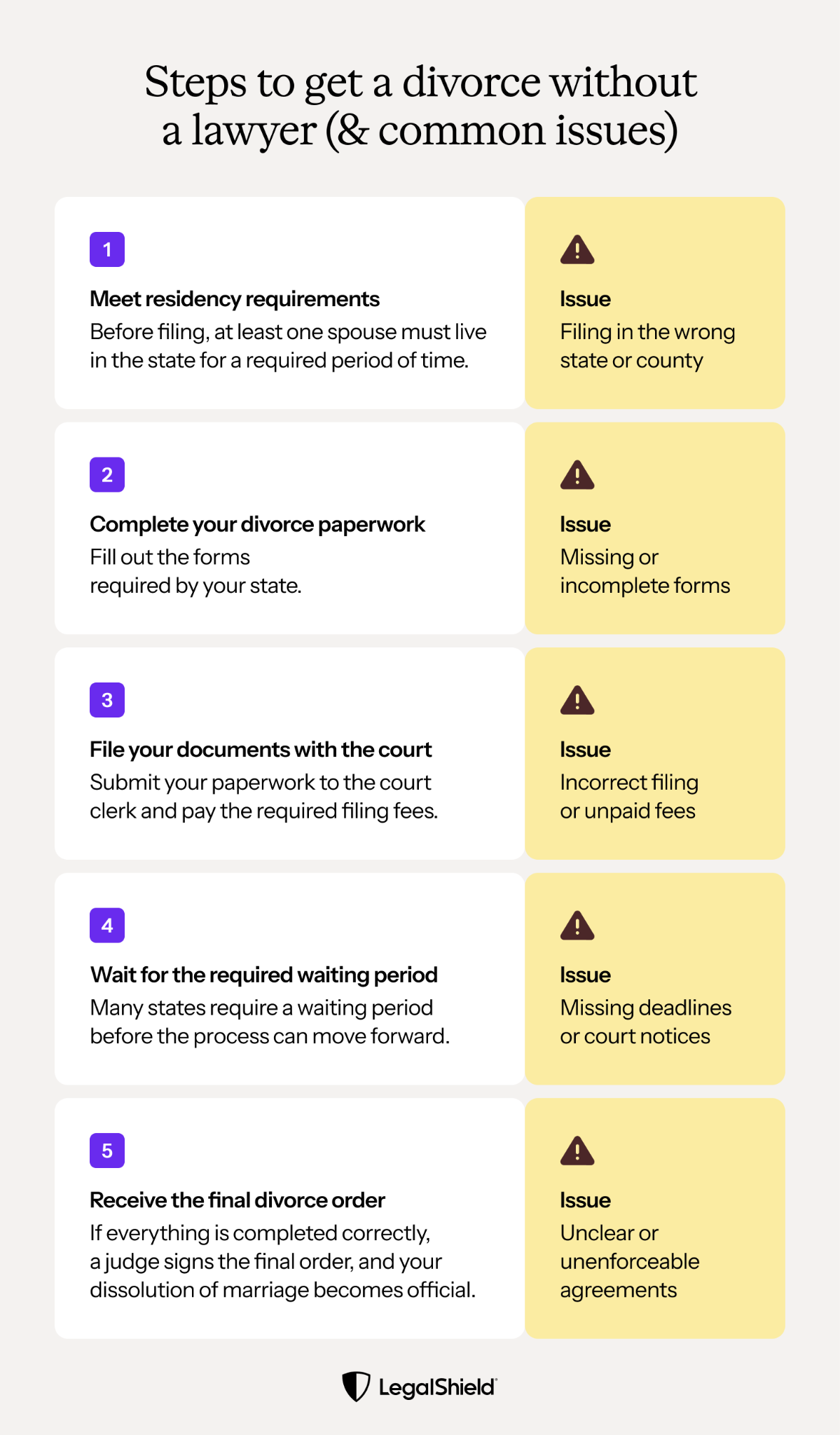
The pro se divorce process looks like this:
Meet the state’s residency requirements: Either you or your spouse must have lived in the state where you’re filing for a specific amount of time. Otherwise, you can’t file for divorce in that state.
Fill out documents: Your state has official forms and procedures you need to use and follow. These differ by state. Be sure to find out what your state requires. Those forms might include a petition for divorce and an agreement for dissolution of marriage (ending the marriage).
File your papers: File your divorce paperwork with the appropriate court clerk. You’ll need to pay filing fees. If your divorce is contested, you may have to serve papers to your spouse.
Waiting period: In many cases, you’ll have to wait a specific amount of time after filing your papers. Once that time passes, your divorce can proceed.
Final hearing: You’ll have to attend a hearing with the court clerk. Be ready to present documents, including a final decree of divorce.
Divorce court: You may have to present your case to the court. You’ll have to follow court etiquette and procedures.
Final signature: Once a judge approves, they will sign your divorce papers. Your agreements become binding court orders.
That might sound easy. The truth is, there are risks. Mistakes in any of these steps can lead to rejected filings and delays. Careful preparation helps move the process along smoothly
Third-party mediation
A mediator is a neutral third party — often, but not always, a lawyer — who is trained to help parties work through disputes. Mediators don't give legal advice. Instead, they point out ways to help you find common ground so both sides can move forward and resolve a dispute.
Most of the time, divorce mediation looks like this:
You and your spouse aren’t in the same room. If you have lawyers, they are with you.
The mediator is in a separate room.
The mediator goes back and forth between each room to hear your and your spouse’s arguments.
If lawyers are present, they explain your side of the argument for you.
Once the mediator hears both sides, they point to common ground.
If a mediator can help you reduce or eliminate disputes, your divorce can move forward faster. The longer you argue, the longer it is until your divorce is final. Your costs will rise, too.
Tips for making sure a joint divorce goes smoothly
An uncontested joint divorce is usually best if it’s possible. To make sure yours goes smoothly, you should follow these steps:
Gather all financial documents.
Agree on key terms before filing.
Consider mediation for any unresolved disputes.
Base decisions on facts rather than emotions where possible.
Keep communications about the divorce in writing.
Focus on the best interests of any shared children.
Use your LegalShield membership.
File jointly.
Divorce is rarely easy, but a smoother process is usually best for everyone involved.
How LegalShield can help
Using your LegalShield Membership, you get the best of both worlds. You save on costly lawyer fees. You also benefit from a lawyer’s advice and guidance. That helps you protect your interests and your wallet. You’ll still have filing fees, but the amount you’ll spend on legal advice is less than you’d pay other lawyers.
LegalShield Members have access to these benefits and more, depending on the selected plan:
Affordable membership plan options
A provider law firm
Assistance in understanding the required forms for their state
Consultations and document reviews, with potential issues brought to their attention
Help working through disputes
Not sure LegalShield is right for you? Don’t take our word for it - Over 8,000 Trustpilot members have reviewed LegalShield. Our TrustScore is 4.6 out of 5.
LegalShield Members can choose from affordable plans that provide access beyond divorce legal services to cover a wide range of personal legal matters. For top-notch legal guidance at an affordable monthly rate, LegalShield is a trusted option.
Content Specialist at LegalShield, creating educational resources about legal and consumer protection topics. She focuses on making complex legal and financial concepts accessible to readers and has contributed to various educational articles on consumer rights and protections.
We’ll provide more information about the trustors vs. trustees comparison, what to consider when filling these roles, and how they work together in Revocable and Irrevocable Trusts.
A power of attorney with springing powers is a legal document that grants someone else the authority to act on your behalf only after a specific event occurs.
There’s no rule that says a lawyer has to set up your Trust for it to be valid. However, Trusts are complex and doing it yourself without a lawyer's help comes with risks.
A Certificate of Trust proves your Trust is real and names who can act for it, while your beneficiaries and assets stay private. It lets your Trustee handle Trust business, like opening accounts or transferring property.
A limited power of attorney often comes in handy when you need help for a short time or for a single purpose. This legal document can help in situations like when you’re traveling, serving in the military, caring for an aging parent, or sending a child to study abroad.
We’ll cover some of the most common scams, the red flags that give them away, how to protect yourself, and what to do if you’ve already been caught out.
An executor is responsible for ensuring your final wishes get carried out, so it’s important that you choose someone who is responsible and can bear the emotional burden.
An employer identification number is a nine-digit number the IRS uses to identify a taxpayer. The estate needs its own, and getting one is usually simpler than it sounds. Learn more about estate EINs.
•
5 min read
Thank you! You're subscribed!
Oops! Something went wrong while submitting the form.







.jpg)