An irrevocable Trust is a legal arrangement that permanently transfers the ownership of certain assets from you into a Trust that you can’t easily change or revoke.
It’s normal to want to protect your assets, especially if you’re worried about the future. You might be thinking about how to plan for long-term care, protect your home, or make sure your family is secure. There are lots of legal tools to choose from. A Will is great, but an irrevocable Trust gives you more structure and protection.
An irrevocable Trust can help protect your assets from creditors and even lower some taxes. It also lets you decide who gets your assets when you pass away. Using an irrevocable Trust has both pros and cons. A LegalShield® provider lawyer can walk you through irrevocable Trusts and other estate planning options to help you decide which are right for you.
What is an irrevocable Trust?
An irrevocable Trust is a legal structure that owns the assets you put into it. Once you transfer those assets, you usually can’t change the Trust terms without complicated legal steps.
Let’s give you some quick definitions of terms used with Trusts. The person who creates a Trust is the grantor. A trustee is a third-party who manages the Trust’s assets. Beneficiaries receive income or principal from the Trust.
Since there are quite a few important aspects of an irrevocable Trust, let’s check out some key features:
Permanent transfer of asset ownership: Assets no longer belong to you—they belong to the Trust.
Can’t change easily: You can’t change or revoke the Trust unless the beneficiaries agree or a court allows it. A Trust Protector (a third party appointed to oversee an irrevocable Trust) may be able to amend the trust under certain circumstances.
Managed by a trustee: A trustee is in charge of the assets, following the Trust’s terms.
Protects assets: Assets held by a Trust are usually protected against the grantor’s creditors and lawsuits.
Tax planning: Because a grantor doesn’t own the assets anymore, their taxable estate is smaller. The Trust might have to pay income taxes, though.
Avoiding probate: The Trust’s assets usually transfer straight to beneficiaries when the grantor passes, avoiding the probate process.
How do irrevocable Trusts work?
Once an irrevocable Trust owns your assets, the Trust is legally separate from you. In fact, the Trust becomes a separate taxpayer with its own Employer Identification Number (EIN). We’ll use an example to make how an irrevocable Trust works easier to understand.
Sarah has been saving for many years for retirement and has an account with a high net worth. She is concerned about lawsuits and wants to protect her large savings account from potential claims.
Sarah creates an irrevocable Trust called “The Sarah Legacy Trust.”
She names her brother David as the Trustee.
Sarah obtains an EIN for the Trust.
She transfers her savings account into the Trust.
The Trust now owns the account, not Sarah personally.
If someone sues Sarah personally, they can’t go after the account since she doesn’t own it anymore.
If Sarah needs funds from the Trust, she can request those funds from David, who can agree or decline to give the funds.
Revocable vs. irrevocable Trusts
Revocable and irrevocable Trusts have different purposes. With a revocable Trust, you’ll keep flexibility and control during your lifetime. It’s a good way to organize your assets and help your heirs avoid probate.
Irrevocable Trusts focus on tax planning and long-term protection. You don’t have direct control of the assets after you transfer ownership to the Trust. Still, you should have some tax advantages and stronger protection against creditors. This type of Trust is often best for people who have a high net worth, need to protect their assets from creditors, or want to reduce estate taxes.
Feature
Revocable Trusts
Irrevocable Trusts
Control and flexibility
High. You can change or cancel it at any time.
Low. Changes are very difficult.
Legal ownership
You still own the assets.
The Trust owns the assets.
Asset protection
None if the grantor is living.
Stronger if used correctly.
Estate tax benefits
Minimal tax advantages.
Can help reduce estate taxes.
Income tax
You'll report income on your personal return.
The Trust may file its own separate tax return.
Probate avoidance
Yes.
Yes.
The benefits of irrevocable Trusts
Irrevocable Trusts can help you in many ways:
Asset protection: The Trust owns your assets. That means that if someone sues or tries to collect money from you, the Trust assets may be safe, depending on factors like the state and how the Trust is administered.
Estate tax reduction: When you die, the IRS could tax your estate. But whenever you give assets to the Trust, it lowers your personal estate tax liability. That lower amount could exempt the estate from federal taxes. And, if the value of your assets grows, the extra value stays in the Trust.
Medicaid eligibility and planning: Medicaid looks at what a person owns before giving help. Medicaid programs have a look-back period that is typically five years, but can vary by state. A transfer of assets, if done correctly, may reduce your assets enough to allow you to qualify for Medicaid.
Avoiding probate: With an irrevocable Trust, you can say who will inherit the assets after your passing. Those assets go straight to those heirs without having to pass through the probate court.
Control over distribution: You can make rules that say exactly when and how your beneficiaries get things from the Trust. That helps you protect them from bad financial choices.
The downside of irrevocable Trusts
Like most things, irrevocable Trusts come with some downsides. Some of the dangers of irrevocable Trusts include:
Loss of ownership: You no longer own what you put into an irrevocable Trust.
Not much flexibility: Changing or ending an irrevocable Trust is a complex legal process.
Gift taxes: The IRS considers transferring assets into an irrevocable Trust as a completed gift. You might have to pay gift taxes.
Complexity: Irrevocable Trusts are usually hard to understand. A lawyer usually needs to create them.
Tax requirements: An irrevocable Trust needs its own EIN, and it has to file yearly tax returns.
Trustee issues: Because you no longer control assets in an irrevocable Trust, choosing your trustee is very important.You rely on a trustee to manage the Trust honestly. That trustee could make mistakes or do something wrong on purpose, leading to legal issues.
Loss of access to assets: You could later have a financial emergency. Access to assets may be limited and distributions are in the sole discretion of the Trustee.
How to set up an irrevocable Trust
Irrevocable Trusts are generally more difficult to set up than revocable Trusts, and it’s best to get the help of a lawyer.
1. Talk to a lawyer about your goals
First, decide why you want to create the Trust. Not everyone does it for the same reason. Some people use irrevocable Trusts to protect assets.
Others are more interested in the tax benefits. Two types of irrevocable Trusts offer specific tax advantages:
Grantor Retained Annuity Trust (GRAT): A short-term irrevocable Trust that lets beneficiaries get an asset’s increased value without paying much in gift taxes.
Spousal Lifetime Access Trust (SLAT): One spouse uses their lifetime gift tax exemption to put assets into the Trust. The other spouse is the beneficiary. This setup lets family members keep some access to the assets. Spouses often set up SLATs to benefit the other spouse, and work with a lawyer on which SLAT holds which assets.
2. Choose your trustee
You’ll have to pick a trustee to oversee your Trust. That choice matters a lot because they’ll be in charge of everything. Mistakes can cause the Trust to lose value and lead to legal issues. Your goal is to choose a trustee who can manage the Trust responsibly.
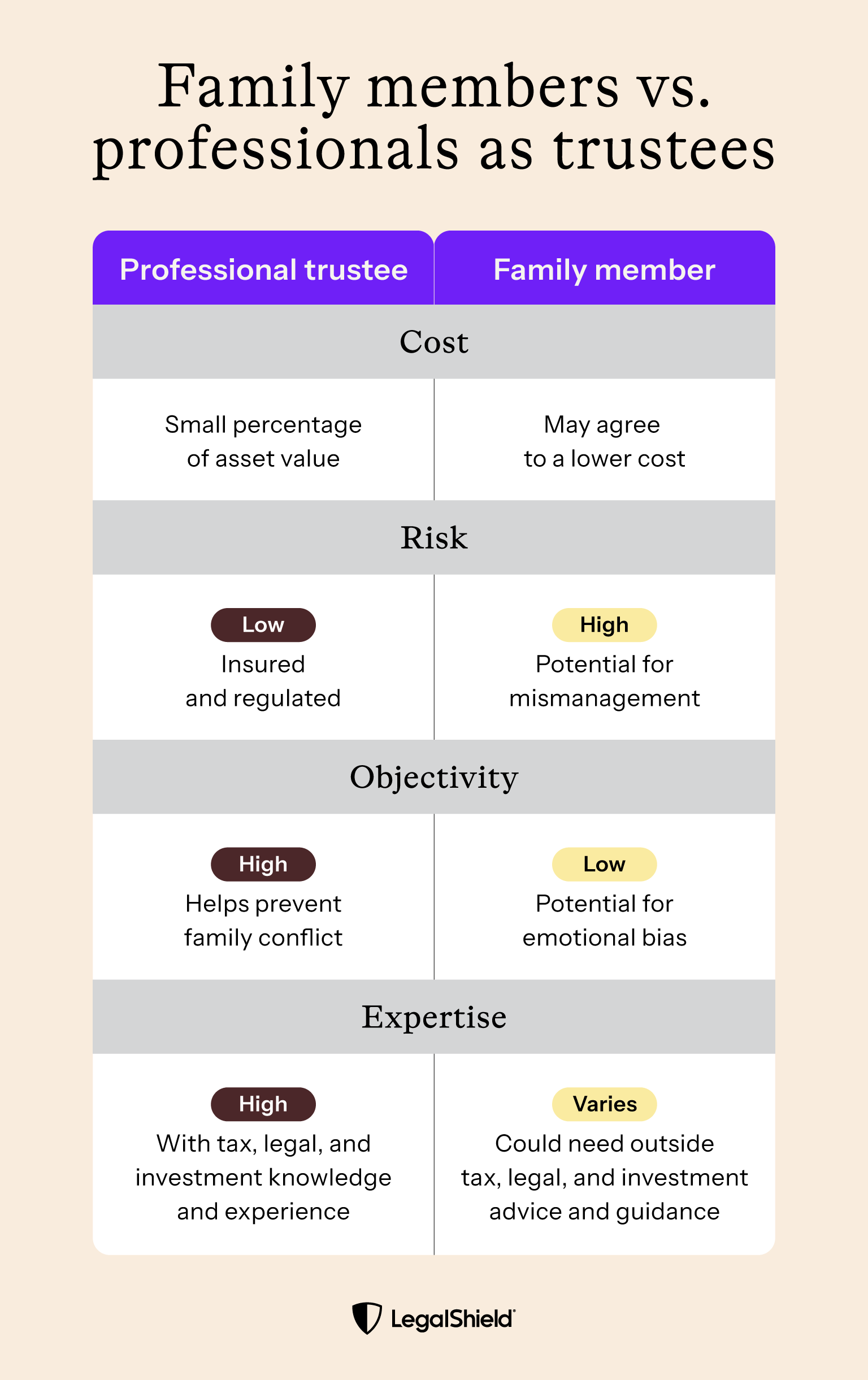
You might want to select a family member. Choose someone who you believe is trustworthy and fiscally responsible. One benefit of selecting a family member is that they often won’t charge as much as a professional trustee. Weigh those benefits against their experience handling finances. Consider whether their emotional connection could cause family conflict.
Professional trustees may cost more, but they have experience. They know how to manage Trusts effectively and protect their irrevocable status with the IRS.
3. Inventory your assets
The type of assets you put into an irrevocable Trust matters. Let’s talk about the purpose for two main kinds of assets:
Growth assets: saving your heirs from estate taxes
Liquid assets: funding Trust operations, protecting the assets
When you put growth assets, like real estate and stocks, into an irrevocable Trust, you’re freezing their value. Any appreciation in those assets can pass to beneficiaries tax-free. This type of asset transfer helps to avoid estate taxes, but it won’t generate fast cash flow. Be sure to talk to your financial advisor and CPA regarding the transfer of assets into an irrevocable Trust. Transfers of stock may require a sell-off, and the transfer of your residence may forfeit your homestead exemption.
You can also put liquid assets, like cash and liquid investments, into an irrevocable Trust. That transfer protects them immediately, and, those funds can help pay for taxes or Trust expenses.
4. Draft the legal document with a lawyer
Most people who create irrevocable Trusts do it for the protections they offer. But, those protections might not last if the Trust breaks rules. For example, the IRS looks closely at these Trusts. It wants to be sure that you’re not using the Trust for tax evasion. The IRS also looks at:
Proper taxes on distributions and retained income
Income reporting accuracy
Whether the grantor still has some control of the assets in the Trust
If you are involved in a lawsuit, the other party may try to prove that you transferred assets in order to protect them from the lawsuit, referred to as a “fraudulent conveyance”. Some states have lookback periods and other transfer restrictions.
Irrevocable Trust documents are complex. Even a small mistake in their preparation can lead to the IRS or a court not recognizing the Trust. This is too important to handle without the help of an experienced legal professional.
A LegalShield provider lawyer understands irrevocable Trusts and their advantages. With a LegalShield membership, your assigned provider law firm is in your state, so they also know state-specific laws that affect irrevocable Trusts. A DIY template can’t give you the safety net that personalized legal guidance can. A provider lawyer will help you make sure that you set your Trust up correctly.
5. Fund the Trust
Setting up an irrevocable Trust is only part of the process. The Trust doesn’t have an advantage until it has assets. You’ll need to title them using the Trust’s name and EIN.
The primary reason that Trusts fail isn’t because of bad drafting. It’s because grantors delay transferring their assets or don’t do it at all. Failing to fund your Trust leaves your assets vulnerable to the taxes and potential creditors you’re trying to avoid.
Secure your legacy with professional estate planning support
Understanding your estate planning goals is very important. An irrevocable Trust isn’t for everyone, but it might be right for you. You don’t have to figure it out on your own, though. Every situation is different, so legal support is invaluable.
Talk to a LegalShield provider lawyer who can answer your estate planning questions. They can give you guidance on the right Trust structure and make sure that your documents are legally sound. LegalShield members get reliable legal advice, with plans starting at around $1/day. Get help protecting your assets and heirs with LegalShield.
Frequently asked questions about irrevocable Trusts
Can I be my own trustee?
One of the key differences between an irrevocable Trust and a revocable Trust is that the grantor no longer has control of the assets, which is important for creditor protection. So adding yourself as a trustee defeats the purpose of an irrevocable Trust. Other options for a trustee are your spouse (as long as they are not also the grantor), a family member, professional trustee, or other responsible person.
Can an irrevocable Trust be revised or dissolved?
Changing an irrevocable Trust is very hard to do. You can’t unless the court approves, the beneficiaries agree, and if you have a Trust Protector named in the Trust. Dissolving an irrevocable Trust is also legally complex, which includes defunding the Trust of assets.
Communications Director at LegalShield overseeing content creation designed to make legal protection simple and approachable. He focuses on offering straightforward, trustworthy guidance that empowers people to make informed decisions about their legal rights and responsibilities.
We’ll provide more information about the trustors vs. trustees comparison, what to consider when filling these roles, and how they work together in Revocable and Irrevocable Trusts.
A power of attorney with springing powers is a legal document that grants someone else the authority to act on your behalf only after a specific event occurs.
There’s no rule that says a lawyer has to set up your Trust for it to be valid. However, Trusts are complex and doing it yourself without a lawyer's help comes with risks.
A Certificate of Trust proves your Trust is real and names who can act for it, while your beneficiaries and assets stay private. It lets your Trustee handle Trust business, like opening accounts or transferring property.
A limited power of attorney often comes in handy when you need help for a short time or for a single purpose. This legal document can help in situations like when you’re traveling, serving in the military, caring for an aging parent, or sending a child to study abroad.
We’ll cover some of the most common scams, the red flags that give them away, how to protect yourself, and what to do if you’ve already been caught out.
An executor is responsible for ensuring your final wishes get carried out, so it’s important that you choose someone who is responsible and can bear the emotional burden.
An employer identification number is a nine-digit number the IRS uses to identify a taxpayer. The estate needs its own, and getting one is usually simpler than it sounds. Learn more about estate EINs.
•
5 min read
Author Name
,
Author Title
September 16, 2026
Thank you! You're subscribed!
Oops! Something went wrong while submitting the form.







.jpg)