If the Will specifies executor compensation, that amount applies. If not, compensation varies by state and is dependent on the estate size and complexity.
Dealing with the loss of a close family member or friend can be difficult, and this grieving process can sometimes be made harder for those who are executors. Serving as an executor carries many responsibilities and a lot of hard work. This is why states allow for executor compensation.
Whether you've been asked to serve as an executor or you're drafting your own Will and want to plan ahead, it helps to understand how executor compensation works. This article explains how executors are compensated, the factors that can affect the amount, and how state laws play a role.
Why executors receive payment
Serving as an executor, especially for a large or complicated estate, can be a lot of work. This can involve tasks such as:
Filing legal documents and appearing at probate court hearings.
Identifying and locating all property in the estate.
Publishing required notice for heirs, creditors, and other interested parties.
Settling the estate's debts, such as unpaid credit card or medical bills.
Working with banks and other companies to manage the deceased’s assets.
Notifying the Social Security Administration of the deceased’s death.
Making ongoing payments as required by the estate. This might include mortgage payments and utility bills for the deceased’s home until it can be sold or transferred to the beneficiary.
Making decisions and carrying out tasks as required by the deceased’s business before it can be transferred to its new owner(s) or sold.
Traveling to and from companies and court, which can be costly if the assets are not in the same area where you reside.
Distributing property from the estate to heirs.
Most of these tasks carry little cost or risk for the executor. But sometimes, these involve judgment calls that heirs might disagree with. This could lead the executor to defend their decisions if heirs believe they didn't act in the estate's best interests.
How much an executor can be compensated
The terms of the Will decide what’s reasonable compensation for the executor of an estate. If the Will doesn’t mention anything, then the probate court’s state laws apply.
Many state laws state that executors are entitled to “reasonable compensation”. Factors that affect this standard are:
Size of the estate
Complexity
Time and effort
It is a good idea to consult with a lawyer when you first become an executor, so you can manage expectations and understand your responsibilities. Many times, executors do not receive compensation until the end of a probate, and a court still has to approve executor compensation.
What happens when the Will lists a specific fee
The provisions of the Will serve as the primary source for figuring out how to calculate executor compensation. This is yet another reason why it’s important to have a Will.
The testator (the person who creates the Will) has a lot of freedom to decide the amount and method of paying the executor. The testator can choose to pay:
An hourly rate;
A flat fee;
A specific percentage of the estate’s value; or
With specific property from the estate
A lawyer can help with these executor compensation decisions; this is one of the things a LegalShield provider law firm can assist with.
What happens when the Will is silent
If the Will doesn’t provide a precise amount or formula for deciding how much an executor gets paid, then state law will apply. Some states use a sliding percentage scale that’s based on the size of the estate.
For a hypothetical example, an executor might receive:
5% of the first $10,000;
4% of the next $40,000;
3% of the next $50,000; and
2% of the rest (an amount over $100,000).
So, for example, if the estate is worth $500,000, the executor receives $11,600:
5% of 10,000 = $500
4% of $40,000 = $1,600
3% of $50,000 = $1,500
2% of $400,000 = $8,000
Other states use the “reasonable compensation” method of calculating executor compensation.
Executor fees by state
The majority of states allow probate courts to decide how much compensation an executor should receive. This is usually an amount that’s “reasonable” based on what’s fair under the circumstances. Other states, such as California and New York, use a fixed sliding scale based on the estate’s value.
States handle executor compensation differently. Keep in mind that each probate case is unique, and there could be factors that raise or lower these amounts. If you’re looking for an exact answer, a LegalShield provider law firm can help.
Here is a list of how each state typically handles executor compensation.
Reasonable compensation:
Alabama
Alaska
Arizona
Colorado
Connecticut
Delaware
District of Columbia
Florida
Hawaii
Idaho
Illinois
Indiana
Kansas
Maine
Massachusetts
Michigan
Minnesota
Mississippi
Montana
Nebraska
New Hampshire
New Mexico
North Dakota
Pennsylvania
Rhode Island
South Carolina
South Dakota
Tennessee
Utah
Vermont
Virginia
Washington (state)
Flat or varying percentage:
California
Georgia
Louisiana
Missouri
Nevada
New Jersey
New York
Ohio
Oklahoma
Oregon
Texas
West Virginia
Wisconsin
Wyoming
Executor compensation with set limits or guidelines:
Arkansas
Iowa
Kentucky
Maryland
North Carolina
Factors that change the payment amount
Some estates are simple, with just a few pieces of property and basic bills to pay. Others are more complicated, such as expensive property located overseas or property that’s hard to sell. Some of the key factors that change compensation are below.
Handling complex assets
The more complex an estate, the more work an executor should expect. Imagine the deceased owned a business, and the executor must take over its management. Or there were numerous creditors the executor had to notify and pay. Probate courts may approve higher executor fees to account for this extra work.
Working with more than one executor
In some states, the executor fee is the same, whether there’s one or more executors. The total fee then gets split among the executors. In other states, the executor fees are multiplied by the number of executors. This ensures each executor gets the full compensation amount.
If executors change mid-probate, then executor compensation may be prorated to reflect time in position.
Hiring a professional or a lawyer
Someone preparing a Will can select a professional, whether a person or a company, like a trust company, to be their executor. These professionals may have fee schedules that differ from what state law allows. If you're considering naming a professional executor, a lawyer can help you understand what fee arrangements are typical. You can also contact the prospective executor and inquire about fees and services before you add them to your Will.
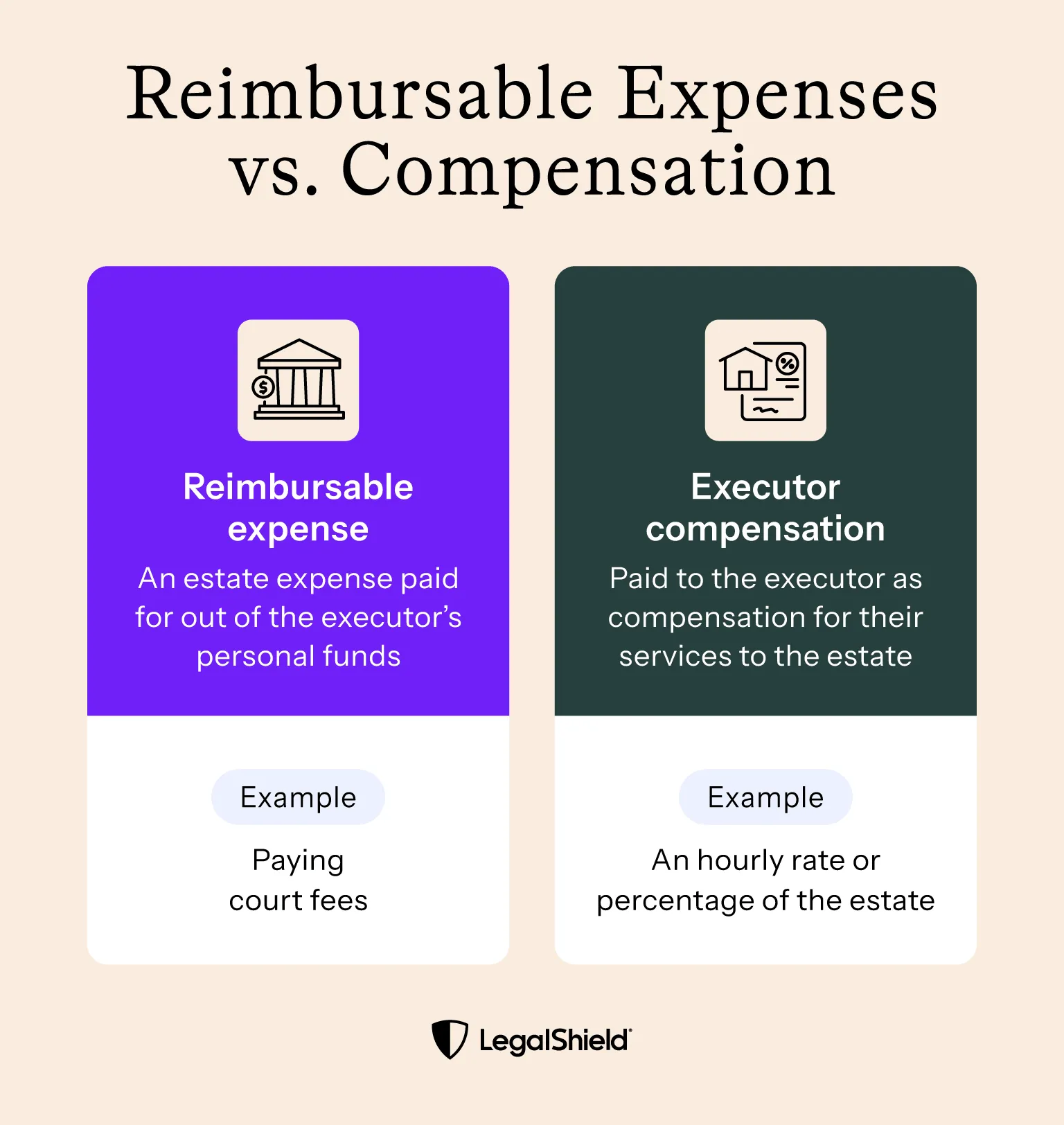
Reimbursable expenses vs. compensation
Title: reimbursable-expense-vs-compensation | Alt: An explanation of the difference between a reimbursable expense, an estate expense paid for out of the executor's personal funds, and compensation, paid to an executor for their services.
Reimbursable expenses are costs the executor normally pays out of pocket and later reimburses from the estate. These can include things like pre-probate expenses, like paying for certified copies of a death certificate. Executor compensation, on the other hand, is money paid to the executor for their time and effort in serving as an executor.
Once a probate has been opened, the executor can request reimbursement of pre-probate expenses. It is important that any request for reimbursement be made to the court to maintain transparency and proper recordkeeping. If you are not sure if you can reimburse yourself from estate assets, you should consult with a lawyer.
Is executor compensation taxable income?
The IRS treats executor compensation as taxable income. This income must be reported on the executor’s personal tax return, and the executor will need to pay income taxes on it. Additionally, the estate can usually list the executor’s compensation as an expense when it files an estate return.
An executor typically has the right to waive compensation or take a reduced amount. Whether an executor waives compensation or not is in their sole discretion.
Get legal help with executor compensation
Whether you're serving as an executor or working on your own estate plan, there's a lot to think through. Having access to a lawyer when questions come up can make the process a lot less stressful.
Luckily, you can use your LegalShield® membership for an affordable way to get legal guidance. From executor compensation questions to drafting a Will, a provider law firm can help you navigate the process with confidence. Learn more about LegalShield Personal Plans to get started.
Frequently asked questions about executor compensation
Can an executor turn down compensation?
Yes, an executor may refuse compensation. A family member serving as an executor may wish to waive compensation, but a professional executor likely will not.
When does the executor receive compensation?
When an executor is compensated depends on the state. In some states, executors get paid only after paying all of the estate’s debts and bills. In other states, executors may be compensated throughout the probate process.
If an executor is also a beneficiary, are they still compensated?
Yes, the executor who’s also a beneficiary can receive compensation. The exception is if the Will specifically states something different. In some Wills, the executor’s inheritance is intended to also be their compensation for handling the estate.
Content Specialist at LegalShield, creating educational resources about legal and consumer protection topics. She focuses on making complex legal and financial concepts accessible to readers and has contributed to various educational articles on consumer rights and protections.
We’ll provide more information about the trustors vs. trustees comparison, what to consider when filling these roles, and how they work together in Revocable and Irrevocable Trusts.
A power of attorney with springing powers is a legal document that grants someone else the authority to act on your behalf only after a specific event occurs.
There’s no rule that says a lawyer has to set up your Trust for it to be valid. However, Trusts are complex and doing it yourself without a lawyer's help comes with risks.
A Certificate of Trust proves your Trust is real and names who can act for it, while your beneficiaries and assets stay private. It lets your Trustee handle Trust business, like opening accounts or transferring property.
A limited power of attorney often comes in handy when you need help for a short time or for a single purpose. This legal document can help in situations like when you’re traveling, serving in the military, caring for an aging parent, or sending a child to study abroad.
We’ll cover some of the most common scams, the red flags that give them away, how to protect yourself, and what to do if you’ve already been caught out.
An executor is responsible for ensuring your final wishes get carried out, so it’s important that you choose someone who is responsible and can bear the emotional burden.
An employer identification number is a nine-digit number the IRS uses to identify a taxpayer. The estate needs its own, and getting one is usually simpler than it sounds. Learn more about estate EINs.
•
5 min read
Thank you! You're subscribed!
Oops! Something went wrong while submitting the form.






.jpg)