There is no specific legal document called a “house deed.” A deed is a legal document that transfers ownership of real estate from one person to another. You can usually get a copy of your deed from the county recorder, county clerk, register of deeds, or land records office.
If you surveyed 100 homeowners to ask them when they last thought about the deed with their home, most of them would say they don’t think about it at all until they need it. But you may need the deed more often than you realize! You might need your deed when you’re selling your home, adding a spouse to the deed, checking ownership, or trying to settle estate questions.
Your deed differs from a title, and the different types of deeds can affect the rights and promises that transfer with the property. That, coupled with varying state and county rules, means this issue can get complicated fast. It’s often helpful to get legal guidance.
If you’re looking for guidance, a LegalShield® Membership can connect you with a provider law firm for legal guidance during parts of the home sale process. For now, you can learn more about deeds if you keep reading.
What is a deed?
A deed is a legal document that transfers ownership of real estate from one person or entity to another. Think of it as the written record of the transfer.
While your house and other structures might sit on the property, the deed just contains the legal description of the land. The legal description identifies where and size of the property based on official surveys and existing records. Sometimes the description includes surface rights, but it also may contain what is below the surface, referred to as mineral rights.
Even though the legal description does not contain the structures, for the purposes of this article we may refer to the deed as a house deed.
Typically, the deed names the seller (called the grantor) and the buyer (the grantee). It may also describe the property, explain the type of ownership interest it’s transferring, and include the grantor’s signature. But the exact format will vary by state and county.
Different types of deeds
There’s more than one type of deed. In fact, there are several types, and the right one will depend on the property, the transfer, state law, and the level of responsibility the seller is taking for the title.
Here are some of the most common types of deeds:
General warranty deed: This type of deed gives the buyer some broad promises about the property’s title. It tends to mean the seller is promising they have the right to transfer the property and that no undisclosed claims are affecting the title.
Special warranty deed: This deed gives the buyer more limited promises than a general warranty deed. It usually covers title issues that arose while the seller owned the property — not those from previous owners.
Quitclaim deed: Quitclaim deeds transfer whatever ownership interest the grantor has (if any). It doesn’t promise that the grantor has a clear title or even full ownership of the property.
Transfer-on-death deed: These deeds allow real estate to pass to a named beneficiary upon the owner's death. That is, if state law allows it. The owner keeps control of the property while they’re alive.
Is a deed the same thing as a title?
A deed vs. title comparison comes down to document vs. ownership rights. A deed is a written document that transfers real property from one party to another. “Title” is the legal concept of owning the property.
You’re more likely to deal with a deed when real estate is changing hands. That might be during a sale, a gift, a divorce, an estate transfer, or when adding an owner.
Title, meanwhile, comes up when someone needs to confirm who owns the property — and whether there are liens, claims, or other issues that might affect ownership. That’s why a title search is often part of the home sale process.
What does a deed to a house look like?
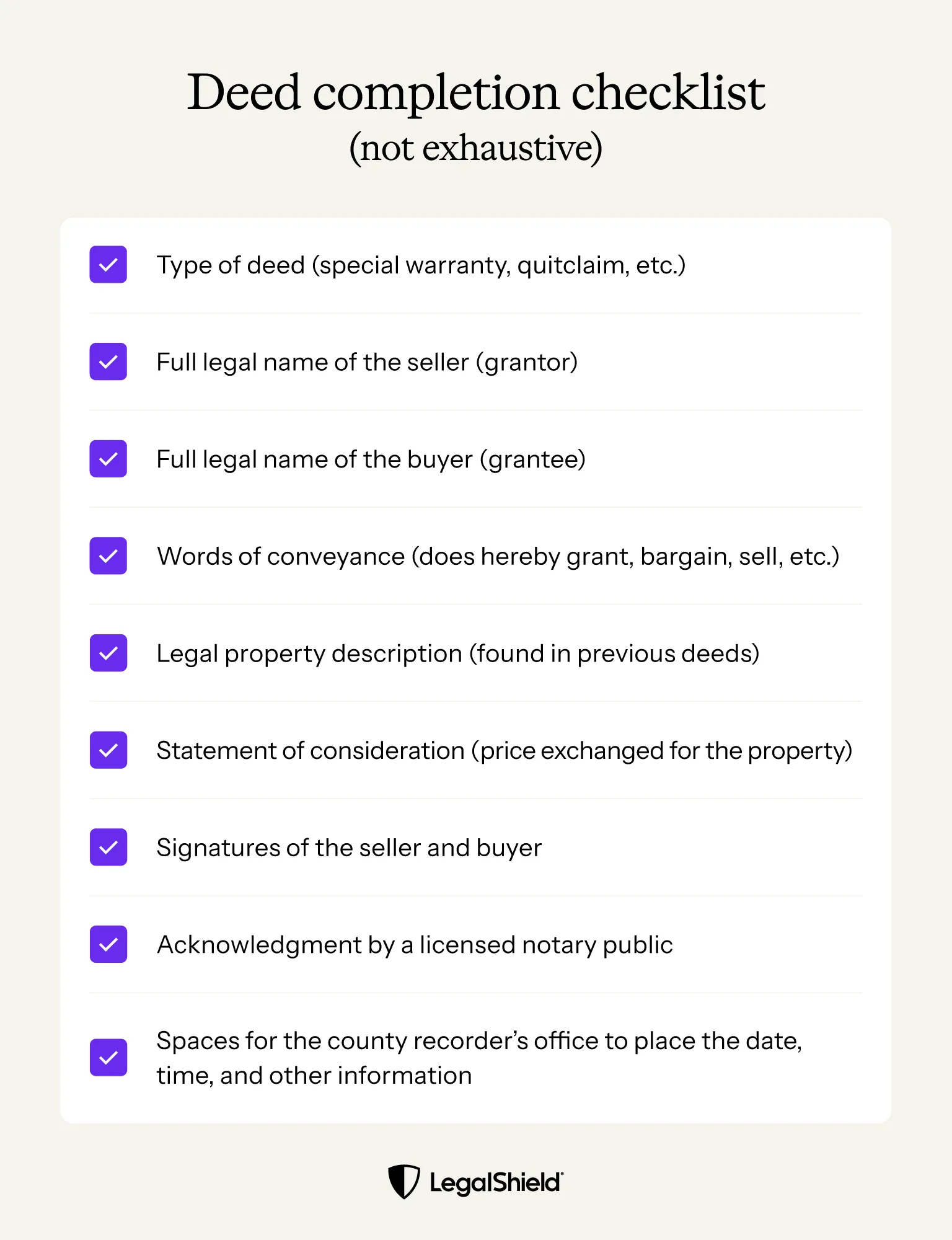
The exact form of a house deed can vary depending on the deed type and the state and county you’re in. Still, most deeds include the same basic information to ensure the property and the transfer are clear.
Deeds often include:
Seller, or grantor: The person or entity transferring the property.
Buyer, or grantee: The person or entity receiving the property.
Legal description of the property: A detailed description that can include lot numbers, block numbers, boundary lines, metes and bounds, subdivision names, and other survey details.
Granting clause: Language that shows that the grantor intends to transfer ownership to the grantee.
Consideration: A statement about what value, such as money, was exchanged.
Grantor’s signature: The person transferring the property signs the deed. The signature might need to be notarized before it’s recorded.
Recording information: Once you’ve filed it, the deed might include county recording details, such as a book and page number, instrument number, date, or stamp.
Buying or selling a home comes with a stack of documents, and the deed is one you don’t want to have to guess your way through. With a LegalShield Personal Plan, members can ask a provider law firm questions about deed language, real estate documents, recording steps, and other paperwork that may come up.
How do you record a deed?
Recording puts the transfer into the public record so later buyers, lenders, and title companies can see the ownership history of the property. You usually record the deed with the local county recorder, register of deeds, county clerk, or land records office where the property is. Precise recording rules and fees can vary by location.
Where do I get the deed to my house to make changes?
Start with the local county recorder, register of deeds, county clerk, or land records office. Usually, recorded deeds are public record. So homeowners can request a copy online, in person, or by mail.
If you’re looking to change a deed, such as by adding or removing someone, you typically need to prepare and record a new deed. That process may look like this:
Getting a copy of the prior deed. The most recent recorded deed allows you to confirm the current owners’ names, legal description, and recording information.
Choosing the right deed form. The right form comes down to the transfer and state law. A warranty deed, for instance, often works in a regular sale, while a quitclaim deed often fits ownership changes between family members.
Drafting and notarizing the new deed. The new deed needs to match local requirements and use the correct legal description. It’s a good idea to have a lawyer prepare or review this document before it’s signed and notarized.
Recording the new deed. After signing, you’ll usually file the new deed with the county recording office. This updates the public record and shows the new ownership info.
Get legal guidance for deed questions
The deed is one of the key documents in a home sale, property transfer, or ownership change. So it’s important to get it right. If you’re getting ready for a sale, you may also want to understand how a real estate purchase agreement works before the deed is signed and recorded.
With a LegalShield Membership, you can connect with a provider law firm for legal guidance on real estate documents. As a member, you can ask questions about deed language, document review, title concerns, recording steps, or what to expect when buying or selling a home.
A LegalShield Provider Lawyer can help you understand the paperwork before you sign or file it, helping you stay informed as you navigate important decisions around your real estate needs.
Frequently Asked Questions
The county recorder, register of deeds, county clerk, or land records office usually keeps the official public record after the deed gets recorded. You might also have a copy in your closing documents. And if you have a mortgage, your lender might keep certain loan documents, including the deed. How to get the deed to your house varies by location, though.
There’s no single best deed for every situation. A general warranty deed is common in home sales because it gives broad promises about the title to the buyer. But a quitclaim deed might be the right call for certain transfers between family members, spouses, or trusted friends.
Losing your personal copy of the deed doesn’t mean you lose ownership. Recorded deeds are typically public records and you may be able to obtain a copy online. You can often request a certified copy from the county office that holds the deed. Fees and the exact request process vary by location.
Banks don’t “hold” the deed in the way many people think in most cases. If you have a mortgage, the lender holds a lien or security interest in the property, but the deed is usually still on file with the local land records office (or a similar office). Some lenders might charge for copies, payoff documents, and recording-related paperwork, though.
You usually get your house deed after closing, once you’ve recorded the signed deed with the local land records office (or similar office). The timing can vary by county, title company, and transaction, though. Sometimes, you get a copy with your closing documents. For others, you request one later from the county recorder or register of deeds.
Communications Director at LegalShield overseeing content creation designed to make legal protection simple and approachable. He focuses on offering straightforward, trustworthy guidance that empowers people to make informed decisions about their legal rights and responsibilities.
We’ll provide more information about the trustors vs. trustees comparison, what to consider when filling these roles, and how they work together in Revocable and Irrevocable Trusts.
A power of attorney with springing powers is a legal document that grants someone else the authority to act on your behalf only after a specific event occurs.
There’s no rule that says a lawyer has to set up your Trust for it to be valid. However, Trusts are complex and doing it yourself without a lawyer's help comes with risks.
A Certificate of Trust proves your Trust is real and names who can act for it, while your beneficiaries and assets stay private. It lets your Trustee handle Trust business, like opening accounts or transferring property.
A limited power of attorney often comes in handy when you need help for a short time or for a single purpose. This legal document can help in situations like when you’re traveling, serving in the military, caring for an aging parent, or sending a child to study abroad.
We’ll cover some of the most common scams, the red flags that give them away, how to protect yourself, and what to do if you’ve already been caught out.
An executor is responsible for ensuring your final wishes get carried out, so it’s important that you choose someone who is responsible and can bear the emotional burden.
An employer identification number is a nine-digit number the IRS uses to identify a taxpayer. The estate needs its own, and getting one is usually simpler than it sounds. Learn more about estate EINs.
•
5 min read
Thank you! You're subscribed!
Oops! Something went wrong while submitting the form.






.jpg)