A personal representative is anyone the court officially authorizes to manage a deceased person's estate, whether or not there was a Will. An executor is a specific type of personal representative: the person named in a Will by the person who wrote it. Every executor is a personal representative, but not every personal representative is an executor.
If you've been named in a Will or started thinking about your own estate planning, you've probably run into the terms "personal representative" and "executor," which are often used as if they mean the same thing. Sometimes they do. However, the personal representative vs. executor terminology is more nuanced than most people realize. Using the wrong term in the wrong context can create confusion during an already difficult time.
An executor is always a type of personal representative, but a personal representative isn't always an executor. The term that applies in any given situation depends on two things:
Whether the deceased left a valid Will
Which state's laws govern the estate
We know this can be a confusing issue to address alone. To help you confidently deal with these details, we’ve explained the basics of both roles, where they overlap, and why the distinction matters for an estate plan. Provider lawyers available through a LegalShield® Membership can help make sure estate planning documents use the correct terminology for the applicable state.
At a glance: How personal representatives and executors differ
The distinction between executor and personal representative starts with how each term came to exist.
In 1969, legal scholars created the Uniform Probate Code (UPC), a model law designed to standardize and simplify probate procedures across the country. The UPC introduced "personal representative" as a single umbrella term, replacing the older system that used "executor" for estates with a Will and "administrator" for estates without one.
Sixteen states have adopted the UPC in its entirety. In those states, the court uses "personal representative" as the official title regardless of what the Will says. The remaining states have adopted parts of the UPC or kept their own statutes, which is why "executor" is still widely used today.
Feature
Personal representative
Executor
Legal definition
An umbrella term for the person appointed by the court to manage an estate
A specific type of personal representative named in a Will
Appointment source
Named by the deceased in a Will or appointed by the court
Named by the deceased to act in their Will
Is a Will required?
Can serve whether or not a Will exists
This title requires a valid Will naming an executor
Common usage
Preferred term in states following the UPC
Traditional term used in common law and states not fully adopting the UPC
What is a personal representative?
A personal representative is the person the court officially authorizes to administer a deceased person's estate. The term covers anyone who steps into that role, whether they were named in a Will or appointed by the court because the deceased didn't leave one.
In states that have adopted the UPC, this is the only official title used, regardless of how the Will refers to the role. Even if a Will names someone as executor, the court in a UPC state will formally appoint that person as a personal representative. It's a standardized term, intended to be broad enough to cover every situation.
One of the most important scenarios it covers is what happens when someone dies "intestate," meaning they didn't leave a valid Will. The court appoints a personal representative to handle the estate according to the state's probate laws. This specific type of personal representative is called an "administrator," and carries the same legal duties as any other personal representative.
What is an executor?
An executor is the person specifically named in a Will to carry out the deceased's instructions. The deceased, also called the "testator," chooses this person themselves. The choice is intentional and personal, not left to the court.
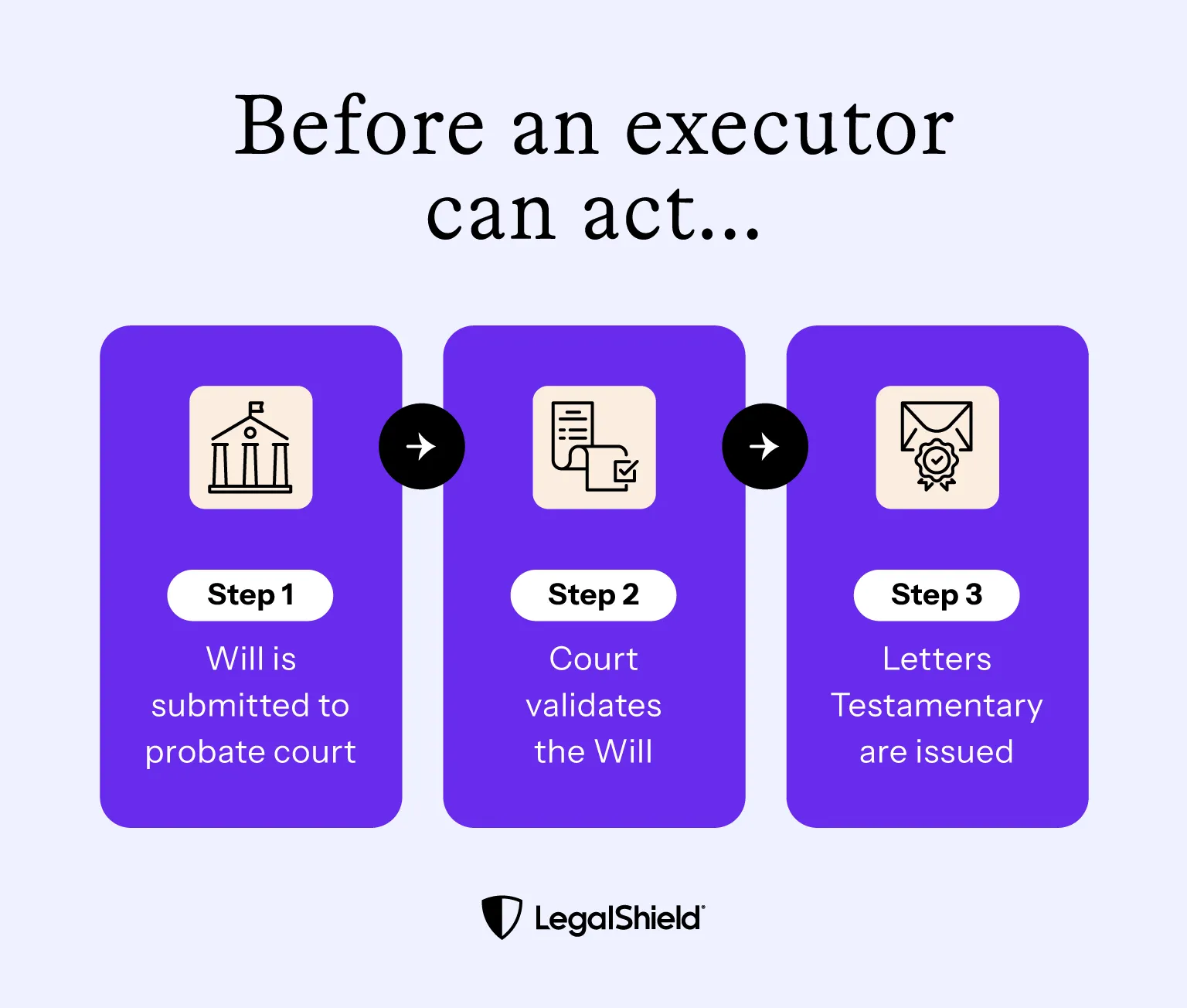
But here's something many people don't realize: being named as executor in a Will doesn't give you legal authority right away. An executor's power to act on behalf of the estate only begins once the Will is admitted to probate and the court issues a document called Letters Testamentary.
Letters Testamentary are the official court order that the Will is valid and that the executor has the legal authority to collect assets and pay debts. Without this order, a bank won't release funds, and a title company won't transfer property (no matter what the Will says).
Administrators vs. executors
The easiest way to understand both terms is to ask whether the deceased left a valid Will.
If they did, the person handling the estate is an executor, confirmed by the court through Letters Testamentary. If not, the court appoints someone to administer the estate under state probate law, and that person is called an administrator. The court order that person receives is called Letters of Administration.
Both roles carry identical legal duties once the court has made its appointment. The administrator isn't a lesser version of the executor. They do the same work under the same legal obligations. The title simply reflects how they got there.
Navigating state laws and core responsibilities
The title used in each state's court doesn't change what the role actually requires. What does change is the filing procedures and the specific forms the state uses. Some states follow the UPC and use streamlined probate procedures. Others have their own statutes with different requirements and court involvement. A lawyer familiar with local requirements can make a meaningful difference in how smoothly the process goes.
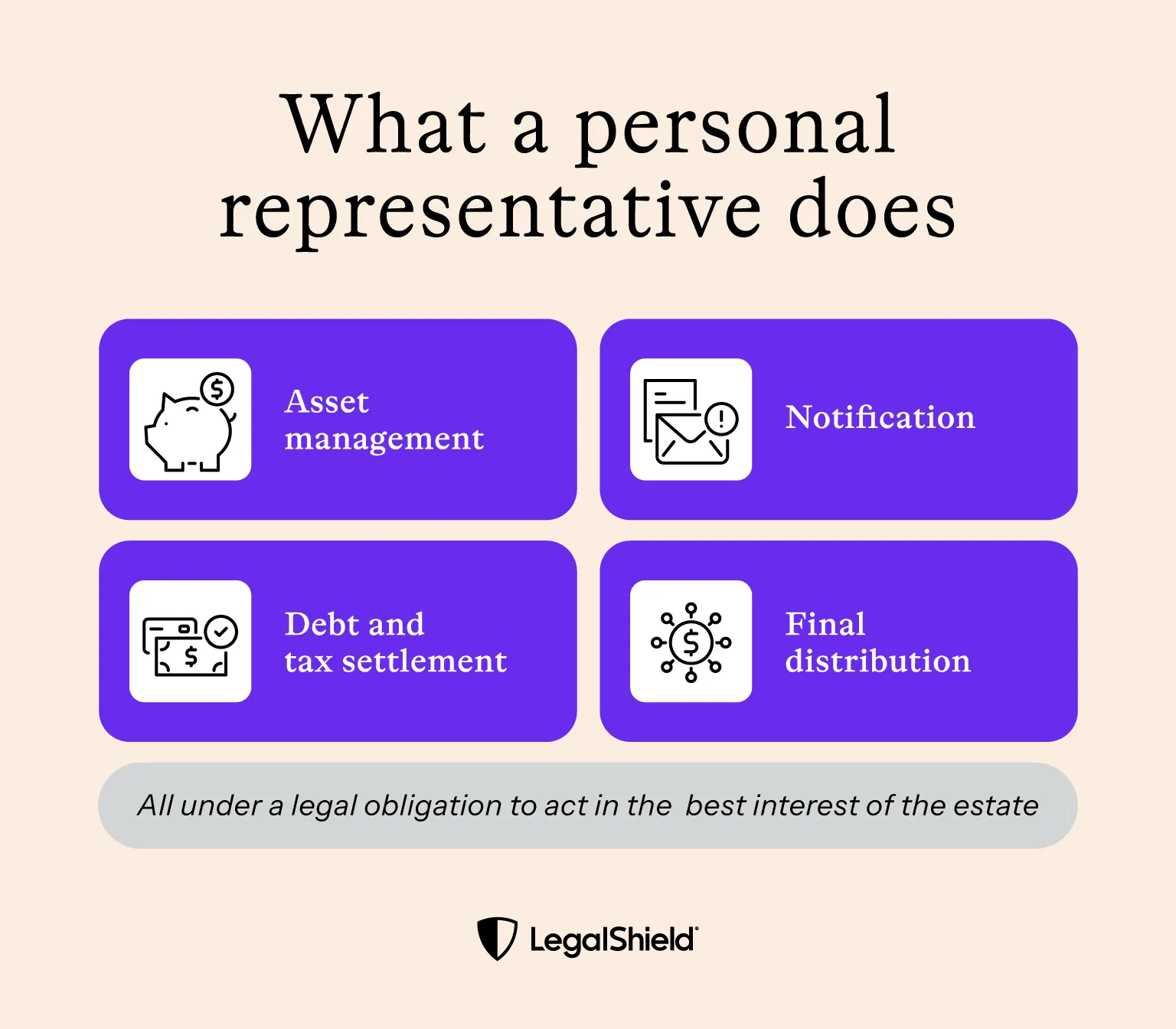
Regardless of the title, anyone serving in this role takes on a fiduciary duty, which is a legal obligation to act in the best interests of the estate and its beneficiaries. It's a strict legal standard, and failing to meet it can expose the personal representative to personal liability. The work itself falls into four main categories:
Asset management. Locating, inventorying, and protecting the deceased's assets (e.g., real estate, bank accounts, vehicles, investments, and personal property). Everything gets identified and secured before any distribution happens.
Notification. Informing creditors, heirs, and government agencies that the person has died and that the estate is being administered.
Debt and tax settlement. Using estate funds to pay valid creditor claims, funeral expenses, and any outstanding state and federal taxes before beneficiaries receive anything.
Final distribution. Transferring the remaining assets to the rightful heirs or beneficiaries once all financial obligations have been met. Distribution follows the Will's instructions or, if there's no Will, state probate law.
You can learn more about the documents involved in this process by reviewing the estate planning documents that typically accompany a complete estate plan.
Why accurate designations matter in estate planning
When a Will uses the term "executor" but the estate falls under a UPC state where courts use "personal representative," that inconsistency won't invalidate the documents, but it can slow things down. Courts may need to clarify intent before proceeding, and probate delays are the last thing a family needs during an already difficult time. Getting terminology right for the applicable state from the start keeps the transition of authority seamless.
This is one of the practical reasons why having a provider lawyer draft estate planning documents matters. Provider lawyers available through a LegalShield Membership are familiar with state-specific probate terminology and can make sure a Will reflects the terms the local probate court uses.
Through an active LegalShield Membership, Will preparation, a durable Power of Attorney, and a Living Will are available at no additional cost. Reviewing what to include in your Will can make that conversation more productive.
Simplify estate planning with LegalShield Plans
Knowing the difference between a personal representative and an executor is a meaningful step. Putting the right person in that role, with the right documents to back it up, is what actually protects you when it matters most.
Provider lawyers available through a LegalShield Membership can help with naming the right person in an estate plan and making sure the Will holds up. For someone writing a Will for the first time, that can mean getting the designations right, structuring distributions clearly, and using the terminology that matches the applicable state's probate court. For someone who already has a Will but has moved to a new state or wants to make sure it still reflects their wishes, a LegalShield Advanced or Premium Plan includes a provider lawyer’s review and update for the current state law.
Whether planning ahead or helping settle an estate, explore estate planning to find a membership that fits the situation. For more on what the process looks like for members, our blog on creating a will with LegalShield covers it in detail.
Content Specialist at LegalShield, creating educational resources about legal and consumer protection topics. She focuses on making complex legal and financial concepts accessible to readers and has contributed to various educational articles on consumer rights and protections.
We’ll provide more information about the trustors vs. trustees comparison, what to consider when filling these roles, and how they work together in Revocable and Irrevocable Trusts.
A power of attorney with springing powers is a legal document that grants someone else the authority to act on your behalf only after a specific event occurs.
There’s no rule that says a lawyer has to set up your Trust for it to be valid. However, Trusts are complex and doing it yourself without a lawyer's help comes with risks.
A Certificate of Trust proves your Trust is real and names who can act for it, while your beneficiaries and assets stay private. It lets your Trustee handle Trust business, like opening accounts or transferring property.
A limited power of attorney often comes in handy when you need help for a short time or for a single purpose. This legal document can help in situations like when you’re traveling, serving in the military, caring for an aging parent, or sending a child to study abroad.
We’ll cover some of the most common scams, the red flags that give them away, how to protect yourself, and what to do if you’ve already been caught out.
An executor is responsible for ensuring your final wishes get carried out, so it’s important that you choose someone who is responsible and can bear the emotional burden.
An employer identification number is a nine-digit number the IRS uses to identify a taxpayer. The estate needs its own, and getting one is usually simpler than it sounds. Learn more about estate EINs.
•
5 min read
Author Name
,
Author Title
September 16, 2026
Thank you! You're subscribed!
Oops! Something went wrong while submitting the form.







.jpg)