Per stirpes distributes a deceased beneficiary's share among that beneficiary's descendants. Per capita distribution is equal among all surviving beneficiaries.
Estate planning comes with a lot of terminology that many people have never encountered before. The difference between per stirpes and per capita is among the most confusing. The terms sound alike, and they sometimes appear side by side on a legal document. Both refer to how and who inherits your assets when a named beneficiary dies before you do.
Estate planning decisions like this one are also exactly where having access to LegalShield® Provider Lawyers can make a real difference. Provider lawyers, available through a LegalShield Membership, work with families on estate planning matters and can draft estate planning documents for them. Through LegalShield Memberships, members get access to lawyers experienced in helping families navigate these kinds of choices.
Now let’s get down to the basics. We’re here to explain the definitions and differences of per stirpes and per capita. We’ll also help you think through which one best fits your situation.
What does per stirpes mean?
Per stirpes is a Latin phrase that translates to "by branch.” It means that a person’s share from another estate passes to their descendants, which are often their children or grandchildren (and further down the branch of the family tree) upon their death. It appears in Wills, Trusts, and account and insurance beneficiary forms to describe what happens to someone's estate share after their passing.
Definition: Descendants In the context of estate planning, your descendants are anyone in your direct line going down from you. This can include children, grandchildren, great-grandchildren, and so forth. Plus, it can include legally adopted children and their descendants.
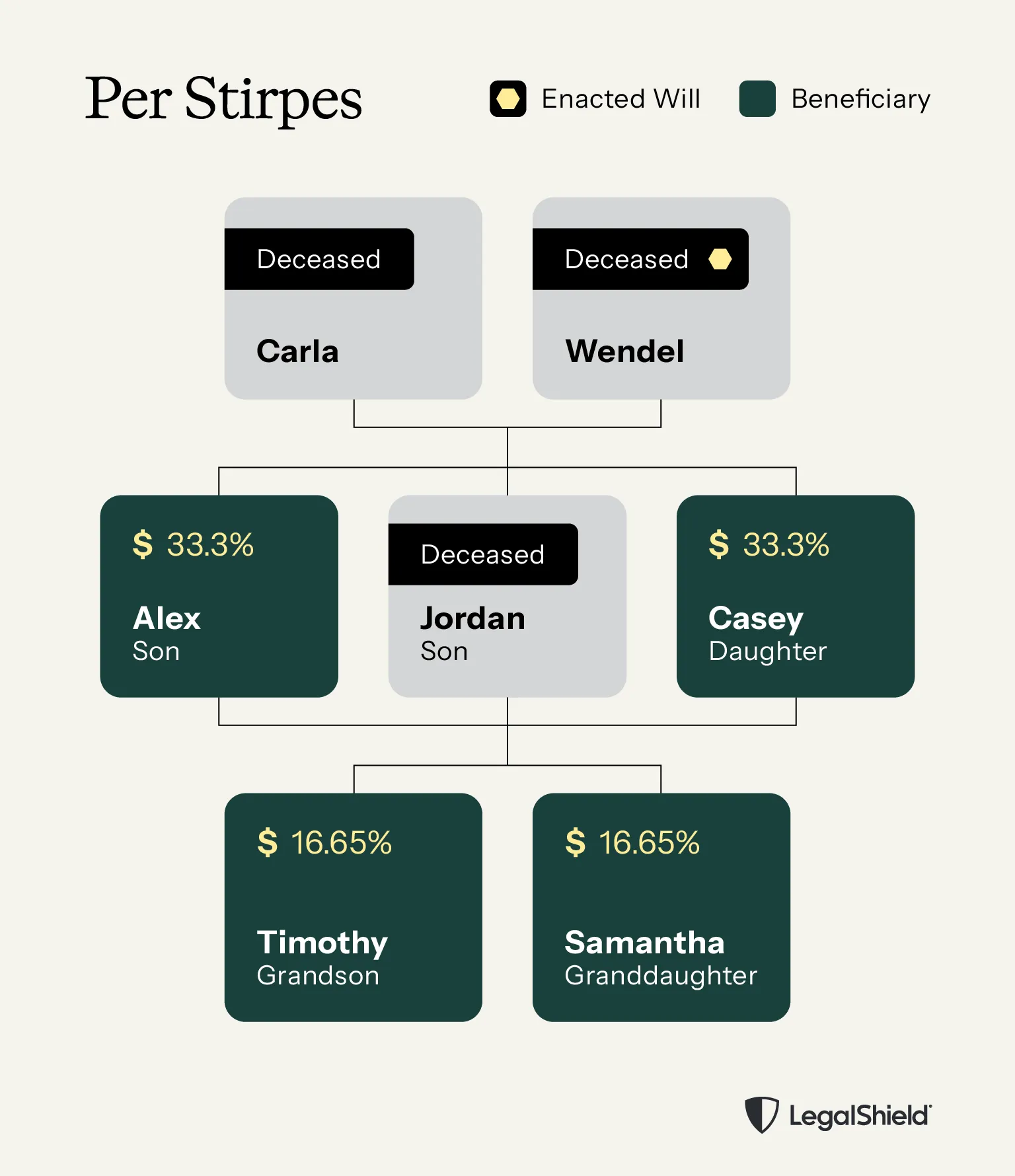
Say you have three children: Alex, Jordan, and Casey. You leave your estate equally to all three, per stirpes. Jordan passes away before you, leaving two children of their own. Alex gets one-third. Casey gets one-third. Jordan's two children split Jordan's one-third equally, each receiving one-sixth. Jordan's branch still gets its share, but it just moves down a generation.
What does per capita mean?
Per capita is a Latin phrase that translates to "by heads." If a named beneficiary dies before you, their share doesn't pass to their children. It gets divided equally among the surviving beneficiaries instead.
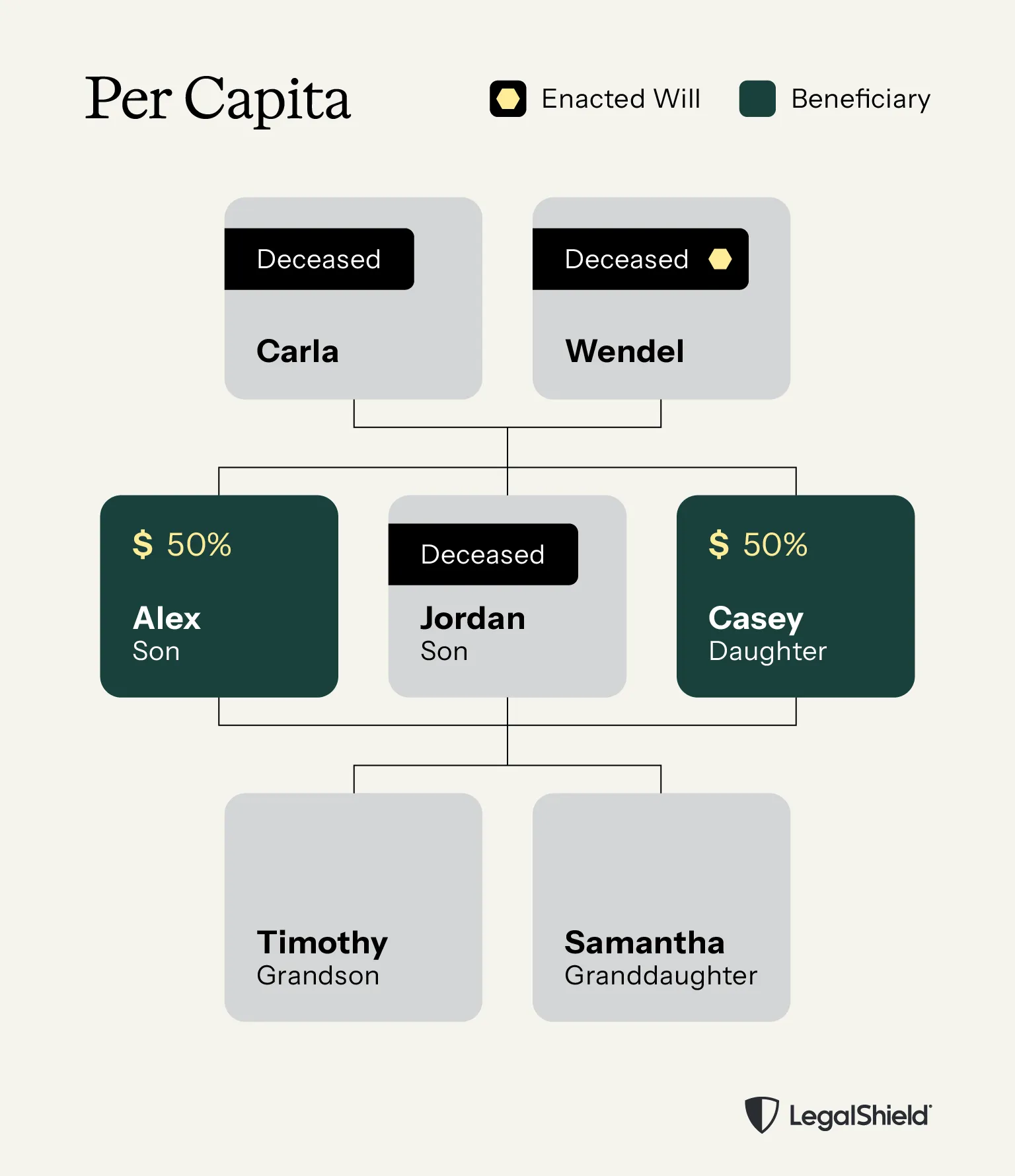
Consider the same family as before: Alex, Jordan, and Casey. You leave your estate equally to all three, per capita. Jordan passes away before you, leaving two children of his own. Alex gets one-half. Casey gets one-half. Jordan's children receive nothing. The estate splits only among the beneficiaries still living, and Jordan's branch is cut out entirely.
Per stirpes vs. per capita: how they compare
The difference between per stirpes and per capita comes down to one question: what happens to a beneficiary's share when they die before you do?
How assets are distributed
Per stirpes divides the estate by family branch. Each branch receives its proportional share regardless of how many living members it has. Per capita divides the estate equally among surviving named beneficiaries only. When someone dies before you, the remaining beneficiaries absorb that share, and the total number of recipients is adjusted accordingly.
What happens when a beneficiary passes away first
When all your named beneficiaries are living, per stirpes and per capita produce the same result. The difference only appears when someone dies before you do. Per stirpes keeps the deceased beneficiary's branch intact by passing that share to the beneficiary's descendants. Per capita distributes it to the surviving named beneficiaries, and the deceased beneficiary's descendants receive nothing unless the Will names them separately.
Which one is right for your family?
There's no universal answer. The right choice depends on your family structure and how you want your assets distributed in the event of an unexpected event. That said, a few patterns point toward one option or the other.
If you are married, it is important that you and your spouse’s estate planning documents reflect the goals for the family. One spouse may have a different per stirpes or per capita distribution branch than the other.
Families with children and grandchildren may find that per stirpes fits their situation well, as it keeps each branch protected regardless of who predeceases. It also tends to suit situations where assets spanning multiple generations need to follow the family tree.
Per capita tends to fit situations in which the estate passes only to a specific group of named beneficiaries, with no intention of passing shares down a generation. Families comfortable with redistributing their shares among survivors rather than passing them on to the next generation may find it the simpler choice.
Family structures can get complicated quickly, especially when relationships are blended, estranged, or span multiple generations. Provider lawyers available through a LegalShield Membership can help determine which designation best fits a specific situation. Brushing up on Trust or Will basics and reviewing common terms can also make that conversation easier.
How LegalShield can help with your estate plan
Choosing between per stirpes and per capita is the kind of choice that's easy to get wrong when you're working through it alone. Provider lawyers available through a LegalShield Membership can walk through exactly what each designation means for your specific family and help make sure your documents reflect what you actually intend.
LegalShield Provider Lawyers can draft a Will for you, including beneficiary language that helps ensure your wishes are clear. If your family situation is more complex — for example, a blended family, children from multiple relationships, or a beneficiary with special needs — they can ensure the language of the Will protects the people you care about most.
With an active LegalShield Membership, provider lawyers can prepare your Will and Durable Power of Attorney at no additional cost. Other estate planning services, including Trusts, may be available at a discount or at a flat rate in a more enhanced plan.
If you're ready to explore your options, check out the available LegalShield Plans to find the right membership for your family and get access to provider lawyers who can help you think through per stirpes vs. per capita and the other decisions that go into protecting the people you love.
Frequently Asked Questions
Per stirpes is the more widely used designation in Wills, Trusts, and account beneficiary forms. Estate planning professionals may default to per stirpes language, which is the legal default in many, but not all, states' inheritance statutes, because it keeps assets within family branches when a beneficiary predeceases the grantor. Per capita is certainly used, but less frequently as a starting point. The right choice for any family depends on their specific goals and structure.
Yes, per stirpes and per capita designations apply to retirement accounts and life insurance policies, not just Wills, but not automatically. These accounts pass outside your Will, so the choice you make on each account controls the distribution regardless of what your Will says. Learning how a Trust works can also help you understand how different estate planning tools fit together.
Yes. For a Will, you can update a beneficiary designation by amending it with a codicil or by executing a new Will entirely. For retirement accounts and life insurance policies, the beneficiary designation form gets updated directly with the account holder or insurer. Ensure any new update is compliant with your local laws.
If a per stirpes beneficiary predeceases you and leaves no descendants of their own, their share doesn't pass through that branch. Instead, the remaining beneficiaries receive that share in accordance with your Will's other terms or your state's law. Your Will should explicitly address this scenario.
There's no legal requirement to use a lawyer, but the complexities behind choosing per stirpes or per capita can benefit from using one. LegalShield Provider Lawyers can walk through the implications for your family and help make sure your documents say exactly what you intend. With an active LegalShield Membership, provider lawyers can handle your Will preparation at no additional cost.
Content Specialist at LegalShield, creating educational resources about legal and consumer protection topics. She focuses on making complex legal and financial concepts accessible to readers and has contributed to various educational articles on consumer rights and protections.
We’ll provide more information about the trustors vs. trustees comparison, what to consider when filling these roles, and how they work together in Revocable and Irrevocable Trusts.
A power of attorney with springing powers is a legal document that grants someone else the authority to act on your behalf only after a specific event occurs.
There’s no rule that says a lawyer has to set up your Trust for it to be valid. However, Trusts are complex and doing it yourself without a lawyer's help comes with risks.
A Certificate of Trust proves your Trust is real and names who can act for it, while your beneficiaries and assets stay private. It lets your Trustee handle Trust business, like opening accounts or transferring property.
A limited power of attorney often comes in handy when you need help for a short time or for a single purpose. This legal document can help in situations like when you’re traveling, serving in the military, caring for an aging parent, or sending a child to study abroad.
We’ll cover some of the most common scams, the red flags that give them away, how to protect yourself, and what to do if you’ve already been caught out.
An executor is responsible for ensuring your final wishes get carried out, so it’s important that you choose someone who is responsible and can bear the emotional burden.
An employer identification number is a nine-digit number the IRS uses to identify a taxpayer. The estate needs its own, and getting one is usually simpler than it sounds. Learn more about estate EINs.
•
5 min read
Thank you! You're subscribed!
Oops! Something went wrong while submitting the form.







.jpg)