Setting up a Trust fund for kids typically involves choosing a Trust type, naming a Trustee, and working with an attorney to draft and fund the Trust.
Most people hear "Trust fund" and picture old money and boarding schools. In reality, a Trust fund for kids could be one of the most practical tools any parent uses to help provide for their family. If you own a home, carry life insurance, or have money in savings, you have something worth protecting. Using a Trust to direct who will receive those assets, when, and under what conditions is a great way to provide for your family.
Settling an estate without a Trust usually means going through probate court. That can consume a percentage of the estate's value in legal fees and court costs, and can tie up your child's inheritance for a year or more.
What is a Trust fund?
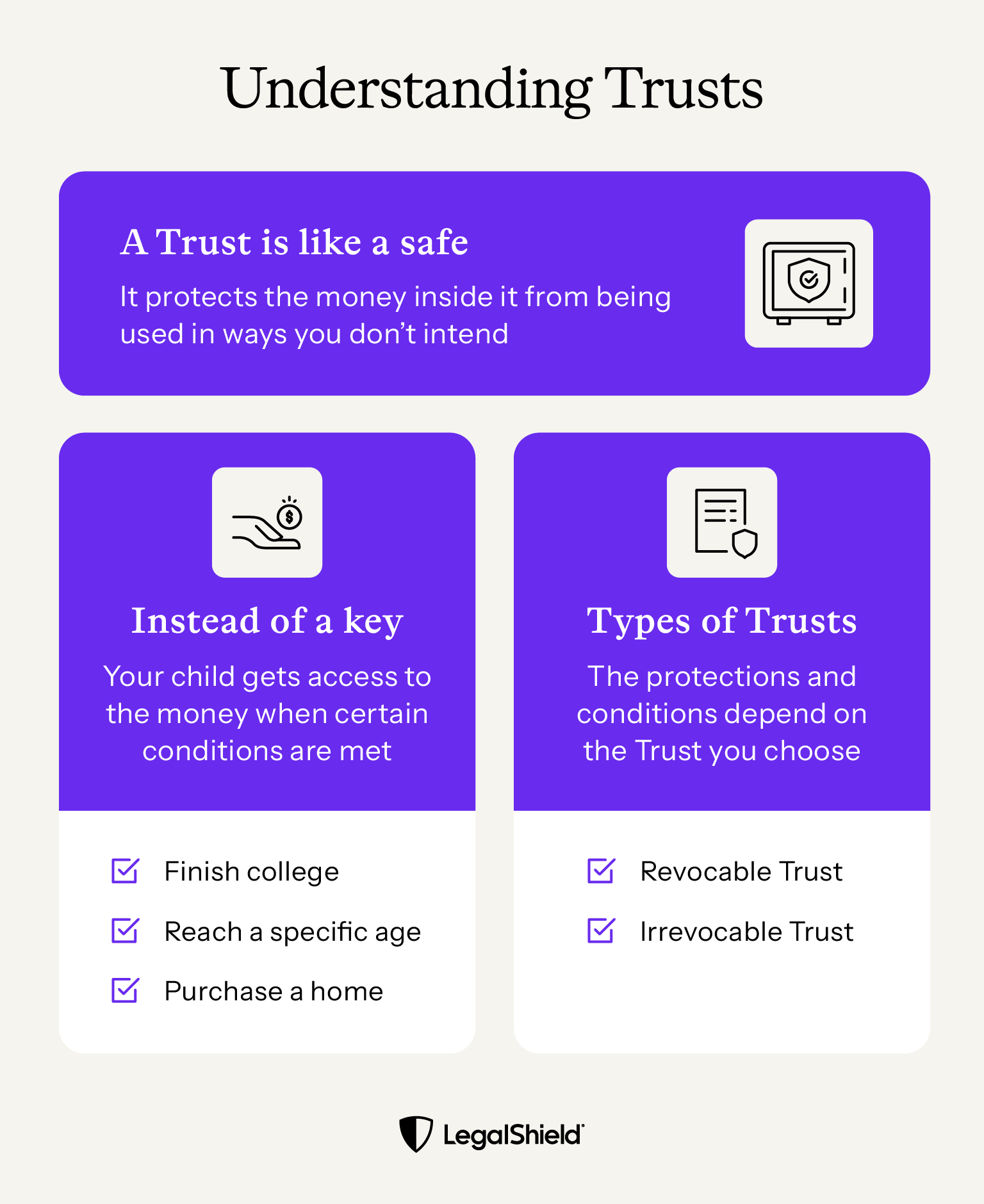
Filename: trust-fund-overview | Alt text: A general description of Trusts and what they do.
Think of a Trust fund as a piggy bank with a lock on it. You put assets in, set the rules for when and how it opens, and name someone responsible for holding it until then. More formally, a Trust is a legal arrangement in which one person transfers assets to another to manage them on a child's behalf, and it's more accessible than most people think.
Every Trust involves three roles:
Grantor: The person who creates and funds the Trust, usually a parent or grandparent.
Trustee: The person who manages the assets and follows the Trust's instructions. For a revocable Trust, this is often the parent themselves, with a named backup in case something happens.
Beneficiary: The child (or children) who will eventually receive the assets.
Trust funds aren't just for the ultra-wealthy. Many common family assets are worthy of the protection a Trust provides. A Trust gives you a way to choose how your assets move for your specific family: who gets what, when they get it, and under what conditions.
{{billboard-1}}
Why choose a Trust over a standard savings account?
A savings account is a great place to keep money. It's not a great place to protect it. If your child inherits money through a savings account and then faces a lawsuit or divorce as an adult, those funds may be exposed.
A Trust could help change that. Assets held in a Trust may be shielded from creditors and legal judgments, depending on the type of Trust and how it’s set up. Revocable Trusts generally do not offer this protection, as assets are still considered yours.
A Trust also gives you control that a savings account never can. You can include a spendthrift provision. That prevents your child from pledging their inheritance to a creditor before they even receive it. Depending on the state, the spendthrift provision can have limits and exceptions. For example, it might not prevent child support and government claims.
You could also add other conditions:
Require them to finish college
Reach a specific age before they access the funds directly
Use the funds only for a home purchase
A savings account hands over the money and steps aside. A Trust lets you set the terms you choose.
Another advantage is speed and privacy. When assets pass through a savings account after death, they often end up in probate. Assets held in a Trust skip that process entirely.
Your child receives their inheritance without legal fees and without their financial situation becoming part of the public record. For families with significant assets, certain Trust types can also reduce estate tax exposure, which a savings account can't do at all.
Revocable vs. irrevocable Trusts
Before choosing a Trust type, it helps to understand one foundational distinction: every Trust is either revocable or irrevocable. This is the structure that everything else is built on.
A revocable Trust can be changed, updated, or canceled at any time. You stay in control. An irrevocable Trust, once created, is very difficult to undo or modify — but that permanence is what gives it stronger asset protection and potential tax advantages.
Many parents starting out will lean toward a revocable Trust. If your situation involves significant assets or a child with special needs, an irrevocable Trust may be worth exploring with a provider law firm.
Revocable Trusts
A revocable Trust is the most common starting point for families. You stay in control of the property during your life. You can change the terms, add assets, or cancel it entirely at any time. When you die, the Trust takes effect, and your assets pass directly to your named beneficiaries without going through probate.
The main trade-off is taxes. Because you keep control of the assets, they stay in your taxable estate. A revocable Trust won't reduce your estate tax bill. What it does is keep your estate out of court and move quickly when your family needs it most. For most parents, that's exactly what matters.
Irrevocable Trusts
An irrevocable Trust is the opposite of a revocable one in almost every way. Once you create it, it's very difficult to change or cancel, but that inflexibility is exactly what makes it a powerful tool for asset protection.
When you transfer assets into an irrevocable Trust, they legally leave your estate. That shields those assets from creditors and legal judgments and reduces the size of your taxable estate. In 2026, the federal estate tax exemption is $15,000,000 per person or $30,000,000 for married couples. Estates above that threshold pay a tax on the excess.
This type of Trust might be used by families planning ahead for Medicaid or those who have valuable assets they want to protect; however, this is extremely complex, and the rules vary by state. An attorney's guidance is important from the start.
Choosing the right Trust for your family
Not all Trust funds for kids work the same way. Some give you full control and flexibility. Others trade flexibility for tax benefits or asset protection. The right choice depends on what matters most to you: keeping control, reducing taxes, protecting a child with special needs, or making sure your assets skip probate.
Check out this comparison of the four most common Trusts and whether each is revocable or irrevocable:
Name
Trust Type
Primary Goal
Flexibility
Tax Advantage
Distribution Age
2503(c) Minor's Trust
Irrevocable
Tax-advantaged gifting to children
Medium: Mandatory rules apply
High: Gifts qualify for the $19,000 annual exclusion (2026)
Must allow access at 21
Crummey Trust
Irrevocable
Long-term control plus tax perks
High: Flexible terms and timelines
High: Uses $19,000 exclusion via withdrawal notices
You decide
2503(b) Income Trust
Irrevocable
Teach money management
Low: Mandatory income distributions
Partial: Income qualifies; principal does not
Income now; principal whenever you decide
Special Needs Trust
Revocable or Irrevocable
Support without losing benefits
Variable: Must follow SSA/Medicaid rules
High: Protects government program eligibility
Based on the beneficiary's needs
1. 2503(c) Minors Trust
This is an irrevocable Trust built specifically for tax-advantaged gifting to children under 21. Every contribution qualifies for the annual gift tax exclusion ($19,000 per person in 2026). Married couples who split gifts can contribute $38,000 per child per year without triggering gift tax. That adds up fast, especially if grandparents are contributing too.
There's one rule you need to know upfront: when your child turns 21, they must be given the legal right to withdraw all of the Trust's assets. No exceptions. If they choose not to withdraw, the Trust can continue under new terms, but you cannot simply block access. For parents who lie awake imagining a 21-year-old with unchecked access to a large sum of money, there is a better option coming up next.
2. Crummey Trust
This irrevocable Trust gives you the same annual gift tax benefit as the 2503(c) Trust without handing your child the keys at age 21. You set the distribution age of your choice, keeping the tax benefit and the timeline completely separate.
Every time you contribute, you must send a written notice to your child or their guardian, called a Crummey Notice or Right to Withdraw. That notice gives them a short window (typically 30 days) to withdraw the gift. If they don't withdraw, the money stays in the Trust and the contribution qualifies for the annual gift tax exclusion.
The notice period and conditions are part of complying with the Trust terms and the IRS requirements. Miss the notice, and you lose that tax benefit for that contribution, so the paperwork is not optional. You don’t want to skip it!
3. 2503(b) Income Trust
Also irrevocable, this Trust splits into two separate parts: income and principal. The income (interest, dividends, and other earnings) must be paid out to your child on a regular basis. The principal — the core pool of assets — can be held until any age you choose.
That structure makes it a built-in financial education tool. Your child receives real money on a real schedule and learns to manage it. The principal stays locked away, so a bad year of decisions doesn't wipe out their inheritance. Keep in mind that only the income interest qualifies for the annual gift tax exclusion and the principal does not.
4. Supplemental Needs Trust (SNT)
A Supplemental Needs Trust can be an irrevocable or revocable Trust, and can be a standalone Trust or can be included in the terms of other Trusts. A Supplemental Needs Trust is designed to support a child with a disability without disqualifying them from government benefits they depend on. Programs like SSI and Medicaid have strict asset limits. If your child inherits money directly, that inheritance can push them over those limits. An SNT holds the money separately and has very specific conditions so it doesn't count against those limits.
The key is understanding what the Trust can and cannot pay for the child. SNT funds are meant to cover supplemental needs that government programs don't already provide, like therapy, travel, electronics, education, and personal care items, often considered “comfort and quality of life expenses”.
They can't be used for basic food and housing that SSI or Medicaid already covers. If the Trust pays for those things, your child's benefits may be reduced or eliminated. You can learn more about SNT spending guidelines before you start.
Trust alternatives: UTMA and UGMA accounts
A Trust fund for kids isn't the only way to save for their future. Custodial accounts set up under the Uniform Transfers to Minors Act (UTMA) or the Uniform Gifts to Minors Act (UGMA) offer a simpler, lower-cost alternative.
You can open one at most banks or brokerage firms. For families with modest assets who want a straightforward savings vehicle, they're worth knowing about. It's still a good idea to get legal guidance when deciding which option fits your situation.
The catch is control. When your child reaches the age of majority in your state (typically 18 or 21), they receive full, unconditional control of the account. Before choosing, it helps to understand your child's rights as a Trust beneficiary. The protections are very different.
How to set up a Trust fund
Setting up a Trust fund for a child takes a clear process, and working with an attorney can help make sure each step is done correctly for your state. Here are the steps it often involves.
Define the Trust's purpose. Start by deciding what the Trust is for, because its purpose shapes every decision that follows, including which Trust type makes the most sense and what conditions you want to build in.
Choose the right Trust type. A revocable Trust is the most common starting point. Special circumstances point toward other types. If you're not sure, an attorney can help you decide.
Appoint a Trustee. Choose someone with good financial judgment and long-term expected availability. For a revocable Trust, you can serve as your own Trustee. Either way, name a successor Trustee who takes over if the Trustee becomes unable to serve.
Draft the document. Trust documents must comply with state- and tax-specific laws, and the details matter. If you're thinking about setting up a Trust, a provider law firm can make sure each step is done correctly for your state.
Fund the Trust. Transfer assets into the Trust's name. This step is where many parents stumble, and it's the most important one to complete. An unfunded Trust is just a piece of paper. It does nothing until it holds assets.
Schedule regular reviews. Tax laws change. Family circumstances change. Children's needs evolve. Build in a review schedule (at a minimum every three years) to make sure the Trust still reflects your intentions and complies with any legal changes that may have occurred since you set it up.
Help secure your child’s future with professional legal support
Trust funds aren't a luxury reserved for the wealthy. They're a practical tool for any parent who wants to protect what they've built and make sure their child's inheritance doesn't get tied up in probate. A solid estate planning guide can help you see the full picture. From Will preparation and power of attorney to basic revocable Trust preparation for Premium plan members, LegalShield gives families a way to get their estate planning done right — without the hourly fees.
LegalShield® Personal Plans connect you with a provider law firm that can advise you on covered estate planning options, review documents, and prepare documents on your behalf. Premium plan members can also access basic revocable Trust preparation through a provider law firm. Get estate planning guidance today.
Frequently asked questions about kids' Trust funds
Check out our answers to some of the most common questions parents ask when they start looking into Trust funds for kids.
How much money do I need to start a Trust?
There's no legal minimum to fund a Trust. You can start one with any amount. That said, setup costs and attorney fees can range from a few hundred to a few thousand dollars, depending on the Trust type and your state. For small estates, a UTMA or UGMA custodial account may be more practical than a formal Trust.
Can I be the Trustee of my child's Trust?
Yes, parents commonly serve as their own Trustees, especially for revocable Trusts. You manage the assets, follow the Trust's terms, and make distributions according to the rules you set. The most important thing is to name a successor Trustee who takes over if you become unable to serve due to incapacity or death.
How does a trust fund affect college financial aid?
Trust assets are generally counted as assets on the Free Application for Federal Student Aid (FAFSA) forms, which can reduce your child's financial aid eligibility. The exact impact depends on who controls the Trust and on its type.
Trusts controlled by a parent are treated differently from Trusts controlled by the student. Families who plan well in advance of the FAFSA application year have more options available to them. A provider law firm can help you think through how Trust structure decisions may interact with financial aid rules.
Can I change the rules of the Trust later?
Whether you can change the rules of a Trust depends on its type. Revocable Trusts are designed to be changed at any time while you're competent. Irrevocable Trusts are a different story. They're very difficult to change by design, because that inflexibility is what provides the legal and tax protection. When in doubt, it’s helpful to talk to an attorney before you sign anything you can't undo.
Internal Revenue Service. (2024, October 22). IRS releases tax inflation adjustments for tax year 2026, including amendments from the One Big Beautiful Bill (Rev. Proc. 2025-32). IRS tax inflation adjustments for 2026
Communications Director at LegalShield overseeing content creation designed to make legal protection simple and approachable. He focuses on offering straightforward, trustworthy guidance that empowers people to make informed decisions about their legal rights and responsibilities.
We’ll provide more information about the trustors vs. trustees comparison, what to consider when filling these roles, and how they work together in Revocable and Irrevocable Trusts.
A power of attorney with springing powers is a legal document that grants someone else the authority to act on your behalf only after a specific event occurs.
There’s no rule that says a lawyer has to set up your Trust for it to be valid. However, Trusts are complex and doing it yourself without a lawyer's help comes with risks.
A Certificate of Trust proves your Trust is real and names who can act for it, while your beneficiaries and assets stay private. It lets your Trustee handle Trust business, like opening accounts or transferring property.
A limited power of attorney often comes in handy when you need help for a short time or for a single purpose. This legal document can help in situations like when you’re traveling, serving in the military, caring for an aging parent, or sending a child to study abroad.
We’ll cover some of the most common scams, the red flags that give them away, how to protect yourself, and what to do if you’ve already been caught out.
An executor is responsible for ensuring your final wishes get carried out, so it’s important that you choose someone who is responsible and can bear the emotional burden.
An employer identification number is a nine-digit number the IRS uses to identify a taxpayer. The estate needs its own, and getting one is usually simpler than it sounds. Learn more about estate EINs.
•
5 min read
Thank you! You're subscribed!
Oops! Something went wrong while submitting the form.






.jpg)