"Et al." on a Deed means there are additional owners beyond the one person named, but it doesn't say who they are.
You're reviewing your property Deed for the first time in years, maybe because you're refinancing or thinking about selling. You spot your name followed by two unknown words: "et al." (sometimes written as "etal"). If that phrase looks unfamiliar, you're not alone. It's Latin shorthand meaning "and others." The Deed is telling you that other people also own the property, but it isn't naming them.
A Deed with "et al." can complicate a future sale or refinance, and it can create real trouble when it's time to settle an estate or pass the property to your kids. In many cases, 'et al.' can be fixed by recording a new Deed. We’ll explain what the phrase means and how to remove it from your Deed.
What does “et al.” mean on a Deed?
"Et al." is short for the Latin phrase "et alii," meaning "and others." On a Deed, it shows up after the name of one property owner to indicate that other people also have ownership rights, but those people aren't listed by name. If a Deed reads "John Smith et al.," it tells you John Smith owns the property along with at least one other person whose identity isn't recorded on the document itself.
Because the Deed doesn't say who the other owners are, anyone trying to verify ownership later has to search through other records to figure it out. This is different from a Deed that lists multiple full names, like "John Smith and Mary Smith," where the ownership is fully spelled out. The problem with "et al." is the lack of specificity, not the existence of multiple owners.
How to remove “et al.” from a Deed
Removing "et al." from a Deed means recording a new Deed that lists every owner by name. For most homeowners, having a lawyer review the paperwork is the most reliable way to get the revised deed correct. LegalShield® Members have ongoing access to a provider law firm that can offer legal support for real estate matters along the way.
Before starting, most people gather their paperwork. At the very least, the current Deed is needed. Prior sale records and probate filings tied to the property also may help confirm who actually has an ownership interest, which is the whole point of the revised Deed.
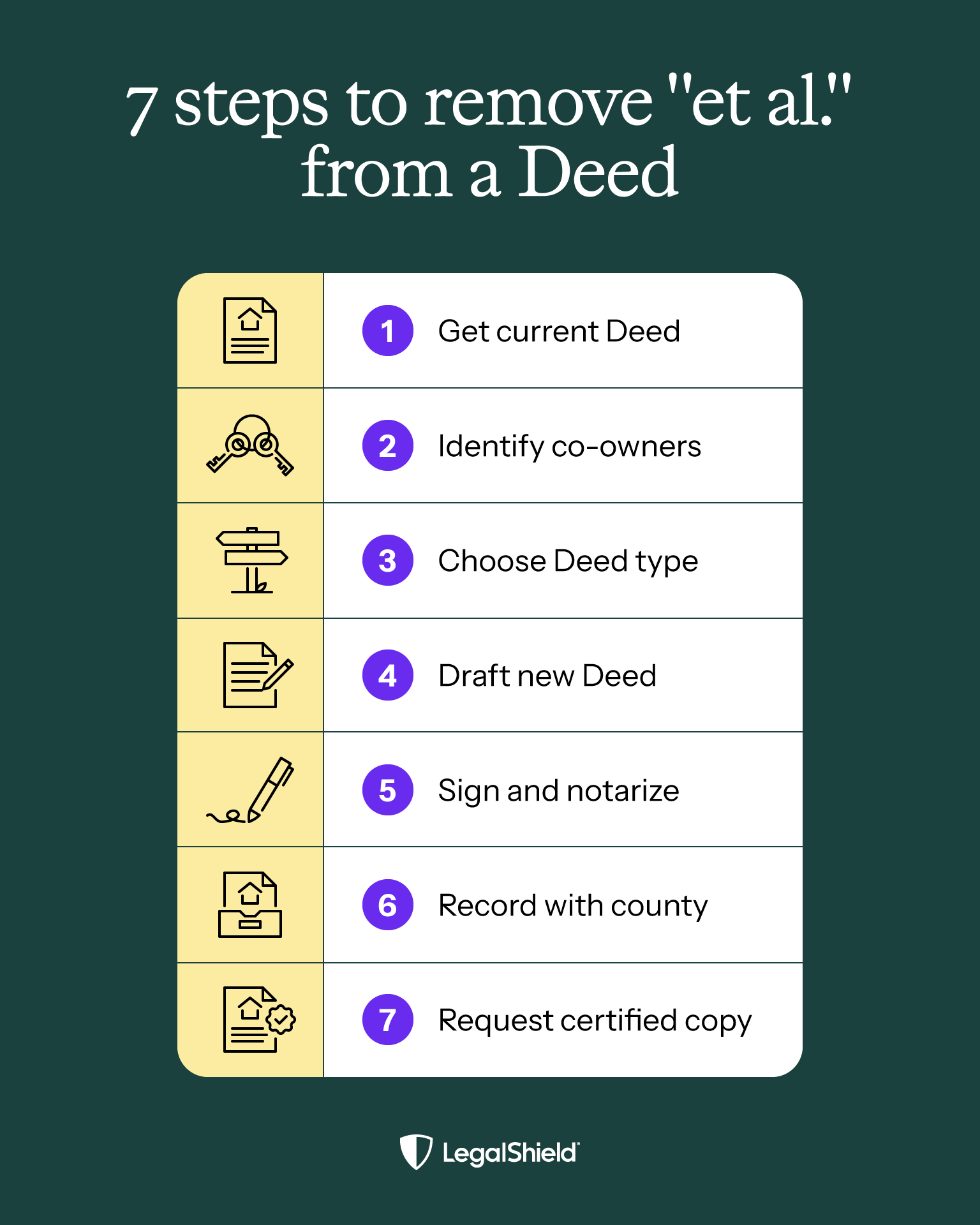
State and county rules differ on the specifics, but the basic steps are similar. You will often need to fulfill these requirements:
Getting a copy of the current Deed: Most people request a copy from the county recorder's office or the office where the Deed was filed. Many counties offer online lookups or mail-in requests.
Identifying all co-owners: This usually means looking at probate records, original sale documents, or family records. Every owner needs to be identified before a new Deed can be drafted.
Choosing the right type of Deed: A Quitclaim Deed is the most common option for clearing up title issues between known parties. A Warranty Deed offers more protection for the buyer in a sale. The right choice depends on whether the goal is correction, transfer, or both. Our article on the Quitclaim Deed process covers when that option makes sense.
Drafting the new Deed: The new Deed typically includes the legal description of the property, the names of all current owners, and how they're holding title (joint tenants, tenants in common, and so on). Errors here can get the filing rejected.
Signing and notarizing the Deed: All current owners sign the new Deed in front of a notary, either together or in front of different notaries. If even one signature is missing or improperly notarized, the county can reject the filing.
Recording the Deed with the county: The signed and notarized Deed gets submitted to the county recorder's office, along with the required filing fee. Recording is what makes the ownership change part of the public record.
Requesting a certified copy for records: Once recorded, some people may request a certified copy of the new Deed to keep with their other important property documents.
Pay attention to how the current Deed lists co-ownership before drafting the new one.
Joint tenants share equal ownership with rights of survivorship, meaning if one owner dies, their share passes automatically to the surviving owners. Tenants in common can own unequal shares and pass their portion through a Will. Getting the new Deed wrong on this point can undo the correction you're trying to make.
Potential complications of “et al.” on a Deed
Title companies and lenders want a clear chain of title before they'll touch a real estate transaction, and the “et al.” on property documents directly affects that chain. Every person with an ownership interest needs to be identified by name in the public record.
Chain of title is the documented history of every person who has owned the property. Title insurance protects buyers and lenders if a previously unknown owner steps forward to claim a share of the property. Both tools depend on the public record being accurate. "Et al." breaks that accuracy by leaving owners unnamed.
When "et al." shows up, the chain has a gap, and that gap can stall or kill a deal. Knowing what “et al.” means on a property Deed is a good first step, but the bigger question is what to do about it.
“Et al.” can cause these specific problems:
Title insurance issues: A title company may refuse to issue insurance because the title is considered unmarketable until all owners are identified.
Lender refusal: A buyer's lender may decline to fund the loan if title insurance can't be obtained.
A property that won't sell: Until the ownership question gets resolved, the property may sit on the market with no path to closing.
If a co-owner is unnamed and later dies, their heirs may struggle to prove their share of the ownership. Disputes can also arise if more than one person claims to be one of the "others" that the Deed references. The longer "et al." sits on a Deed without being resolved, the harder it usually gets to figure out who the unnamed owners actually are.
Common Deed mistakes to avoid
Once you know what "et al." means on a Deed, the next step is fixing it. The process usually isn't hard, but a few common mistakes can get the filing rejected and force you to start over.
Using an online template with the wrong legal description: Templates often miss the precise property description recorded with the county, which can get the filing rejected.
Failing to get all co-owners to sign: Every current owner must sign the new Deed. A missing signature usually means a rejected filing.
Recording the Deed in the wrong county: Deeds must be recorded in the county where the property sits, not where the owners live.
Not having the Deed notarized before recording: Most counties won't accept a Deed without proper notarization, even if everything else is correct.
Assuming a corrected Deed automatically updates the title insurance policy: It doesn't. You need to contact your title insurance provider separately to update the policy.
When to get a lawyer involved
Having a lawyer review the paperwork is the safest way to get the Deed correction right the first time.
Consult a lawyer when these situations arise:
One or more co-owners refuse to sign the new Deed
A co-owner has died, and the estate hasn't been fully settledThere's a dispute over who the unnamed "others" on the Deed actually are
The property is tied up in a divorce or other legal proceeding
Missing or unreachable owners are one of the most common reasons people end up in court over Deed corrections. If a co-owner has died and their heirs can't be found, or if someone has moved with no forwarding address, a regular filing won't work. In those cases, a lawyer can help with a quiet title action, a court proceeding used to formally establish ownership when there's no other way to clear the title (though requirements and procedures vary by state).
Trying to handle a contested filing yourself can end up costing more than legal fees would have cost. If you're looking to transfer property to family or transfer property without probate, we’ve covered the process in more detail in these handy articles.
How a LegalShield Provider Law Firm can help with Deeds
Addressing a Deed with "et al." on it is just one part of keeping your property records in order, and property questions can get complicated fast. With a LegalShield® Personal Plan, you can speak with a provider law firm about your specific situation and get help reviewing your Deed.
Whether you're sorting out unnamed co-owners on a Deed or dealing with a dispute before a sale, a LegalShield Provider Law Firm can advise you on the process for an affordable monthly fee instead of expensive hourly rates that can climb past $300/hour.
Frequently Asked Questions
Generally, no, if the property has multiple owners. Every current owner with an interest in the property must sign the Deed for the transfer or correction to be valid. The exception is when one owner has legal permission to sign for another, such as through a Power of Attorney or a court order.
Refinancing is one of the most common triggers because most lenders won't approve a new loan if the title has any unresolved ownership questions. That includes Deeds with "et al." on them. If you're planning to refinance in the next year or two, fixing the Deed first means one less thing to worry about when the closing date comes.
Communications Director at LegalShield overseeing content creation designed to make legal protection simple and approachable. He focuses on offering straightforward, trustworthy guidance that empowers people to make informed decisions about their legal rights and responsibilities.
We’ll provide more information about the trustors vs. trustees comparison, what to consider when filling these roles, and how they work together in Revocable and Irrevocable Trusts.
A power of attorney with springing powers is a legal document that grants someone else the authority to act on your behalf only after a specific event occurs.
There’s no rule that says a lawyer has to set up your Trust for it to be valid. However, Trusts are complex and doing it yourself without a lawyer's help comes with risks.
A Certificate of Trust proves your Trust is real and names who can act for it, while your beneficiaries and assets stay private. It lets your Trustee handle Trust business, like opening accounts or transferring property.
A limited power of attorney often comes in handy when you need help for a short time or for a single purpose. This legal document can help in situations like when you’re traveling, serving in the military, caring for an aging parent, or sending a child to study abroad.
We’ll cover some of the most common scams, the red flags that give them away, how to protect yourself, and what to do if you’ve already been caught out.
An executor is responsible for ensuring your final wishes get carried out, so it’s important that you choose someone who is responsible and can bear the emotional burden.
An employer identification number is a nine-digit number the IRS uses to identify a taxpayer. The estate needs its own, and getting one is usually simpler than it sounds. Learn more about estate EINs.
•
5 min read
Author Name
,
Author Title
September 16, 2026
Thank you! You're subscribed!
Oops! Something went wrong while submitting the form.









.jpg)