A Revocable Trust keeps you in control but leaves your assets exposed to creditors, while an Irrevocable Trust protects your assets and reduces estate taxes by permanently transferring ownership out of your hands.
What if something happened to you tomorrow? Would your family have everything they need to carry out your wishes and settle your estate? It’s not pleasant to think about, but estate planning can be complicated. Wills must go through court probate, which can take a long time. Some people use Trusts to pass important assets down directly, which can potentially help your family sooner.
There are two general Trust structures. A Revocable vs. Irrevocable Trust comes down to one trade-off: control versus protection. Revocable lets you stay in the driver's seat. Irrevocable moves your assets somewhere creditors and estate taxes can't easily reach.
We’re here to help break down how each Trust works, how they differ, and what to look for when choosing between them. Understanding the trade-offs is a great starting point, but we also recommend legal assistance with each step of the process. We’ll tell you how a LegalShield provider lawyer can help you with these big legal decisions!
Revocable vs. Irrevocable Trust structure basics
Both Trust types help your family avoid probate, but they take very different approaches to control, taxes, and asset protection. Check out this table to see how they compare:
Revocable (Living) Trust
Irrevocable Trust
Control
High: You can change beneficiaries, sell assets, or dissolve the Trust entirely at any time.
Low: Once signed, you generally cannot change it without beneficiary or court approval.
Flexibility
Maximum: Acts as a living document that you can update with changes in your life and finances.
Fixed: Designed to be a permanent legal arrangement.
Asset protection
None: Because you still control the assets, creditors and lawsuits can reach them.
Strong: Assets are no longer legally yours, making them off limits against most creditors.
Probate avoidance
Yes: Assets pass directly to your heirs privately and quickly.
Yes: Assets pass directly to your heirs privately and quickly.
What is a Revocable Trust?
Think of a Revocable Trust like a suitcase. You pack it, you unpack it, you swap things in and out as your life changes. Formally, a Revocable Trust (also called a Living Trust or Revocable Living Trust) is a legal arrangement you create during your lifetime to hold and manage your assets. You still control everything.
In most cases, you serve as your own Trustee. You can add property, remove it, change your beneficiaries, or dissolve the Trust entirely. When you die, your successor Trustee steps in and distributes everything according to your instructions without a probate court involved.
What is a Revocable Trust good for? Mostly, it's a cleaner, faster, and more private way to pass assets to the people you love or organizations like charities. Because you still control the assets, you don’t have creditor protection and there is no separate tax return. But for families focused on avoiding probate and keeping things simple, it's often the right place to start.
Potential benefits of a Revocable Living Trust
A Revocable living Trust offers several practical advantages:
Avoiding probate. Assets held in the Trust pass directly to your beneficiaries when you die. This lets you bypass courts, lengthy waiting periods, and hefty legal fees.
Privacy. A Will becomes a public record when it goes through probate. A Trust doesn't. Your beneficiaries, your assets, and your wishes stay private.
Financial control. You manage your own assets for your entire lifetime. You don't give anything up by creating a Revocable Trust.
Tax-neutral status. The Trust uses your Social Security number. Income is reported on your personal tax return. No separate Trust return is required while you're alive.
Drawbacks of a Revocable Living Trust
A Revocable Trust comes with some limitations:
No creditor protection. Because you still control the assets, they remain reachable by creditors and legal judgments. A Revocable Trust is not a shield.
Included in your taxable estate. The Trust doesn't move assets out of your estate for tax purposes. If estate taxes are a concern, a Revocable Trust won't help.
Upfront cost and effort. You'll need a lawyer to draft the document, and you'll need to retitle your assets in the Trust's name for it to work. An unfunded Trust is just paperwork.
No Medicaid benefit. Because you still legally own the assets, Medicaid counts them toward eligibility limits.
What is an Irrevocable Trust?
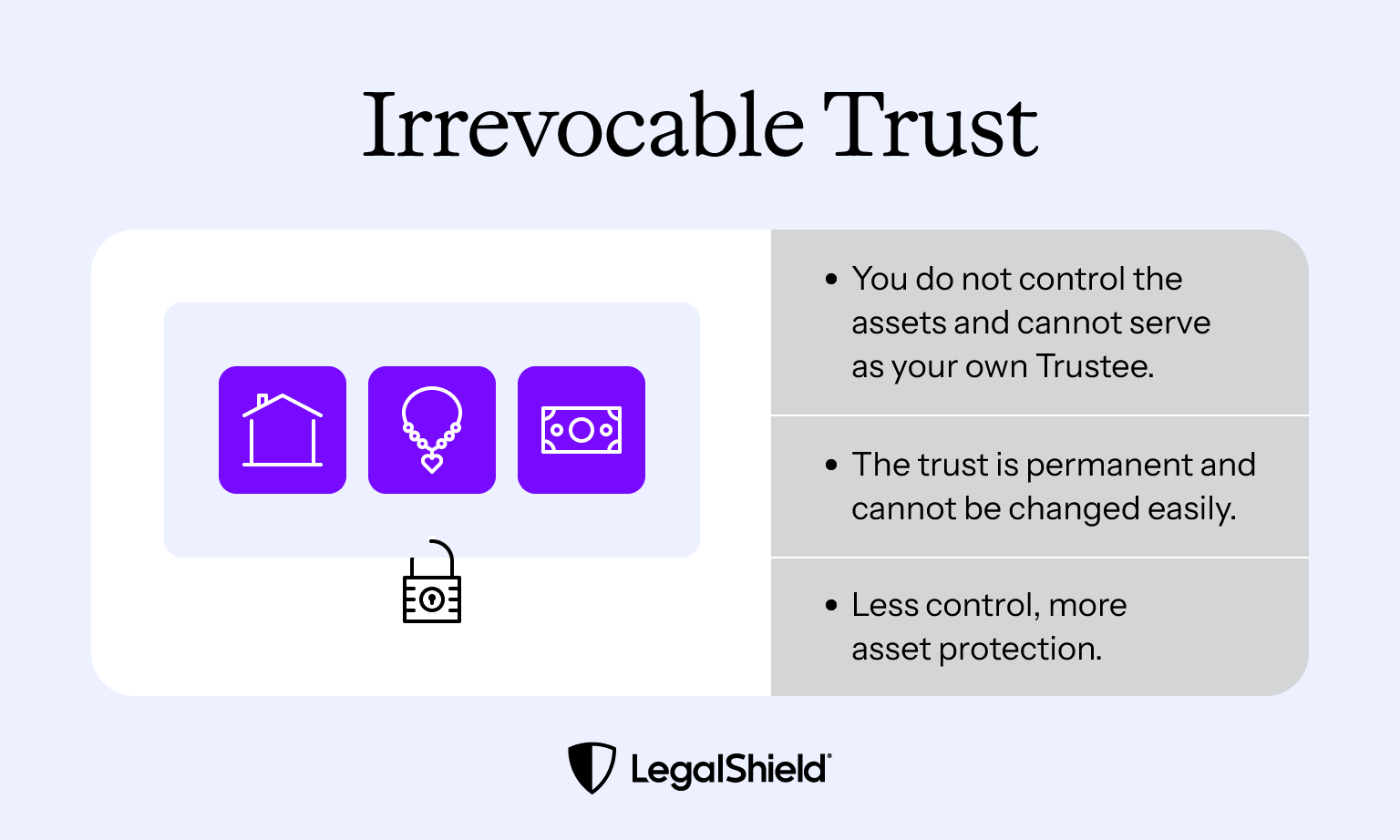
An Irrevocable Trust works very differently from a Revocable one. When you transfer assets into an Irrevocable Trust, you give up ownership. The assets no longer belong to you — they belong to the Trust. You can't take them back or change the terms without significant legal intervention. That might sound like a bad deal. For the right circumstances, it isn't.
When assets leave your legal ownership, two things tend to happen. Creditors can no longer easily reach them because they're no longer yours to claim. And those assets leave your taxable estate, which matters for families whose estates may exceed the federal estate tax exemption.
Because you give up control, you also give up the right to serve as your own Trustee. An independent Trustee manages the assets and follows the Trust's terms. The Trust gets its own tax ID number and files its own annual tax return as a separate legal entity.
Potential benefits of an Irrevocable Trust
Here are some benefits that come with transferring ownership to an Irrevocable Trust:
Strong asset protection. Assets transferred into an Irrevocable Trust are no longer legally yours. That means creditors, lawsuits, and legal judgments generally can't touch them, but that doesn’t mean you can use a Trust to escape paying legitimate existing debts. Transfers made to avoid existing creditors may be challenged under fraudulent transfer laws.
Estate tax reduction. If you have a significantly large estate, removing assets from your taxable estate reduces your tax exposure. In 2026, estates above a threshold ($15 million for single people and $30 million for couples) face a 40% federal tax on the excess.1 An Irrevocable Trust can help keep more below that line.
Medicaid planning. An Irrevocable Trust can be used as a tool to protect assets from Medicaid's asset thresholds. If you utilize a Trust for this purpose, planning well before you need Medicaid is key, as the lookback period is five years in most states.
Protection for high-risk professions. Business owners, doctors, and others in high-liability fields may find an Irrevocable Trust useful for helping protect assets from litigation.
Drawbacks of an Irrevocable Trust
An Irrevocable Trust offers meaningful protection, but it also comes with real trade-offs:
Permanent loss of control. Once assets transfer into the Trust, they're gone from your direct management. You cannot change your mind, reclaim the assets, or adjust the terms without unanimous beneficiary consent or a court order.
Higher complexity and cost. Irrevocable Trusts are more expensive to draft, require ongoing Trustee management, and must file their own annual tax return.
Inflexibility to life changes. Accommodating major changes (divorce, new children, changed financial circumstances) after the fact is difficult.
Potential gift tax triggers. Transferring assets into an Irrevocable Trust is treated as a completed gift. Large transfers may require filing Form 709 and could count against your lifetime gift tax exemption.
Key differences: Revocable vs. Irrevocable Trusts
These are the differences that matter most when making the Revocable vs. Irrevocable Trust decision.
Control and flexibility
With a Revocable Trust, you stay in charge. You serve as your own Trustee, manage the assets day-to-day, and can update the terms as your life changes. Whether it’s a new baby, a divorce, or you finally bought your dream lakehouse, the document evolves with you.
An Irrevocable Trust works differently. Because the whole point is legal separation between you and the assets, you generally can't serve as your own Trustee. A third party manages the assets according to the Trust's terms, and changes typically require either unanimous beneficiary consent or a court order.
One important transition: a Revocable Trust typically becomes Irrevocable upon the death of the surviving grantor. Your successor Trustee steps in, the terms lock, and distribution begins without probate. Understanding their rights as a Trust beneficiary helps clarify what that transition means for the people you leave behind.
Tax implications
Revocable Trusts are tax-neutral during your lifetime. The Trust uses your Social Security number, and income flows through to your personal tax return. The IRS essentially treats it as if it doesn't exist while you're alive.
An Irrevocable Trust is different. It files its own tax return under its own tax ID number, and income kept inside the Trust can be taxed at higher rates than it would be in your hands. Trust income quickly hits high taxation, so you should discuss this with an accountant.
Assets inside an Irrevocable Trust leave your taxable estate entirely. Transferring assets in is also typically treated as a completed gift, which may require filing a gift tax return. An estate tax planning overview can help you understand how these rules may apply.
Asset protection
A Revocable Trust generally doesn't protect assets against lawsuits or legal judgments. An Irrevocable Trust works differently. Once assets transfer in, you no longer have a legal claim to them, and neither do creditors in most cases. That separation is what provides the protection.
You have to run your Irrevocable Trust according to its terms and any state laws to maintain protection, or else a court could find your Trust invalid.
An example of using an Irrevocable Trust in asset protection is the business owner in a high-risk industry, like construction. A business owner can utilize an Irrevocable Trust to hold high value assets like retirement accounts to add another layer of protection against claims against their business and ultimately them personally.
How to choose the right Trust for your goals
The right choice for you depends on what you're trying to protect, how much control you want to keep, and where you are in life. The framework below isn't legal advice. It's a starting point for thinking through your priorities before you talk to a lawyer.
A Revocable Trust is often a fit if you...
An Irrevocable Trust is often a fit if you...
Want to avoid probate while keeping full control
Want to help protect assets from creditors or lawsuits
Are in the early stages of estate planning and expect things to change
Are planning ahead for Medicaid and long-term care
Aren't currently concerned about creditors or estate taxes
Have an estate that may approach or exceed estate tax exemptions
Want a plan you can update as your life evolves
Work in a high-liability field
Some families use both, with a Revocable Trust for everyday assets and an Irrevocable Trust for high-value or liability-exposed assets. Your plan can grow with you. A solid estate planning guide can help you see how Trusts fit into the bigger picture before you speak with a lawyer.
How LegalShield® Plans can help you navigate estate planning
Choosing the right Trust structure is one of the more consequential estate planning decisions you can make, and the details matter. That’s why LegalShield offers affordable plans to give you access to the legal advice you deserve. A LegalShield provider lawyer can help you understand which structure fits your situation.
Premium Plan members can also access basic Revocable Trust preparation through a provider law firm. Get estate planning guidance.
2 Internal Revenue Service. (2024, October 22). IRS releases tax inflation adjustments for tax year 2026, including amendments from the One Big Beautiful Bill (Rev. Proc. 2025-32). IRS tax inflation adjustments for tax year 2026
4 Internal Revenue Service. (n.d.). Frequently asked questions on gift taxes. https://www.irs.gov/businesses/small-businesses-self-employed/frequently-asked-questions-on-gift-taxes
5 Internal Revenue Service. (2026). Form 1041-ES — estimated income tax for estates and Trusts. https://www.irs.gov/pub/irs-access/f1041es_accessible.pdf
6 Cornell Law School Legal Information Institute. (n.d.). 26 U.S. Code § 2503 — Taxable gifts. https://www.law.cornell.edu/uscode/text/26/2503
Frequently Asked Questions
Yes, a Revocable Trust typically becomes Irrevocable upon the surviving grantor's death. The successor Trustee steps in, the terms lock in place, and distribution begins according to your instructions. No court involvement or probate is required if the assets are properly titled. That automatic transition is one of the core reasons people set up Revocable Trusts in the first place.
In most cases, yes. A Trust usually only controls assets formally titled in its name, so a pour-over Will can catch anything left outside it and direct those assets into the Trust at death. Understanding living Trust costs involved in setting up both helps you plan ahead.
It depends on the type. A Revocable Trust typically costs a few hundred to a few thousand dollars in legal fees. An Irrevocable Trust generally costs more due to added complexity. DIY options exist, but errors in a Trust document can invalidate the arrangement or create tax consequences that cost far more to fix.
An Irrevocable Trust may help protect assets from long-term care expenses, but typically only if it's established well before you need care. Consulting with a lawyer about using an Irrevocable Trust for long-term health planning is a good first step.
Content Specialist at LegalShield, creating educational resources about legal and consumer protection topics. She focuses on making complex legal and financial concepts accessible to readers and has contributed to various educational articles on consumer rights and protections.
Yes, an HOA can foreclose on your house. If you fall behind on dues, it can put a lien on the house and, depending on your state, sell it, sometimes without a judge. Losing the house doesn't erase your mortgage, so you can still owe the bank. If you get a lien or foreclosure letter, call a lawyer that day.
We’ll provide more information about the trustors vs. trustees comparison, what to consider when filling these roles, and how they work together in Revocable and Irrevocable Trusts.
A power of attorney with springing powers is a legal document that grants someone else the authority to act on your behalf only after a specific event occurs.
There’s no rule that says a lawyer has to set up your Trust for it to be valid. However, Trusts are complex and doing it yourself without a lawyer's help comes with risks.
A Certificate of Trust proves your Trust is real and names who can act for it, while your beneficiaries and assets stay private. It lets your Trustee handle Trust business, like opening accounts or transferring property.
A limited power of attorney often comes in handy when you need help for a short time or for a single purpose. This legal document can help in situations like when you’re traveling, serving in the military, caring for an aging parent, or sending a child to study abroad.
We’ll cover some of the most common scams, the red flags that give them away, how to protect yourself, and what to do if you’ve already been caught out.
An executor is responsible for ensuring your final wishes get carried out, so it’s important that you choose someone who is responsible and can bear the emotional burden.
•
8 min read
Author Name
,
Author Title
September 17, 2026
Thank you! You're subscribed!
Oops! Something went wrong while submitting the form.



.png)





.jpg)