Transferring a property deed typically involves confirming how the property was owned, following the legal processes — probate, a trust transfer, or a Transfer on Death Deed (TODD) — and recording the deed with your county office.
There’s a lot of pressure when you’re responsible for a loved one’s estate. Suddenly, you must deal with finances and legalities while you’re grieving. There’s often real estate to deal with, which adds more complexity. Let’s look at one of the complexities you might face: Deeds.
Deed transfer is an important part of the process, but it depends on the deed’s specifics. Let’s look at some ways property might transfer to help you understand what to expect.
If you need advice, a LegalShield® Personal Plan can connect you with a provider law firm to review documents and answer your questions about deeds.
Determining how the property was owned
The most recent deed is the easiest way to find out how the property was titled. You’ll likely find it through the county recorder’s or county clerk’s office.
Many counties have online search tools, so you might pull this off without leaving your house. And if there’s no online search, you could always try a quick phone call before putting your shoes on.
Once you’ve got eyes on the deed, look at how the ownership is listed. This detail matters more than you might think. Often, the ownership type tells you whether the property transfers automatically or goes through probate.
The wording is pretty formal, so let’s decode it. Here are a few common ways the deed might describe ownership:
Joint tenancy with right of survivorship: Ownership passes automatically to the surviving owner after the other owner’s death. This typically bypasses probate.
Tenants in common: Each owner has a separate share of the ownership. This is usually going to require probate to untangle before transfer.
Sole ownership: One person — your deceased loved one — has their name on the property. Probate is pretty likely here.
Transfer on Death Deed (TODD): This type of deed might name a beneficiary. That person can claim the property after the owner’s death. In many cases, that means no probate.
Trust: If your relative had a Trust and put the real estate into it, the owner of the property will show the Trust name, a reference to the trustees, and possibly the date of the Trust. If a Trust is the owner, then probate will probably not be required.
Determining the type of ownership is worth figuring out now. It usually takes just a few minutes, and it sets the foundation for all the rest of the steps in this process.
Understanding the transfer process (Trust vs. probate)
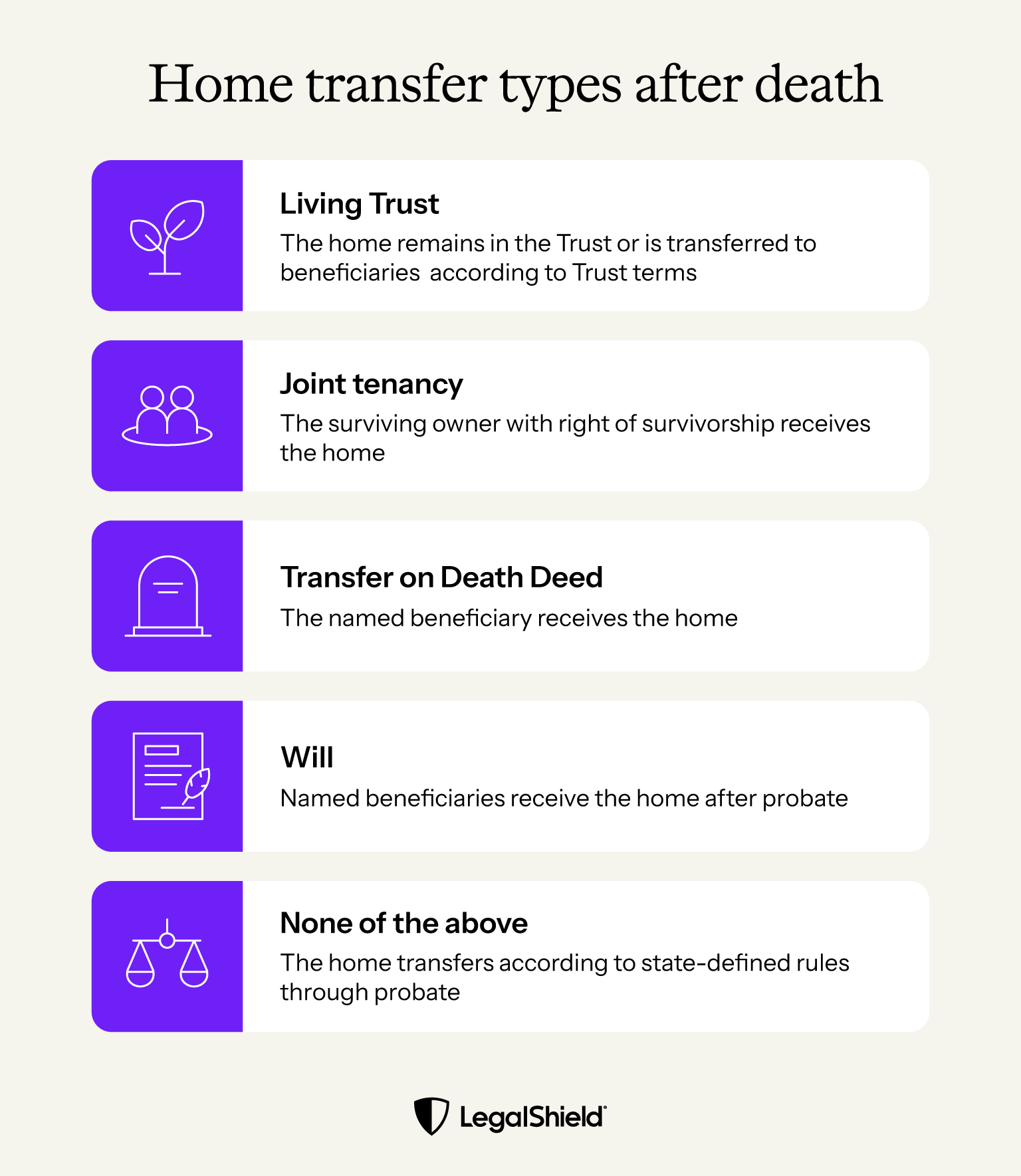
Some transfers happen with minimal action by the executor, trustee, or beneficiary. Others go through the courts. For instance, if the property was in a living Trust, joint tenancy with right of survivorship, or TODD, it’s likely to pass to the next owner without court involvement.
But if none of those apply to your situation, you’re likely looking at probate. Probate is the court-supervised process that settles a person’s estate. Probate is common, but it can take time.
If there’s a Will in place, then the court is probably going to issue Letters Testamentary. These give the executor (you, if you’re the one handling this estate) the authority to act on behalf of the estate. But if there’s no Will, the court issues Letters of Administration. Whichever is used, these name the court-appointed person, or in some cases a company, to handle the whole process.
Check out your various transfer options:
Transfer method
Mechanism of transfer
Court involved?
Trust (one grantor)
Successor trustee executes a trustee's deed
No
Joint Trust
Trust continues holding the real estate until it is sold, removed via deed, or the surviving grantor passes away
No
Joint tenancy with right of survivorship
Surviving owner files an Affidavit of Surviving Joint Tenant
No
Transfer on Death Deed
Beneficiary records an Affidavit of Death
No
Probate (with Will)
Court issues Letters Testamentary and executor has deed prepared transferring property to the beneficiary
Yes
Probate (no Will)
Court issues Letters of Administration and representative has deed prepared transferring property to the beneficiary
Yes
Tip: If this makes you wonder what might happen to your own property in the future, planning early can make things much easier for your family. Find out more about estate planning options for your home.
Handling property transfers if there is no Will
How can you transfer property after a death when the deceased person didn’t have a Will? This is known as “intestate,” and usually requires probate. The state’s laws govern asset distribution and who takes priority.
Usually, inheritance follows a distribution hierarchy set by state law. It typically begins with the surviving spouse, then living children, and finally other relatives (like siblings) if there are no spouses or children.
Understanding costs, taxes, and timelines
How long it takes to transfer a deed upon death is going to depend entirely on the path you’re on. Going through a trust, joint tenancy, or TODD[LR1] , you might be looking at a matter of weeks. Probate? That’s more like months or even a year or more (depending on estate complexity).
You’ll also need to keep a few financial details in mind. First, many heirs can benefit from a step-up in basis. This just means the property’s value gets reset to its market value at the time of the owner’s death. That matters because it can reduce capital gains taxes if you sell the property later. Also, you might see property taxes reassessed. This is going to depend on your state and how the home gets transferred. In order to get a step-up in basis, you may need to get an appraisal on the property as of the date of death.
Worried about a “Due-on-Sale” clause? Many mortgages include this clause, stating that the full loan must be paid if the property changes ownership. In some cases, the Garn-St. Germain Depository Institutions Act of 1982 provides an exemption that allows heirs to take over the property without the lender calling the loan “due” right away. However, this may depend on additional specifics, such as requirements that an heir intends to live in the property.
Recording the new deed and notifying authorities
Making the transfer official is what typically comes next, which usually means filing the updated docs with the appropriate county office. Recording the new deed puts this ownership transfer into the public record. The exact steps to record the new deed can vary from state to state. But the goal remains the same everywhere: Make sure the new owner is properly listed in local records.
To do this, you’ll typically need a few key pieces of paper:
The original Certified Death Certificate to confirm the owner has passed
An Affidavit of Death, Affidavit of Joint Tenant, or other required forms to support the transfer.
The new deed — a Quitclaim, Grant, or Executor’s Deed, depending on your unique situation
You might be able to file online in some counties. But most allow you to file in person or by mail.
Get help ensuring a smooth transition for future generations
Even if you’re pretty sure you know how to transfer a property deed from a deceased person, you might still feel overwhelmed. Each step carries legal weight. And small mistakes can create title problems that are hard and expensive to fix.
LegalShield connects you with a provider law firm so that you can get professional advice when you need it. When you’re navigating life’s difficult moments, a provider lawyer can help give you clarity and confidence.
With a LegalShield Personal Plan, you can ask questions, submit a document to be reviewed, and find out if there are further steps you need to take.
Frequently Asked Questions
Can I sell a deceased loved one’s house without probate?
In some cases, you can sell a deceased person’s house without probate. If the property was in a Trust with no surviving grantor, held in joint tenancy with right of survivorship or had a TODD, it might go right to the new owner without probate. That would allow a sale to move forward more quickly. But probate is usually required before sale if none of those applies.
Does a Will automatically transfer a property deed?
No, a Will doesn’t automatically transfer the property deed. It outlines who should receive the property. But the estate usually still needs to go through probate for the transfer to be possible.
What happens to the mortgage when the owner dies?
When the owner dies, the mortgage doesn’t disappear. The person who inherits the property is generally responsible for keeping up with payments if they want to keep the home. And in most cases, federal law prevents lenders[VK1] from demanding full repayment right away when the property passes to an heir. Even if there is a pause on payments, you will want to contact the mortgage company as soon as possible.
How much does it cost to transfer a deed after death?
How much it costs to transfer a deed after death can vary widely. Simple transfers might involve some modest recording fees. In contrast, probate can rack up court costs, filing fees, and other expenses over time. The total cost often comes down to your state, the property value, and whether you need probate.
How long do you have to transfer property after death?
Usually, there’s no strict deadline for transferring property after someone dies, but waiting can cause problems with taxes, insurance, and property maintenance. And if probate is required, the court will set some timelines.
How long can a house stay in a Trust after death?
A house can stay in a Trust for as long as the Trust’s terms allow. If the Trust is a joint Trust, usually between spouses, then the property will stay in the Trust until the surviving spouse transfers it out or passes away. Some Trusts are built to distribute assets fast. Others may transfer property to family members after years. The timeline is going to depend on state law and the instructions in the Trust. So if you are a successor trustee of your relative’s Trust, it’s a good idea to review the Trust and speak with a lawyer if you’re not sure.
Communications Director at LegalShield overseeing content creation designed to make legal protection simple and approachable. He focuses on offering straightforward, trustworthy guidance that empowers people to make informed decisions about their legal rights and responsibilities.
We’ll provide more information about the trustors vs. trustees comparison, what to consider when filling these roles, and how they work together in Revocable and Irrevocable Trusts.
A power of attorney with springing powers is a legal document that grants someone else the authority to act on your behalf only after a specific event occurs.
There’s no rule that says a lawyer has to set up your Trust for it to be valid. However, Trusts are complex and doing it yourself without a lawyer's help comes with risks.
A Certificate of Trust proves your Trust is real and names who can act for it, while your beneficiaries and assets stay private. It lets your Trustee handle Trust business, like opening accounts or transferring property.
A limited power of attorney often comes in handy when you need help for a short time or for a single purpose. This legal document can help in situations like when you’re traveling, serving in the military, caring for an aging parent, or sending a child to study abroad.
We’ll cover some of the most common scams, the red flags that give them away, how to protect yourself, and what to do if you’ve already been caught out.
An executor is responsible for ensuring your final wishes get carried out, so it’s important that you choose someone who is responsible and can bear the emotional burden.
An employer identification number is a nine-digit number the IRS uses to identify a taxpayer. The estate needs its own, and getting one is usually simpler than it sounds. Learn more about estate EINs.
•
5 min read
Author Name
,
Author Title
September 16, 2026
Thank you! You're subscribed!
Oops! Something went wrong while submitting the form.







.jpg)