A Beneficiary Deed is a legal document where you name someone to get your real estate after you die. In many states, it’s also called a Transfer-on-Death Deed (TODD). This type of deed can help property pass to a named beneficiary without the hassle of probate.
If you own a home or other real estate, you may be thinking about who should get it after you die and how to make that transfer easier for your family. That’s one reason some people look into Beneficiary Deeds.
In states that allow these deeds, they can transfer real estate outside of probate. In other words, Beneficiary Deeds can help your beneficiaries skip some of the time, expense, and confusion that can come with transferring a home.
Like all estate planning tools, Beneficiary Deeds aren’t always the right fit for every situation. This article explains how and when you might want one, as well as some things to watch for. We’ll also compare Beneficiary Deeds with other estate planning tools to help you understand the differences.
For more personalized estate planning guidance, a LegalShield® Personal Plan can connect members with provider law firms. Provider lawyers can help you understand your options, ask questions, and prepare or review specific documents.
What is a Beneficiary Deed?
A Beneficiary Deed is a deed that allows a property owner to name a beneficiary for their real estate. A “beneficiary” is the person or organization named to receive the property. These deeds may also be called Transfer-on-Death Deeds (TODDs). Some states use a Beneficiary Deed while others use a TODD form.
How does a Beneficiary Deed work?
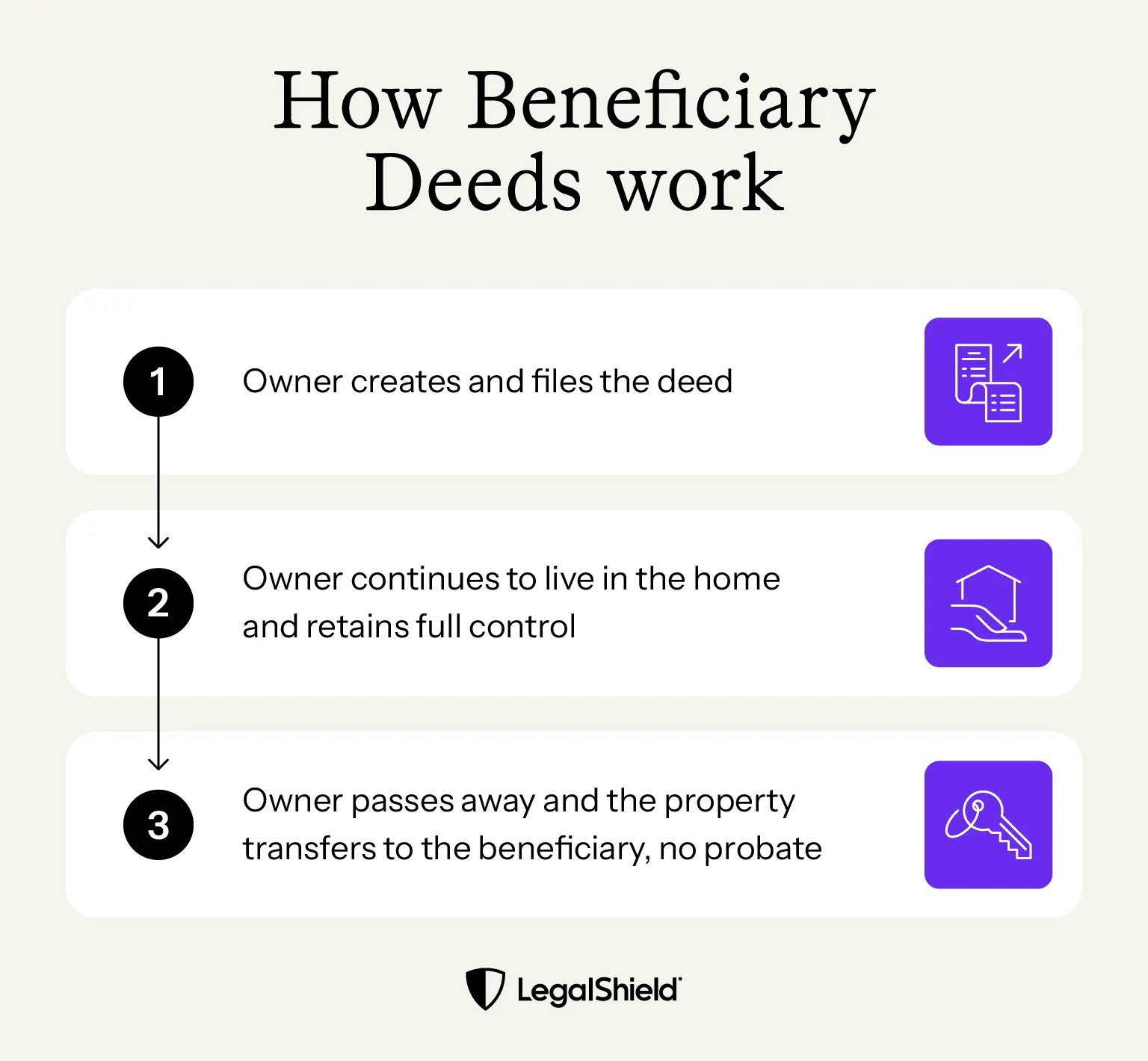
In the many U.S. states that recognize Beneficiary Deeds, the property goes to the named beneficiary automatically after the owner passes away. The beneficiary generally doesn’t have control of the property during the owner’s life.
So, the owner can usually keep living in the home and sell or refinance it if they want to. And they can revoke the deed during their lifetime. But when they pass, if the deed was signed, properly notarized, and recorded, the property in question passes to the beneficiary.
That transfer often happens without probate, too. Still, the beneficiary must take specific steps, such as filing a proof of death or updating property records. The specifics here depend on state and local rules.
Another thing to keep in mind is that joint ownership can affect how a Beneficiary Deed works. For instance, if two people co-own a home, the document might only transfer the signer’s share of the property to someone else. And survivorship rights can sometimes decide what happens before a Beneficiary Deed takes effect.
Advantages of a Beneficiary Deed
A Beneficiary Deed can make a lot of sense in certain real estate planning situations. It’s particularly helpful when the owner wants to retain control of the property while they’re alive but still designate an automatic beneficiary.
With that said, here are some of the benefits of Beneficiary Deeds:
May cost less than a trust: Beneficiary Deeds may be simpler and less expensive to prepare than trusts in some situations. Importantly, these deeds don’t replace trusts because trusts and estates cover a broader range of estate planning issues.
Usually revocable: There’s a lot of flexibility here. The property owner can often revoke the deed, change the beneficiary, sell the property, or refinance.
May promote privacy and simplicity: Probate is not private, and it’s complex. If the Beneficiary Deed helps the property avoid probate, it can mean the beneficiary avoids court filings and additional steps.
Disadvantages of a Beneficiary Deed
Despite their potential for usefulness, Beneficiary Deeds have their limits:
May not ward off creditors: The property might avoid probate, but that doesn’t make it immune to creditor claims, estate claims, or other valid debts.
May not be ideal for minors: Practically and legally, leaving property to a minor child can make for problems. Sometimes, a court-appointed adult must manage the property until the child is old enough. If you want to pass real property to a minor using a Beneficiary Deed, you should speak to a lawyer first.
May be complex with co-owners: The deed might only apply to the deed signer’s share of the property if there are co-owners. Survivorship might also get in the way of the transfer in the first place, depending on the details.
May not come with a backup plan: What happens if the named beneficiary dies before the property owner? The deed may not work as intended unless it names a contingent beneficiary or state law provides a fallback rule.
Not available in every state: Some states simply don’t recognize Beneficiary Deeds. And in the states that do, the rules for signing, notarizing, recording, and revoking vary a lot.
Beneficiary deed alternatives or options to consider
A Beneficiary Deed is just one possible solution to an estate planning problem. You have other options depending on the property, your goals, state law, and other relevant details. Here are some of the alternatives:
Quitclaim deed
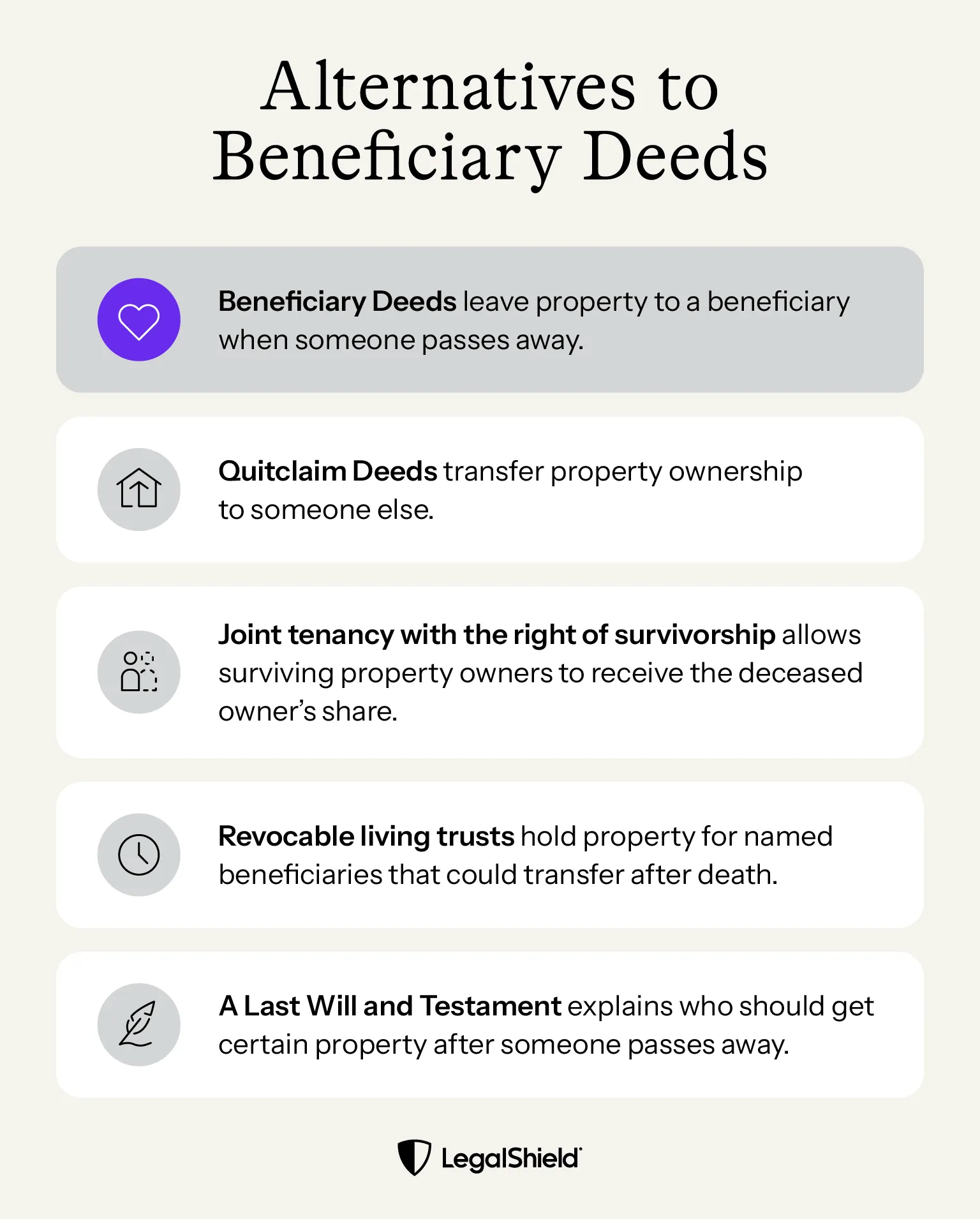
A Quitclaim Deed transfers ownership interest in real property to somebody else. This usually happens during the owner’s life, unlike with a Beneficiary Deed. That difference can be useful in some situations, but it can also mean giving up property sooner.
Joint tenancy with right of survivorship
Joint tenancy is a type of shared property ownership. In some states, “joint tenancy with right of survivorship” can allow a surviving property owner to receive the deceased owner’s share without probate. The outcome can be similar to that of a Beneficiary Deed, but it’s more specifically focused on joint tenants.
Revocable living trusts
A revocable living trust is an estate planning document that can hold property for named beneficiaries. During their lifetime, the property owner can often transfer the property into the trust (known as “funding” the trust). The trust explains what happens to the property after the owner dies. This can cover more assets than real estate.
Last Will and Testament
A Last Will and Testament is a document that explains who should get certain property after someone dies. It can also name someone to manage that person’s estate. In a Beneficiary Deed vs. Will comparison, the key difference is that a Will still leads to probate.
Get estate planning guidance with a LegalShield Membership
A Beneficiary Deed can be helpful, but you need to understand how it’ll work in your state and whether you’ll need to coordinate it with a Will or Trust.
A LegalShield Personal Plan can help members answer those kinds of questions by connecting them with a provider law firm for estate planning guidance. Provider lawyers may be able to help you review documents, prepare them, and understand how estate planning tools like deeds can come together.
Maryland General Assembly. States that allow transfer on death deeds. https://mgaleg.maryland.gov/cmte_testimony/2023/jud/1wJMl0zDWp5Hflp893uG1lVthCwpUQK81.pdf
A Beneficiary Deed may control what happens to the property named in the deed, even if the Will says something different. But state law and the document's wording matter here. It can help to have a lawyer review the documents together.
A valid Beneficiary Deed may allow the property named in the deed to be transferred without probate. This doesn't mean it skirts every estate issue. Creditor claims, taxes, title issues, and disputes can still factor here.
Yes, in some situations, someone can challenge a Beneficiary Deed. Questions about the legal capacity of the owner, fraud, undue influence, improper signing, and deed recording can all spark challenges.
Communications Director at LegalShield overseeing content creation designed to make legal protection simple and approachable. He focuses on offering straightforward, trustworthy guidance that empowers people to make informed decisions about their legal rights and responsibilities.
Trust administration involves managing the assets inside a trust. Administrators protect the assets and ensure they are kept and distributed according to the trust’s rules for the benefit of beneficiaries.
En Estados Unidos, un divorcio sin oposición generalmente cuesta al menos $1,500, mientras que un divorcio con oposición puede empezar en $5,000 y superar los $20,000 en casos complejos. El costo total depende de los honorarios de abogados, los costos judiciales y el nivel de conflicto entre los cónyuges.
Decidir tramitar el divorcio ya es bastante difícil sin tener que preguntarte si estás llenando el formulario correcto. Cada estado maneja el proceso de manera un poco distinta, y es normal sentir dudas acerca de dónde empezar. Reunimos información sobre lo que puede suceder durante el trámite, incluyendo perspectivas de una abogada de verdad, para darte más claridad en este camino.
La mayoría de nosotros sabemos que deberíamos tener un testamento. Simplemente seguimos encontrando razones para posponerlo. Si eso te suena familiar, no estás solo/a. Sigue leyendo para aprender qué puedes hacer al respecto.
Prepararse para un divorcio implica reunir documentos financieros y personales, hacer un presupuesto de tus gastos mensuales, asegurar tus cuentas digitales e inventariar tus bienes. También es importante decidir qué tipo de divorcio se adapta a tu situación y consultar con un abogado antes de presentar la petición para proteger tus derechos.
¿Necesitas un poder notarial pero te preocupa el costo? Es natural preocuparse por pagar servicios legales, pero es importante no quedarse atrapado/a en dólares y centavos. Después de todo, no le puedes poner precio a la tranquilidad, y eso es exactamente lo que ofrece un poder notarial.
Ya sea que te estés casando, pasando por un divorcio o simplemente estés listo para un nuevo comienzo, cambiar tu nombre es un gran paso. Puede ser un proceso sorprendentemente difícil, y las tarifas varían mucho.
•
8 min read
Thank you! You're subscribed!
Oops! Something went wrong while submitting the form.