

Small Business
15 min read
What Is an S Corporation, and What Are Its Benefits?
For the right company, S status can lower the yearly tax bill and give owners a cleaner way to take home profits.


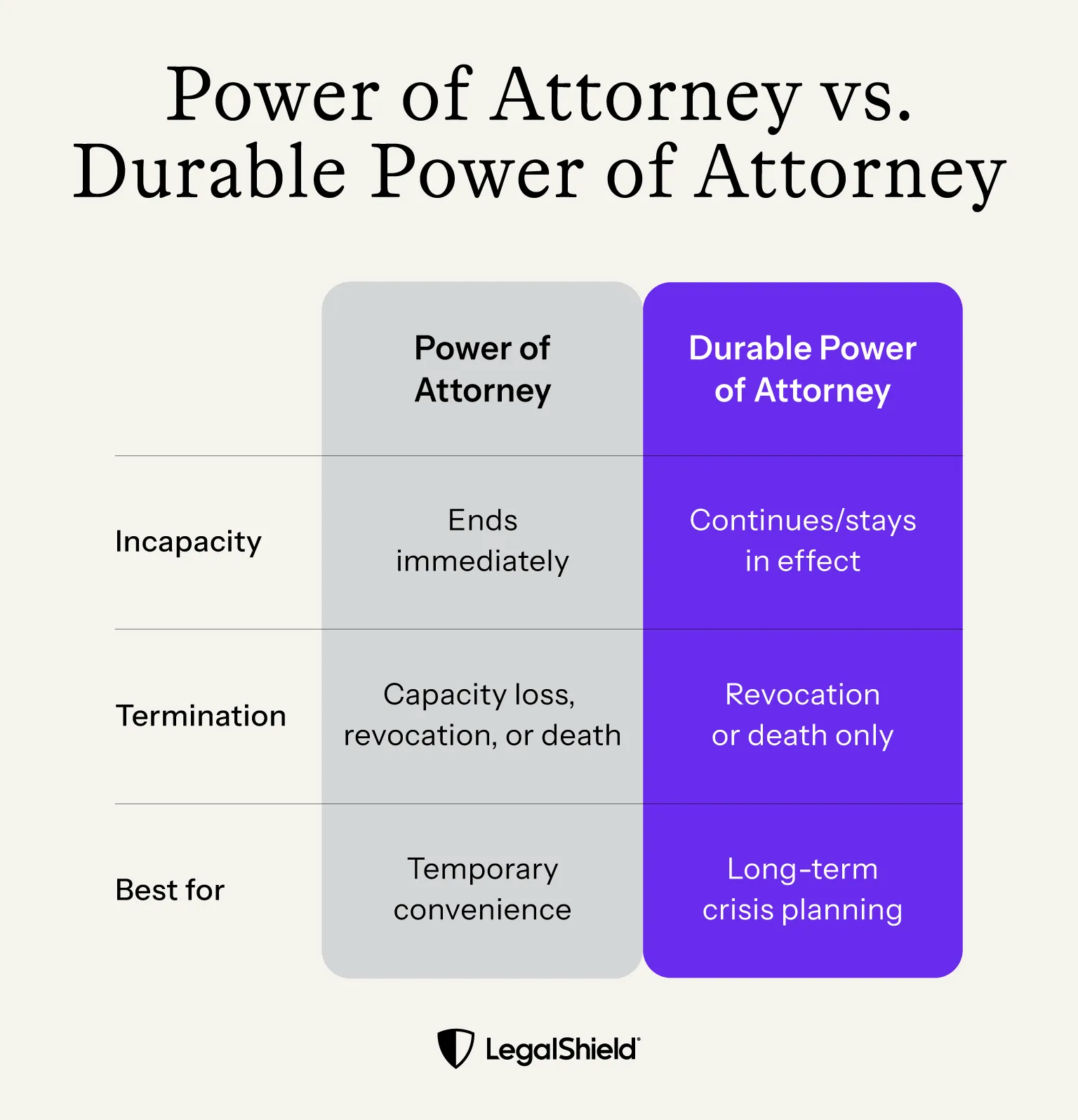
A Power of Attorney is a legal document that authorizes someone to make decisions on behalf of another person. A Durable Power of Attorney stays in effect even if the principal becomes incapacitated. It terminates if the principal dies or revokes it.
Planning for the unexpected is one of the most thoughtful things you can do for yourself and the people you care about. If you were ever in an accident or became seriously ill, who would make decisions for you? It’s better to have a Power of Attorney before an emergency occurs.
A Durable Power of Attorney lets you answer that question on your own terms. You get to choose a trusted person to carry out your wishes, which can help avoid costly, time-consuming legal battles down the road. This article walks you through the different types of Durable Powers of Attorney and what's involved in setting one up.
A Durable Power of Attorney (DPOA) is a legal document that grants someone else the authority to act on a person's behalf in certain circumstances.
Even if you’re married, your spouse may be limited in acting on your behalf in certain situations. For example, you can’t sign any legal documents just because you’re married, which can delay things if you’re signing up for a joint bank account or filing joint tax returns.
Important Note:
A DPOA is a less expensive alternative to a court-ordered guardianship or conservatorship.
A Power of Attorney is a legal document in which a principal appoints an agent to act on the principal’s behalf. Normally, a Power of Attorney ends when the principal loses mental capacity.
A Durable Power of Attorney, like any legal document, remains in effect even if the principal becomes incapacitated. This could happen if the principal loses consciousness following a car accident. A Durable Power of Attorney ends when either the principal dies or revokes it.
A Durable Power of Attorney can be drafted to only be in effect when you become incapacitated or immediately, and you can even designate different rules for different people. Like you may want your spouse to have powers immediately, but may choose someone else to act in the event of your incapacity.
You can use a DPOA to cover both health and financial decisions, giving your agent authority over a broad range of your affairs, such as:
The Durable Powers of Attorney for medical and financial decisions are the two most common types of DPOAs. You can choose to combine these into a single DPOA or keep them separate. The most common reasons to separate these two types are to use different agents, to maintain privacy between medical and financial matters, or due to complexity.
If there’s a decision involving the purchase or sale of property, then the Durable Power of Attorney for finances will probably apply. It’s also helpful when paying bills, applying for government benefits, and filing taxes. Besides incapacity, many Durable Powers of Attorney for finances are used for convenience reasons.
An HCPOA is a key planning document for medical arrangements. It’s useful because medical problems and accidents can lead to incapacitation, even if temporary. If this happens, an agent can choose treatments for you. They can also make end-of-life choices, if needed.
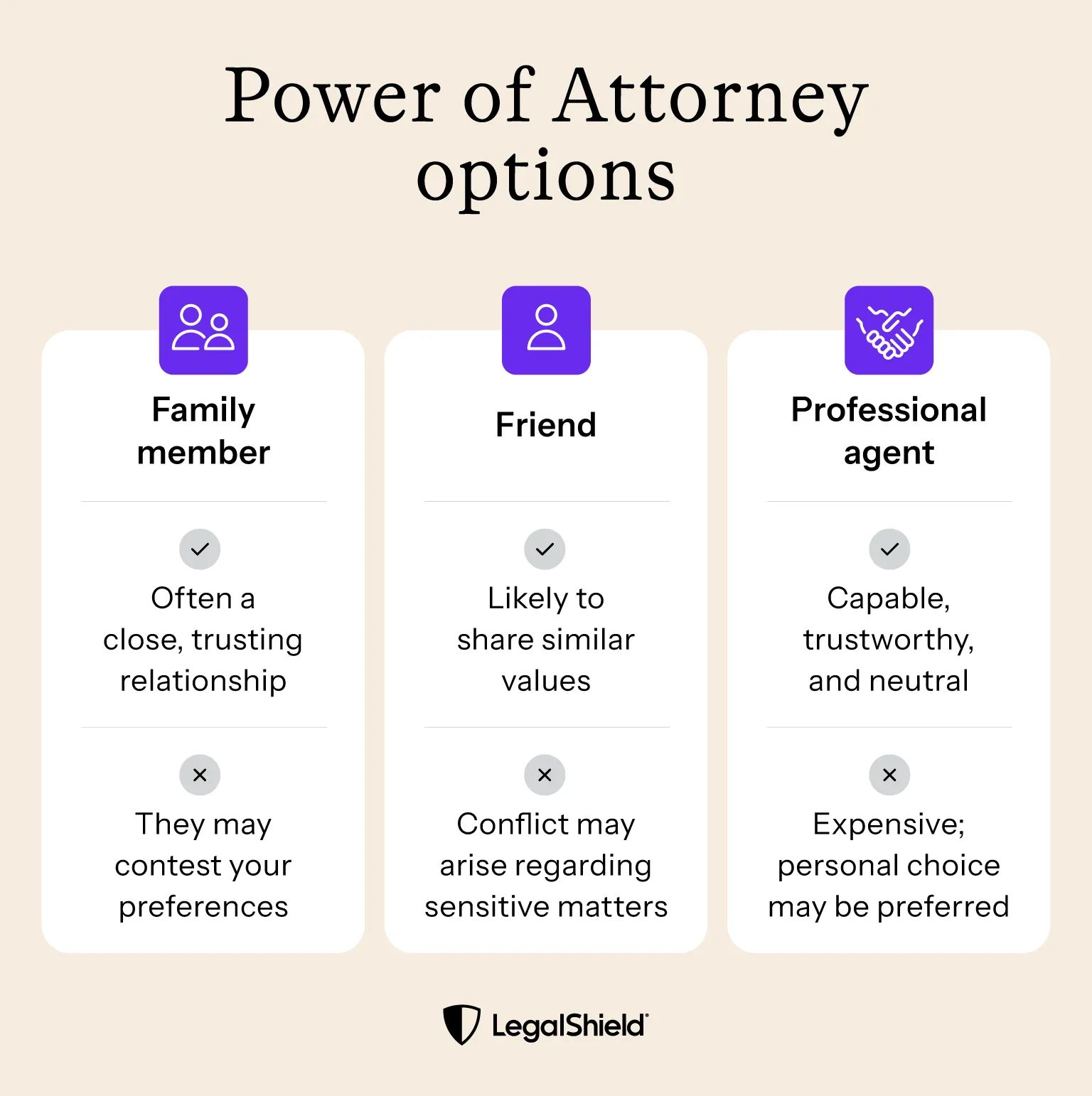
Choosing an agent is one of the most important decisions in your estate plan; don't rush it. It’s a critical decision that, if made incorrectly, could result in your wishes not being carried out the way you would want.
To help make this selection, there are several qualities you want your potential agent to have:
The law requires your agent to act in your best interests and honor your wishes. Despite this, it’s still important to have an honest talk with them to confirm their willingness and ability to serve as your agent.
If you’re having trouble finding one person who meets most of these qualities, consider choosing two agents. You can require them to both agree before making a decision, or you can authorize them to act independently.
In case your first choice is unavailable or unwilling to serve as your agent, you can select a successor agent.
If you have other estate plan documents, such as a trust, it is important to ensure that the people you appoint work well together. A trustee will likely control trust assets during your incapacity. If your POA and trustee are different people, there is potential conflict on how things are handled or confusion about responsibility.
There are strict requirements for creating a Durable Power of Attorney. Most states require you to sign your Durable Power of Attorney before a notary.
Some states have other requirements. For instance, in Arizona, another person must witness and sign the Power of Attorney. If your state requires a witness, there are usually specific requirements about who isn’t allowed to serve as this witness. Arizona doesn’t allow this witness to be the agent, the agent’s spouse, the agent’s child, or the notary public.
States also differ in their execution requirements. For example, an Illinois HCPOA doesn’t need to be notarized. However, a POA for real estate transactions must be notarized.
Every state and Power of Attorney is different. This is why you should consult with a lawyer to confirm what your state requires to make your Power of Attorney legally valid.
Figuring out your Durable Power of Attorney is an important step, but it's just one piece of a complete estate plan. You may also need documents like a Will or a healthcare directive to make sure all your wishes are covered.
A lawyer can help you think through whether a Durable Power of Attorney makes sense for your situation, which type is right for you, and what your state requires to make it legally valid.
If you’re thinking about a Durable Power of Attorney, contact LegalShield to learn more about its Personal Plans and get started protecting you and your family’s future.
When a Durable Power of Attorney goes into effect depends on its type. A Durable Power of Attorney can give powers immediately, or upon incapacity.
You can revoke or cancel your Power of Attorney as long as you’re mentally capable of making this decision. You can also draft your Power of Attorney so that it automatically expires after a certain period or upon a specific event.
A Durable Power of Attorney ends when the principal dies. At this point, the instructions in the principal’s Will or trust take over and determine how their affairs will be handled. Most discretionary decisions will be handled by the executor or trustee at that point.
A DPOA is not the same thing as a Will. A Will is in effect after its creator dies, while a DPOA is only in effect when its principal is still alive. A DPOA also can’t be used to change the terms in a Will. Additionally, most trusts prohibit a Power of Attorney from revising it; however, a Power of Attorney may be able to help with trust funding.
Content Specialist at LegalShield, creating educational resources about legal and consumer protection topics. She focuses on making complex legal and financial concepts accessible to readers and has contributed to various educational articles on consumer rights and protections.
For the right company, S status can lower the yearly tax bill and give owners a cleaner way to take home profits.

Dissolving an LLC can be tricky, and doing it without guidance can lead to unnecessary stress and delays. We’ve put together some helpful information so you can start the LLC dissolution process with more peace of mind.

An employment contract is an important piece of paperwork because it defines the working relationship, your expectations, and conditions. Here are some of the common components included.

Virtual business addresses can be a practical option for those forming an LLC from home, working remotely, or trying to keep their business and personal mail separate.

By the end of this blog, you’ll get a high-level summary of trademarking a name and logo, how logos differ from business names and artwork, and how much it all costs.

A DBA is a name registration that lets you run your business under a name other than your personal legal name or legal business entity. While a DBA offers branding flexibility and market expansion opportunities without creating a new legal structure, it does not provide legal liability protection, tax benefits, or function as a business license.

An indemnity agreement settles the “who is responsible” question ahead of time. One party promises, in writing, to cover certain losses tied to the work, so the other isn't left with the bill. These promises appear in construction contracts, leases, and business sales.

A certificate of good standing is official proof from your state that your business is registered and current on its requirements. Most lenders and agencies want a recent one, so it helps to know how to get it before someone asks.