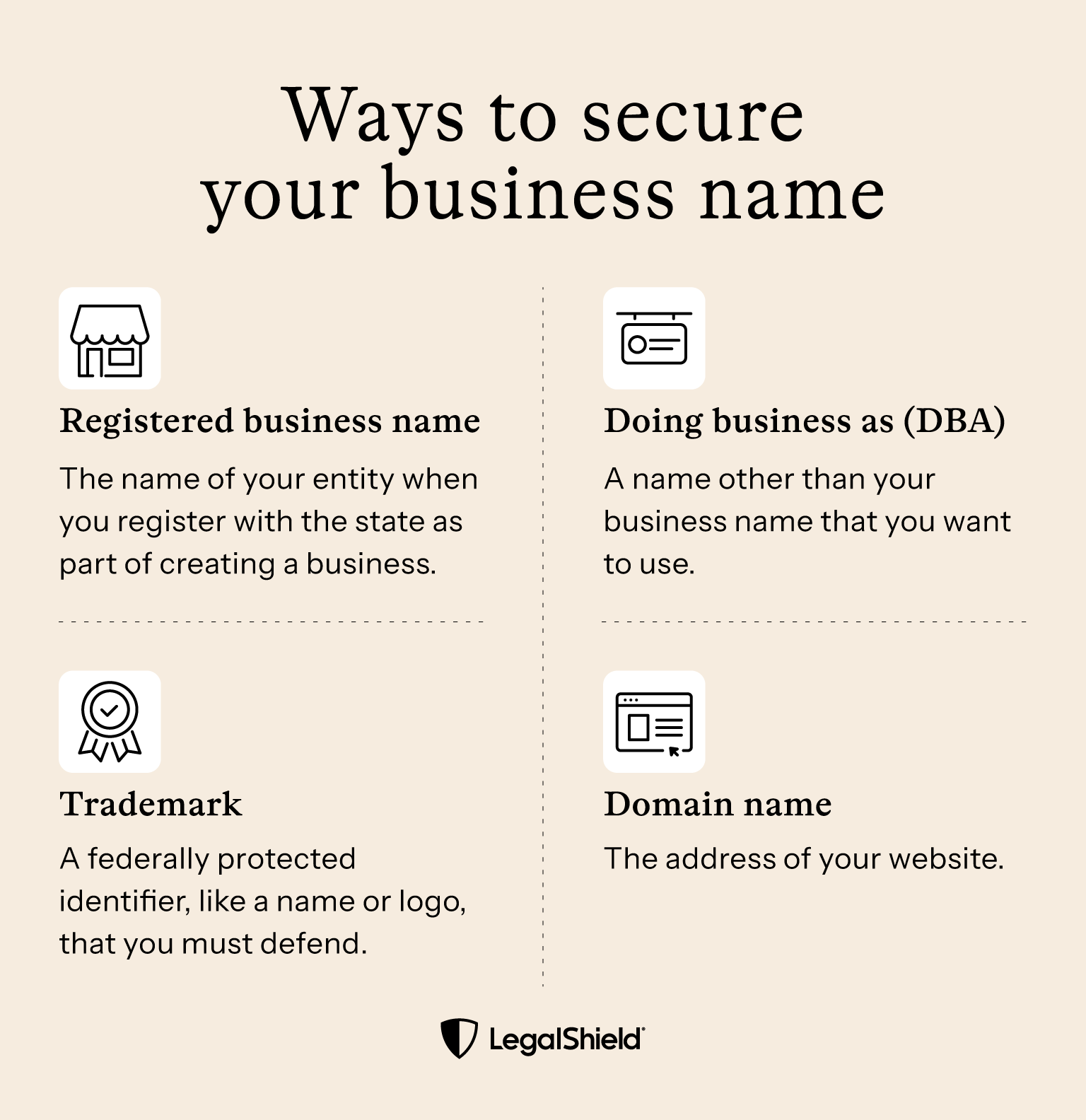
The four main ways people secure a business name are as an entity formation, a DBA, a trademark, or a domain name.
One of the first (and most exciting) steps to starting a business is finding a name for it. Often, you can operate as a sole proprietorship using your own name. But you don’t get any business registration benefits. If you want to operate using anything other than your legal name, you’ll probably want to secure your business name.
It can be frustrating to find the perfect name, only to learn that it’s already taken. Even if your chosen name is available, registering a business name can protect against others trying to use it. Properly registering your business’s name also makes it easier to grow your business and protect its legal rights.
The naming process can involve up to four different methods. We’ll describe what these methods are and how to use them. We’ll also explain where you can get help if you have questions when choosing a business name.
First things first: Check if your name is actually available
After brainstorming a few business name ideas, you can check to see if they’re available. Several tools are available online for state, federal, and domain level searches.
State level: Search your Secretary of State’s business website. There should be a database where you can search for registered businesses by name.
Federal level: You can search for registered trademarks using the United States Patent and Trademark Office’s (USPTO) Trademark Search system.1 A thorough search requires different combinations of search words and spellings. Start your search with the Wordmark option. This will look for registered marks that contain the search term(s).
Domain level: Businesses can register domain names using a registrar service. You can find accredited registrars on the Internet Corporation for Assigned Names and Numbers (ICANN) website.2 Also, complete an online search for existing social media handles or usernames.
When completing these searches, search for variations of your potential business name. This includes alternate spellings and partial name searches. Lastly, have two or three backup alternatives in case your first choice isn’t available.
Four ways to secure your business name
You can choose from several methods. Which one you choose can depend on the structure of your business and how you plan to market it.
For instance, if you rely on a unique name for your business, you might want to trademark it. If you just use your personal name as your “brand,” then a trademark probably isn’t necessary. Here’s a summary of four types of name registration:
Registration method
Best for
Scope of protection3
Entity formation
LLCs and corporations
State-level: Prevents others from forming a business with that exact name in your state
DBA (doing business as)
Companies that want to operate under branding or with multiple divisions
Local/State-level: Does not provide liability protection, but allows for brand recognition
Federal trademark
National brands, e-commerce, and high-growth startups
State or national: You can register a trademark at the national level, and most states have state-level registrations
Domain name
Any business with a website
Global (Digital): Does not provide protection, but prevents others from creating matching domain names
Register an entity name
During entity formation or incorporation, the name you choose is a key requirement. It’s handled at the state level; you can search for names and apply with the secretary of state. Each state has different rules about words you can and can’t use, plus how to identify your business type. Once registered, other businesses in the same state can’t register the same business name as yours.
File a DBA (Doing Business As)
A DBA is an additional name for a business that’s different from its legal name. If you want to use a name publicly that’s different from your legal business name, you can register a DBA.
For example, a sole proprietor often operates under their personal name. If they don’t want to use their personal name, a DBA is an option. Or a company in one particular industry might wish to branch out into a new and unrelated business but use the same legal entity for operations. Creating a DBA makes all of this possible without having to set up a new LLC or corporation. However, a DBA offers no liability protection for the owner.
Get a federal trademark
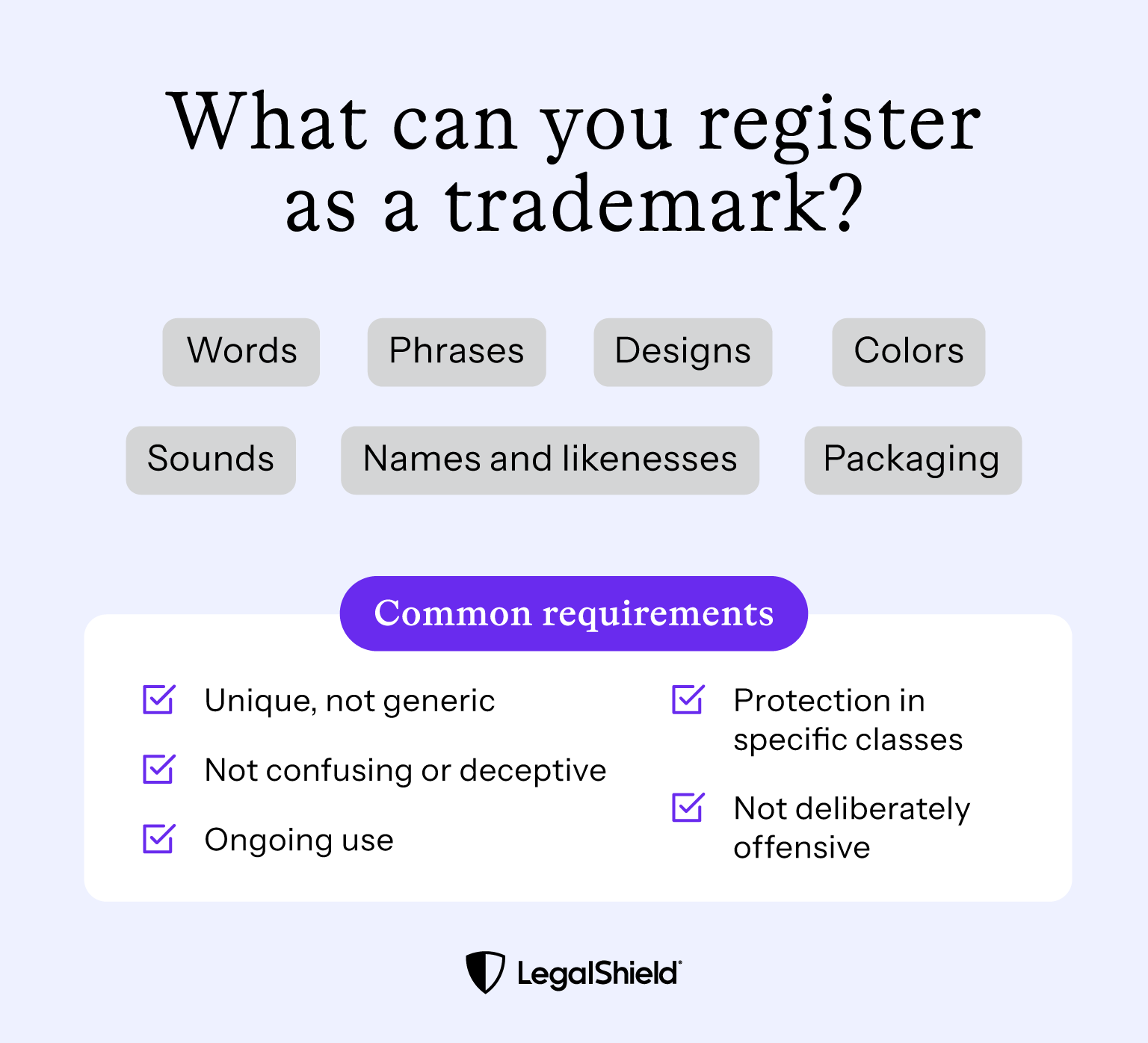
Registering a trademark allows you to legally enforce your rights if any other entity in the U.S. uses it. Trademarks can be words, phrases, symbols, sounds, colors, or a combination.4 You can also register trade dress, which are product characteristics like shape and packaging, as long as they are non-functional and clearly distinctive.
It’s possible to have limited trademark protections without federal registration, but they are harder to enforce. When you use your business or brand name, you gain certain unregistered protections, but you should speak to a lawyer to understand how far they extend.
While trademark protection is robust, trademarks require you to actively use and defend them. If you don’t, you could lose protection. Your responsibility to your trademarks can become a significant business expense.
You want to expand your business to other states and you rely heavily on its brand for marketing to new customers.
You want the option to generate income by licensing your business name to other entities.
You worry about other businesses using a brand or business name that’s confusingly similar to what your business uses.
Most of your business’s sales occur online.
Trademark registration and enforcement has a cost, so as a business owner, you must weigh the benefits of a federal registration against cost and ongoing administration. Intellectual property and trademarks are complex topics, so you should consult a lawyer to understand your options, rights, and responsibilities.
Secure your domain name
If you want your business to have an online presence, it’s important to have a website address (domain name). Ideally, this domain name will relate to the business’s name or brand.
Register your domain as soon as you can. This is important because anyone can buy an unclaimed domain. Sometimes people will register domain names for profit and try to sell them back to you.
Domain names can have multiple “extensions,” and each version is unique. For example, if you register “verycoolbusiness.com” someone else can register “verycoolbusiness.org” or another extension like .ai, .net, .co, .io, etc.
You can register multiple common versions of your business’s domain name and then “redirect” them to your main website. That means that when someone types “verycoolbusiness.net” their browser sends them to “verycoolbusiness.com” instead.
Where to get help with your business name
If you need help protecting your business name, a lawyer can explain the various options and let you know which approach might be best for you. LegalShield® provider lawyers can answer your questions about business names and trademarks. For example, it might be better to register a DBA instead of creating an LLC or applying for a trademark.
A provider lawyer can also offer guidance as your business grows. Having a provider lawyer review contracts and vendor agreements can help protect the rights of your business. Get started today with a LegalShield® Small Business Plan.
Sources:
1 United States Patent and Trademark Office. (2026, April 21). Search our trademark database. Search our trademark database
Pre-Paid Legal Services, Inc. (“LegalShield”) provides access to legal services offered by a network of provider law firms to LegalShield members through membership-based participation. Neither LegalShield nor its officers, employees or sales associates directly or indirectly provide legal services, representation, or advice. Small Business Legal Plans and certain benefits are not available in all states. See a Small Business Legal Plan contract for a specific state for complete terms, coverage, amounts, and conditions. The information made available in this blog is meant to provide general information and is not intended to provide legal advice, render an opinion, or provide a recommendation as to a specific matter. The blog post is not a substitute for competent legal counsel from a licensed professional lawyer in the state or province where your legal issues exist, and you should seek legal counsel for your specific legal matter. Information contained in the blog may be provided by authors who could be a third-party paid contributor. All information by authors is accepted in good faith, however, LegalShield makes no representation or warranty of any kind, express or implied, regarding the accuracy, adequacy, validity, reliability, availability, or completeness of such information.
Content Specialist at LegalShield, creating educational resources about legal and consumer protection topics. She focuses on making complex legal and financial concepts accessible to readers and has contributed to various educational articles on consumer rights and protections.
Dissolving an LLC can be tricky, and doing it without guidance can lead to unnecessary stress and delays. We’ve put together some helpful information so you can start the LLC dissolution process with more peace of mind.
An employment contract is an important piece of paperwork because it defines the working relationship, your expectations, and conditions. Here are some of the common components included.
Virtual business addresses can be a practical option for those forming an LLC from home, working remotely, or trying to keep their business and personal mail separate.
By the end of this blog, you’ll get a high-level summary of trademarking a name and logo, how logos differ from business names and artwork, and how much it all costs.
A DBA is a name registration that lets you run your business under a name other than your personal legal name or legal business entity. While a DBA offers branding flexibility and market expansion opportunities without creating a new legal structure, it does not provide legal liability protection, tax benefits, or function as a business license.
An indemnity agreement settles the “who is responsible” question ahead of time. One party promises, in writing, to cover certain losses tied to the work, so the other isn't left with the bill. These promises appear in construction contracts, leases, and business sales.
A certificate of good standing is official proof from your state that your business is registered and current on its requirements. Most lenders and agencies want a recent one, so it helps to know how to get it before someone asks.
Whether the goal is selling a company, bringing in a business partner, or passing it to a family member, the LLC ownership transfer often involves reviewing the LLC's operating agreement and the applicable state's rules.
•
11 min read
Author Name
,
Author Title
August 4, 2026
Thank you! You're subscribed!
Oops! Something went wrong while submitting the form.