
C Corporation vs. S Corporation: Key Tax Status Differences


Get the legal advice you need without the hourly legal fees
Key Takeaways
C corp and S corp are tax statuses, not different kinds of companies. A C corp pays tax on its profits and owners pay tax again on dividends, while an S corp lets profits pass straight through to the owners' personal returns instead.
Every corporation starts out taxed as a C corp. An S corp is a status a corporation or LLC can request from the IRS instead, and it changes how the business handles its profits. The better fit typically depends on how much money the business keeps versus how much it pays out.
We’ll walk through what each status actually means for a business. We’ll also talk about what usually pushes a growing company from one to the other, and how legal access could make this process much simpler for you as a business owner.
S-corps and C-corps are tax statuses
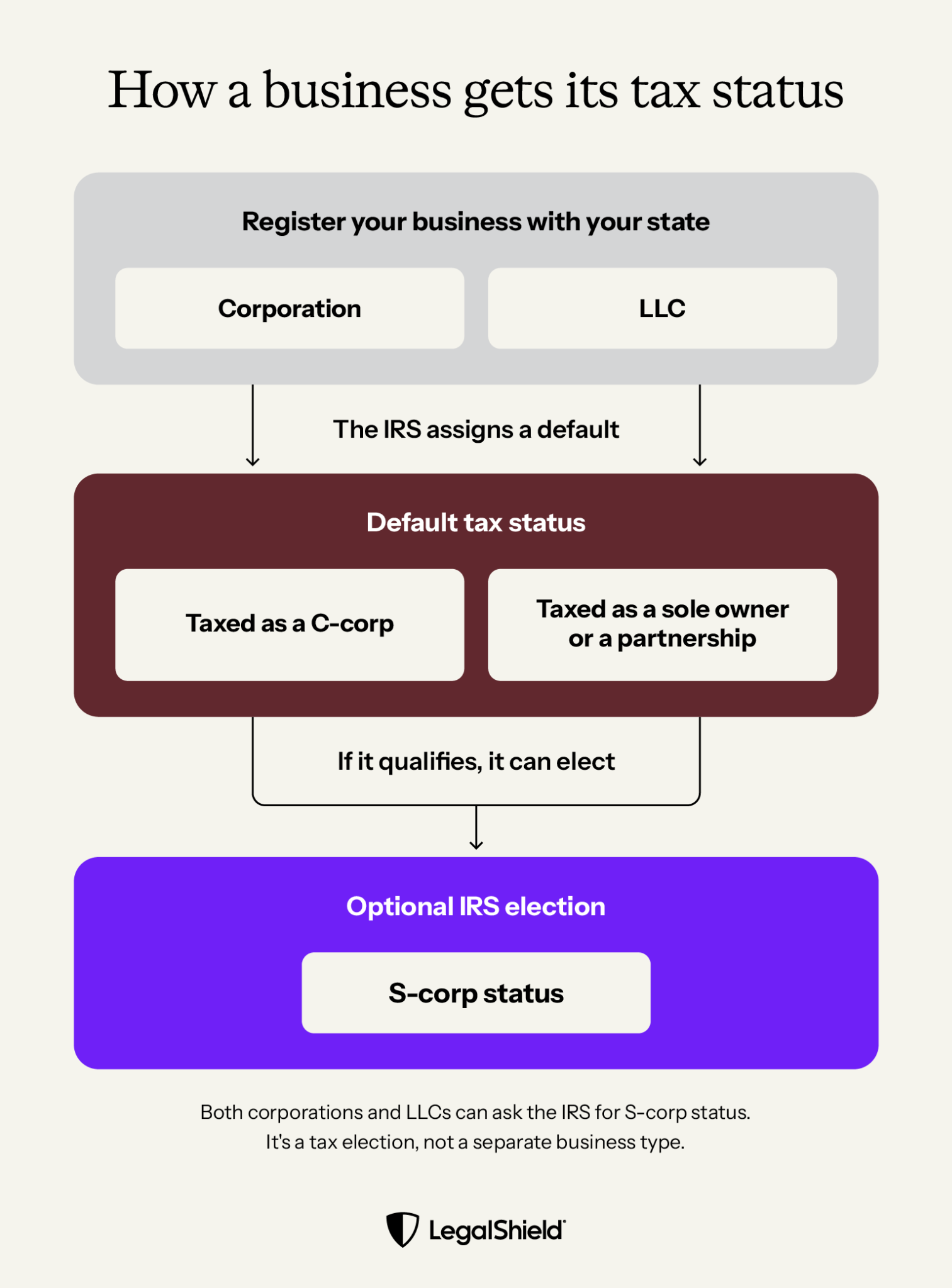
When you start a business, you form a corporation with your state, not the IRS, and once that's done, the IRS automatically taxes it as a C-corp by default. If the corporation meets certain IRS requirements, it can elect to be taxed as an S-corp instead. LLCs work a bit differently, since an LLC isn't a corporation, but it can still elect S-corp treatment once it qualifies.
Here's a closer look at default tax statuses by business type.
The key form for electing S-corp status is Form 2553, filed no more than 2 months and 15 days after the start of the tax year the election takes effect, or any time in the year before.
How to Find Your Business’s Current Tax Setup
If you haven't filed anything extra with the IRS, your business runs on the default status for its type. A corporation defaults to a C-corp. A single-member LLC defaults to a disregarded entity, taxed like a sole proprietorship, and a multi-member LLC gets taxed like a partnership.
To check whether an S-corp election is already in place, look for these details in your business records:
- IRS Form 2553
- A confirmation letter from the IRS called a CP261 Notice
If you’re not sure who has that paperwork, that’s a good first question for a Certified Public Accountant (CPA).
S-Corp and C-Corp statuses compared
A business's tax status determines who pays tax on profits, how much of it is taxed twice, and how the owners are paid. We’ve laid out a basic overview of how those things work out differently for a C-corp and an S-corp.

Choosing business types and tax statuses
An LLC or a corporation may want to change statuses when reaching certain milestones, such as when profits grow or ownership changes. For an LLC, that usually means weighing self-employment tax. For a corporation, it usually means deciding whether to stay open to outside investors.
Electing S-Corp status
To elect S-corp status, a corporation or LLC must first meet the IRS's basic requirements. It must be a domestic business with no more than 100 shareholders, all of whom are U.S. citizens or residents, and it may have only one class of stock. LLCs have to file as either a corporation or a partnership before they can request S-corp treatment.
Once the business meets those requirements, it files IRS Form 2553 to make the election official. The form asks for basic details about the business and its shareholders, and every shareholder must sign it for the election to count. Because timing and eligibility rules can get specific, a CPA can confirm whether your business qualifies and help you file correctly.
Electing C-Corp status
Electing C-corp status is only relevant to LLCs, since a corporation is already taxed as a C-corp by default. An LLC might request this treatment if the owners want to reinvest most of the profits back into the business rather than pay them out, since C-corp status lets the company keep earnings at the lower 21% corporate rate instead of passing them through to the owners' personal tax rates.
To make the request, an LLC files IRS Form 8832. Once approved, the LLC is subject to the same double taxation rules as a corporation, meaning profits are taxed at the business level and again when paid out as dividends. A CPA can help confirm whether that trade-off makes sense before filing.
Help keep your business protected at every step with a LegalShield Small Business Plan
Running a business comes with legal questions that go beyond your tax status. Maybe a vendor contract needs a second look before you sign it, or a client stops paying, and you need a debt collection letter sent on your behalf. A LegalShield Small Business Plan puts a provider lawyer on the other end of those questions.
If the business faces an IRS audit, the LegalShield Small Business Plan includes audit-assistance hours.
Once your tax status is settled, the legal side of running a business keeps going. A LegalShield Small Business Plan connects you with a provider law firm for contract reviews, debt collection letters, and the questions that come up as you grow. Learn more about LegalShield Business Plans.
LegalShield® is a trademark of Pre-Paid Legal Services, Inc. (“LegalShield”). LegalShield provides this blog as a public service and for general information only. The information made available in this blog is meant to provide general information and is not intended to provide legal advice, render an opinion, or provide a recommendation as to a specific matter. The blog post is not a substitute for competent legal counsel from a licensed professional lawyer in the state or province where your legal issues exist, and you should seek legal counsel for your specific legal matter. All information by authors is accepted in good faith. However, LegalShield makes no representation or warranty of any kind, express or implied, regarding the accuracy, adequacy, validity, reliability, availability, or completeness of such information. The materials contained herein are not regularly updated and may not reflect the most current legal information. No person should either act or refrain from acting on the basis of anything contained on this website. Nothing on this blog is meant to, or does, create an attorney-client relationship with any reader or user. An attorney-client relationship may be formed only after the execution of an engagement letter with an attorney and after that attorney has confirmed that no conflicts of interest exist. Nothing on this website, or information contained or transmitted by this website, is intended to be an advertisement or solicitation. Information contained in the blog may be provided by authors who could be a third-party paid contributor. LegalShield provides access to legal services offered by a network of provider law firms to LegalShield members through membership-based participation. LegalShield is not a law firm, and its officers, employees or sales associates do not directly or indirectly provide legal services, representation, or advice.
Get the Answers You Need, When You Need Them
Content Specialist at LegalShield, creating educational resources about legal and consumer protection topics. She focuses on making complex legal and financial concepts accessible to readers and has contributed to various educational articles on consumer rights and protections.