If your parents pass away, you and your siblings might inherit property like cash, investments, or real estate. If more than one sibling inherits real estate, things can get really complicated, really fast. If you want to keep it but the others don’t, you need to find out how to buy out your siblings on a shared property.
Losing a parent is emotional, and deciding what to do with their home adds to the stress. When emotions are running high, it’s easy to argue with each other. A lawyer can help you focus on legal issues, avoid conflict, and protect your interests. Let’s find out what the steps are and how a LegalShield provider lawyer can help.
Step 1: Confirm ownership details and local rules
You’ll start by checking the property records to see how the property’s deed lists ownership. Common types of ownership are:
Sole ownership means that one person owns the property. When they die, it becomes part of their estate and may have to go through the probate process.
Joint tenancy with right of survivorship is when more than one person owns equal shares of the property. Each owner has the right of survivorship. That means that if one owner dies, their share automatically goes to the other owners.
Tenancy in common means two or more people own separate shares, which might not be equal. There is no right of survivorship.
Trust ownership means that a trust holds the property for the beneficiaries. Putting property into trusts is a common part of estate planning.
Next, you need to find out if the property has a mortgage or other kind of loan. You’ll need to deal with this loan as part of the process.
We know that sounds really confusing. Inheritance and property transfer laws vary by state, and you have to follow the ones from the state where the property is, not where you live. You can research all this yourself, or your LegalShield® provider lawyer can provide consultation for you as part of your membership. Take that stress off your shoulders!
Understanding probate
Probate is a legal process that happens after someone dies and property is not specifically designated to transfer on death or held by a trust. The probate court oversees the person’s estate. If there’s a Will or estate plan, the court has to make sure it’s valid. After the estate pays any debts, the court distributes the remaining assets to the beneficiaries. Probate and property transfers can take a long time.
Step 2: Know your fallback if you can’t agree
Sometimes siblings disagree about what to do with an inherited property. One might want to keep it, while others want to sell. Maybe the one who wants to keep it can’t afford to buy out the others. If you can’t all agree, you have a couple of options.
You can involve a third party to help work out your differences. A neutral third party helps to guide discussions, keeping negotiations on track and easing tensions between siblings.
Or, one sibling can try to force the sale through a legal action, even if none of the other siblings agree. There are a few conditions for filing a partition action:
At least one owner wants to sell the property, while others want to keep it.
There’s no fair way to divide the property.
The owner who wants to file the partition action has to first give the others the chance to buy out their share at fair market value.
A partition action is usually a last-resort option, due to its adversarial nature, and it can create negative feelings in your family. If you are considering a partition action, you can use your LegalShield membership to consult with a provider lawyer about the process.
Step 3: Get a neutral opinion on the property’s value
Now, it’s time to find out the property’s fair market value. That’s the estimated price a willing buyer would pay on the open market. You can’t buy out your sibling’s share of inherited real estate if you don’t know how much their share is worth. You have some options here when getting a neutral third party to assign a value:
A licensed appraiser is the most common choice.
Local real estate agents can give you a comparative market analysis (CMA).
You and your siblings can come up with an informal value agreement, but that isn’t always the best idea due to tax-related concerns.
If the property is in probate, the court may also require a formal appraisal.
You might think that property tax appraisals are good enough to tell you how much the property is worth. But, those appraisals determine equitable taxation, not fair market value. The two values are often a lot different.
Step 4: Calculate the buyout amount and each sibling’s share
Once you know how much the property is worth, you need to figure out how much each sibling’s share is worth. If you’re equal owners, it’s pretty simple. The formula looks like this: Fair market value - mortgage balance = total equity. Divide the equity by the number of siblings, and you’ll have the value of each person’s share (which is also the buyout amount).
Let’s say the property’s fair market value is $300,000. There’s $120,000 left on the mortgage, and there are three siblings. You’d calculate like this:
$300,000 - $120,000 = $180,000
$180,000 / 3 = $60,000
Sometimes, sibling shares aren’t equal. Or, you may agree to adjust each person’s ownership percentage. The formula for determining a share’s value is a little different in this case.
You’d still subtract the mortgage balance from the fair market value to get the total equity amount. Then, you’d multiply the equity by the sibling’s ownership percentage. That’s the buyout amount for that sibling.
Using the same equity amount as before, let’s say that one of you has a 25% ownership. $175,000 x 25% = $43,750. Now that you know the exact ownership amounts, you can think about payments.
Step 5: Decide how payment will work
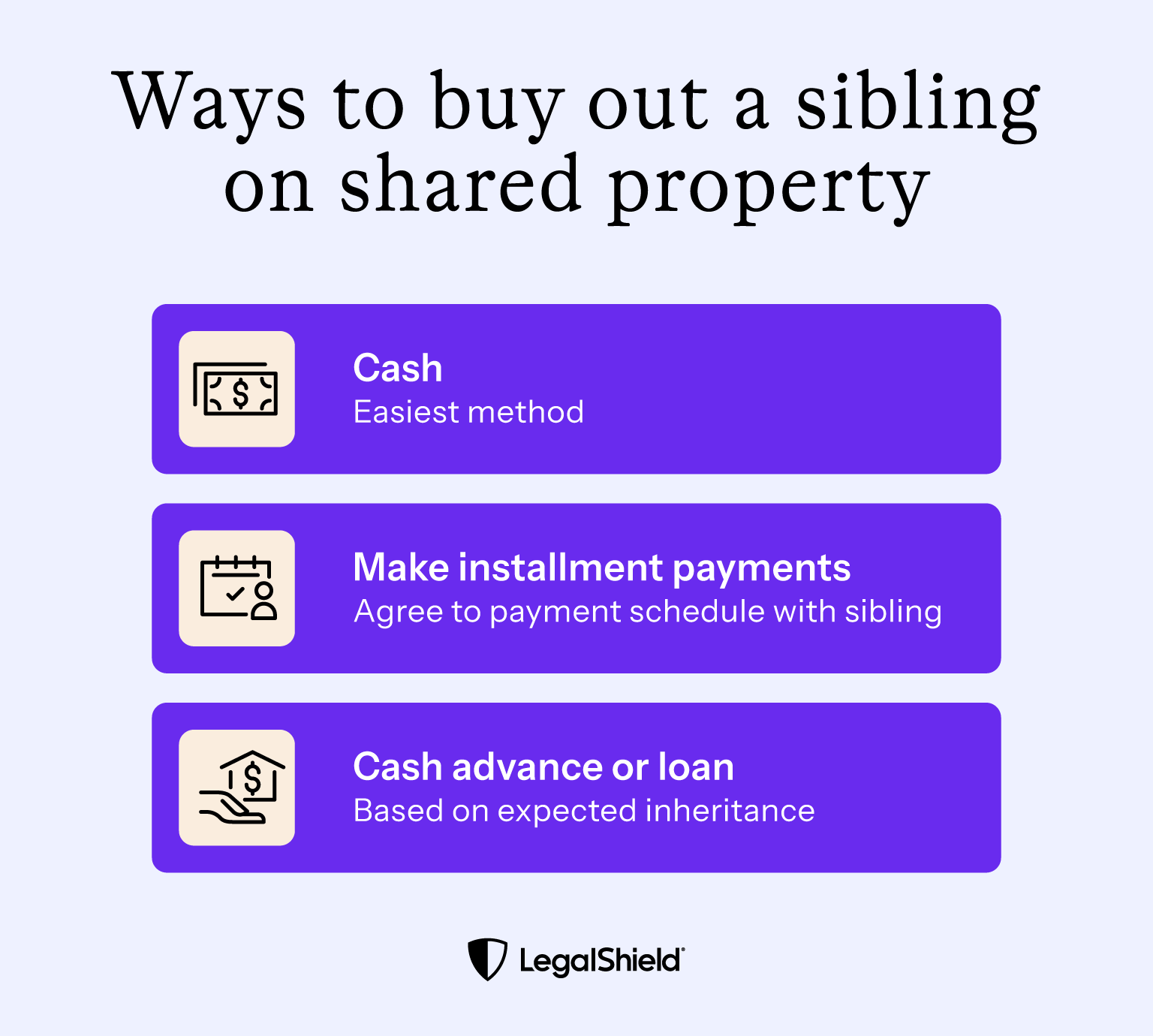
It’s time to talk about getting the money. You’ll need to pay your sibling(s) for their share(s) of the property. You’ve got a few options to choose from:
Choose a cash buyout: If you have the funds, you can always pay your siblings in cash.
Make installment payments: If your siblings agree, you can make payments in installments directly to them.
Apply for a cash advance or loan: You might be able to get an advance on any cash inheritance you’ll receive once the probate process is complete.
When you buy out a sibling, it’s important that their name comes off the mortgage, allowing you to have control over the financing of the real estate.
Real estate paperwork involving multiple parties and buyouts can be complicated. A LegalShield provider lawyer can explain and review your documents, giving you guidance and advice to help you make good decisions.
Step 6: Put everything in a written agreement
It’s best to put your buyout agreement in writing. People can change their minds, and misunderstandings happen. Having things written down can help you avoid arguments. It’s more difficult to legally enforce verbal agreements. If you’re getting a loan to fund your buyout, the lender may need a written copy.
Include all the details of your buyout. Names, the property involved, ownership percentages, dollar amounts, and payment dates. To be sure your agreement has everything you need to protect your interests, LegalShield plans offer document reviews. See our plan coverage on the LegalShield Personal Plan page.
Step 7: Close the sale and transfer ownership
After the probate on the property has concluded and the property has been transferred to you and your siblings, you can begin the process of buyout. Using a quitclaim deed (which transfers ownership without a guarantee of clear title) or a warranty deed (which guarantees clear title) to transfer property to a family member is common. Both of these remove the sibling’s name from the property’s title. The county clerk’s office often has these forms available online, but to avoid future title issues, make sure the form is completed correctly.
The siblings who are selling their part of the property have to sign the deed (whichever one your state allows), and someone has to notarize it. You’ll need to turn in the signed and notarized form at the county clerk’s office, and pay the filing fees. Once recorded, your property transfer is complete!
Some states (and lenders) require more paperwork that you’ll need to complete. It’s a good idea to use the document review from a LegalShield provider lawyer before you submit them.
Step 8: Address any taxes you owe
Let’s talk about possible tax issues. Inheriting a home from your parents usually doesn’t trigger federal estate taxes. If you buy out your siblings at fair market value, they probably won’t have to pay gift taxes, but they may have capital gains tax when they sell you their inherited property. You may have to pay capital gains taxes if you sell the property later. When you are discussing buy-out terms with your siblings, it is a good idea to discuss tax implications with a lawyer or CPA.
When you should use a lawyer for a sibling buyout
Most real estate deals are complicated. A lawyer’s help is especially useful for situations like these:
Siblings disagree about ownership percentages, property value, terms, or whether to keep or sell the property
The property is collateral for a mortgage or another kind of loan
The trust or Will has special conditions related to the property.
There are title issues
You need help drafting or reviewing a promissory note or mortgage for a sibling buyout
The sibling buying others out is the estate’s trustee or executor (to avoid a conflict of interest)
Your situation might have other issues that require a lawyer’s help.
How to talk to your sibling about buying out their share of inherited property
You and your siblings need to talk about what to do with your inherited property. Those discussions can be really stressful. If you want to buy out your sibling’s share, follow these tips:
Find out if your sibling wants to sell their share. Listen without arguing.
Follow the formula in this blog to figure out how much your sibling’s share is worth.
Talk through your goals about buying them out. Discuss how you’ll pay for your sibling’s part of the property and when you’ll pay.
Keep discussions business-like. Focus on things like the appraisal value and legal steps instead of letting emotions cause arguments.
Consider a neutral third party to help if you can’t agree on the buyout terms.
Put your buyout agreement in writing.
Get legal assistance to help. Your LegalShield provider law firm can research any issues, review your documents, and advise you.
Simplify buying out a sibling on shared property with LegalShield
Buying out your sibling on shared property might be stressful, but following the steps in this guide should help. A LegalShield provider lawyer can help you understand real estate transactions and simplify the buyout process.
Whether you need help buying out your siblings, doing your own estate planning, tax advice, or another matter, your LegalShield membership is here for you. Get essential legal advice for a low monthly fee with a LegalShield Personal Plan.
Frequently Asked Questions
If siblings can’t agree about what to do with a shared property, there are a few options. Try using a third party to work out your differences. If that doesn’t work, there are other legal options, such as a partition action.
First, find out how much the real estate is worth. Then subtract any current loans from it. This is the total equity amount. If every sibling has an equal share, divide the equity amount by the number of siblings. If the shares are unequal, multiply that sibling’s ownership percentage by the equity amount.
This can be a complicated issue. If that sibling inherits a share of the property and other siblings don’t object, they can keep living there. They might have to pay rent to the other owners. A Will or trust might also give them permission to stay or there might be an existing lease. This is a situation where speaking to a lawyer might make sense.
Communications Director at LegalShield overseeing content creation designed to make legal protection simple and approachable. He focuses on offering straightforward, trustworthy guidance that empowers people to make informed decisions about their legal rights and responsibilities.
We’ll provide more information about the trustors vs. trustees comparison, what to consider when filling these roles, and how they work together in Revocable and Irrevocable Trusts.
A power of attorney with springing powers is a legal document that grants someone else the authority to act on your behalf only after a specific event occurs.
There’s no rule that says a lawyer has to set up your Trust for it to be valid. However, Trusts are complex and doing it yourself without a lawyer's help comes with risks.
A Certificate of Trust proves your Trust is real and names who can act for it, while your beneficiaries and assets stay private. It lets your Trustee handle Trust business, like opening accounts or transferring property.
A limited power of attorney often comes in handy when you need help for a short time or for a single purpose. This legal document can help in situations like when you’re traveling, serving in the military, caring for an aging parent, or sending a child to study abroad.
We’ll cover some of the most common scams, the red flags that give them away, how to protect yourself, and what to do if you’ve already been caught out.
An executor is responsible for ensuring your final wishes get carried out, so it’s important that you choose someone who is responsible and can bear the emotional burden.
An employer identification number is a nine-digit number the IRS uses to identify a taxpayer. The estate needs its own, and getting one is usually simpler than it sounds. Learn more about estate EINs.
•
5 min read
Thank you! You're subscribed!
Oops! Something went wrong while submitting the form.








.jpg)