If you need inheritance money quickly, a probate loan allows you to borrow money using your inheritance as collateral. Probate loans are great, but come with several considerations:
The interest rate and fees can quickly add up.
If the probate process takes longer than expected, or the inheritance is smaller than anticipated, the borrower could face financial difficulty.
Probate loans often require a credit check.
Losing a loved one is hard enough, but having to go through a lengthy probate process to receive an inheritance can make an already difficult time more challenging. There might be bills that you can’t pay because the probate court is taking its time handling the deceased’s estate. Thankfully, there are probate loans that can help.
Probate loans offer a quick way to get cash using your inheritance as collateral for the money you’re borrowing. While they could be helpful, there are potential drawbacks to know about, which we discuss further in the following sections.
How probate loans work: Key aspects
Probate loans offer quick access to cash at the cost of potentially high fees.
Below is a quick summary of how they work:
Purpose: Probate loans (sometimes called inheritance loans) provide quick access to cash to individuals who expect to inherit money or assets from an estate.
Useful situations: A probate estate loan is ideal when someone has an immediate need for cash. Even without delays in the probate process, this can take 6 months or more to transfer the property after death.
Repayment terms: Many loans require borrowers to repay the loan in a single lump sum after the probate court has administered the estate. But some probate loans also require monthly payments during the probate process.
Requirements: Probate estate loans usually require applicants to submit information about themselves and the estate they intend to inherit. The applicant will also need to complete a credit check.
Costs: The primary expense with these loans comes with the interest rate charged. These rates are usually comparable to most other personal loans, plus an extra 1%-2% depending on the borrower’s credit history. There may also be fees in addition to the interest.
Risks: Probate loan lenders aren’t usually regulated the same way banks and other financial institutions are. As a result, they might charge more fees and higher interest rates than a typical bank. Also, if the inheritance turns out to be smaller than expected or takes longer to receive, it could result in the loan costing much more than the borrower anticipated.
What’s the difference between probate loans and probate advances?
In addition to the probate loan, there’s also the probate advance (sometimes called an inheritance advance). Both exist to make it easier to obtain cash from an inheritance, but work in different ways. These differences are summarized in the following table.
Characteristics
Probate loans
Probate advances
Primary cost
Interest.
The advance fee.
Payment terms
The borrower pays back the loan with monthly payments, plus a lump sum after the court settles the estate.
The borrower pays back the advance by allowing the lender to collect a lump sum directly from the estate after it's settled.
Who pays?
The lender gets its money back from the borrower.
The lender gets its money back from the estate.
Credit check usually required?
Yes
No
Approval timetable
Several weeks.
Several days.
Recipient of funds liable for nonpayment?
Yes, because the lender collects from the borrower.
No, because the lender collects from the estate. If there's not enough money in the estate, the borrower isn't liable for the difference.
There are three major differences to emphasize. First, probate loan lenders primarily earn their profit from interest. Probate advance lenders mostly earn their money from the advance fee.
Second, probate loans sometimes require monthly payments until the loan is fully repaid. Probate advances require a lump sum that the probate advance lender collects directly from the estate.
Third, with a probate loan, the lender’s primary legal interest is with the borrower. With a probate advance, the lender acquires a legal interest in the estate. Basically, the probate advance lender pays the advance to the heir. In return, the lender now has a legal right to a portion of the heir’s inheritance.
Benefits & risks of probate loans
Probate loans can offer several useful benefits, but come with risks, which we summarize below.
Benefits
Risks
Quickly access an expected inheritance.
Personal liability if you can't repay the loan.
Easily convert an intangible inheritance into cash.
Uncertainty of how long the probate process will take or if there will be legal challenges to litigate.
Can give the heir additional time to sell an asset for full market value.
Lowered credit score.
The interest and loan fee can make up a significant portion of the inheritance.
Probate loan benefits
Obtaining a probate loan can offer the following benefits:
Can provide the cash to meet an heir’s immediate cash needs, such as tuition costs, medical bills, or car repairs.
Provides additional time to sell non-cash property to get more money for the estate. This extra time can prevent selling property at a significant discount, which is usually necessary when selling something like real estate as quickly as possible.
Proceeds from the loan can be used to buy out other heirs who aren’t interested in being part of the probate process or aren’t interested in their inheritance beyond its cash value.
Probate loan risks
As beneficial as a probate loan can be, there are risks to take into account before signing on any dotted line:
Interest and loan fees can add up to a sizable amount and significantly reduce the total inheritance.
The loan’s terms may require monthly payments during the probate process, which might not always be affordable.
Unexpected circumstances in probate court could cause significant issues if the delays result in a smaller inheritance or lengthy litigation. During this time, monthly payments still need to be made, and interest continues to accrue.
Obtaining a probate loan could temporarily lower a credit score given the required credit check and the increase in the borrower’s total debt.
Common reasons for probate loans
Not all financial obligations require a probate loan. However, below are some reasons why someone might need one.
Property tax in California
California’s Proposition 19 allows children to inherit their parents’ family home (or farm) without creating a new owner for property tax purposes. This is an important benefit because the value of a family home is often significantly higher at the time of the parents’ passing than when they first bought it.
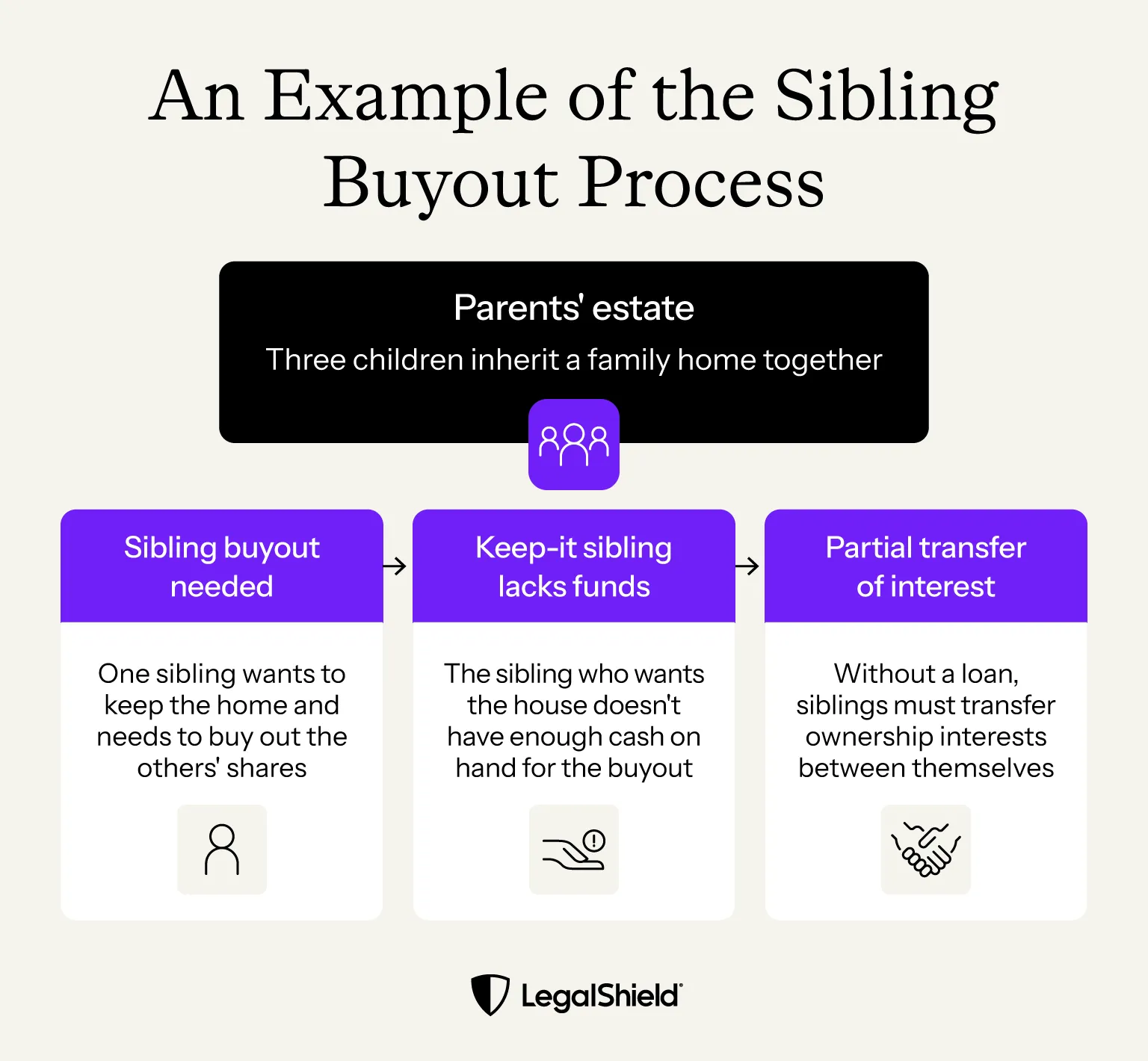
If multiple children stand to inherit a single home, they may lose the benefits of Proposition 19. The transfer from the parents to the children can usually avoid a property tax reassessment. But when several of the children wish to sell their interest in the home to get their share of the home’s value, a property tax reassessment occurs.
To avoid this reassessment, one of the children can buy out their siblings’ interests in the home. This allows a direct transfer from the parents to a single child while providing the tax benefits from Proposition 19. But most individuals don’t have the cash needed to buy out multiple siblings. A probate loan can provide the cash for this purpose.
Disagreements between multiple heirs
Heirs sometimes disagree on what to do with an inheritance. An heir can sometimes resolve these disagreements by buying out another heir. Probate loans can help if an heir lacks the cash to buy out the other heir.
Estate obligations
Executors and heirs don’t usually need to use their personal funds to pay the debts and bills of the estate, such as funeral costs. Instead, the estate uses cash or property of the deceased to pay these costs. Estate funds also pay most of the other probate court costs, including probate lawyer fees and the probate bond.
Even though the estate is legally responsible for these bills, an executor or personal administrator may need to initially pay these costs out-of-pocket. The estate can then reimburse them later.
In cases where an heir wishes to sue the estate (they may not be sure if someone has a valid will), the person suing will need to use their personal funds to pay for their lawyer.
How to get probate loans in 6 steps
Getting a probate loan is much faster than the probate process. Despite this, it’s not instant and involves several steps. The exact time can vary, but potential borrowers should expect the entire process to take several weeks.
Step 1: During an initial consultation, the lender will ask questions to determine eligibility.
Step 2: Assuming the borrower is eligible, they’ll submit an application. This application will include information about the estate, the probate court, and the borrower. The application may require copies of documents like the death certificate, the will, the letters of administration, and the property in probate.
Step 3: The lender reviews the application and conducts a credit check.
Step 4: The lender decides whether it approves the loan. If so, the lender sets the loan amount and the interest rate to charge.
Step 5: The borrower reviews the loan offer and decides whether to accept the loan.
Step 6: Assuming the borrower agrees to the loan’s terms, the lender transfers the money to the borrower for immediate use.
Verdict: Should you get a probate loan?
Probate loans are a great way to meet immediate financial needs after losing someone close. Yet they come with their share of risks and costs that may make other options more attractive.
If you’re not sure how to proceed during the probate process, you might benefit from one of LegalShield’s Personal Plans. For a customizable price, you’ll have access to a provider lawyer who can answer probate questions and any others you might have about creating your own estate plan or overseeing the probate process as an executor.
Frequently asked questions
How do executors apply for probate loans?
Executors and estate administrators can apply as an heir would. The main difference is that the lender doesn’t have to notify the executor of the loan.
What are the fees for probate loans?
It depends on the specific probate loan and the borrower's credit history. Most probate loan rates range from 7% to 15% per year. But some lenders charge interest rates based on the loan amount.
For example, the first $100,000 borrowed might have a 5% rate, while the next $100,000 would have a 4% rate. Then the next $300,000 might have a 3% interest rate, and any amounts over $500,000 might have a 2% interest rate. In these situations, the probate loan provider should offer a probate loan fee calculator to help you estimate what your fees will be.
Communications Director at LegalShield overseeing content creation designed to make legal protection simple and approachable. He focuses on offering straightforward, trustworthy guidance that empowers people to make informed decisions about their legal rights and responsibilities.
We’ll provide more information about the trustors vs. trustees comparison, what to consider when filling these roles, and how they work together in Revocable and Irrevocable Trusts.
A power of attorney with springing powers is a legal document that grants someone else the authority to act on your behalf only after a specific event occurs.
There’s no rule that says a lawyer has to set up your Trust for it to be valid. However, Trusts are complex and doing it yourself without a lawyer's help comes with risks.
A Certificate of Trust proves your Trust is real and names who can act for it, while your beneficiaries and assets stay private. It lets your Trustee handle Trust business, like opening accounts or transferring property.
A limited power of attorney often comes in handy when you need help for a short time or for a single purpose. This legal document can help in situations like when you’re traveling, serving in the military, caring for an aging parent, or sending a child to study abroad.
We’ll cover some of the most common scams, the red flags that give them away, how to protect yourself, and what to do if you’ve already been caught out.
An executor is responsible for ensuring your final wishes get carried out, so it’s important that you choose someone who is responsible and can bear the emotional burden.
An employer identification number is a nine-digit number the IRS uses to identify a taxpayer. The estate needs its own, and getting one is usually simpler than it sounds. Learn more about estate EINs.
•
5 min read
Thank you! You're subscribed!
Oops! Something went wrong while submitting the form.







.jpg)