A codicil works best for simple changes to a Will, not major updates. To be valid, it needs to follow the same legal formalities as a Will. Too many codicils can create conflict or confusion. You’ll need to follow your state’s laws and get advice from a lawyer.
You may already have a Will, but say a new grandchild arrives. Maybe a close friend becomes more important in your life. You may have gotten married or divorced. Those are all good reasons to consider updating your estate plan. A codicil lets you make specific minor edits to your Will. Creating one is a simple way to update your wishes without having to start from scratch.
Your estate plan doesn’t always need a full rewrite when life changes. We’ll explore when a codicil is enough and when a new document makes more sense. Getting help with your Will from a LegalShield provider lawyer helps keep everything clear and legally sound, and plans start at around $1/day.
What is a codicil to a Will?
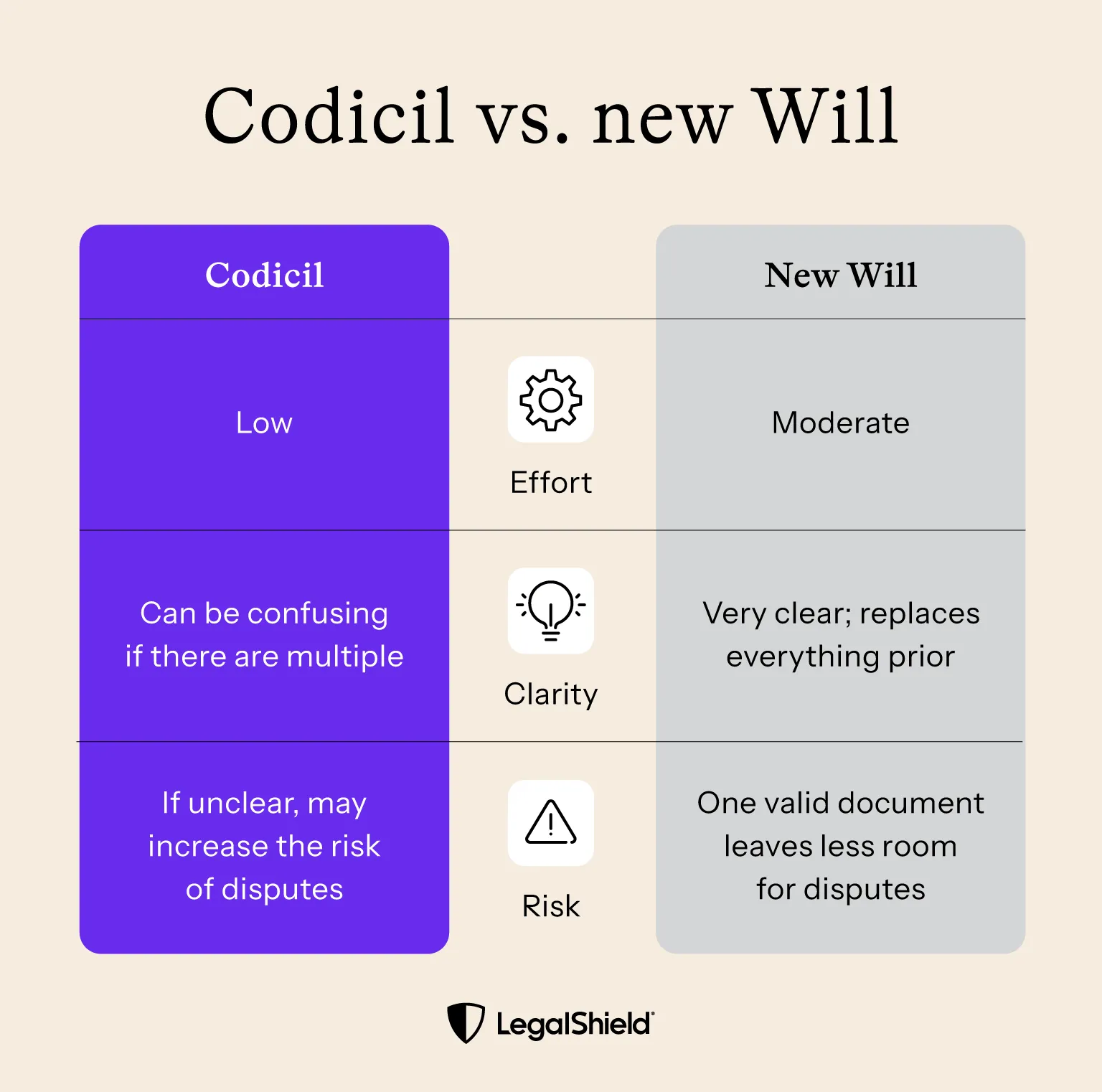
Codicils are, in the simplest terms, an amendment to a Will. They let you add, change, or remove specific parts without affecting the rest of the document. To be effective during probate, you’ll need to keep a codicil with the original Will. Let’s look at a brief overview of a codicil and a new Will before we go into more depth.
Should you use a codicil or write a new Will?
There are lots of reasons why you may want to update your Will. If you want to make small, clear changes to your Will without changing its overall structure, a codicil can work. This choice could save time and effort, but it’s not always the best option.
If you already have codicils or are addressing major life changes, a new Will would probably be better. A fresh document lays everything out clearly. Probate courts need to understand your wishes, and a single Will without attached codicils could make that easier.
Minor Will changes suitable for a codicil
A codicil may be acceptable in these situations:
Changing an executor
Changing a beneficiary’s last name, resulting from marriage or divorce
Removing a beneficiary who passed away
Correcting details in your existing Will
Making minor changes to a specific bequest
Remember, codicils can lead to confusion, mistakes, and fights between your beneficiaries later on. A new Will might be better if there are significant changes or you need to make more than one change.
When a new Will is probably required
Major life events usually mean you need to make major changes to your Will. A codicil often won’t work. You’ll probably need to rewrite your Will if one or more of these things happen in your life:
You get married or divorced
You have or will adopt a new child
You move to a different state
Estate laws changed in your state
You need to make several changes
You already have multiple codicils
Your assets or financial situation change significantly
You want to remove a living beneficiary or disinherit a natural heir
Changes like these need more explanation than you can give with a codicil, and multiple codicils could have conflicting terms. A new Will would give the probate court a cleaner, less confusing document.
Legal requirements for a valid codicil
A codicil has to follow the same legal standards as a Will to be legally binding. You have to be of sound mind and act under your own free will when you create it.
That means you understand what you’re doing, and nobody is forcing you to change your Will. It also means you know what assets you have and how the changes you make will affect your beneficiaries.
You’ll usually need to sign your codicil in front of two witnesses who aren’t named beneficiaries or an executor. Those witnesses can confirm that you signed the document voluntarily. Some states don’t require you to have your codicil notarized, but it is a good practice.
Laws can change, and following out-of-date rules could invalidate your codicil or new Will. So, it’s important to check your state’s current laws.
Tips for adding a codicil to a Will
The words you use can determine whether a Will works the way you want. You must treat codicils carefully and understand the effects of overriding or adding language.
The first tip is to work with a lawyer. Lawyers know how to pick the exact words for the result you desire. Small mistakes can lead to big issues for your family down the line, and you won’t be there to clarify what you intended.
Follow these other tips while creating a codicil:
Use very specific language to describe the changes you want to make and define the result you want.
Define the limits of the codicil by referencing the exact words of the original Will that it changes.
Check your state’s current laws for signing requirements, because they vary significantly. Often, they include a notary and witnesses who can’t be beneficiaries.
Keep your codicils and Wills together.
Your Will or codicil and the probate process
If codicils become an issue during the Will's probate, the court might not consider them. The judge might follow a previous valid Will. Or, they could use your state’s intestacy laws as if you didn’t have a Will.
Common mistakes when updating a Will
A Will or a codicil lets your family know how you want your estate handled. The last thing you want is to make avoidable mistakes that mean your wishes aren’t carried out. These errors often cause legal disputes or invalidate your codicil.
Let’s talk about common mistakes people make when updating a Will so you can avoid them.
Using vague language
Your family or the probate court might not understand what you meant. That can cause disagreements and legal battles. The judge might even throw out your codicil.
Keeping your Will and codicil(s) in different places
Your family might never find your codicils, so they won’t know about your updated wishes.
Creating conflicting instructions
If you’re not careful, your codicil and your Will could say different things about the same asset or beneficiary. That can cause confusion and lead to legal problems.
Adding too many codicils
Making too many updates makes your plans hard to follow. Think about having to read a stack of sticky notes instead of a single page. Confusion isn’t good when it comes to your final wishes.
Using the wrong signing procedure
Most states are specific about who can witness you signing your Will or codicil. They also govern when everyone needs to sign the document and if you should have it notarized. Be sure to follow your state’s current laws.
Not getting legal guidance
Writing or updating a Will successfully takes legal knowledge. The terms have to be exactly right, and you have to follow state laws. Doing it yourself could mean an invalid Will or codicil, and the probate court won't follow your wishes.
How to store and share your Will and codicil safely
Creating your Will or codicil is only part of the process. Keeping all of your estate planning documents together in a safe place can be helpful. Many probate courts will require the original Will to be entered into court, as well as any codicil. The lawyer may also retain the original as part of their service, or they may charge a fee. Many people keep their estate planning documents in a fireproof safe or safety deposit box. Wherever you store them, be sure to let your executor and other trusted person know of the location.
Why legal help matters when creating or updating a Will
Nothing about estate planning is easy. It’s an emotional process, and the legal implications can be overwhelming. Still, more and more people are writing and updating Wills, creating Trusts and living Wills, and assigning powers of attorney.
Small mistakes can create serious legal problems later. Estate laws vary by state. If you don’t follow those laws exactly, your Will or codicil probably isn’t valid. An experienced lawyer in your state can give you invaluable advice that gives you peace of mind. They can assist in these ways:
Help you decide whether a codicil or a new Will is better to update your wishes
Use language that prevents confusion and conflict
Reduce mistakes so your documents are more likely to hold up in court
How LegalShield helps you update your Will
You want to know that your estate planning documents are legally binding, but you probably don’t want to spend a fortune creating them. That’s where LegalShield comes in. The Basic Plan starts at around $1/day, and a provider lawyer can prepare your Will with you, plus they can give you advice when you need it about many other personal legal issues. If you want to make changes to your Will, the Advanced and Premium Plans include annual Will updates.
LegalShield Personal Plans connect you with a provider lawyer who can offer guidance to help with your estate planning needs. Help protect your family with support from LegalShield.
Frequently asked questions about codicils
Can a codicil be used to completely remove a beneficiary from a Will?
You can add or remove a beneficiary through a codicil to your Will. However, you need to be very clear with your wording. State who you’re adding or removing. If you’re removing someone, also explain what should happen with what they were originally inheriting. Vague language can lead to disputes.
Is there a limit to how many codicils a person can add to one Will?
There’s not a strict limit, but adding several codicils can create confusion. You might even have conflicting instructions. A new Will is a cleaner way to make your wishes clear.
Is a handwritten codicil legal?
Some states accept handwritten codicils. You’ll probably need witnesses, and adding notarization helps. Be aware that handwritten codicils are much easier to challenge. Find out if your state allows handwritten codicils.
What is the cost difference between a simple codicil and a full Will rewrite?
A simple codicil can be cheaper if the changes are minimal. Rewriting a Will can cost more, but it might be necessary depending on the updates you want to make.
Content Specialist at LegalShield, creating educational resources about legal and consumer protection topics. She focuses on making complex legal and financial concepts accessible to readers and has contributed to various educational articles on consumer rights and protections.
We’ll provide more information about the trustors vs. trustees comparison, what to consider when filling these roles, and how they work together in Revocable and Irrevocable Trusts.
A power of attorney with springing powers is a legal document that grants someone else the authority to act on your behalf only after a specific event occurs.
There’s no rule that says a lawyer has to set up your Trust for it to be valid. However, Trusts are complex and doing it yourself without a lawyer's help comes with risks.
A Certificate of Trust proves your Trust is real and names who can act for it, while your beneficiaries and assets stay private. It lets your Trustee handle Trust business, like opening accounts or transferring property.
A limited power of attorney often comes in handy when you need help for a short time or for a single purpose. This legal document can help in situations like when you’re traveling, serving in the military, caring for an aging parent, or sending a child to study abroad.
We’ll cover some of the most common scams, the red flags that give them away, how to protect yourself, and what to do if you’ve already been caught out.
An executor is responsible for ensuring your final wishes get carried out, so it’s important that you choose someone who is responsible and can bear the emotional burden.
An employer identification number is a nine-digit number the IRS uses to identify a taxpayer. The estate needs its own, and getting one is usually simpler than it sounds. Learn more about estate EINs.
•
5 min read
Author Name
,
Author Title
September 16, 2026
Thank you! You're subscribed!
Oops! Something went wrong while submitting the form.








.jpg)