
LLC vs. Corporation: Key Differences + Which To Choose for Your Business

Editor's note: This post was originally published on May 2, 2019, and has been updated for accuracy, comprehensiveness, and freshness on March 30, 2026.
Corporations and LLCs are some of the most popular business structures in the U.S. It’s important to choose the right one for your venture.
When you’re ready to start a small business, deciding how to structure it legally is one of the most important choices you’ll make. Understanding the differences between organizing as an LLC and as a corporation (or “corp”) helps you make an informed decision.
As you operate your business, legal questions and issues may come up. When they do, it’s best to consult an experienced lawyer to protect your interests. Get access to a vetted lawyer for answers, advice, and more with affordable small business plans from LegalShield.

Corp vs. LLC overview
Before going any further, let’s make a distinction between a legal entity (LLC vs. corporation) and a tax entity (sole proprietor/ partnership vs. C corporation vs. S corporation). A tax entity classification is how the IRS (and the state tax board) sees the business. The legal entity is how everybody else, like courts, the state, and contractual partners, sees the business.
These business entities are very different, especially when it comes to taxes, liability, and ownership.
What is a corporation?
A corporation is a type of business entity. The corporation is totally separate from its shareholders, or owners. Like people, corporations can buy or sell, sue or be sued, and enter into contracts.
Corporations are run by a board of directors and its officers. Shareholders, or owners of the corporation, enjoy limited liability protection, meaning they usually aren't personally liable for corporate obligations. To keep that protection, corporations have to follow strict rules and government regulations.
S-corp vs. C-corp
S-corps and C-corps are two of the main types of tax structures for corporations. Both kinds offer limited liability. The main differences involve ownership, stocks, and taxes:
- S-corps: Up to 100 U.S. shareholders can benefit from pass-through taxation, which helps prevent double taxation. Only one class of stock is allowed. This choice is often better for small businesses.
- C-corps: Pass-through taxation isn’t available, so double taxation occurs. This type of entity allows for foreign owners and an unlimited number of shareholders. Larger companies that may want to attract investors or raise capital may prefer this type of business entity, as it can issue multiple types of stock.
What is an LLC?
Limited liability companies, or LLCs, are a popular kind of business entity. This structure offers owners personal liability protection against business obligations and debts, as long as owners follow the state’s LLC rules. These rules are much more flexible than corporate rules.
LLCs can choose their own tax structure. Pass-through taxation is possible, so the LLC doesn’t pay income tax. Instead, the owners claim the business income on their personal tax returns. LLCs can also choose to be taxed as an S-corp, C-corp. If the LLC has more than one member, it is automatically taxed as a partnership by the IRS, unless it chooses to be an S-corp or C-corp.
An LLC can have several owners, but it’s also possible for only one person to set up an LLC. There’s no need for a board of directors, though some LLCs choose to have this structure.
Differences between a corp and an LLC
Corporations and LLCs are business entities with major differences in taxes, ownership structure, and ongoing requirements. Before choosing your business structure, think about how much paperwork you want to do, how much control you want, how you want to pay taxes, and whether flexibility is important to you.
Business ownership
- Corp: Owned by shareholders with stock-based ownership.
- LLC: Owned by members with flexible ownership allocations defined in the operating agreement.
C-corps can create multiple classes of stock, while S-corps allow only a single class with dividends proportional to each shareholder’s investment. Ownership changes occur through selling or gifting stock according to the shareholder agreement.
LLCs offer more flexibility: both ownership stakes and profit distributions can be allocated freely among members, regardless of financial contribution.
Taxes
Corp
- Corp: C-corps face double taxation; S-corps allow pass-through taxation.
- LLC: Members can choose pass-through, S-corp, or C-corp taxation.
LLCs offer flexible tax options, while C-corps face double taxation as profits are taxed at the corporate level, then again when distributed as dividends to shareholders.
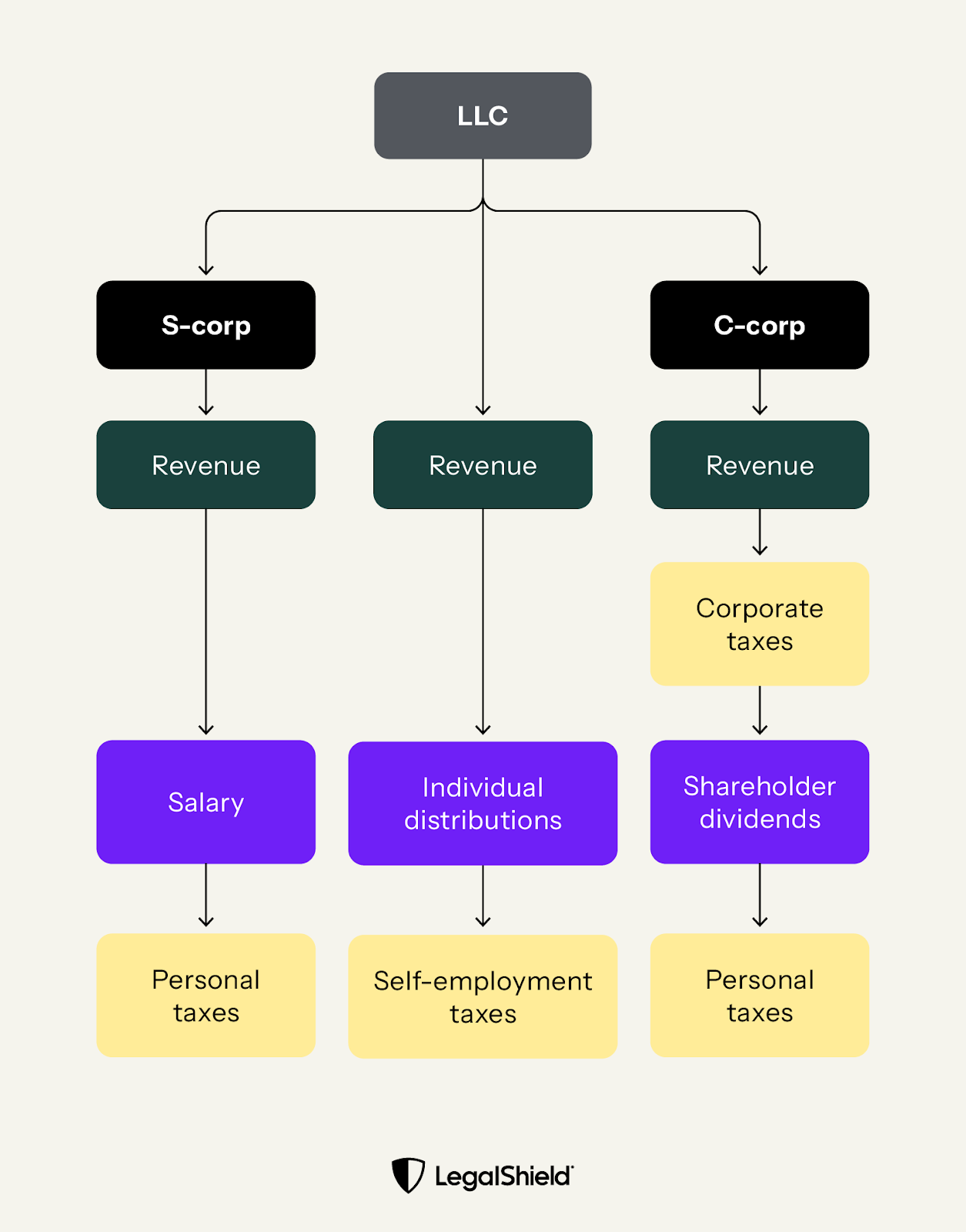
The S-corporation designation allows pass-through taxation (no corporate tax), but there are requirements to qualify as an S-corp.
- Must be a domestic corporation
- Have only allowable shareholders (individuals, certain trusts, and estates)
- Have no more than 100 shareholders and issue only one class of stock
Some businesses may have no choice but to be a C-corp and face double taxation.
By default, an LLC is treated as a pass-through entity, but it can elect C-corp or S-corp taxation if eligible, with profits reported on members’ personal tax returns.
Business structure
A corporation must have a Board of Directors handling management responsibilities and corporate officers running day-to-day operations. Shareholders own the corporation, but they usually don’t participate in its daily business decisions. Shareholders typically have power only to elect directors. However, individual shareholders may be elected as directors or appointed as officers.
An LLC’s management structure is more centralized and less formal. A member can act as manager, and the LLC can elect to have no distinction between LLC owner and manager. However, an LLC needs to create and follow an operating agreement.
Legal discrepancies
States have their own laws on how corporation and LLCs are to operate and the formalities required. While there is some conformity from state to state, you should check the state’s laws where your business is formed.
You can get advice from your LegalShield provider lawyer if you’d like to learn more about the legal formalities of a corp vs. an LLC.
Liability
- Corp: Shareholders have strong liability protection, but strict rules must be followed to maintain it.
- LLC: Owners are protected from personal liability if state LLC regulations are met.
Corporate liability protections are strong, but shareholders must comply with all legal requirements to remain shielded from business debts. LLCs offer similar protections with fewer formalities, but members must keep personal and business finances separate and follow state-specific rules.
Assets
- Corp: Transfers often require shareholder votes or formal resolutions.
- LLC: Members or managers can transfer assets per the operating agreement.
Corporate transfers may also create tax liabilities. LLCs can often transfer assets or intellectual property directly under their operating agreement, sometimes avoiding extra taxes.
Funding
Corp
- Corporations can offer shares of their stocks to investors in return for funding
- Potential investors usually want something to show for the funds they provide. Corporations can issue stock, which usually makes raising capital much easier.
LLC
- An LLC doesn’t have stocks, so it’s more difficult to attract investors
- Even with a solid business plan, an LLC cannot issue shares to investors, which can make fundraising more difficult.
How to choose between an LLC vs. a Corporation
Every entrepreneur has different concerns, so there’s not a one-size-fits-all answer that can tell you whether a corp or an LLC is best for you. The type of business you’ll have, how many owners there are, and state regulations are only some of the factors you need to consider.
Ask yourself:
- How much time and effort do I want to spend on setting up my business?
- How much flexibility do I want?
- How important is the tax structure to me?
- Will I want to attract investors?
- How much paperwork do I want to do to keep my business entity in good standing?
- How do I want to oversee daily operations?
Think carefully about the corporation vs. LLC pros and cons as you decide.
Protect your business interests with LegalShield
Understanding the differences between a corp vs. LLC and weighing them is important for making informed decisions, like your business designation or the best state for your incorporation.
As you begin operations, you’ll probably need legal advice. If you aren’t sure what to include in your LLC’s operating agreement, try one of the LegalShield small business plans. We connect you with lawyers who can provide professional advice on an unlimited number of business legal matters. Instead of paying an exorbitant hourly rate, you’ll pay a monthly subscription fee. Choose one of our legal plans for businesses, and get started today!

Frequently asked questions
Is an LLC a corporation?
An LLC is a limited liability company, which is an unincorporated business. It is not a corporation or corporate entity.
What is the difference between an LLC and a corporation?
There are several differences between LLCs and corporations. Some of them are tax, management, and ownership structures.
Who pays more taxes, LLC or corporation?
It depends on the tax structure.
In most cases, a C-corp pays the most taxes because it is subject to double taxation, meaning it is taxed at the corporate level and again when profits are distributed to shareholders as dividends.
An LLC and an S-corp can avoid double taxation by passing income directly to members and shareholders, who report it on their personal tax returns.
Is it better to have an LLC or corporation?
There isn’t a single answer that’s right for everyone. The best choice for you depends on several factors that are specific to your situation.
LegalShield® is atrademark of Pre-Paid Legal Services, Inc. (“LegalShield”). LegalShieldprovides this blog as a public service and for general information only. The information made available in this blog is meant to provide general information and is not intended to provide legal advice, render an opinion, or provide a recommendation as to a specific matter. The blog post is not a substitute for competent legal counsel from a licensed professional lawyer in the state or province where your legal issues exist, and you should seek legal counsel for your specific legal matter. All information by authors is accepted in good faith. However, LegalShield makes no representationor warranty of any kind, express or implied, regarding the accuracy, adequacy, validity, reliability, availability, or completeness of such information. The materials contained herein are not regularly updated and may not reflect the most current legal information. No person should either act or refrain from acting on the basis of anything contained on this website. Nothing on this blog is meant to, or does, create an attorney-clientrelationship with any reader or user. An attorney-client relationship may beformed only after the execution of an engagement letter with an attorney and after that attorney has confirmed that no conflicts of interest exist. Nothing on this website, or information contained or transmitted by this website, is intended to be an advertisement or solicitation. Information contained in the blog may be provided by authors who could be a third-party paid contributor. LegalShield provides access to legal services offered by a network of provider law firms to LegalShield members through membership-based participation. LegalShield is not a law firm, and its officers, employees or sales associates do not directly or indirectly providelegal services, representation, or advice.
LegalShield is a trademark of Pre-Paid Legal Services, Inc. (“LegalShield”). LegalShield provides this blog as a public service and for general information only. The information made available in this blog is meant to provide general information and is not intended to provide legal advice, render an opinion, or provide a recommendation as to a specific matter. The blog post is not a substitute for competent legal counsel from a licensed professional lawyer in the state or province where your legal issues exist, and you should seek legal counsel for your specific legal matter. All information by authors is accepted in good faith. However, LegalShield makes no representation or warranty of any kind, express or implied, regarding the accuracy, adequacy, validity, reliability, availability, or completeness of such information. The materials contained herein are not regularly updated and may not reflect the most current legal information. No person should either act or refrain from acting on the basis of anything contained on this website. Nothing on this blog is meant to, or does, create an attorney-client relationship with any reader or user. An attorney-client relationship may be formed only after the execution of an engagement letter with an attorney and after that attorney has confirmed that no conflicts of interest exist. Nothing on this website, or information contained or transmitted by this website, is intended to be an advertisement or solicitation. Information contained in the blog may be provided by authors who could be a third-party paid contributor. LegalShield provides access to legal services offered by a network of provider law firms to LegalShield members through membership-based participation. LegalShield is not a law firm, and its officers, employees or sales associates do not directly or indirectly provide legal services, representation, or advice.

How To Start an LLC in Michigan in 7 Steps
LLC vs. Corporation: Key Differences + Which To Choose for Your Business
